
零跑汽车

Search documents
【新能源】2026年1月新能源乘用车厂商批发销量快讯
乘联分会· 2026-02-04 08:31
Core Viewpoint - The article predicts a 25% growth in sales for Chinese new energy passenger vehicle manufacturers by 2025, aligning with the growth expectations set for the "14th Five-Year Plan" period [2]. Group 1: Market Predictions - The end of the new energy vehicle purchase tax exemption policy in December 2025 is expected to lead to a recovery period in January 2026, with some consumers likely to make purchases in December to benefit from the policy [2]. - January 2023 saw a decline of 8% in new energy vehicle sales due to the withdrawal of subsidies, while January 2024 experienced a positive growth despite the anticipated policy changes [2]. - The late timing of the 2026 Spring Festival and contributions from exports have positively influenced January's sales performance [2]. Group 2: Sales Data - According to the latest data from the Passenger Car Association, manufacturers with sales exceeding 10,000 units in December accounted for 93% of the total new energy passenger vehicle wholesale sales for that month [3]. - Preliminary data for January indicates that these manufacturers achieved sales of 830,000 units, leading to an estimated total of 900,000 new energy passenger vehicles sold nationwide in January, reflecting a 1% year-on-year growth [4][3]. Group 3: Leading Manufacturers - Key manufacturers such as GAC Aion, XPeng Motors, and Great Wall Motors reported significant sales figures in January, with GAC Aion leading at 21,635 units sold [8]. - Other notable performances include XPeng Motors with 20,011 units, Great Wall Motors with 18,019 units, and FAW Hongqi with 8,265 units [8]. - The total estimated sales for manufacturers exceeding 10,000 units in January amounted to 832,461, representing 93% of the total market share for that month [8].







重仓新能源的车厂们
投中网· 2026-02-04 07:13
Core Viewpoint - The Chinese automotive market in January 2026 is characterized by a stark contrast, with most automakers experiencing negative growth, particularly in the new energy vehicle (NEV) sector, highlighting the importance of having a diversified product lineup that includes both fuel and electric vehicles [5][6][7]. Sales Performance Summary - In January, the retail sales of passenger cars are expected to reach 1.8 million units, a month-on-month decline of 20.4%, with NEV sales around 800,000 units, marking a penetration rate drop to 44.4%, nearly 10 percentage points lower than the peak at the end of 2025 [6][7]. - Traditional automakers like SAIC, Geely, and GAC Toyota reported stable sales due to their dual strategy of offering both fuel and NEVs, with SAIC's total sales reaching 327,400 units, a year-on-year increase of 23.94% [10][11]. - Geely's total sales were 270,167 units, with fuel vehicles contributing significantly to its performance, while BYD faced a 30.11% decline in NEV sales, indicating the challenges faced by companies heavily reliant on NEVs [12][15]. Market Dynamics - The differentiation in sales performance among automakers is attributed to their strategic choices, particularly the presence of a fuel vehicle base, which enhances resilience against market fluctuations [9][19]. - The demand for fuel vehicles surged during the pre-Spring Festival period, as consumers preferred mature technology and the convenience of fuel vehicles for long-distance travel, further supported by the limited impact of policy changes on fuel vehicles [19][20]. Export Growth - Exports have become a crucial support for many leading automakers, with companies like Chery and SAIC reporting significant increases in overseas sales, indicating a dual strategy of maintaining domestic stability while expanding globally [17][18]. Future Outlook - The current market conditions signal a shift from policy-driven growth to market-driven dynamics, emphasizing the need for automakers to maintain a balanced portfolio of fuel and NEVs to navigate future uncertainties [22]. - Companies that can effectively manage their fuel vehicle base while rapidly advancing in the NEV sector are likely to emerge as market leaders, while those focusing solely on NEVs may face greater risks during market fluctuations [21][22].



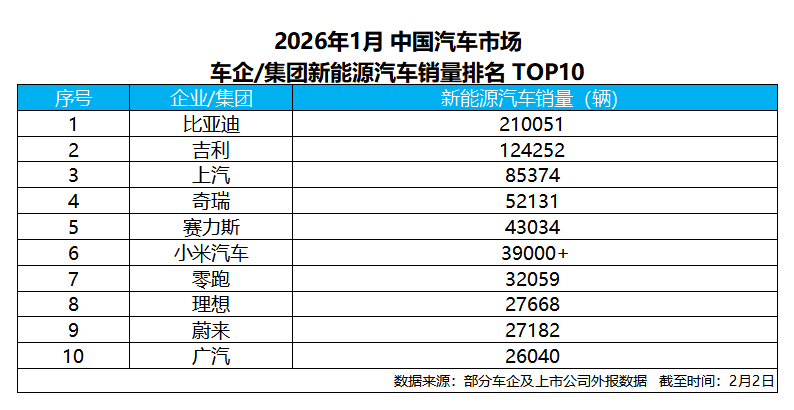
比亚迪稳夺1月新能源汽车销冠,头部格局进一步分化
Xin Lang Cai Jing· 2026-02-04 06:54
| 序 | 企业/集团 | 新能源汽车销量(辆) | | --- | --- | --- | | 1 | 比亚迪 | 210051 | | 2 | 吉利 | 124252 | | 3 | 上汽 | 85374 | | ব | 奇瑞 | 52131 | | 5 | 塞力斯 | 43034 | | e | 小米汽车 | 39000+ | | 1 | 零跑 | 32059 | | 8 | 理想 | 27668 | | 9 | 蔚来 | 27182 | | 10 | 广汽 | 26040 | | | | 数据来源:部分车企及上市公司外报数据 截至时间:2月2日 | 新年伊始,中国新能源汽车市场的竞争轮廓迅速显现,头部车企之间的差距在1月销量榜单中被进一步拉开。截 至2月2日,根据部分车企及上市公司对外披露的数据,比亚迪以超21万辆的新能源汽车销量位居行业首位,展现 出强大的市场竞争力,继续稳居中国新能源市场头部位置,并在主要车企中拉开明显差距。(深圳新闻网) ...

2025年度中国汽车产业盘点——销量篇 车企竞争进入深水区
Zhong Guo Zhi Liang Xin Wen Wang· 2026-02-04 06:51
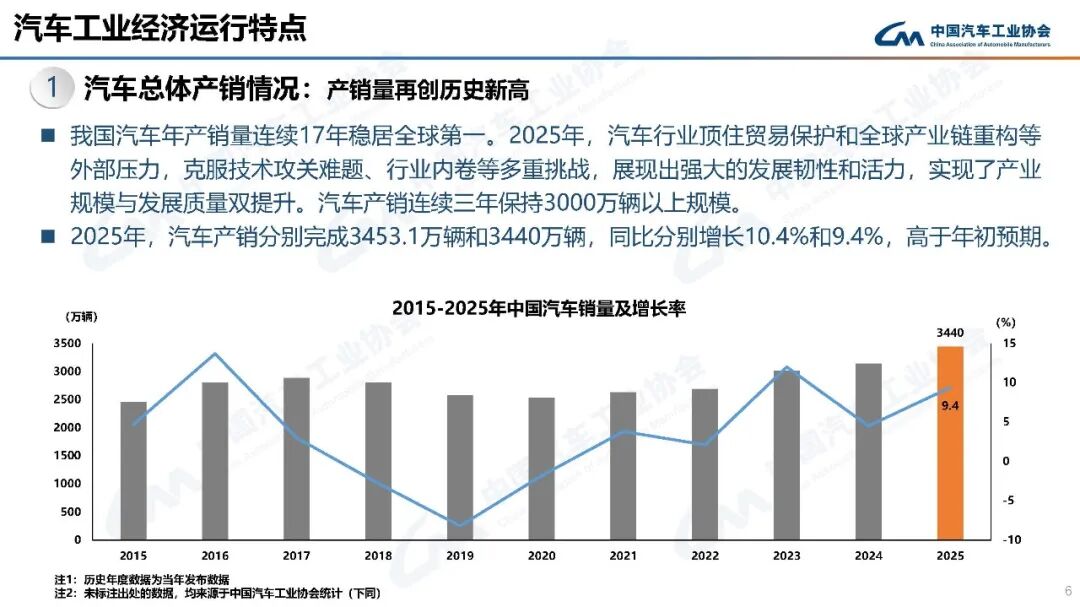
Overall Market - In 2025, China's automotive industry achieved record production and sales, with 34.53 million vehicles produced and 34.40 million sold, marking year-on-year growth of 10.4% and 9.4% respectively, driven by policy support and market dynamics [1][5] - The market demonstrated strong resilience against global trade protectionism, supply chain restructuring, and intensified competition [1] Market Dynamics - The "Two New" policy expanded consumer goods categories and support for equipment upgrades, stimulating vehicle replacement demand, particularly in lower-tier cities [5] - The transition to electric vehicles (EVs) was facilitated by stable tax policies and improved charging infrastructure, lowering barriers for potential EV buyers [5] - Consumer preferences are shifting towards intelligent features and green travel, pushing the market towards higher quality development [5] Segmented Market - In 2025, new energy vehicles (NEVs) became the dominant growth segment, with production and sales reaching 16.63 million and 16.49 million respectively, reflecting year-on-year growth of 29% and 28.2% [6] - NEVs accounted for 47.9% of total new vehicle sales, a 7 percentage point increase from the previous year [6] - The traditional fuel vehicle market is undergoing structural adjustments, with demand for high-displacement, high-fuel-consumption models declining, while smaller, hybrid models remain popular [10] Market Structure - Domestic brands solidified their leading position, with their market share exceeding 60% for the first time, driven by strong performances from companies like BYD, Geely, and Changan [13][15] - BYD led the market with over 4.6 million units sold, benefiting from its technological advancements in NEVs [15] - Joint venture brands faced significant pressure, with declining market shares due to slow adaptation to the NEV market and product homogenization [16] Export Market - In 2025, China's automotive exports exceeded 7 million units, achieving a year-on-year growth of 21.1%, maintaining its position as the world's largest automotive exporter for three consecutive years [18] - Emerging markets in Southeast Asia, the Middle East, and South America remain key destinations for Chinese automotive exports, with NEVs becoming a significant export category [18] Sales Rankings - The top ten automotive brands in 2025 showcased a strong performance from domestic brands, with five spots occupied by them, and a combined market share of 37.3% [21] - BYD, Geely, and Changan maintained their positions through a dual strategy of fuel and NEV offerings [21] - Traditional joint venture brands like FAW-Volkswagen and SAIC Volkswagen continued to experience declines, unable to offset losses from fuel vehicle sales with NEV growth [21] Emerging Brands - New entrants like Leap Motor and Hongmeng Zhixing showed remarkable growth, with Leap Motor doubling its sales through self-developed technology and competitive pricing [23] - Traditional automakers' NEV sub-brands also performed well, rapidly capturing market share through targeted strategies [23] Consumer Trends - Successful models in 2025 aligned with market trends, focusing on price adaptability, user needs, and technological highlights [24] - Family and young consumers emerged as core target groups, with vehicles designed for spaciousness and smart features gaining popularity [26] - The integration of new energy and intelligent technologies became essential for popular models, addressing consumer concerns about range and charging [26] Future Outlook - The strong rise of NEVs indicates China's automotive industry is positioned advantageously in the global transformation of the sector [28] - Continued policy support for NEVs and smart vehicles is expected, alongside growing consumer demand for high-quality, intelligent products [28] - The industry is likely to see further integration across the supply chain, enhancing competitiveness [28]

新能车ETF(515700)红盘向上,1月新能源车销量亮眼
Xin Lang Cai Jing· 2026-02-04 06:50
新能车ETF紧密跟踪中证新能源汽车产业指数,中证新能源汽车产业指数选取50只业务涉及新能源整 车、电机电控、锂电设备、电芯电池、电池材料等新能源汽车产业的上市公司证券作为指数样本,反映 新能源汽车产业龙头上市公司证券的整体表现。 截至2026年2月4日 14:15,中证新能源汽车产业指数(930997)上涨0.51%,成分股银轮股份上涨10.01%, 亿华通上涨9.47%,盟固利上涨5.91%,富临精工上涨5.87%,宁德时代上涨4.91%。新能车ETF(515700) 上涨0.57%,最新价报2.46元。 消息面上,1月新能源车销量亮眼,造车新势力阵营的零跑汽车、蔚来、理想汽车等主要车企实现销量 同比增长。华为鸿蒙智行成绩亮眼,1月交付量同比增长高达65.6%。 开源证券指出,在购置税减免退坡及梯度以旧换新补贴预计对主流价位段新能源车销量造成较大影响的 背景下,2026年重点看好高端化发展方向。尊界S800连续蝉联超豪华轿车市场冠军,重点推荐国产超 豪华领军车企江淮汽车。其次,问界、极氪9X等车型在高端车市场持续放量,也有望明显增强相关车 企的业绩,看好赛力斯、吉利汽车等后续发展。同时,海外市场将继续成为车 ...

视频|零跑朱江明回应年会争议,不回避问题、不推卸责任,直面此次年会暴露的组织能力短板
Xin Lang Cai Jing· 2026-02-04 02:29
新浪声明:此消息系转载自新浪合作媒体,新浪网登载此文出于传递更多信息之目的,并不意味着赞同 其观点或证实其描述。文章内容仅供参考,不构成投资建议。投资者据此操作,风险自担。 责任编辑:宋雅芳 炒股就看金麒麟分析师研报,权威,专业,及时,全面,助您挖掘潜力主题机会! 来源:爱车918 零跑朱江明回应年会争议,不回避问题、不推卸责任,直面此次年会暴露的组织能力短板,明确表示已 启动年会全流程复盘优化 炒股就看金麒麟分析师研报,权威,专业,及时,全面,助您挖掘潜力主题机会! 来源:爱车918 零跑朱江明回应年会争议,不回避问题、不推卸责任,直面此次年会暴露的组织能力短板,明确表示已 启动年会全流程复盘优化 新浪声明:此消息系转载自新浪合作媒体,新浪网登载此文出于传递更多信息之目的,并不意味着赞同 其观点或证实其描述。文章内容仅供参考,不构成投资建议。投资者据此操作,风险自担。 责任编辑:宋雅芳 ...

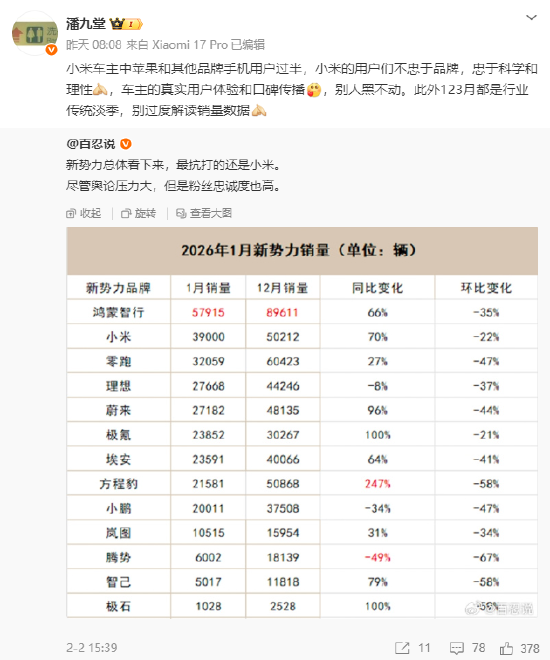
潘九堂回应小米粉丝忠诚度高:小米用户不忠于品牌,忠于科学和理性
Xin Lang Cai Jing· 2026-02-04 02:12
这份销量榜单显示,小米汽车1月销量为39000辆,12月销量为50212辆,环比下降22%。原博主表示, 新势力总体看下来,最抗打的还是小米,尽管舆论压力大,但是粉丝忠诚度也高。 2月3日,小米产业投资部合伙人潘九堂转发了一份2026年1月新势力销量榜单并表示:"小米车主中苹果 和其他品牌手机用户过半,小米的用户们不忠于品牌,忠于科学和理性,车主的真实用户体验和口碑传 播,别人黑不动。此外,1、2、3月都是行业传统淡季,别过度解读销量数据"。 | | | 2026年1月新势力销量(单位:辆) | | | | --- | --- | --- | --- | --- | | 新势力品牌 | 1月销量 | 12月销量 | 同比变化 | 环比变化 | | 鸿蒙智行 | 57915 | 89611 | 66% | -35% | | 小米 | 39000 | 50212 | 70% | -22% | | 零跑 | 32059 | 60423 | 27% | -47% | | 理想 | 27668 | 44246 | -8% | -37% | | 蔚来 | 27182 | 48135 | ઠેરિય | -44% | | ...

美团、腾讯、百度、阿里,集体下跌
Di Yi Cai Jing Zi Xun· 2026-02-04 01:46
科网股多数走低,美团、快手、腾讯控股、携程集团、华虹半导体、哔哩哔哩、百度集团均跌超1%。 | 名称 | 现价 | 涨跌 | 涨跌幅 - | | --- | --- | --- | --- | | 美团-W | 91.500 | -1.700 | -1.82% | | 快手-W | 72.150 | -1.300 | -1.77% | | 携程集团-S | 476.600 | -8.200 | -1.69% | | 金蝶国际 | 12.450 | -0.210 | -1.66% | | 腾讯控股 | 572.000 | -9.000 | -1.55% | | 零跑汽车 | 39.000 | -0.600 | -1.52% | | 华虹米音体 | 106.300 | -1.400 | -1.30% | | 比亚迪股份 | 88.900 | -1.100 | -1.22% | | 哔哩哔哩-W | 250.000 | -3.000 | -1.19% | | 百度集团-SW | 139.900 | -1.500 | -1.06% | | 阿里巴巴-W | 159.400 | -1.600 | -0.99% | | ...


美团、腾讯、百度、阿里,集体下跌
第一财经· 2026-02-04 01:38
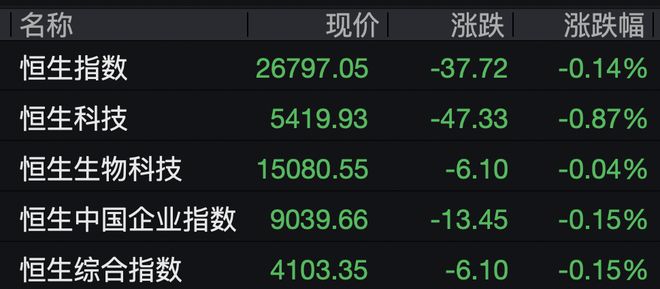
2月4日,港股低开,恒生指数跌0.14%,恒生科技指数跌0.87%。 科网股多数走低,美团、快手、腾讯控股、携程集团、华虹半导体、哔哩哔哩、百度集团均跌超1%。 | 名称 | 现价 | 涨跌 | 涨跌幅 ^ | | --- | --- | --- | --- | | 美团-W | 91.500 | -1.700 | -1.82% | | 快手-W | 72.150 | -1.300 | -1.77% | | 携程集团-S | 476.600 | -8.200 | -1.69% | | 金蝶国际 | 12.450 | -0.210 | -1.66% | | 腾讯控股 | 572.000 | -9.000 | -1.55% | | 零跑汽车 | 39.000 | -0.600 | -1.52% | | 交汇录备体 | 106.300 | -1.400 | -1.30% | | 比 亚迪股份 | 88.900 | -1.100 | -1.22% | | 昨週昨週-W | 250.000 | -3.000 | -1.19% | | 百度集团-SW | 139.900 | -1.500 | -1.06% | | 阿里巴 ...

销量环比下滑超20%,单车成本激增7000元:2026车市开局承压
Xin Hua Cai Jing· 2026-02-04 01:16
Core Viewpoint - The automotive market in China experienced a significant month-on-month decline in January 2026, influenced by changes in tax policies and early consumer demand, while year-on-year sales remained relatively stable [1]. Group 1: Market Performance - In January 2026, the retail sales of narrow passenger vehicles in China were approximately 1.8 million units, representing a month-on-month decrease of 20.4% and a slight year-on-year increase of 0.3% [1]. - The retail sales of new energy vehicles (NEVs) in January were around 800,000 units, showing a year-on-year decline of 40.2%, but a month-on-month growth of 7.5% [1]. - Major traditional automakers like SAIC and Geely surpassed BYD in sales, with SAIC selling 327,000 units (up 23.9% year-on-year) and Geely selling 270,200 units (up 1.3% year-on-year) [2]. Group 2: New Energy Vehicle Segment - In the new energy vehicle sector, brands like Xiaomi, Hongmeng Zhixing, and NIO saw significant year-on-year growth, with Xiaomi's sales increasing by 95% to over 39,000 units [3][4]. - NIO delivered 27,200 units in January, marking a 96% year-on-year increase, driven by the new ES8 model [4]. - Conversely, companies like XPeng and Li Auto experienced declines, with XPeng's deliveries down 47% month-on-month and 34% year-on-year [4]. Group 3: Cost Pressures - The automotive industry is facing rising costs, with single-vehicle costs increasing by 4,000 to 7,000 yuan due to surging prices of key materials like lithium, aluminum, and DRAM [5][6]. - The price of battery-grade lithium carbonate rose from 75,700 yuan per ton at the beginning of 2025 to 146,600 yuan per ton by February 3, 2026, a nearly 94% increase [5]. - UBS reported that the cost increases in metals and chips could compress profit margins significantly, with potential reductions of 33% to 93% for vehicles priced at 150,000 yuan [6]. Group 4: Strategic Directions - To counteract rising costs and stagnant market demand, automakers are focusing on international expansion, with Chery exporting 119,600 units in January, accounting for nearly 60% of its total sales [7]. - BYD's overseas sales exceeded 100,000 units, a year-on-year increase of 43.3%, while Geely's exports grew by over 120% [7]. - Companies are also targeting the high-end market, with Great Wall Motors launching the WEY brand's flagship V9X, indicating a competitive push in the premium segment [9]. Group 5: Market Outlook - The automotive consumption index for January 2026 was reported at 31.1, reflecting a cautious consumer sentiment influenced by various factors, including the upcoming Spring Festival and changes in tax policies [10]. - Industry experts suggest that the market may not see a clear recovery until March or the end of the first quarter [10].