
中科电气

Search documents
锂电负极行业首份半年报出炉,翔丰华毛利率下降6个百分点
Hua Xia Shi Bao· 2025-08-02 12:22
Core Viewpoint - Xiangfenghua (300890.SZ) reported its first half-year loss since its listing, with a revenue of 688 million yuan, a 2.8% year-on-year decline, and a net profit of -2.95 million yuan, a 107.7% year-on-year decrease, indicating significant challenges in the anode materials industry due to rising raw material costs and oversupply [3][4][5]. Company Performance - In the first half of 2025, Xiangfenghua's gross margin fell to 12.35%, down 6.23 percentage points from the previous year, while operating costs increased by 4.17 percentage points [5]. - The company experienced a significant drop in its net profit, with a non-recurring net profit of -14.80 million yuan, primarily due to non-operating income of 11.85 million yuan, including government subsidies [6][7]. - Xiangfenghua's market share is in the middle of the industry, with a production capacity utilization rate of 83.43% in 2024, and it shipped 68,900 tons that year [4]. Industry Context - The anode materials industry is facing oversupply and intense competition, leading to a divergence in performance among companies, with leading firms maintaining profitability while smaller firms struggle [4][10]. - The average gross margin for major listed companies in the industry was 22.26% in 2024, highlighting the pressure on margins due to rising costs and competitive pricing [5]. - The industry has seen a significant increase in production capacity, with output rising from 450,000 tons in 2020 to 1.89 million tons in 2024, resulting in a 320% increase [9]. Market Dynamics - The price of petroleum coke, a key raw material, surged over 70% in early 2025, impacting the cost structure of anode manufacturers [7]. - Despite a slight recovery in raw material prices in the second quarter, the overall profitability of the anode industry remains under pressure due to oversupply and price wars [8][9]. - High-end products are more profitable, with companies like Zhongke Electric maintaining profitability through premium offerings, while lower-end products struggle to generate profit [10].


电力设备行业董秘薪酬榜:安科瑞收利双降 董秘罗叶兰涨薪56万至193万、涨幅位列业内第四
Xin Lang Zheng Quan· 2025-08-01 07:25
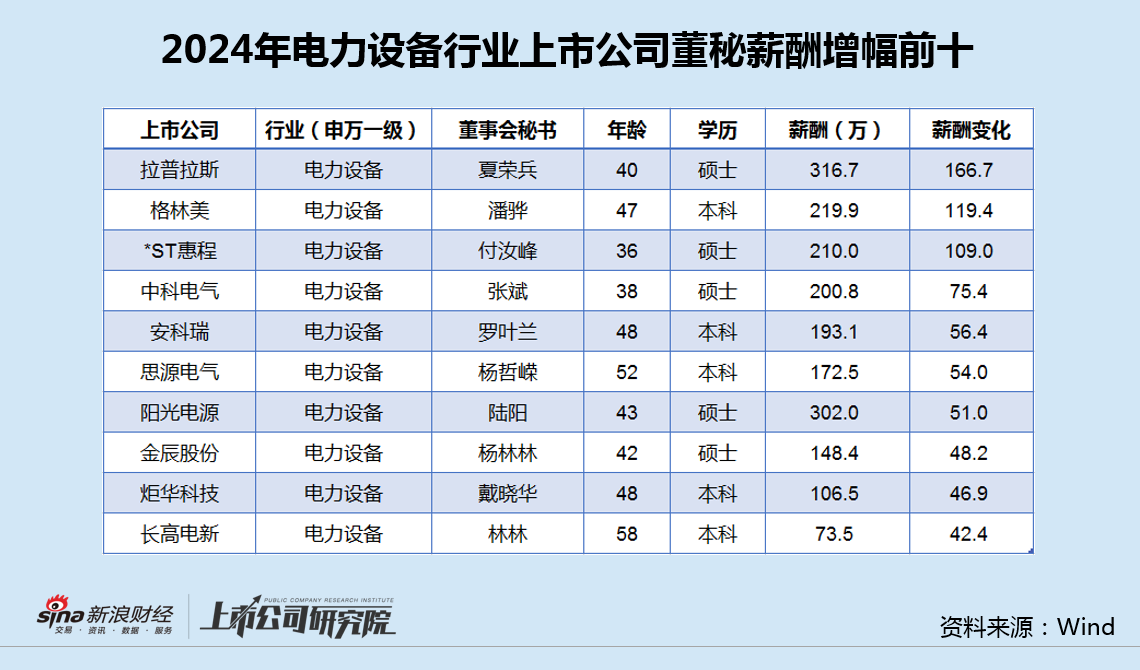
专题:专题|2024年度A股董秘数据报告:1144位董秘年薪超百万 占比超21% 导语:安科瑞 2024 年收利双降,董秘罗叶兰却涨薪 56.4 万至 193.1 万,年薪涨幅位列业内第四。 从董秘薪酬涨幅看,前10的上市公司分别为拉普拉斯、格林美、*ST惠程(维权)、中科电气、安科瑞、思源电气、阳光电源、金辰股份、炬华科技和长高 电新。 值得注意的是,2024年安科瑞营收和归母净利润同比分别下降5.24%和15.68%,业绩逆势下滑的同时,公司董秘罗叶兰却涨薪56.4万至193.1万元,涨幅位列 业内第五。 董秘作为连接投资者与上市公司的"桥梁",在上市公司资本运作中发挥着关键作用。新浪财经《2024年度A股董秘数据报告》显示,2024年A股上市公司董 秘薪酬合计达40.86亿元,平均年薪75.43万元。 分行业来看,A股和新三板电力设备行业(申万一级)进入统计的上市公司共371家,董秘薪酬合计金额2.72亿元,平均年薪约73.39万元,中位数约60万 元。 | 上市公司 | 行业(申万一级) | 董事会秘书 | 年龄 | 学历 | 薪酬(万) | 薪酬变化 | | --- | --- | --- | -- ...

中科电气:公司管理层持续坚定地看好公司的发展前景
Zheng Quan Ri Bao Zhi Sheng· 2025-07-31 11:40
证券日报网讯 中科电气7月31日在互动平台回答投资者提问时表示,公司部分董事、高管因个人资金需 求减持公司股份,是股东的正常行为。公司管理层持续坚定地看好公司的发展前景,并将一如既往地经 营好企业,用良好的经营成果回馈投资者。此外,针对技改项目公司会充分借助相关支持政策,助力公 司持续发展。 (编辑 王雪儿) ...

电力设备行业董秘薪酬榜:*ST惠程多次违规内控问题严重 董秘付汝峰年内涨薪百万
Xin Lang Zheng Quan· 2025-07-31 02:22
登录新浪财经APP 搜索【信披】查看更多考评等级 专题:专题|2024年度A股董秘数据报告:1144位董秘年薪超百万 占比超21% 导语: *ST 惠程(维权) 2024 年多次违规,内控存在严重问题,而公司董秘付汝峰年内却涨薪 109 万,年薪高达 210 万。 董秘作为连接投资者与上市公司的"桥梁",在上市公司资本运作中发挥着关键作用。新浪财经《2024年度A股董秘数据报告》显示,2024年A股上市公司董 秘薪酬合计达40.86亿元,平均年薪75.43万元。 值得注意的是,上述企业中,*ST惠程因存在 信息披露虚假、误导性陈述或重大遗漏、高管未依法履行职责等违规行为,在2024年受到监管层公开谴责、内 部通报批评等多次处罚。 然而,公司董秘付汝峰年薪却从2023年的101万元涨至2024年的210万元,涨薪超百万,幅度高达108%。 责任编辑:公司观察 分行业来看,A股和新三板电力设备行业(申万一级)进入统计的上市公司共371家,董秘薪酬合计金额2.72亿元,平均年薪约73.39万元,中位数约60万 元。 从董秘薪酬涨幅看,前10的上市公司分别为拉普拉斯、格林美、*ST惠程、中科电气、安科瑞、思源电气、阳 ...

重组成功!2025年全国418家全国重点实验室名单公布
仪器信息网· 2025-07-30 04:08
Core Viewpoint - Nearly 500 national key laboratories have been approved or restructured, primarily led or participated in by "Double First Class" universities, with around 110 such universities involved in approximately 80% of these laboratories [1][2]. Summary by Sections Overview of National Key Laboratories - As of July 20, 2025, close to 500 national key laboratories have been established or restructured, with a significant majority led by "Double First Class" universities [2]. - Approximately 110 "Double First Class" universities are involved in the establishment or co-construction of nearly 400 national key laboratories, representing about 80% of the total [2]. List of National Key Laboratories - A detailed list of national key laboratories includes various fields such as artificial intelligence, drug development, and environmental protection, with notable institutions like Tsinghua University, Peking University, and Shanghai Jiao Tong University leading many of these initiatives [3][4][5][6][7][8][9][10][11]. Notable Institutions and Their Contributions - Tsinghua University, Peking University, and Shanghai Jiao Tong University are highlighted for their significant contributions to the number of approved key laboratories [2][3]. - Various universities and research institutes are collaborating on specialized laboratories focusing on areas such as renewable energy, advanced manufacturing, and medical research [4][5][6][7][8][9][10][11]. Implications for Research and Development - The establishment of these laboratories is expected to enhance research capabilities and foster innovation across multiple sectors, including technology, healthcare, and environmental science [2][3][4]. - The collaboration between universities and industries in these laboratories indicates a strong commitment to advancing scientific research and practical applications [5][6][7].

价格法修订草案公布,近期碳酸锂价格显著反弹
GOLDEN SUN SECURITIES· 2025-07-27 06:51
Investment Rating - The report maintains an "Overweight" rating for the electric equipment sector [6] Core Views - The global photovoltaic installation forecast for 2025 has been revised upwards to 570-630 GW, indicating potential demand exceeding expectations in the second half of the year [14] - The recent draft amendment to the Price Law aims to promote healthy industry development and return to normal profit levels, emphasizing product quality and service [14] - Key investment opportunities are identified in three areas: supply-side reform leading to price increases, long-term growth opportunities from new technologies, and industrialization opportunities from perovskite GW-level layouts [14] Summary by Sections New Energy Generation - **Photovoltaics**: The global installation forecast for 2025 has been revised to 570-630 GW, with the potential for higher-than-expected demand in the second half of the year. The Price Law amendment focuses on clarifying standards for unfair pricing behavior, promoting healthy competition and quality [14] - **Wind Power & Grid**: The Hainan CZ7 project, a 1500 MW offshore wind project, is set to begin construction by September 30, 2025. The State Grid's fixed asset investment exceeded 270 billion yuan in the first half of 2025, a year-on-year increase of 11.7% [15][16] - **Hydrogen & Energy Storage**: A 10 million ton green methanol project in Gansu has been announced with a total investment of 1.05 billion yuan. The report recommends focusing on leading equipment manufacturers and hydrogen compression companies [20][28] New Energy Vehicles - Recent fluctuations in lithium carbonate prices are attributed to resource disruptions and anti-involution policy expectations. The price reached 80,500 yuan per ton, with potential impacts on global production due to strict scrutiny of non-compliant mining operations [29][30][31] Energy Storage - The average bid price for energy storage systems in July was 0.4985 yuan/Wh, with a range of 0.5635 to 1.6912 yuan/Wh for EPC bids. The report suggests focusing on domestic and international large-scale storage opportunities [23][28] Market Performance - The electric equipment and new energy sector saw a 3.0% increase from July 21 to July 25, 2025, with a year-to-date increase of 7.8% [10] - Specific sub-sectors such as photovoltaic equipment, wind power equipment, batteries, and grid equipment also experienced positive growth during this period [12][13]
从“产品出海”到“产能出海” 锂电产业绽放全球市场
Zheng Quan Shi Bao· 2025-07-25 18:12
Core Viewpoint - The lithium battery industry is experiencing rapid growth in global markets, with Chinese companies leading the way in exports and production capacity, but they must navigate challenges in policy, market dynamics, and cost management to maintain competitive advantages. Industry Overview - China supplies 70% of battery materials and 60% of power batteries globally, showcasing its competitive edge in the lithium battery supply chain [2] - From 2020 to 2024, China's lithium battery exports are projected to grow from $15.9 billion to $61.1 billion, with a compound annual growth rate of approximately 40% [2] - Major companies like CATL and Guoxuan High-Tech have significantly increased their overseas revenues, indicating a shift from product export to capacity export [2] Market Trends - The overseas market is still in a "blue ocean" phase with high demand and limited local supply, prompting companies to establish production facilities abroad [3] - Companies such as Hunan Youneng and Tianqi Materials are announcing substantial overseas investment plans, indicating a trend of industry collaboration in international expansion [3] Investment and Financing - The trend of overseas listings is gaining momentum, with companies like Guoxuan High-Tech and Gree Energy issuing GDRs to support global expansion [5] - Hong Kong has become a preferred listing destination for many lithium battery companies, driven by supportive policies and the need for funding [6] Production Capacity and Profitability - Several leading lithium battery companies have reported full order books and are beginning to achieve profitability from their overseas factories [9] - CATL's factory in Germany has reached profitability, and its Hungarian facility is expected to follow suit, benefiting from lessons learned in Germany [9] Localized Operations - Companies are focusing on localizing their operations to enhance customer loyalty and reduce trade barriers [4] - The establishment of joint ventures and acquisitions is a strategy employed by companies like EVE Energy and Rongbai Technology to integrate into local markets [12] Strategic Considerations - The lithium battery industry must consider various factors such as downstream order demand, policy changes, and local operational capabilities when expanding internationally [11] - Companies are investing in training and development to prepare their teams for overseas operations, ensuring successful project implementation [11]


7月中上旬乘用车新能源渗透率54.9%!新能车ETF(515700)开盘上涨超1.0%
Xin Lang Cai Jing· 2025-07-24 01:58
Group 1 - The core viewpoint of the articles highlights the growth in the Chinese passenger car market, with retail sales reaching 978,000 units from July 1-20, representing an 11% year-on-year increase, although it shows a 12% decline compared to the previous month [1] - The cumulative retail sales for the year amount to 11.88 million units, also reflecting an 11% year-on-year growth [1] - In the new energy vehicle (NEV) sector, retail sales reached 537,000 units during the same period, marking a 23% year-on-year increase, while the penetration rate for NEVs stands at 54.9% [1] Group 2 - The China Securities New Energy Vehicle Industry Index (930997) has seen a 0.87% increase, with notable stock performances from companies such as Defu Technology (up 7.89%) and Huayou Cobalt (up 4.22%) [1] - The New Energy Vehicle ETF (515700) has risen by 0.80%, with a recent price of 1.76 yuan, and has accumulated a 4.67% increase over the past week [1] - The index includes 50 companies involved in various aspects of the NEV industry, with the top ten stocks accounting for 55.74% of the index [2]
锂电行业“反内卷”:从价格厮杀走向“理性繁荣
高工锂电· 2025-07-20 12:11
Core Viewpoint - The "anti-involution" policy is reshaping market expectations and is seen as a 2.0 version of China's supply-side reform, particularly impacting emerging industries like lithium batteries, photovoltaics, and electric vehicles [2][3]. Group 1: Industry Overview - The lithium battery industry has experienced explosive growth over the past decade, with total production reaching 1170 GWh and industry output exceeding 1.2 trillion yuan in 2022, compared to just 29.868 GWh in 2014 [8]. - Despite significant growth, the industry faces challenges as rapid physical growth has not translated into corporate profits, with many companies selling inventory at prices just covering raw material costs [9][10]. - The lithium battery sector holds over 70% of the global market share, yet it is engaged in "bottom competition" internationally, leading to a decline in average prices [10]. Group 2: Policy and Legislative Changes - The "anti-involution" initiative has moved towards legislative depth, with new laws targeting price stability and fair trading conditions, including the prohibition of selling below cost [4]. - The government is addressing issues of homogeneous capacity caused by chaotic investment practices, emphasizing the need for transparent investment disclosures [5]. Group 3: Market Dynamics and Challenges - The industry is experiencing a price war, with over 30 car manufacturers reducing prices to clear inventory, leading to a significant drop in profit margins within the automotive sector [13]. - The lithium price has been on a downward trend since late 2022, with expectations of continued oversupply in the market, affecting upstream material suppliers [14]. Group 4: Future Directions and Innovations - The "anti-involution" marks a critical turning point for the lithium battery industry, focusing on the elimination of outdated capacity and driving technological upgrades [16][17]. - New investment trends are emerging, with a focus on battery recycling and solid-state batteries, indicating a shift towards a circular economy and technological innovation [20]. - Companies are increasingly investing in high-pressure lithium iron phosphate batteries, which are expected to enhance profit margins and meet rising demand for fast-charging solutions [21].
电力设备与新能源行业7月第3周周报:国常会提出规范新能源汽车产业竞争秩序-20250720
Bank of China Securities· 2025-07-20 10:31
Investment Rating - The report maintains an "Outperform" rating for the electric equipment and new energy industry [1] Core Insights - The State Council meeting emphasized the need for high-quality development in the new energy vehicle (NEV) industry, addressing irrational competition and promoting a regulated competitive environment, which is beneficial for the NEV sector [1] - According to the China Association of Automobile Manufacturers, NEV production and sales are expected to reach 6.968 million and 6.937 million units respectively in the first half of 2025, representing year-on-year growth of 41.4% and 40.3%, with NEV sales accounting for 44.3% of total new car sales [1] - The report highlights the clear trend towards the industrialization of solid-state batteries, suggesting a focus on related materials and equipment companies [1] - In the photovoltaic sector, the central economic work conference called for a comprehensive rectification of "involution" competition, leading to price increases in the upstream photovoltaic supply chain [1] - The hydrogen energy sector is seeing continuous policy support for industrialization, with recommendations to focus on electrolyzer manufacturers and companies benefiting from hydrogen infrastructure [1] Industry Dynamics - The electric equipment and new energy sector saw a 0.57% increase this week, with power generation equipment rising by 3.86% and the NEV index increasing by 2.62% [10] - The report notes that the photovoltaic sector experienced a decline of 2.53%, while the wind power sector fell by 0.27% [10] - The report indicates that the price of silicon materials has been supported by cost factors, with recent price adjustments reflecting a positive response to the "anti-involution" policy [1][15] - The report also mentions that the domestic lithium battery market is experiencing price fluctuations, with certain materials showing varying trends [14] Company Updates - Longi Green Energy is expected to report a net loss of 2.4 to 2.8 billion yuan for the first half of the year, while Tongwei Co. anticipates a net loss of 4.9 to 5.2 billion yuan [29] - Zhongke Electric is projected to achieve a net profit of 232 to 301 million yuan, marking a year-on-year increase of 235% to 335% [29] - The report highlights that Tianqi Lithium is expected to report a net profit of 0 to 155 million yuan for the first half of the year [29] - The report also notes that Tianqi Materials has signed a procurement agreement to supply at least 550,000 tons of electrolyte products by the end of 2030 [29]