华锡有色

Search documents
铜坑矿业建成全国首个非煤矿山井下全流程无人采矿试验采场
Guang Xi Ri Bao· 2025-12-19 14:09
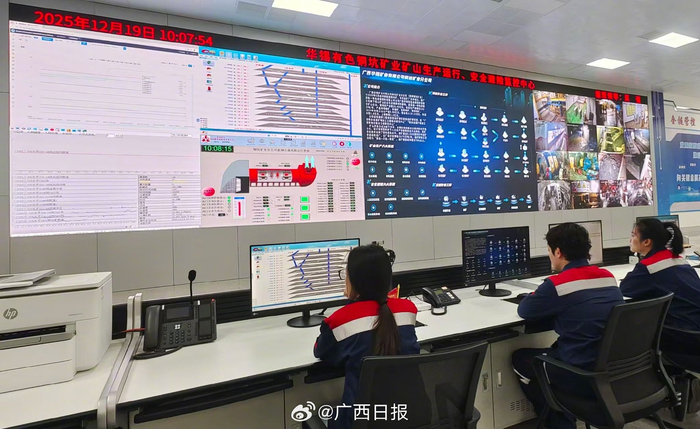
Core Viewpoint - The company Guangxi Huaxi Mining Co., Ltd. is advancing its "smart mining" initiative, achieving automation in underground mining operations through intelligent equipment and technology [1]. Group 1: Company Overview - Guangxi Huaxi Mining Co., Ltd. operates the Tongkeng Mining branch, which is a core mining enterprise under the state-controlled listed company Huaxi Nonferrous Metals [1]. - The company has an annual production capacity of 1.32 million tons of various concentrates, including tin, zinc, lead, and antimony [1]. Group 2: Technological Advancements - The company has implemented a comprehensive upgrade in mechanization, information technology, and intelligence across the entire production chain, including drilling, blasting, transportation, and mineral selection [1]. - It has established the first fully automated underground mining test site in a non-coal mine in China, with its intelligent equipment cluster and collaborative mining technology reaching an internationally leading level [1]. Group 3: Industry Impact - The integration of AI technology is significantly enhancing the quality of development in traditional mining sectors, providing strong new momentum for growth [1].

长江有色:17日锡价上涨 资金助推多头增仓上行但交投清淡
Xin Lang Cai Jing· 2025-12-19 07:27
Core Viewpoint - The tin market is experiencing a "tight balance" in supply and demand, influenced by macroeconomic factors and structural constraints in the industry, leading to price support and fluctuations in tin prices [2][3][4]. Supply Side - The supply side of the tin market is characterized by a "tight balance" due to various constraints throughout the industry chain, including geopolitical challenges in major production areas and slow recovery of production in Myanmar [3]. - The recovery of Indonesian export activities is slow, and domestic smelting regions maintain high operating rates, but low processing profits hinder capacity expansion, resulting in limited refined output growth [3]. - Overall, every link in the industry chain faces real constraints, establishing a structural norm of "tight balance" in supply, which provides solid support for price levels [3]. Demand Side - Traditional consumer electronics demand remains weak, with sluggish growth in shipments of key products like smartphones and personal computers, negatively impacting overall demand [4]. - Emerging sectors such as artificial intelligence, green energy, and semiconductors are becoming strong demand drivers, with AI-related server shipments increasing and the commercialization of heterojunction solar cells contributing to structural growth in tin usage [4]. - The semiconductor industry, which accounts for over 60% of tin demand, is experiencing a cyclical recovery, providing solid support and growth potential for tin demand [4]. - The tin industry is driven by both resource scarcity and technological upgrades, with leading companies benefiting from rising tin prices and high-end demand in solar and semiconductor sectors [4]. Short-term Price Trend Prediction - In the short term, macroeconomic easing expectations and low inventory levels provide support, but weak spot transactions pose upward resistance, making significant price breakthroughs unlikely [6].

锡价如虹破云霄,供需裂变定新锚!
Xin Lang Cai Jing· 2025-12-19 07:26
Price Trends - Current tin price is reported at 332,500-334,500 CNY per ton, with an average of 333,500 CNY per ton, reflecting an increase of 8,000 CNY per ton (+2.46%) from the previous day, continuing a strong upward trend [1] - The short-term trend indicates a confirmed upward channel with prices consistently rising, supported by a strong performance in the futures market, where the main contract for tin reached 334,220 CNY per ton, up 2.63% [1] - Global supply is under significant pressure due to geopolitical conflicts in major production areas and tightening policies in resource-rich countries, leading to a high level of uncertainty in over 20% of global supply [1] Supply and Demand Dynamics - The supply side is shifting from "sudden disruptions" to "systemic constraints," with clear limitations on supply growth due to declining ore grades and rising costs in global mining [2] - Demand is experiencing a structural divergence, with traditional consumer electronics facing a cyclical downturn while high-end demands from AI hardware and electric vehicles are on the rise, creating a tug-of-war between declining traditional demand and the long-term potential of emerging sectors [2] Industry Chain Response - The upstream resource sector maintains strong bargaining power, focusing on resource integration and technological innovation to ensure long-term supply stability [3] - The midstream smelting sector is under significant pressure, caught between high raw material costs and the price acceptance of downstream markets, leading to a focus on optimizing capacity and extending into high-value-added products [3] - Major companies are adopting differentiated strategies to solidify their positions, with leading firms leveraging resource reserves and global expansion, while others focus on technological upgrades and high-end product development [3] Short-term Outlook for Tin Prices - Tin prices are currently at historical highs, with market dynamics shifting from a "one-way increase" to a "bull-bear contest," indicating a phase of high volatility and potential price fluctuations [4] - Market participants are advised to monitor inventory levels, actual policy implementations in major producing countries, and marginal changes in downstream purchasing intentions, suggesting a range-based approach to trading [4]
长江有色:资金轮动激活纳指引擎美股齐涨 19日锡价或上涨
Xin Lang Cai Jing· 2025-12-19 07:26
Group 1 - The core contradiction in the tin market is the increasing long-term resource scarcity versus structural demand growth [2] - Upstream mines face systemic challenges such as declining reserves and geopolitical policy disruptions, providing rigid support for prices [2] - Demand is significantly differentiated, with traditional solder demand stable while high-end applications like semiconductors and photovoltaics drive growth, enhancing tin's status as a "strategic metal" [2] Group 2 - Leading companies in the tin industry are showing clear paths of differentiation, with Tin Industry Co. leveraging its own mines to gain an advantage in resource value reassessment [2] - Huaxi Nonferrous's growth is closely tied to domestic industrial policies and the recovery of overseas high-end demand [2] - Xinyi Silver Tin is highly sensitive to fluctuations in tin prices, making it an elastic target [2] Group 3 - The current trading logic in the market has fundamentally shifted from balancing supply and demand to trading under extremely low inventory conditions, where any marginal supply disruption could lead to amplified vulnerability expectations [2] - Macroeconomic easing expectations inject liquidity premiums into prices, while factors like Myanmar's resumption of production and geopolitical conflicts serve as critical variables for market dynamics [2]
广西发布31宗9738亩土地资源信息,涵盖商住、科研、工业等多种用途
Sou Hu Cai Jing· 2025-12-19 04:41
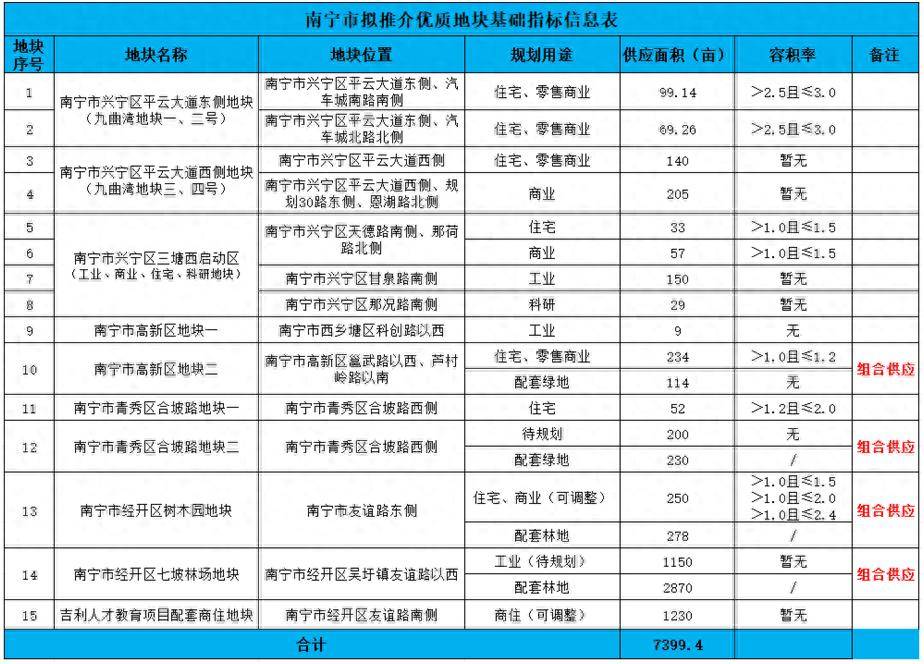
Core Insights - The Guangxi Land Reserve Center has recently launched 31 plots of land totaling 9,738 acres across six cities, with a significant focus on mixed-use development to meet market demands and enhance living quality [1][2]. Group 1: Land Distribution and Usage - The land is distributed among Nanning (15 plots, 7,399 acres), Liuzhou (1 plot, 187 acres), Guilin (1 plot, 866 acres), Hechi (2 plots, 112 acres), Laibin (7 plots, 705 acres), and Chongzuo (5 plots, 469 acres) [1]. - The land usage is categorized into residential and commercial (4,134 acres), industrial and research (1,338 acres), and other uses such as agriculture (4,266 acres) [1]. Group 2: Nanning Land Details - Nanning is set to offer 15 plots totaling 7,399.4 acres, with a mix of residential, commercial, and industrial uses, primarily in districts like Qingxiu, Xingning, and High-tech [2]. - A significant portion (6,192 acres) will utilize a natural resource asset combination supply method, allowing for family farms and various agricultural and recreational developments [2]. Group 3: Specific City Developments - Liuzhou's proposed land is located in a prime area near the ancient Gu Ting Mountain, emphasizing ecological residential development with unique landscape features [5]. - Guilin's land in the Yanshan District covers 866 acres, with a focus on residential and tourism-related developments, benefiting from nearby educational institutions and cultural sites [7]. - Hechi's two plots, totaling 112 acres, are designated for residential use and are strategically located near transportation hubs [9]. - Laibin's seven plots, totaling 705 acres, are primarily for mixed-use development, showcasing various advantages in location and infrastructure [11]. - Chongzuo's five plots, totaling 469 acres, are also for mixed-use, situated in an area rich in educational and ecological resources [15].
弱供给周期下的行业配置属性再探讨—小金属板块估值及收益弹性有望释放 | 投研报告
Zhong Guo Neng Yuan Wang· 2025-12-19 02:02
Group 1: Metal Industry Overview - The metal industry is experiencing a significant optimization in supply-demand structure, with a weak supply cycle expected to continue until 2028, characterized by rigid supply and vertical expansion in the industry chain [2] - The transition to a liquidity cycle is anticipated to enhance the elasticity of metal prices, with a shift from a tightening to a loosening monetary policy expected to normalize by 2026, potentially driving liquidity premiums for small metal varieties [2] - The report predicts that small metals such as rare earths, lithium, and others will see improved fundamentals and price elasticity due to ongoing supply-demand optimization and liquidity effects [2] Group 2: Lithium Industry Insights - The lithium supply is projected to increase from 123.1 thousand tons LCE in 2024 to 186 thousand tons LCE by 2027, with a CAGR of 15% [1][7] - The production of lithium from salt lakes is expected to rise significantly, with output increasing from 47.5 thousand tons LCE in 2024 to 84 thousand tons LCE in 2027, representing a CAGR of 21% [1][7] - Demand for lithium is driven by the growth of electric vehicles and energy storage systems, with total lithium battery shipments expected to rise from 1,545 GWh in 2024 to 2,778 GWh by 2027, leading to a demand increase from 103 thousand tons to 184 thousand tons of lithium [7] Group 3: Rare Earth Industry Developments - The rare earth industry is undergoing a structural optimization, with supply growth slowing down due to regulatory changes and industry consolidation, while demand is increasing from sectors like electric vehicles and robotics [3] - The export control of rare earths has become a strategic tool in the US-China trade conflict, enhancing China's pricing power in the global market [3] - The supply growth rate for rare earth mining is expected to decrease significantly in 2024, indicating a tightening supply situation [3] Group 4: Rubidium and Cesium Market Expansion - The global rubidium and cesium market is entering a rapid expansion phase, with supply expected to grow significantly due to increased production capacity from key players [5] - Demand for rubidium and cesium is projected to rise sharply, driven by upgrades in existing consumption structures and emerging applications in solar energy [5] - The combined demand for rubidium and cesium is forecasted to increase from 2,466 tons in 2025 to 4,600 tons by 2027, with a CAGR of 36.6% [5] Group 5: Antimony Market Dynamics - The antimony industry is entering a strong growth cycle due to supply constraints from mine closures and environmental regulations, while demand is increasing from the photovoltaic sector [8] - The global antimony supply gap is expected to widen significantly from 2024 to 2027, indicating a bullish outlook for antimony prices [8] - The demand growth rate for antimony is projected to reach a CAGR of 11% during the forecast period [8] Group 6: Molybdenum Supply and Demand - The global supply of molybdenum is expected to grow slowly, with an increase from 273 thousand tons to 292 thousand tons from 2020 to 2024, reflecting a CAGR of only 1.6% [9] - Demand for molybdenum is anticipated to rise due to the high-end and green transformation of the steel industry, with a projected CAGR of 3.8% from 2024 to 2027 [9] - The tight supply-demand balance in the molybdenum market is likely to push prices upward, benefiting related companies [9] Group 7: Magnesium Industry Outlook - The magnesium industry is expected to enter a state of sustained tight balance, with global production projected to increase from 1.12 million tons to 2 million tons from 2024 to 2027 [11] - Demand for magnesium is anticipated to grow significantly due to trends in automotive lightweighting and other emerging applications [11] - The supply-demand gap for magnesium is expected to remain tight, indicating a potential recovery in pricing and profitability for magnesium producers [11]
东兴证券晨报-20251218
Dongxing Securities· 2025-12-18 09:11
Economic News - In November, Shanghai's import and export value reached 387.49 billion yuan, a year-on-year increase of 10.6%, with exports at 186.6 billion yuan, up 18.2%, marking a monthly historical high [1] - The Ministry of Commerce reported that China and Europe are negotiating on electric vehicle issues, with China willing to resolve differences through dialogue [1] - The National Bureau of Statistics released unemployment rates for November, showing a youth unemployment rate of 16.9% for ages 16-24 and 7.2% for ages 25-29 [1] - The National Development and Reform Commission emphasized the need to optimize investment structure and maintain stable growth in traditional sectors while fostering new investment growth [1] - Yantai, Shandong, announced the discovery of Asia's largest underwater gold mine with proven reserves of over 39,000 tons, accounting for 26% of the national total [1] - The China Meteorological Administration aims to establish an advanced earth system forecasting system by 2035 [1] - The Sichuan Provincial Government plans to form a diversified R&D investment pattern by 2027, targeting a R&D investment intensity of 2.5% [1] - The People's Bank of China completed three financial preparations for Hainan Free Trade Port, enhancing cross-border financial risk prevention capabilities [1] - The China Photovoltaic Industry Association reported a total export value of photovoltaic products at $24.42 billion from January to October 2025, a decrease of 13.2% year-on-year, but a significant improvement from the previous year's decline [1] - The Hubei Provincial Government is advancing the asset reform of state-owned water resources [1] Important Company News - China National Airlines' subsidiary Shenzhen Airlines plans to raise 16 billion yuan through equity financing [2] Metal Industry Outlook - The metal industry is experiencing an optimization in supply-demand structure, with a weak supply cycle expected to continue until 2028, while demand is anticipated to rise due to green energy transitions and new productivity developments [5] - The liquidity cycle shift is expected to enhance metal price elasticity, with small metals projected to see significant price and valuation increases due to supply-demand improvements and liquidity premiums [5] - Small metals like rare earths, rubidium, cesium, lithium, antimony, molybdenum, and magnesium are highlighted for their potential in terms of supply-demand dynamics and future trends [5] Rare Earth Industry - The rare earth industry is undergoing a supply-demand optimization, with supply growth slowing and demand increasing due to sectors like electric vehicles and robotics [6] - The introduction of export controls has redefined the value of the rare earth industry, enhancing China's global pricing power [6] - Related companies include China Rare Earth, Northern Rare Earth, and others [7] Rubidium and Cesium Market - The global rubidium and cesium market is entering a rapid expansion phase, with significant supply growth expected from companies like Zhongmin Resources and Jinyin Galaxy [8] - Demand is projected to grow significantly due to upgrades in consumption structures and emerging applications [8] - Related companies include Zhongmin Resources and Jinyin Galaxy [9] Lithium Industry - The lithium supply-demand relationship is expected to improve, with supply growth driven by low-cost production in South America and increasing demand from the electric vehicle sector [10] - Global lithium supply is projected to grow from 1.231 million tons LCE in 2024 to 1.86 million tons LCE by 2027, with a CAGR of 15% [10] - Related companies include Zhongmin Resources, Jinyin Galaxy, Tianqi Lithium, and others [11] Antimony Industry - The antimony industry is entering a strong growth cycle due to supply constraints and increasing demand from the photovoltaic sector [11] - The global antimony supply-demand gap is expected to widen, leading to price increases and enhanced profitability for related companies [11] - Related companies include Huayu Mining, Huaxi Nonferrous, and Hunan Gold [12] Molybdenum Industry - The molybdenum market is expected to maintain a tight balance, with prices projected to rise due to increased demand from high-end steel and aerospace sectors [12] - Global molybdenum supply is expected to grow slowly, with demand projected to increase at a CAGR of 3.8% [12] - Related companies include Luoyang Molybdenum, Jintong Molybdenum, and Western Mining [13] Magnesium Industry - The magnesium industry is entering a state of sustained balance, with significant demand growth expected from sectors like automotive lightweighting and renewable energy [14] - Global magnesium demand is projected to grow from 1.12 million tons in 2024 to 2 million tons by 2027, with a CAGR of 21% [14] - Related companies include Baowu Magnesium, Xingyuan Zhuomai, and Wanfu Aoxian [15]
小金属及新材料行业2026年度投资策略(有色板块成长篇):小金属供给收紧筑底,AI金属需求高增空间广
Western Securities· 2025-12-18 07:16
Core Conclusions - The small metal sector is expected to benefit from the rising demand in the AI industry, presenting new investment opportunities [6] - The report maintains an "overweight" rating for the small metal sector, indicating a positive outlook for the industry [7] Industry Overview - The small metal sector significantly outperformed the market in 2025, with an annual cumulative return of 83.54%, surpassing the cumulative return of the Shenwan Nonferrous Metals Index (82.05%) and the CSI 300 Index (20%) [10][13] - The rare earth sector is projected to maintain an upward trend in 2026 due to strong demand recovery and supply-side policy constraints, indicating that the industry cycle is not yet over [10] - The tungsten market is entering a new price cycle driven by supply constraints and emerging demand, suggesting a strategic value for investors [10] - The antimony market is experiencing a new phase characterized by supply rigidities and policy relaxations, with potential price increases anticipated in 2026 [10] - The tin market is also entering a new phase with supply constraints and demand upgrades, indicating a resilient supply-demand balance [10] - The demand for new metal materials is expected to grow alongside the rapid development of the AI industry, particularly for permanent magnetic materials and high-end copper alloys [10] Investment Recommendations - Recommended stocks in the rare earth sector include Northern Rare Earth, Zhenghai Magnetic Materials, and Jinli Permanent Magnet, with a focus on China Rare Earth and Shenghe Resources [6] - For tungsten, attention is drawn to Zhongtung High-tech and Xiamen Tungsten [6] - In the antimony sector, recommended stocks include Huayu Mining, Huaxi Nonferrous, and Hunan Gold [6] - For tin, focus on Tin Industry Co. and Huaxi Nonferrous [6] - In the new materials sector, recommended stocks include Bowei Alloy and Srey New Materials [6] Supply and Demand Dynamics - The rare earth industry is experiencing a strong price increase driven by supply-side constraints and a recovery in export demand, with the price of praseodymium-neodymium oxide increasing by 45.49% in 2025 [31] - The global rare earth production is expected to grow moderately, with China's production leading the market, indicating a dominant position in both production and reserves [41] - Domestic supply indicators for light rare earths are showing a significant slowdown in growth, with the supply structure increasingly dominated by major players [48]




金属行业2026年度展望(Ⅲ):弱供给周期下的行业配置属性再探讨:小金属板
Dongxing Securities· 2025-12-18 04:31
Group 1 - The metal industry is experiencing a significant optimization in its supply-demand structure, with a weak supply cycle expected to continue until 2028, characterized by strong rigidity and vertical diffusion in the industry chain [5][24][25] - The transition to a liquidity cycle is anticipated to enhance the elasticity of metal prices, as global monetary policy shifts from a tightening to a loosening phase, with central bank balance sheet expansion likely to provide liquidity premiums for small metal varieties [5][49][50] - The report highlights that small metals such as rare earths, rubidium, cesium, lithium, antimony, molybdenum, and magnesium are expected to see improved fundamentals and price elasticity due to the optimized supply-demand structure and liquidity premiums [5][23] Group 2 - The rare earth industry is undergoing a structural optimization, with supply entering an accelerated improvement phase due to industry consolidation and regulatory changes, while demand is driven by sectors like electric vehicles and robotics [6][23] - The global rubidium and cesium market is entering a rapid expansion phase, with supply expected to grow significantly due to increased production capacity, while demand is driven by upgrades in consumption structure and emerging applications [7][8][23] - The lithium industry is projected to see a continuous improvement in supply-demand dynamics, with global lithium supply expected to grow from 1.231 million tons LCE in 2024 to 1.86 million tons LCE in 2027, driven by the growth of electric vehicles and energy storage systems [9][23] - Antimony is entering a strong prosperity cycle due to supply constraints and robust demand growth from the photovoltaic sector, with a widening supply-demand gap expected to push prices higher [10][23] - Molybdenum supply is expected to remain tight, with demand driven by the high-end transformation of the steel industry, leading to an upward price trend [11][23] - The magnesium industry is anticipated to enter a sustained tight balance state, with significant demand growth driven by automotive lightweighting and other emerging applications [12][23]
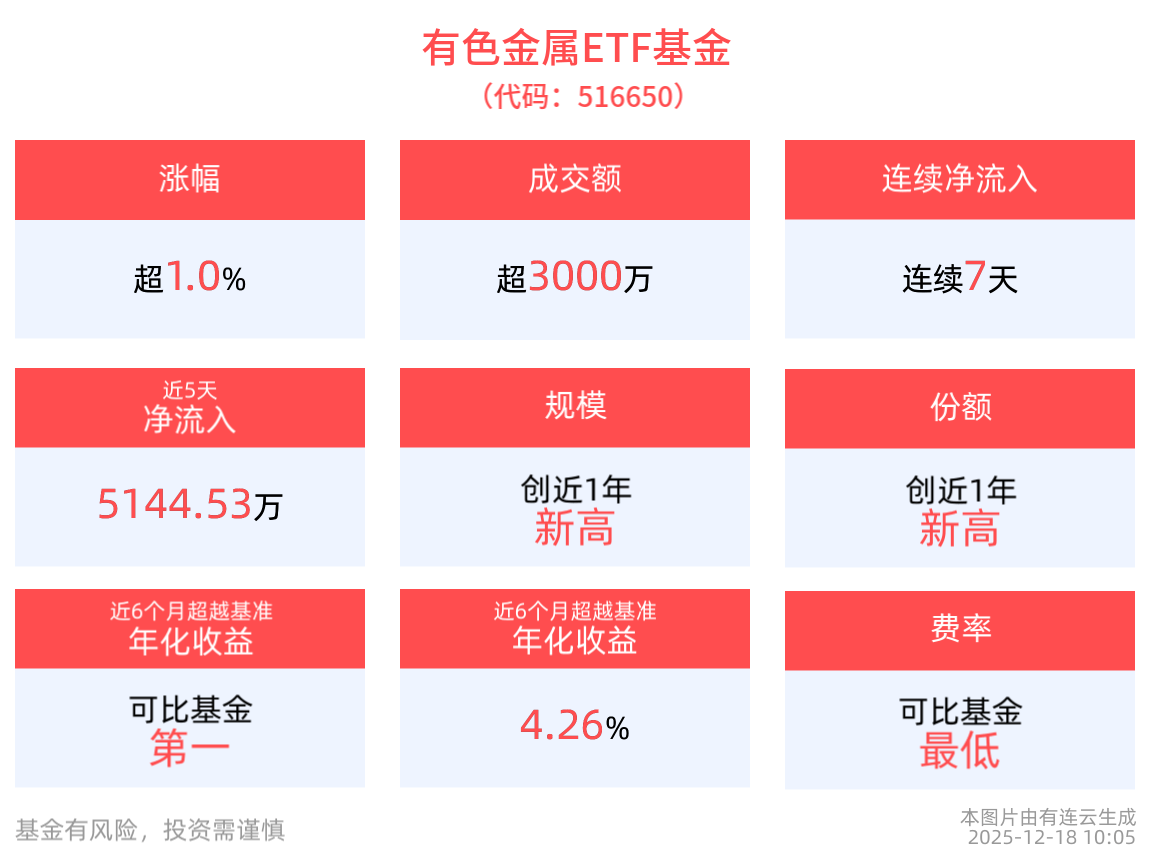
份额规模均创新高,有色金属ETF基金(516650)连续7天吸金1.44亿
Sou Hu Cai Jing· 2025-12-18 02:35
Core Insights - The recent rise in precious metals, including gold, silver, and copper, has positively impacted various ETFs, particularly the gold and non-ferrous metal ETFs [2] - The non-ferrous metal ETF (516650) has seen a continuous inflow of funds over the past week, totaling 144 million yuan, reaching a record high in both share count and total assets [2] - The ETF closely tracks the CSI sub-index for the non-ferrous metal industry, with the top ten weighted stocks accounting for 52.65% of the index [2] ETF Performance - The gold ETF (518850) increased by 0.13%, while the gold stock ETF (159562) rose by 0.46% [2] - The non-ferrous metal ETF (516650) experienced a 1.09% increase, with notable stock performances including Huaxi Nonferrous (7.01% increase) and Chihong Zinc & Germanium (5.04% increase) [2] - The latest share count for the non-ferrous metal ETF reached 1.391 billion, with a total asset size of 2.417 billion yuan [2] Top Holdings - The top ten weighted stocks in the non-ferrous metal ETF include Zijin Mining, Luoyang Molybdenum, Northern Rare Earth, Huayou Cobalt, and China Aluminum, among others [2] - These stocks are significant contributors to the ETF's performance, reflecting the overall strength of the non-ferrous metal sector [2]