携程集团

Search documents
酒店-供需驱动-结构优化-酒店行业景气度上行
2026-01-20 01:50
Summary of Hotel Industry Conference Call Industry Overview - The hotel industry is experiencing an upward trend driven by supply-demand dynamics and structural optimization, with a significant mismatch in supply and demand in 2023 due to a post-pandemic demand surge while supply lagged behind, leading to increased Average Daily Rates (ADR) [1][2] - The chain hotel rate in China is approximately 40%, lower than over 70% in the U.S., indicating potential for growth in the chain hotel segment, particularly in the economy sector [1][10] Key Insights - **Supply and Demand Dynamics**: The pandemic caused a significant reduction in hotel supply, with recovery to pre-pandemic levels only occurring in 2023 and 2024. The mismatch in supply and demand has led to a notable increase in ADR, attracting single hotels back into the market, which disrupts the chain rate [2][4] - **Challenges Facing the Industry**: The hotel industry faces challenges such as oversupply, deteriorating operations, and intense competition. Single hotels are heavily reliant on Online Travel Agencies (OTAs) for customer acquisition, facing high commission rates, while large chain hotels are reducing dependence on OTAs through proprietary channels [5][6][8] - **Investor Sentiment**: Despite low returns, investors are attracted to the hotel industry due to stable cash flows, reasonable payback periods (5-6 years, with some regions achieving 4 years), and opportunities for property transformation [5][9] Performance of Major Brands - **Huazhu Group**: The group operates approximately 11,000 to 12,000 stores, with improvements in RevPAR for its economy brands (Hanting, Haiyou) and mid-to-high-end brand (Quanjing) in Q4 2026. However, most other brands have not shown recovery, indicating that the recovery is not widespread across the industry [12][14] - **Investment Returns**: There are significant differences in returns when investing in different hotel brands. For instance, Quanjing has shown higher premiums compared to Jinjiang's Vienna brand, which has performed poorly [13] Future Trends and Recommendations - **Chain Rate Trends**: The chain rate is expected to continue growing, particularly in the luxury and mid-to-high-end segments, while the economy segment may see a decline due to the influx of single hotels [4][9] - **Impact of Policy Changes**: Upcoming policy changes, such as the potential expansion of holiday systems, are expected to positively impact travel and hotel demand, creating more opportunities for the industry [17] - **Recommendations for Investors**: Focus on large chain brands like Huazhu, which have shown strong growth potential. However, due to Huazhu not being available on the Hong Kong Stock Connect, investors are recommended to consider Shoulv, which is showing positive trends [18][19] Conclusion - The hotel industry is in a stabilization phase, with signs of recovery in select brands. However, the overall recovery is not expected to be uniform across the industry, and competition is likely to intensify as single hotels engage in price wars. Investors should prioritize large chain brands with strong growth momentum for future investments [20]

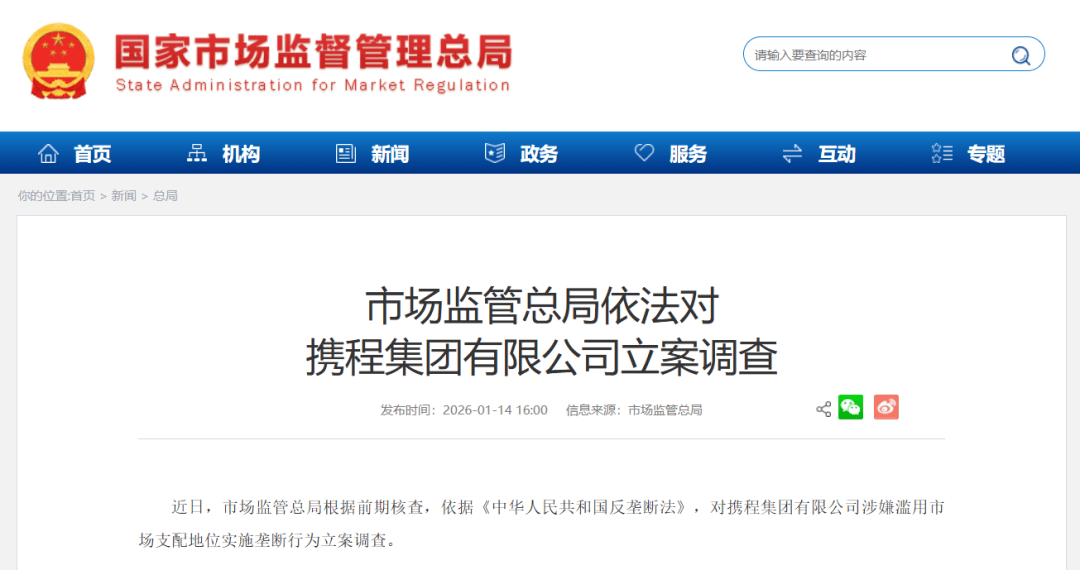
携程,被立案调查!
Sou Hu Cai Jing· 2026-01-19 10:14
Core Viewpoint - The State Administration for Market Regulation has initiated an investigation into Ctrip Group for suspected monopolistic behavior due to abuse of market dominance [3][14]. Group 1: Investigation Details - The investigation is based on prior checks and is conducted under the Anti-Monopoly Law of the People's Republic of China [3]. - Ctrip has been previously warned multiple times for practices such as unauthorized price changes and setting unreasonable trading conditions [10]. - In August 2025, the Guizhou Provincial Market Supervision Administration held a meeting with Ctrip and other travel platform companies to address price irregularities and potential issues like "choose one from two" practices [11]. - In September 2025, the Zhengzhou Market Supervision Administration conducted an administrative interview with Ctrip for unreasonable restrictions on transaction prices and practices [12]. - In December 2025, the Yunnan Provincial Tourism Homestay Industry Association initiated anti-monopoly protection efforts against online travel agencies, citing Ctrip's unfair trading conditions [13]. Group 2: Company Response - Ctrip has acknowledged the investigation and stated it will cooperate with regulatory authorities while ensuring normal business operations [15]. - The company emphasizes its commitment to providing quality services to users and partners [15].


以反垄断执法促平台经济创新和健康发展
Zhong Guo Jing Ji Wang· 2026-01-19 05:51
Group 1 - The central government emphasizes the importance of balancing development and regulation in the platform economy, aiming to enhance the governance system and regulatory standards [1] - The State Administration for Market Regulation has initiated an investigation into Ctrip Group for alleged monopolistic behavior, marking a significant step in promoting fair competition in the digital market [1][2] - The investigation reflects the government's strong stance against monopolistic practices and its commitment to creating a fair competitive environment for various business entities [2] Group 2 - The online travel and accommodation industry is a crucial sector within the platform economy, facing issues such as forced exclusive partnerships and price manipulation, which have raised public concern [3] - The platform economy ecosystem consists of platform enterprises, operators, and consumers, with the need for platforms to consider the interests of all stakeholders to ensure sustainable development [3] - The investigation serves as a response to long-standing concerns and aims to foster a win-win ecosystem that promotes healthy development in the platform economy [3] Group 3 - The revised Anti-Monopoly Law in 2022 includes "encouraging innovation" as a legislative goal, aiming to shift large platform enterprises from a focus on scale to one on technological innovation and service optimization [4] - Effective antitrust enforcement is crucial for breaking down monopolistic barriers and preventing companies from stifling innovation through their advantages [4] - The investigation seeks to uncover potential monopolistic behaviors in the online travel industry, aiming to create a more diverse and inclusive innovation ecosystem [4]
贾国龙再发声:“从来不存在两岁的西蓝花”;马斯克向OpenAI微软索赔千亿美元;欧盟多国考虑对930亿欧元美国商品加征关税...
Sou Hu Cai Jing· 2026-01-19 02:25
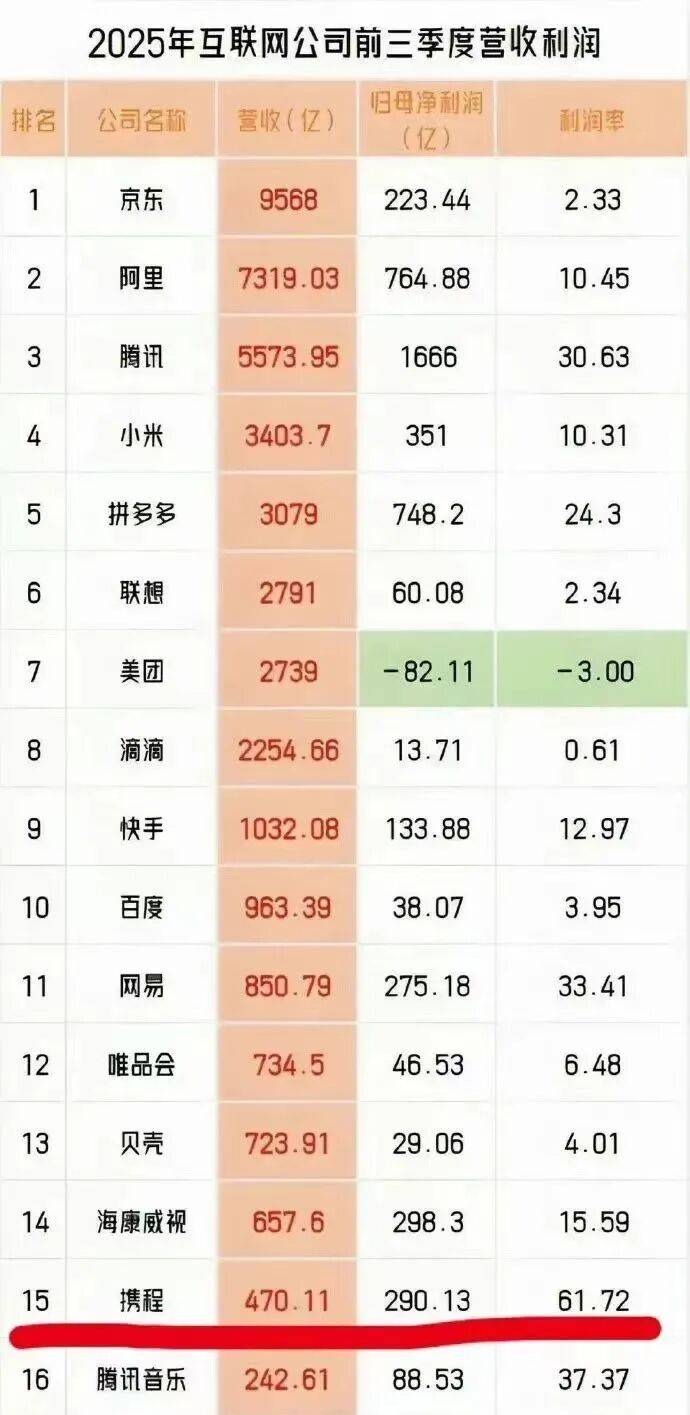
Group 1: Internet Company Revenue and Profit - JD.com leads the revenue chart with 956.8 billion, followed by Alibaba at 731.9 billion and Tencent at 557.4 billion [1] - Alibaba's net profit stands at 76.5 billion, significantly higher than JD.com's 22.3 billion, while Tencent shows a strong profit of 166.6 billion [1] - The profit margin for Tencent is notably high at 30.63%, compared to Alibaba's 10.45% and JD.com's 2.33% [1] Group 2: Market Trends and Insights - The data indicates a competitive landscape among major internet companies, with varying revenue and profit margins suggesting different business strategies and operational efficiencies [1] - The significant profit margins of Tencent may indicate a focus on high-margin services, while JD.com and Alibaba are still scaling their operations [1] Group 3: Financial Performance Overview - The overall financial performance of the top internet companies reflects a diverse range of growth strategies, with some companies prioritizing revenue growth while others focus on profitability [1] - The financial results for the third quarter of 2025 highlight the ongoing evolution of the internet sector in China, with implications for future investment opportunities [1]


盘前必读丨2025年国民经济运行数据将公布;容百科技涉嫌误导性陈述被立案
Di Yi Cai Jing· 2026-01-18 23:19
Group 1 - The A-share market is expected to maintain a slow bull trend, with a focus on high growth or improved performance during the concentrated disclosure period of annual performance forecasts in late January [1][17] - The current A-share market is driven by both technology and cyclical sectors, suggesting investors should maintain confidence and allocate resources wisely [17] - The market has entered the second phase of spring volatility, with a shift towards validating annual performance, particularly in growth sectors with high prosperity and earnings elasticity [17] Group 2 - The State Council is taking measures to boost consumption and ensure the payment of wages to migrant workers, which may positively impact economic activity [6] - The People's Bank of China has adjusted the minimum down payment ratio for commercial housing loans to no less than 30%, which could influence the real estate market [6] - The Ministry of Finance has extended tax incentives for public rental housing construction and operation until December 31, 2027, which may support the housing sector [7]


湾财周报 | 大事记 “广货行天下”开门红;央行发大礼包;携程被立案调查
Nan Fang Du Shi Bao· 2026-01-18 15:11
Group 1 - The "Guanghuo Hang Tianxia" spring campaign launched in Guangdong, with over 1,300 local appliance companies participating, aiming to boost sales through online and offline promotions [5] - The campaign will feature 12 synchronized promotional events throughout the first quarter, targeting over 6,000 enterprises to enhance online sales of quality products [5] Group 2 - The People's Bank of China announced eight major policy measures to support economic transformation, including a 0.25 percentage point reduction in various structural monetary policy tool rates and a special relending quota of 1 trillion yuan for private enterprises [6] - The measures also include increasing relending quotas for technological innovation to 1.2 trillion yuan and lowering the minimum down payment for commercial housing to 30% [6] Group 3 - In 2025, the national real estate market continued to adjust, with new residential sales area declining by 4.9% year-on-year to approximately 390 million square meters, and sales value dropping by 10% to around 5.4 trillion yuan [7] - The total transaction volume of new and second-hand residential properties reached 839 million square meters, indicating stable demand from residents [7] Group 4 - Zeekr Automotive clarified its cross-year vehicle purchase tax subsidy policy, stating that it has covered the tax subsidy for 8,125 users who placed orders in 2025 and received their vehicles in January 2026 [9] - The confusion arose from the overlap of two policies, leading to misinterpretations regarding payment and vehicle delivery [10] Group 5 - The State-owned Assets Supervision and Administration Commission disclosed the 2024 salary information for over 80 central enterprise leaders, showing a stable salary range without extreme high salaries [11] - The top earners are primarily from telecommunications and energy sectors, with China Mobile's former chairman leading at a pre-tax salary of 1.2582 million yuan [11] Group 6 - The State Administration for Market Regulation has initiated an antitrust investigation into Trip.com Group for suspected monopolistic behavior [12] - Trip.com has committed to cooperating with the investigation and ensuring normal business operations [12] Group 7 - IKEA announced the closure of its Guangzhou Panyu store, raising questions about the future of its 40,000 square meters of self-owned property [13] - IKEA is currently evaluating arrangements for the asset and will comply with relevant laws and regulations [13] Group 8 - CHALI Tea clarified rumors regarding a 200 million yuan salary debt, admitting to cash flow pressures due to strategic missteps in bottled tea, while assuring that its core bagged tea business remains operational [16] - The company is addressing salary issues for departing employees in batches, although some employees have expressed ongoing concerns about unpaid wages [16] Group 9 - The white wine market is experiencing a price decline, influenced by the price adjustments of flagship products like Moutai, leading to a broader price reduction across various brands [15] - The industry is facing inventory pressures, prompting some distributors to lower prices to stimulate sales, indicating a shift towards a "price for volume" strategy [15]

学生寒假引爆“春节档”预订,第一批“抢跑”春节档的学生已出发
Xin Lang Cai Jing· 2026-01-18 14:04
Core Insights - The travel market is heating up as the winter vacation and the 2026 Spring Festival holiday approach, with students starting to travel early for the holiday season [1][3] Group 1: Travel Trends - The first wave of travelers includes university students taking advantage of the winter break, leading to a noticeable increase in flight bookings, particularly among the 18-22 age group, which saw a nearly 30% week-on-week increase [3] - Data from Qunar indicates that flight bookings for the period from January 12 to January 19 have significantly increased, with a 20% rise in travelers flying out as the winter break begins [3][7] - The trend of early travel for the Spring Festival is evident, with many families and students opting for trips during the winter break, leading to a surge in bookings for family-oriented travel products [3][4] Group 2: Booking Statistics - Hotel bookings for popular cities during the Spring Festival have increased by 70% year-on-year, with family travel making up over 30% of the bookings [4][7] - The demand for vacation rentals has surged, with bookings for standalone villas increasing by 77% year-on-year, indicating a preference for larger accommodations [5] - The average length of stay for vacation rentals has exceeded 12 days, with a 35% increase in bookings for stays of 7 days or more, reflecting a trend towards longer, more planned vacations [6] Group 3: Family Travel Dynamics - Families are becoming the core demographic for travel during the Spring Festival, with over half of domestic travel bookings on Ctrip being for family trips [11] - The age group of 30-50 years is the primary market for travel, accounting for 45% of flight bookings, while children and teenagers represent 23% of ticket purchases [11][12] - The popularity of theme parks and cultural venues is rising, with ticket bookings for attractions like Shanghai Disneyland and Beijing Universal Resort seeing significant increases [12][13] Group 4: International Travel - The outbound travel market is experiencing notable growth, particularly to Southeast Asia, with a 45% increase in long-haul travel bookings [10][14] - The number of inbound tourists during the Spring Festival has doubled compared to last year, with significant interest from countries like Malaysia, South Korea, and Japan [14]

携程将面临怎样的处罚
Zhong Guo Qing Nian Bao· 2026-01-18 11:34
Group 1 - The core issue revolves around Ctrip facing potential penalties due to antitrust investigations, with estimates suggesting fines could range from 533 million to 5.33 billion yuan based on 2024 revenue, and possibly exceeding 6.5 billion yuan when considering 2025 projections [1] - The focus should not only be on the fines but also on the legal responsibilities that may require Ctrip to alter its current profit model and rules, as well as the potential for confiscation of illegal gains, which could exceed the fines calculated based on sales revenue [1] - The complexity of calculating "illegal gains" is highlighted, as distinguishing between illegal and legal income poses significant challenges, with past antitrust cases showing a lack of precedents for confiscating platform companies' illegal gains [1] Group 2 - From a legal perspective, Ctrip may be involved in three types of market dominance abuse related to small and medium-sized merchants, including unfair pricing practices and unreasonable transaction conditions, particularly concerning its pricing assistant mechanism and high commission rates [2] - Ctrip's practices may also violate consumer protection laws, such as imposing unreasonable conditions on transactions and differential treatment of trading partners under similar conditions [2]
服务消费政策加码,关注结构性投资机会:消费者服务行业周报(20260112-20260116)-20260118
Huachuang Securities· 2026-01-18 09:06
Investment Rating - The report maintains a "Recommendation" rating for the consumer services industry, indicating an expectation that the industry index will exceed the benchmark index by more than 5% in the next 3-6 months [45]. Core Insights - The State Council's recent meeting emphasized the implementation of consumption-boosting policies, which are expected to enhance the strategic position of service consumption as a key driver of domestic demand and economic growth [4][5]. - The report highlights the government's support for new business models and quality service supply, particularly in sectors like culture, tourism, and sports, which are seen as areas with significant growth potential [4]. - The anticipated policies are expected to release consumer spending potential in leisure and tourism, providing substantial benefits to the industry [4]. - The consumer services sector showed a weekly increase of 1.53%, outperforming the overall market indices, with notable performances from companies like Haidilao and Alibaba [7][19]. Industry Data - The consumer services industry consists of 55 listed companies with a total market capitalization of approximately 498.8 billion yuan and a circulating market value of about 457.1 billion yuan [1]. - The absolute performance of the industry over the past month was -7.7%, while the relative performance was -6.9% compared to the benchmark [2]. Market Performance - The consumer services sector's weekly performance was 1.53%, compared to a decline of 0.57% for the CSI 300 index and a 0.51% increase for the overall A-share market [7]. - The report notes that the sector's stocks, such as Haidilao and Alibaba, have shown significant gains, indicating a positive market sentiment towards the consumer services industry [4][19]. Upcoming Events - Several companies in the consumer services sector are scheduled to hold shareholder meetings in the coming month, including Dalian Shengya on February 2, Qujiang Cultural Tourism on January 22, and Chuangye Heima on January 21 [26].
大数据“杀熟”再引争议,“看人下菜碟”式价格歧视该休矣!
凤凰网财经· 2026-01-17 13:00
Core Viewpoint - The online travel industry leader, Ctrip, is facing multiple crises, including a wrongful termination notice, an antitrust investigation, and allegations of price discrimination through data manipulation, reflecting a broader consumer discontent with internet platforms [4][5]. Group 1: Pricing Discrimination Issues - Consumers have reported experiences of price discrimination, such as significant price differences between accounts or devices, abnormal price increases after repeated searches, and higher prices for long-term users compared to new users [4]. - The algorithmic pricing strategy employed by platforms like Ctrip is a form of price discrimination based on user characteristics, utilizing big data to analyze consumer habits and willingness to pay [4][5]. - Traditional economic theories suggest that reasonable price discrimination can expand market size and efficiency, benefiting both producers and consumers, as seen in practices like discounted afternoon tea in Hong Kong [4]. Group 2: Algorithmic Pricing and Market Dynamics - In the context of platform economies, algorithmic pricing has deviated from optimizing resource allocation and has become a tool for platforms to exploit information asymmetry, leading to consumer trust erosion [5][6]. - Consumers often lack a clear understanding of how pricing mechanisms work, while platforms leverage their data advantages to implement dynamic pricing that consumers may not notice, undermining fairness in the digital market [5]. - Examples of pricing anomalies include varying delivery fees based on smartphone brand and model, and ride-hailing prices that increase based on the user's phone battery level, indicating a shift from efficiency tools to profit extraction mechanisms [6]. Group 3: Regulatory Response and Industry Implications - The Chinese government has initiated regulatory measures, including the issuance of guidelines to standardize pricing behaviors on internet platforms, aiming to protect consumer and operator rights [6]. - Ctrip's recent investigation is not an isolated incident but signals a critical industry-wide issue regarding algorithmic pricing practices, emphasizing the need for transparency and fairness in pricing strategies [6]. - The long-term value of a business is rooted in consumer trust, and sacrificing this trust for short-term gains can undermine the foundation of the digital economy [6].