
南山智尚

Search documents
这项投资火了!年内浮盈超20%
中国基金报· 2025-07-01 12:35
Core Viewpoint - In the first half of 2025, public funds actively participated in private placements, with a total allocation exceeding 10.941 billion yuan and an overall floating profit margin exceeding 20% [2][3][4] Group 1: Participation and Performance - A total of 23 public fund institutions participated in 38 A-share companies' private placements, with a total allocation amounting to 10.941 billion yuan [4] - The current floating profit amount reached 2.443 billion yuan, with a floating profit margin of 22.33% [4] - Among the participating institutions, 21 achieved floating profits, with 12 institutions reporting margins of no less than 20% [4] Group 2: Individual Fund Performance - Yimi Fund participated in three private placements, achieving a floating profit margin of 47.60% [5] - Donghai Fund's participation in four placements resulted in a floating profit margin of 39.15% [5] - Notable funds like Nuode Fund and Caitong Fund reported floating profit margins of 21.22% and 23.15%, respectively [6] Group 3: Sector Focus - The basic chemical industry attracted significant attention, with five stocks receiving a total allocation of 1.861 billion yuan [7] - Companies like Leshan Electric Power achieved a remarkable floating profit margin of 177.84%, attracting multiple public fund institutions [7] Group 4: Market Outlook - The recovery of the private placement market is attributed to policy support and market conditions, with increased demand for capital expenditures from companies in various sectors [9][10] - Key sectors to watch in the second half of the year include humanoid robots, artificial intelligence, innovative pharmaceuticals, and solid-state batteries [10]


人形机器人灵巧手行至何处
Zheng Quan Zhi Xing· 2025-07-01 02:34
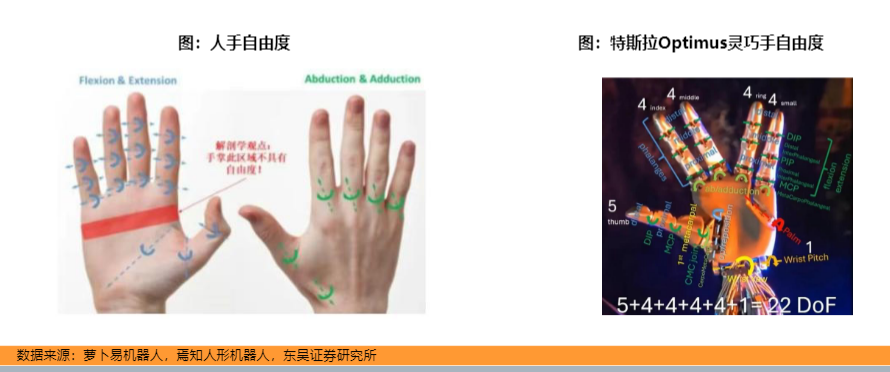
Core Insights - The development of dexterous hands is crucial for humanoid robots, serving as the "last centimeter" in their transition from rigid execution to intelligent interaction [1] - Tesla's Optimus humanoid robot, equipped with a 22-degree-of-freedom dexterous hand, is entering trial production, aiming for mass production of thousands by 2025, marking a significant milestone in the commercialization of this technology [1][3] Industry Overview - The global market for dexterous hands is projected to exceed $1.7 billion in 2024 and approach $2 billion in 2025, driven by the demand for humanoid robots [3] - The cost of dexterous hands currently accounts for approximately 17% of the total cost of humanoid robots, highlighting its role as a critical bottleneck for performance breakthroughs [3] Technological Advancements - The transition from simple two-finger grippers to humanoid multi-finger structures is being driven by increasing industrial demands for precision [3] - Innovations in drive solutions, such as the use of brushless gear motors and hybrid designs, are being explored to balance cost and torque requirements [7] - The integration of multi-modal sensors, including six-dimensional force sensors and flexible electronic skin, is enhancing the sensory capabilities of dexterous hands, allowing for near-human-level performance in tasks like assembly and adaptive grasping [8] Material Innovations - The use of ultra-high molecular weight polyethylene (UHMWPE) fibers is becoming mainstream for tendon systems, offering significant strength and durability advantages [10] - Chinese companies are rapidly advancing in the development of tendon systems, with innovations in anti-creep technology and self-lubricating coatings [11] Competitive Landscape - The supply chain for dexterous hands is evolving, with companies like Nanshan Zhishang and Tongyizhong entering the market with competitive products [11][14] - The upcoming mass production of Tesla's Optimus will serve as a critical test for the durability and reliability of these technologies in real-world applications [12]


深海科技:海洋强国战略的关键支柱产业赛道投资图谱
Tianfeng Securities· 2025-06-29 07:16
Group 1 - The ocean economy is a significant driver of GDP growth, with the national marine production value expected to exceed 10 trillion yuan in 2024, accounting for 7.8% of the GDP, and contributing 11.5% to economic growth [1][8] - The government has highlighted "deep-sea technology" in its reports, indicating its importance alongside commercial aerospace and low-altitude economy, suggesting a rapid development potential in deep-sea equipment and exploration [1][8] - The deep-sea technology sector is identified as a key pillar for building a maritime power, encompassing three main areas: deep-sea materials, deep-sea equipment manufacturing, and deep-sea digital applications [3][17] Group 2 - Various provinces and cities are accelerating the development of marine economy, with policies focusing on high-end, intelligent, and green development, and establishing multi-level industrial systems [2][13] - Shanghai's marine industry development plan (2025-2035) proposes a "3+5+X" industrial system, while Guangdong's regulations emphasize support for eight emerging marine industry clusters [2][14] - The deep-sea materials sector is crucial for deep-sea technology, involving structural and buoyancy materials necessary for the development of marine resources, with a focus on high-performance steel, alloy materials, and composite materials [3][21] Group 3 - The deep-sea equipment sector is essential for supporting deep-sea development, facing challenges from complex underwater environments, with significant growth in China's shipbuilding industry, which saw a 13.8% increase in completed shipbuilding volume in 2024 [4][26] - The deep-sea digitalization and intelligence sector is a vital direction for deep-sea technology development, aiming to create a "digital ocean" that enhances marine decision-making and governance through advanced information technologies [5][17] - The report suggests focusing on marine engineering equipment manufacturing, marine equipment components, and marine observation instruments as key areas for investment [4][26]




“纺织业”项目破冰?HM面料商福恩股份IPO获受理,年分红超3亿藏争议
Hua Er Jie Jian Wen· 2025-06-28 03:41
Core Viewpoint - The IPO application of Hangzhou Fuen Co., Ltd. marks the first textile industry IPO in the A-share market after a two-year hiatus, indicating a potential recovery in the sector [2][6]. Company Summary - Fuen Co. specializes in regenerated fabrics, serving major clothing brands like HM and Uniqlo [2][10]. - The company's revenue and net profit for 2024 are projected to be 1.813 billion and 275 million respectively, remaining stable compared to 2022 [2][19]. - Fuen plans to raise 1.25 billion for expanding fabric production capacity [2]. Financial Performance - Fuen's 2022 cash dividend of 381 million was 138% of its net profit, raising concerns about compliance with IPO regulations [3][15]. - The company’s revenue from regenerated fabrics was 1.317 billion, 1.206 billion, and 1.5 billion from 2022 to 2024, accounting for 70-80% of total revenue [9]. - Compared to 47 A-share textile companies, Fuen's 2024 revenue and net profit rank 21st and 13th respectively [7]. Market Context - The textile sector faced challenges in 2023, with previous IPO applications from companies like Beijiang Zhili and Zhejiang Zhongding being withdrawn [5][6]. - Major clients like HM and Zara are reducing store numbers, which may impact Fuen's future performance [12][13][20]. - The global trend towards sustainable materials presents growth opportunities for Fuen, as major brands aim for eco-friendly sourcing by 2030 [12][13]. Regulatory Environment - Recent regulatory changes have scrutinized "clearance-style" dividends before IPOs, which could affect Fuen's application due to its high dividend payout relative to net profit [15][18].
【重磅深度】灵巧手持续迭代,关注技术路线收敛中的边际增量
东吴汽车黄细里团队· 2025-06-27 15:44
Core Viewpoint - The dexterous hand market is expected to grow significantly, reaching $1.706 billion in 2024 and projected to increase to $1.921 billion in 2025 and $3.036 billion by 2030, driven by the demand for humanoid robots that require more advanced dexterous hands with higher degrees of freedom [2][11]. Market Overview - The dexterous hand market is anticipated to reach 760,100 units in 2024, with projections of 861,800 units in 2025 and 1,412,100 units by 2030, reflecting a compound annual growth rate (CAGR) of 10.38% and 9.59% respectively [28][29]. Driving Solutions - The mainstream driving solutions include underactuated, external/mixed, and electric drives, with a shift from hollow cup motors to brushless gear motors. Underactuated designs sacrifice precision for cost reduction and faster deployment, while electric drives are favored for their modular design and high precision [3][11][45]. - Tesla's third-generation dexterous hand has replaced some hollow cup motors with brushless gear motors, indicating a potential shift in motor solutions [3][11]. Transmission Solutions - Transmission solutions encompass gear/worm gear, linkages, screws, and tendon-driven systems, each with its advantages and disadvantages. The tendon + screw composite transmission can enhance transmission precision while maintaining flexibility, exemplified by Tesla's third-generation dexterous hand [4][5][51]. Perception Solutions - Multi-modal perception is a defined trend, with force/torque sensors evolving towards strain gauge types and flexible sensors focusing on enhancing sensitivity and stability. MEMS pressure sensors, particularly resistive types, are becoming more prevalent in dexterous hand applications [6][66][74]. Industry Trends - Both domestic and international products are increasingly pursuing high degrees of freedom and multi-modal perception, highlighting the industry's development trends. Investment recommendations include companies involved in reducers and screw chains, such as Fuda Co., Zhejiang Rongtai, and Wuzhou Xinchun [8][11]. Future Outlook - The iteration of Tesla's dexterous hand clearly indicates a mainstream shift towards tendon-driven systems, achieving a doubling of degrees of freedom, transmission upgrades, drive switching, and breakthroughs in multi-modal perception [7][11].



1.95亿元资金今日流入纺织服饰股
Zheng Quan Shi Bao Wang· 2025-06-27 09:58
Market Overview - The Shanghai Composite Index fell by 0.70% on June 27, with 18 out of the 28 sectors rising, led by non-ferrous metals and communications, which increased by 2.17% and 1.79% respectively. The textile and apparel sector ranked third in terms of gains [1] - The banking and public utilities sectors experienced the largest declines, with drops of 2.95% and 1.01% respectively [1] Capital Flow Analysis - The main capital flow showed a net outflow of 19.41 billion yuan across the two markets, with 8 sectors seeing net inflows. The communications sector led with a net inflow of 2.579 billion yuan and a daily increase of 1.79%, followed by the electronics sector with a net inflow of 2.435 billion yuan and a daily increase of 0.92% [1] - Conversely, 23 sectors experienced net outflows, with the computer sector leading at 6.630 billion yuan, followed by the defense and military industry with a net outflow of 2.891 billion yuan. Other sectors with significant outflows included basic chemicals, automotive, and electrical equipment [1] Textile and Apparel Sector Performance - The textile and apparel sector rose by 1.23% today, with a net inflow of 195 million yuan. Out of 105 stocks in this sector, 84 stocks increased, including 6 that hit the daily limit, while 17 stocks declined [2] - The top three stocks with the highest net inflow in the textile and apparel sector were Jihua Group with 288.94 million yuan, followed by Feiyada and Jinyi Culture with 165.18 million yuan and 101.35 million yuan respectively [2] - The sector also saw significant outflows, with Wanlima leading at 241.76 million yuan, followed by Bangjie Shares and Nanshan Zhishang with outflows of 35 million yuan and 24.74 million yuan respectively [3]


人形机器人行业深度报告:灵巧手持续迭代,关注技术路线收敛中的边际增量
Soochow Securities· 2025-06-27 07:32
Investment Rating - The report recommends "Buy" for companies involved in the reduction gear and screw chain sectors, specifically highlighting 福达股份 (Fuda Co.), and suggests attention to micro screw chain companies like 浙江荣泰 (Zhejiang Rongtai), 五洲新春 (Wuzhou Xinchun), and 震裕科技 (Zhenyu Technology) [90][92]. Core Insights - The downstream scenarios are driving the evolution of dexterous hands towards humanoid hands, with a broad market outlook. The dexterous hand market is expected to reach USD 1.706 billion in 2024, growing to USD 1.921 billion in 2025 and USD 3.036 billion by 2030 [2][20]. - The report identifies the main driving solutions as underactuated, external/mixed, and electric drives, with a shift from hollow cup motors to brushless gear motors [2][35]. - The transmission solutions include gear/worm gear, linkages, screws, and tendon-driven systems, each with its advantages and disadvantages, with a trend towards tendon and screw combinations for improved flexibility and precision [2][39][49]. - Multi-modal perception is established as a trend, with advancements in force/torque sensors, flexible sensors, and MEMS pressure sensors [2][59][65]. Summary by Sections 1. Dexterous Hands: The Interface Between Humanoid Robots and the External World - Dexterous hands are a type of end effector that replaces traditional tools with claws, evolving from two-fingered to five-fingered humanoid designs to meet complex application requirements [11][12]. 2. Diverse Dexterous Hand Solutions, Routes Still Unconsolidated - Dexterous hands can be categorized by degrees of freedom, drive structure, and sensing technology, with underactuated designs being more prevalent due to lower costs and broader applications [17][24][30]. 3. Future Trends from Tesla's Dexterous Hand Iteration - Tesla's third-generation dexterous hand has doubled its degrees of freedom to 22, with significant changes in motor and transmission solutions, indicating a trend towards higher flexibility and precision [84][87].
通用设备行业:杭州人形机器人大会所见、所想 补贴驱动 硬件的变化开始以量产为目标
Xin Lang Cai Jing· 2025-06-25 06:39
Group 1 - The humanoid robot industry is transitioning from a growth phase to an explosive growth phase, with disruptive innovations expected to drive global stock market growth by three times by 2030, with a projected annual growth rate of 42% [1] - The Hangzhou government is providing significant support for the humanoid robot industry through various policies, including subsidies for R&D, incentives for enterprise establishment, production expansion support, and collaborative industry chain initiatives [1] Group 2 - Current humanoid robots face significant challenges in battery life, with multiple manufacturers exploring solutions such as lightweight PEEK materials, tendon-driven technology, and high-performance batteries to improve energy efficiency and extend operational time [2] - The exhibition showcased a variety of dexterous hand manufacturers, indicating a growing diversity in product offerings, with a focus on independent large models rather than edge models, highlighting the high barriers to entry in this segment [3] Group 3 - Investment recommendations include focusing on lightweight solutions with companies like Weike Technology and Hengbo Co., dexterous hand solutions with companies like Dechang Motor Holdings and Zhejiang Rongtai, and mainframe and module manufacturers such as Hengli Hydraulic and Zhenyu Technology [3]
三星计划于2026年安装2nm设备|首席资讯日报
首席商业评论· 2025-06-25 03:47
Group 1 - Da Yao Beverage responded to rumors of KKR acquiring 85% stake, stating "no comment" [1] - If the acquisition is confirmed, it would indicate a shift from IPO plans to private equity, leveraging KKR's resources for expansion [2] Group 2 - Starbucks China emphasized the growth opportunities in the market and is evaluating the best ways to capture future growth, with a business valuation of approximately $5 to $6 billion [3] - The involvement of local investment firms like Hillhouse Capital and Carlyle Group suggests a strategy to enhance competitiveness through localization [4] Group 3 - Samsung plans to install 2nm equipment at its Taylor factory starting in 2026, after several delays [4] Group 4 - The draft of the Social Assistance Law was presented for review, aiming to strengthen the social safety net and promote social equity [5] - The Food Safety Law amendment focuses on enhancing regulation of liquid food transport and stricter penalties for violations [6][7] Group 5 - R&F Properties has been executed for over 620 million yuan, with a total of over 18.3 billion yuan in outstanding execution cases [8] Group 6 - Prosus, Tencent's largest shareholder, reported a 21% increase in revenue to $6.2 billion, driven by strong e-commerce growth and AI investments [9] - Prosus proposed to double its dividend to €0.2, reflecting positive financial performance [10] Group 7 - Nanshan Zhishang's robot division is focusing on core product development without plans for product exhibitions at upcoming trade shows [11] Group 8 - The cumulative trading volume of the U.S. spot Bitcoin ETF has surpassed $1 trillion since its launch in January 2024 [12] Group 9 - The China Consumers Association called for a ban on extreme eating broadcasts, highlighting the negative impact on public health and consumer behavior [13][14] Group 10 - Amazon plans to invest £40 billion (approximately $54 billion) in the UK over the next three years, creating thousands of jobs [15] Group 11 - A Hong Kong family office managing nearly $4 billion is beginning to invest in cryptocurrencies, indicating a shift in investment strategy towards digital assets [16]

南山智尚:公司机器人负责人将积极参观机器人展会,但暂未有产品展出计划
news flash· 2025-06-24 00:20
Core Viewpoint - Nanshan Zhishang (300918) is focusing on core product development and enhancing product performance testing, while actively participating in robot exhibitions for technology exchange without plans for product showcasing [1] Group 1 - The company’s robot head will actively visit robot exhibitions to focus on cutting-edge dynamics and technology exchange [1] - Currently, the company is concentrating resources to advance the core product development process [1] - The company aims to provide higher quality and more mature products to meet market demands [1]