国泰基金

Search documents
流出超2000亿元!ETF资金迁移路线图曝光
券商中国· 2026-01-18 23:33
Core Viewpoint - The ETF market is experiencing significant internal shifts, with funds moving away from broad-based ETFs towards narrower, higher-volatility products, reflecting a change in investor preferences [2][3]. Group 1: Fund Flows and Market Trends - Over 200 billion yuan has been withdrawn from broad-based ETFs this year, with 9 non-hybrid ETFs experiencing over 10 billion yuan in redemptions each [3]. - The largest stock ETF in China has seen its size drop from 400 billion yuan to 300 billion yuan, while the second-largest has decreased from 300 billion yuan to 200 billion yuan [3]. - In contrast, narrow-based ETFs, cross-border ETFs, and commodity ETFs have attracted significant inflows, with cross-border ETFs growing by 746.32 billion yuan, surpassing the 1 trillion yuan mark for the first time [6]. Group 2: Performance of Different ETF Types - Bond ETFs have shrunk by 810.58 billion yuan, and money market ETFs have decreased by 211 billion yuan since the beginning of the year [5]. - Narrow-based ETFs have gained popularity, with the Southern Nonferrous ETF being the only product to see net inflows exceeding 10 billion yuan, totaling 100.87 billion yuan, driven by rising base metal prices [9]. - The overall market for ETFs with over 100 billion yuan in assets has expanded to 132 products, with 18 industry-specific ETFs attracting over 1 billion yuan each this year [11]. Group 3: Competitive Landscape and Future Outlook - The growth of narrow-based ETFs is reshaping the competitive landscape, with companies focusing on niche sectors seeing significant growth in their ETF management scale [10]. - The current market environment presents a golden opportunity for fund companies to develop narrow-based ETFs, as the investment value in emerging sectors remains largely untapped [11]. - However, there is a concern that narrow-based ETFs may become speculative tools, leading to increased trading frequency and potential volatility in investor returns [12].

半导体相关ETF上涨 行业ETF“吸金”
Zhong Guo Zheng Quan Bao· 2026-01-18 20:45
Group 1: ETF Performance - Semiconductor-related ETFs led the market with weekly gains exceeding 10%, particularly the Penghua Sci-Tech Semiconductor ETF and the Sci-Tech Semiconductor ETF [1] - Aerospace-related ETFs experienced significant declines, with several products, including the Aerospace ETF and the Aerospace ETF Tianhong, dropping over 6% [2] - The top 10 ETFs by net inflow during January 12-16 were predominantly industry ETFs, including software, non-ferrous metals, and media [2] Group 2: Trading Activity - Broad-based ETFs saw active trading, with those tracking the CSI A500 and CSI 300 indices leading in transaction volume [3] - The Huatai-PineBridge CSI 300 ETF recorded a transaction volume of 745.58 billion, while the CSI 500 ETF reached 637.92 billion [3] Group 3: Market Outlook - Morgan Asset Management anticipates that the attractiveness of the A-share market will increase due to a friendly domestic policy environment and a recovery in corporate profits [3] - Guotai Fund suggests that the "anti-involution + technology" theme will continue to dominate, with policies supporting market competition and encouraging R&D investments [4] - Huaxia Fund recommends focusing on high-growth sectors such as AI, gaming, media, software, and chips, while advising caution on previously popular sectors like commercial aerospace [5]
新基金发行加速 多只产品提前结募
Zhong Guo Zheng Quan Bao· 2026-01-18 20:45
Core Viewpoint - The public fund issuance market has shown significant growth since the beginning of the year, characterized by rapid increases in both volume and efficiency, reflecting a recovery in market confidence and changes in product strategies and investor allocation concepts [1][4]. Group 1: Fund Issuance Trends - Over 80 new funds have been launched as of January 18, 2023, marking an increase compared to the same period last year [1]. - In the week from January 12 to January 18, 36 new funds were launched, indicating sustained high demand for new products [1]. - Equity funds, including ordinary stock, mixed, and QDII stock funds, dominate the new fund landscape, accounting for over 70% of total new issuances [1]. Group 2: Focus on Equity Funds - Most newly issued ordinary stock funds are index funds, with only two actively managed funds focusing on technology sectors [2]. - Approximately 40% of active equity funds are sector-focused, targeting areas such as low-carbon economy, manufacturing upgrades, pharmaceuticals, semiconductors, and technology [2]. - In the QDII stock fund category, two new products focus on the Hong Kong market, investing in popular sectors like healthcare and technology [2]. Group 3: Fundraising Efficiency - The efficiency of new fund fundraising has improved, with many equity funds completing their fundraising in just 1 to 3 trading days [3]. - Several funds, including the Penghua CSI Industrial Nonferrous Metals Theme ETF, completed their fundraising in just one day, indicating strong market interest [3]. - The trend of early fundraising closures has become more common, reflecting a shift in market dynamics [3]. Group 4: FOF Product Highlights - FOF products have also seen rapid fundraising, with some funds completing their fundraising in as little as two days, such as the GF Yueying Stable Three-Month Holding Period Mixed FOF, which raised over 3.2 billion yuan [4]. - The Wanji Qi Tai Stable Three-Month Holding Period Mixed FOF reached nearly 2.1 billion yuan in just one day, showcasing the strong demand for these products [4]. Group 5: Underlying Factors for Growth - The surge in new fund issuance is attributed to a combination of policy support, favorable market conditions, increased investor interest, and heightened competition within the industry [5]. - Recent policies have aimed to enhance the scale and proportion of equity investments in public funds, improving registration and issuance efficiency [5]. - The positive performance of the A-share market and expectations of economic recovery have further fueled investor enthusiasm for new fund products [5].
行业竞争激烈 黄金类ETF产品不断优化
Shang Hai Zheng Quan Bao· 2026-01-18 18:40
Core Viewpoint - The gold market is experiencing significant growth, leading to an increase in the scale of related ETFs, with competition among similar products intensifying [1][3]. Group 1: ETF Adjustments - E Fund announced adjustments to its gold ETF, reducing the minimum subscription and redemption units from 300,000 shares to 100,000 shares, and the minimum gold contract from 3,000 grams to 1,000 grams, effective January 19, 2026 [2]. - The ETF will only accept the Au99.99 spot contract from the Shanghai Gold Exchange for physical transactions, enhancing liquidity and execution efficiency [2]. Group 2: Market Competition - The net subscription volume for gold ETFs reached nearly 20 billion shares in 2025, with the Huazhong Gold ETF surpassing 100 billion yuan in scale by January 15, 2026 [3]. - Fund companies are accelerating product optimization, as seen with the Huazhong CSI Hong Kong Gold Industry ETF, which revised its dividend policy to enhance flexibility in profit distribution [3]. Group 3: Industry Dynamics - The gold ETF market is dominated by five major fund companies: Huazhong, E Fund, Bosera, Guotai, and Huaxia, indicating a "Matthew Effect" where the strong continue to grow stronger [4]. - The demand for gold as an asset class is expected to drive long-term growth in gold ETFs, necessitating continuous product optimization by fund companies to enhance competitiveness [4].
ETF互联互通标的扩至364只
Zheng Quan Ri Bao· 2026-01-18 17:17
Core Viewpoint - The recent expansion of the ETF (Exchange-Traded Fund) interconnection marks a significant increase in the number of ETFs available for northbound trading, enhancing investment opportunities for both domestic and international investors [1] Group 1: ETF Interconnection Expansion - On January 19, a total of 98 ETFs were officially included in the northbound trading of the Shanghai and Shenzhen Stock Connect, increasing the total number of products in the "ETF Connect" from 273 to 364, representing a growth of over 30% [1] - The inclusion of more ETFs is expected to enrich the investment options for overseas institutional investors and promote the institutionalization of the A-share market [1] Group 2: Fund Management Perspective - A total of 29 fund companies had products included in the "ETF Connect," with China Asset Management leading with 14 ETFs, followed by E Fund with 10, and FT Fund with 7 [1] - The newly included products cover a wide range of types, including broad-based ETFs and industry-themed ETFs, which are expected to attract significant market attention [2] Group 3: Market Impact and Future Outlook - The expansion of the ETF interconnection is anticipated to enhance the international competitiveness and influence of China's capital market by attracting more professional investors and incremental capital [3] - Since the formal introduction of ETFs into the interconnection mechanism in July 2022, the total trading volume of northbound funds in 2025 is projected to reach 816.58 billion yuan, marking a 76% increase from 2024 [3]

基金周报:国内首只千亿级黄金ETF诞生,沪深北交易所提高融资保证金比例-20260118
Guoxin Securities· 2026-01-18 15:13
- The report does not contain any specific quantitative models or factors related to quantitative investment strategies[3][5][6]
六家机构,研判A股后市
Zhong Guo Zheng Quan Bao· 2026-01-18 14:31
Market Overview - The A-share market is experiencing high volatility with a potential for a stable transition into the second phase of the spring market, supported by favorable factors that have not changed [1][6] - The upcoming earnings announcements are expected to increase the importance of performance indicators, with high-quality companies showing solid fundamentals likely to yield excess returns [1][6] Investment Strategies - The investment focus remains on "anti-involution + technology," with sectors such as AI applications, chemicals, non-ferrous metals, and power equipment gaining attention for their investment value [1][10] - Citic Securities suggests constructing investment portfolios based on "resource + traditional manufacturing pricing re-evaluation," including sectors like chemicals, non-ferrous metals, and new energy [5] - Dongwu Securities emphasizes that the market will focus on performance indicators, with high-quality companies expected to outperform in the latter half of the spring market [6] Regulatory Developments - The People's Bank of China and the National Financial Regulatory Administration have adjusted the minimum down payment ratio for commercial property loans to no less than 30%, allowing local authorities to set lower limits based on local conditions [2] - The China Securities Regulatory Commission is seeking public opinion on the draft regulations for derivative trading, aiming to manage risks and support the development of derivatives for risk management [3] Sector Focus - Open-source Securities highlights three main investment lines: recovery within the technology sector, sectors benefiting from PPI improvements and "anti-involution" policies, and gold and high-dividend assets as long-term holdings [7] - Fortune Fund identifies four main lines for investment: technology sector trends, the impact of Chinese manufacturing going global, cyclical recovery opportunities, and non-bank financial sectors benefiting from RMB appreciation [8] - Huatai-PB Fund anticipates increased attention on resource and energy sectors due to positive domestic and international policy environments, with expectations for improved corporate profitability [9]
ETF周成交超1.28万亿,资金加速“弃宽基追主题”
Di Yi Cai Jing· 2026-01-18 11:23
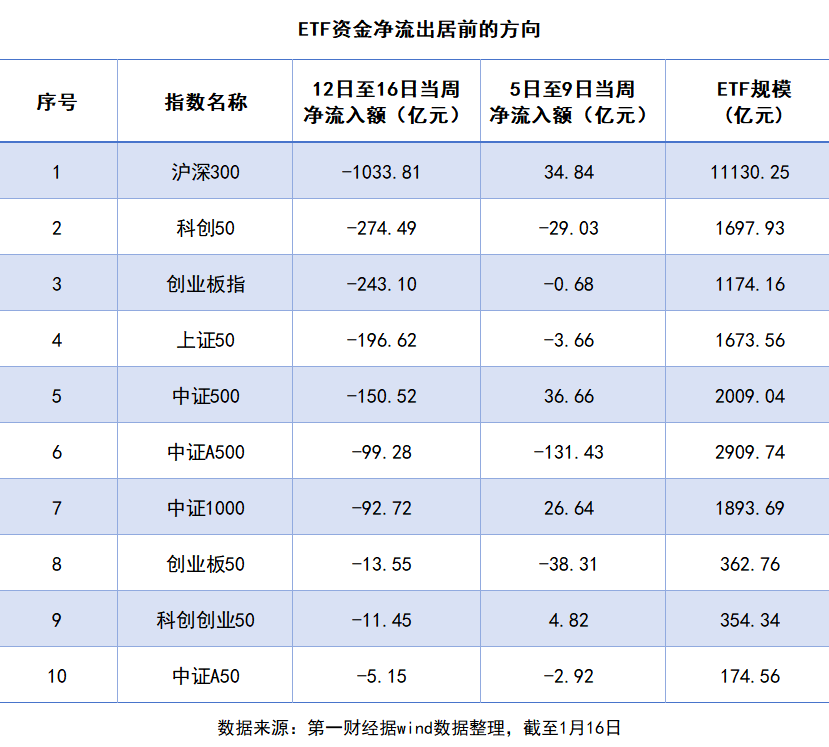
Core Viewpoint - A significant shift in the A-share ETF market has occurred, with over 200 billion yuan withdrawn from core broad-based ETFs and nearly 70 billion yuan flowing into thematic industry ETFs, indicating a potential turning point in market trends [1][2][7]. Group 1: ETF Market Dynamics - From January 12 to 16, over 2 trillion yuan was withdrawn from broad-based ETFs, marking a 15-fold increase compared to the previous week and setting a record for weekly net outflows [2][3]. - The core broad-based ETFs, including the CSI 300 and STAR 50, were the main targets for fund withdrawals, with the CSI 300 ETF alone experiencing a net outflow of over 1 trillion yuan [2][3]. - The total trading volume of stock ETFs reached 1.28 trillion yuan during the same week, the highest in five years, reflecting intense trading activity and rapid fund turnover [7]. Group 2: Thematic ETF Inflows - In contrast to the broad-based ETFs, thematic ETFs saw a net inflow of nearly 70 billion yuan, with 117 products receiving over 1 billion yuan in net subscriptions [3][4]. - Key sectors attracting investment included software, media, and semiconductors, with specific products like the Harvest CSI Software Service ETF receiving a net inflow of 75.43 billion yuan, reaching a record size of 146 billion yuan [3][6]. - The satellite internet sector emerged as a focal point for investment, with six satellite-themed ETFs attracting 74.71 billion yuan in net inflows, highlighting a growing interest in this area [3][4]. Group 3: Market Sentiment and Future Outlook - Analysts suggest that the significant outflows from broad-based ETFs and inflows into thematic ETFs may indicate a healthy market adjustment rather than a downturn, as investors seek more flexible and growth-oriented investment opportunities [7][8]. - The recent regulatory environment is seen as a corrective measure to excessive market speculation, with expectations that market sentiment will improve within a couple of weeks [8]. - The ongoing trend of reallocating funds from broad-based to thematic ETFs reflects a broader shift in investor strategy, moving towards long-term asset allocation rather than short-term trading [9].
黄金ETF近一年吸金规模猛增近3倍
Xin Lang Cai Jing· 2026-01-18 06:11
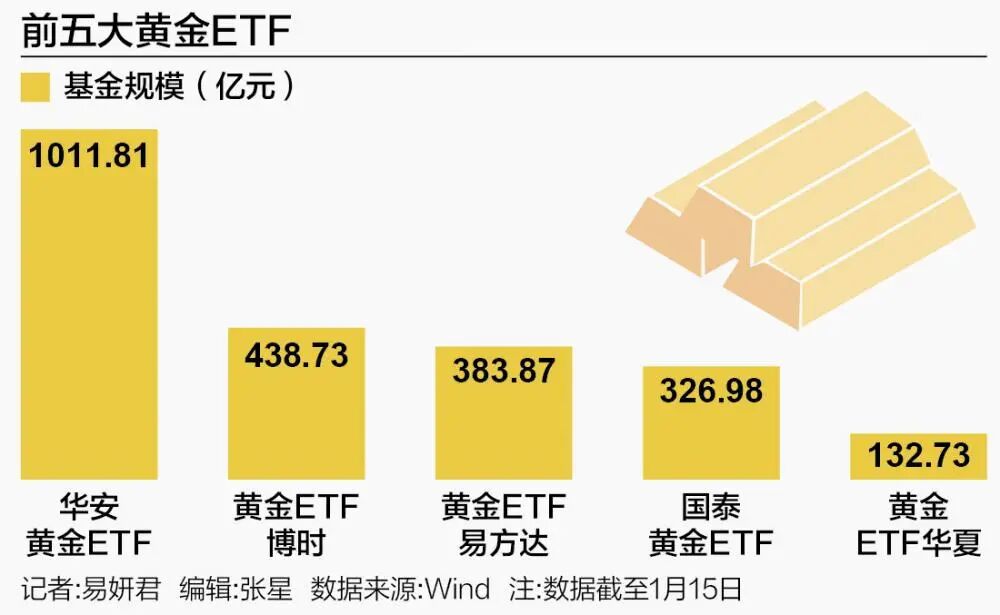
Core Insights - The article highlights the significant growth of gold ETFs in China, particularly the Huaan Gold ETF, which surpassed 100 billion yuan in assets for the first time, reaching 101.81 billion yuan on January 15, 2026 [1][3][15] - The total assets of 14 gold ETFs in the domestic market exceeded 260 billion yuan, marking a nearly threefold increase compared to the previous year [3][15][21] Group 1: Growth of Gold ETFs - The Huaan Gold ETF's assets reached 100.76 billion yuan on January 14, 2026, and continued to grow to 101.81 billion yuan the following day [1][19] - As of January 15, 2026, the total assets of 14 gold ETFs amounted to 2630.61 billion yuan, an increase of over 210 billion yuan from 2415.61 billion yuan on December 31, 2025 [20][21] - Over the past year, the total assets of these gold ETFs increased by more than 190 billion yuan, with a growth rate close to three times [4][21] Group 2: Fund Inflows and Performance - Inflows into gold ETFs have been substantial, with the Huaan Gold ETF, Guotai Gold ETF, and Bosera Gold ETF attracting net inflows of 14.72 billion yuan, 13.78 billion yuan, and 10.86 billion yuan respectively from January 1 to January 15, 2026 [3][18] - The total net inflow for the 14 gold ETFs over the past year was 123.17 billion yuan, with the Huaan Gold ETF leading with 43.79 billion yuan [5][23] - The average return for these gold ETFs exceeded 61% from January 15, 2025, to January 15, 2026, driven by rising international gold prices [6][26] Group 3: Market Dynamics and Future Outlook - The rise in gold prices has been attributed to factors such as declining real interest rates, increased geopolitical risks, and a growing supply-demand gap for gold [7][28] - As of January 16, 2026, spot gold prices approached 4600 USD, reflecting a 6.5% increase since the beginning of the year [9][28] - Fund managers are enhancing liquidity and risk management in response to market conditions, with adjustments to the minimum subscription and redemption units for the gold ETFs [10][29]
黄金ETF近一年吸金规模猛增近3倍
21世纪经济报道· 2026-01-18 05:59
Core Viewpoint - The article highlights the significant growth of gold ETFs in China, driven by rising international gold prices and increased investor interest, with the total scale of gold ETFs surpassing 2600 billion yuan, nearly tripling in a year [1][3][4]. Group 1: Growth of Gold ETFs - As of January 14, 2026, the largest commodity ETF in the domestic market, Huaan Gold ETF, reached a scale of 100.76 billion yuan, marking the first time it surpassed the 100 billion yuan threshold [1]. - By January 15, 2026, the scale of Huaan Gold ETF further increased to 101.18 billion yuan, contributing to a total of 14 gold ETFs in the market with a combined scale of 2630.61 billion yuan, up from 2415.61 billion yuan at the end of December 2025 [3][4]. - Over the past year, the total scale of these 14 gold ETFs increased by over 190 billion yuan, with a growth rate close to 300% [4]. Group 2: Fund Inflows and Performance - In the first half of January 2026, major gold ETFs attracted significant net inflows, with Huaan Gold ETF, Guotai Gold ETF, and Bosera Gold ETF receiving net inflows of 1.472 billion yuan, 1.378 billion yuan, and 1.086 billion yuan respectively [3]. - The total net inflow for the 14 gold ETFs reached 123.17 billion yuan over the past year, with Huaan Gold ETF leading with 43.79 billion yuan [4]. - The return rate for these gold ETFs exceeded 61% from January 15, 2025, to January 15, 2026, driven by strong international gold prices influenced by various economic factors [4]. Group 3: Market Dynamics and Investor Behavior - The continuous rise in gold prices, geopolitical tensions, and financial market volatility have led investors to favor gold ETFs as a safe-haven investment [7]. - The convenience and low cost of investing in gold ETFs have attracted a large number of investors, further boosting their popularity [7]. - Adjustments in the minimum subscription and redemption units for gold ETFs by various fund companies indicate a response to market changes and a strategy to ensure stable fund operations [9]. Group 4: Future Outlook - Analysts suggest that while gold prices may slow down in the short term due to reduced uncertainty in U.S.-China trade relations, the long-term outlook remains positive due to ongoing central bank gold accumulation and high demand for gold ETFs [11]. - Investment strategies should focus on maintaining a reasonable allocation to gold, with recommendations for a 10%-20% portfolio allocation to optimize returns and manage risks [10].