通富微电

Search documents
先进封装龙头积极抢滩布局,产业进入“扩产+提价”新阶段
Zhong Guo Neng Yuan Wang· 2026-01-19 02:10
Group 1 - The core viewpoint of the report highlights the significant price increases in semiconductor packaging services driven by strong demand for AI chips and rising raw material costs, with price hikes expected to range from 5% to 30% across various companies [1][4] - TSMC has raised its capital expenditure guidance for 2026 to between $52 billion and $56 billion, a substantial increase of up to 36.9% from 2025, with 10-20% of this investment allocated to advanced packaging and testing [2] - Major companies are actively expanding capacity to meet the growing demand for advanced packaging, with significant investments announced by firms such as Changdian Technology and Tongfu Microelectronics for new facilities and production lines [3] Group 2 - The semiconductor packaging industry is experiencing structural demand growth, particularly for AI and storage chips, leading to a tightening of standard storage chip packaging capacity as resources shift towards advanced packaging [4] - The increase in prices for raw materials such as gold, silver, and copper is contributing to higher packaging costs, prompting packaging companies to raise prices to maintain profitability [4] - Investment recommendations focus on domestic companies actively engaging in high-end advanced packaging, such as Changdian Technology and Tongfu Microelectronics, as well as potential beneficiaries in the sector [5]


两融余额较上一日增加127.86亿元 电子行业获融资净买入额居首
Sou Hu Cai Jing· 2026-01-19 01:41
Group 1 - As of January 16, the margin trading balance in A-shares reached 27,315.37 billion yuan, an increase of 127.86 billion yuan from the previous trading day, accounting for 1.65% of the A-share circulating market value [1] - The trading volume for margin transactions on the same day was 3,364.9 billion yuan, which is an increase of 184.47 billion yuan from the previous trading day, representing 10.99% of the total A-share trading volume [1] - Among the 31 primary industries, 20 experienced net financing inflows, with the electronics sector leading at a net inflow of 10.279 billion yuan [1] Group 2 - The top individual stocks with net financing inflows exceeding 1 billion yuan included China Ping An, which had a net inflow of 1.332 billion yuan, followed by TBEA, Kweichow Moutai, and others [1] - The report from Huawei indicates that by 2035, the total computing power in society is expected to grow by up to 100,000 times, suggesting a significant upward trend in the semiconductor cycle driven by artificial intelligence [2] - The research from Huajin Securities recommends focusing on the entire semiconductor industry chain, from design and manufacturing to packaging testing and upstream equipment materials [2]





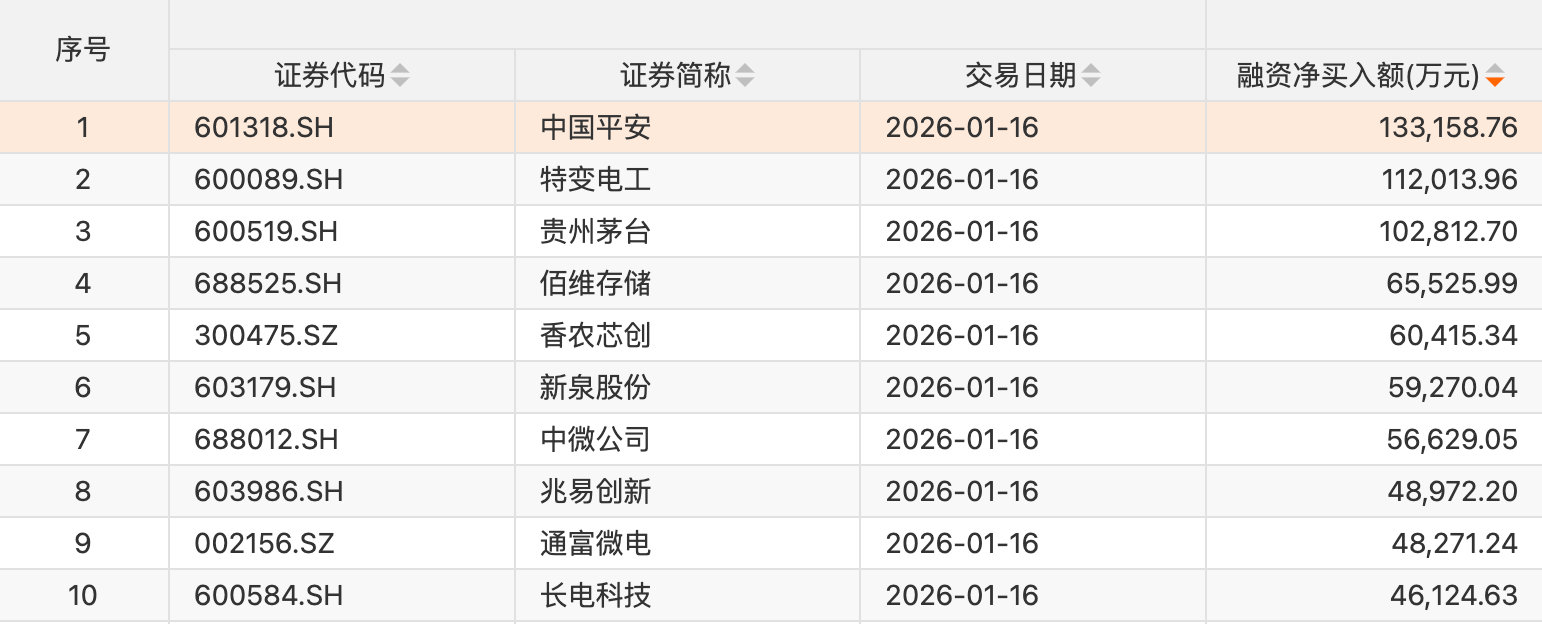
23股获融资净买入额超3亿元 中国平安居首
Zheng Quan Shi Bao Wang· 2026-01-19 01:36
Group 1 - On January 16, among the 31 primary industries tracked by Shenwan, 20 industries experienced net financing inflows, with the electronics sector leading at a net inflow of 10.279 billion yuan [1] - Other industries with significant net financing inflows included power equipment, non-bank financials, food and beverage, banking, machinery, and construction decoration [1] Group 2 - A total of 1,912 stocks received net financing inflows on January 16, with 76 stocks having net inflows exceeding 100 million yuan [1] - Among these, 23 stocks had net inflows over 300 million yuan, with China Ping An leading at a net inflow of 1.332 billion yuan [1] - Other notable stocks with high net financing inflows included TBEA, Kweichow Moutai, Baiwei Storage, Shannon Microelectronics, Xinquan Co., Zhongwei Company, Zhaoyi Innovation, and Tongfu Microelectronics [1]
通富微电:将加快建设和提升面向存储芯片的本土封测产能与技术
Zheng Quan Shi Bao Wang· 2026-01-19 01:33
人民财讯1月19日电,通富微电(002156)1月19日在互动平台表示,存储芯片作为信息基础设施的"底 座",已成为半导体领域国产替代的重点方向之一。公司将在原有存储芯片封测能力的基础上,加快建 设和提升面向存储芯片的本土封测产能与技术。 ...
通富微电:公司存储器产线已稳步进入量产阶段
Zheng Quan Shi Bao Wang· 2026-01-19 01:28
人民财讯1月19日电,通富微电(002156)1月19日在互动平台表示,随着国产存储芯片技术的日趋成 熟,公司布局多年的存储器产线已稳步进入量产阶段并显著提升了公司在相关领域的市场份额。公司存 储芯片封测能力伴随中国存储半导体产业自主发展同步成长,以晶圆减薄与高堆叠封装能力为核心技 术,业务范围已全面覆盖FLASH、DRAM中高端产品封测,能够满足大容量、高速度、高堆叠、高可 靠性等多维度要求,并与领军企业建立了长期稳定合作关系,形成了完备的量产验证和产业化经验。 ...
【公告臻选】芯片+智能家居+星闪+物联网+国家大基金持股!公司客户有谷歌、亚马逊等国外头部大厂
第一财经· 2026-01-18 14:10
Group 1 - The article emphasizes the importance of efficiently filtering key announcements to aid investment decisions, highlighting the service "Announcement Selection" that provides deep insights into complex terms and reveals investment opportunities [1] Group 2 - On January 14, a recommendation was made regarding Ding Tong Technology (688668), which planned to raise no more than 930 million yuan for high-speed communication and liquid cooling production projects. The stock rose by 1.78% on January 15 and continued to increase by 4.78% [2] - A recommendation on January 12 for Hu Dian Co., Ltd. (002463) involved a $300 million investment in high-density optical integrated circuit board projects, leading to an 11% cumulative increase over four days, with a significant rise of over 6% on January 14 [2] - On January 11, a recommendation for Tongfu Microelectronics (002156) highlighted its role as the largest packaging supplier for semiconductor giant AMD, resulting in a 12% increase in stock value for the week, with a strong surge on January 16 [2] Group 3 - The article outlines several companies involved in various sectors: one company is engaged in chips, smart home, and IoT, with clients including Google, Amazon, and GE [3] - Another company is focused on lithography machines and AI PCs, continuously expanding into semiconductor and aerospace satellite fields [3] - A third company specializes in PEEK materials, widely used in military, humanoid robots, and special engineering plastics for low-altitude economy applications [3]

台积电4Q25业绩点评:预计26年销售额增长30%,未来三年的资本支出或显著增加
Xinda Securities· 2026-01-18 12:26
Investment Rating - The industry investment rating is "Positive" [2] Core Insights - TSMC's revenue for Q4 2025 reached NT$1.046 trillion (US$33.73 billion), representing a year-on-year increase of 20.5% and a quarter-on-quarter increase of 5.7% [2][4] - The gross margin for Q4 2025 was 62.3%, up 3.3 percentage points year-on-year and 2.8 percentage points quarter-on-quarter [2][4] - TSMC expects a nearly 30% growth in sales for 2026, driven by strong customer demand, particularly in AI [2][3] - Capital expenditures (CapEx) for Q4 2025 were US$11.51 billion, with a full-year CapEx of US$40.9 billion for 2025, and a planned CapEx of US$52-56 billion for 2026 [2][3] - AI business revenue is projected to account for over 10% of total revenue, with a revised CAGR growth target of 55%-59% for AI revenue from 2024 to 2028 [2][3] - Advanced process technology remains dominant, with 77% of revenue coming from 7nm and below processes in Q4 2025 [2][3] - TSMC's global capacity planning includes multiple factories in Arizona, Japan, and Germany, with significant advancements in 2nm wafer production [3] Summary by Sections Financial Performance - Q4 2025 net income attributable to shareholders was NT$505.74 billion, a 35.0% increase year-on-year [4] - For the full year 2025, TSMC's revenue was US$122.42 billion, a 35.9% increase from 2024 [12] Capital Expenditure and Growth Plans - TSMC plans to significantly increase capital expenditures over the next three years to meet rising demand for AI chips [3] - The company aims to enhance production capacity to address the supply-demand gap in the AI sector [3] Market Demand and Product Segmentation - The revenue from high-performance computing (HPC) applications accounted for 55% of Q4 2025 revenue, with mobile applications contributing 32% [2][3] - TSMC's advanced process technology continues to lead the market, with a notable increase in the share of 3nm technology [2][3]

国产存储龙头纷纷创新高,资金交易从“涨价”迈向“技术成长”逻辑
Di Yi Cai Jing· 2026-01-18 08:45
Core Insights - The global storage industry is undergoing a profound transformation driven by AI technology and a supply crisis, with DRAM contract prices expected to rise by 58% in Q1 2026, particularly for server and mobile DRAM, which may exceed 60% [1][2] - This shortage is characterized as a "structural supply-demand imbalance," with Micron's executives indicating that the shortage may not ease until 2028 [1][2] - The current price surge is attributed to the explosive growth in AI models and inference scenarios, with AI data center storage demand now accounting for 50%-60% of the market [3] Supply and Demand Dynamics - The supply-demand gap in the storage chip market is worsening faster than expected, with Micron's VP stating that the shortage will persist until at least 2028 [2] - UBS and JPMorgan have expressed a consensus that storage chip prices will continue to rise, with predictions for DDR contract prices increasing by 58% and NAND flash by 27% in Q1 2026 [2] - The supply chain is facing challenges, as traditional storage products are experiencing shortages, leading major suppliers like Samsung and SK Hynix to plan significant price increases [2] Market Reactions and Valuation Adjustments - The A-share market has seen significant trading activity in storage stocks, with companies like Biwei Storage, Zhaoyi Innovation, and Jiangbolong reaching new highs, indicating a systematic re-evaluation of the storage industry's valuation logic [1][4] - Investors are focusing on the dual aspects of price increases and technological advancements, which are reshaping the valuation of A-share storage-related companies [4][5] Company Strategies and Growth Projections - Micron is planning to expand its DRAM production through an $1.8 billion acquisition of a facility in Taiwan, which is expected to significantly increase DRAM wafer output starting in H2 2027 [3] - Biwei Storage has projected record revenue and net profit for 2025, with expected revenue between 10 billion to 12 billion yuan, reflecting a year-on-year growth of 49.36% to 79.23% [5][6] - The current price increase is driven by structural demand from AI applications, which is expected to provide a "growth premium" to storage companies, enhancing revenue visibility and sustainability [6]

行业点评报告:先进封装龙头积极抢滩布局,产业进入“扩产+提价”新阶段
KAIYUAN SECURITIES· 2026-01-18 07:43
Investment Rating - The industry investment rating is "Overweight" [1] Core Insights - The semiconductor industry is expected to experience significant growth driven by advancements in AI and high-end packaging technologies. TSMC has raised its capital expenditure guidance for 2026 to between $52 billion and $56 billion, a substantial increase of up to 36.9% from 2025, with a focus on advanced packaging and testing [3][4] - Major companies are actively expanding capacity to meet the rising demand for advanced packaging, with investments in new facilities and technologies across various sectors, including automotive and AI [4] - Price increases in packaging services are anticipated due to strong structural demand and rising raw material costs, with some companies already implementing price hikes of up to 30% [5] Summary by Sections Capital Expenditure and Growth - TSMC's capital expenditure for 2026 is projected to be between $52 billion and $56 billion, with advanced packaging investments expected to contribute over 10% of revenue by 2026 [3] - The revenue contribution from advanced packaging is expected to grow from approximately 8% in 2025 to slightly above 10% in 2026, indicating a higher growth rate than the overall company growth [3] Capacity Expansion - Major players like Changdian Technology and Jinglong Technology are investing heavily in new facilities to enhance their testing capabilities for high-end semiconductors, with investments reaching billions [4] - Companies such as Tongfu Microelectronics and Nexperia are also planning significant investments to boost their packaging capacities, indicating a trend of expansion in response to market demand [4] Price Trends in Packaging - The packaging industry is experiencing price increases driven by high demand for AI and memory chips, with companies like ASE and others in Taiwan raising prices by 5-20% and up to 30% respectively [5] - The increase in raw material costs, including metals like gold and copper, is contributing to the overall rise in packaging costs, which may lead to improved profitability for packaging companies [5] Investment Recommendations - Investors are advised to focus on domestic companies actively engaged in high-end advanced packaging, such as Changdian Technology and Tongfu Microelectronics, as well as those benefiting from the sector's growth like Yongxi Electronics and Huada Technology [6]

先进封装,全速扩产
半导体行业观察· 2026-01-18 03:32
Core Viewpoint - The article discusses the significant investment and strategic shifts in the semiconductor packaging industry, particularly focusing on advanced packaging technologies driven by the AI wave and the structural changes in the storage industry [1][2]. Group 1: Investment and Market Trends - SK Hynix announced a 19 trillion KRW (approximately 12.9 billion USD) investment to build an advanced chip packaging factory in Cheongju, South Korea, reflecting the structural changes in the storage industry due to AI [1]. - The global advanced chip packaging market is projected to grow from 50.38 billion USD in 2025 to 79.85 billion USD by 2032, with a compound annual growth rate (CAGR) of 6.8% [2]. - By early 2026, leading packaging and testing companies are expected to ramp up advanced packaging capacity, indicating a competitive landscape focused on advanced packaging capabilities [2]. Group 2: TSMC's Dominance - TSMC is recognized as the leader in advanced packaging, holding over 60% market share in semiconductor manufacturing and establishing significant competitive barriers in advanced packaging technologies [2][3]. - TSMC has developed three branches of CoWoS technology: CoWoS-S for medium-sized chips, CoWoS-R for greater design flexibility, and CoWoS-L for large AI chips [3]. - TSMC's SoIC technology, based on CoWoS and wafer-on-wafer stacking, offers higher interconnect density and improved performance compared to traditional 2.5D packaging [3]. Group 3: Capacity Expansion and Technological Advancements - TSMC's CoWoS capacity is projected to increase 6-8 times from 2023 to 2026, with a CAGR exceeding 60% [5]. - TSMC's new advanced packaging facilities, including the flagship AP6 plant in Zhunan, are designed for full automation and are expected to handle significant orders from major clients like NVIDIA and AMD [5][6]. - TSMC is also expanding its advanced packaging capabilities in the U.S. with plans for two new facilities in Arizona, focusing on SoIC and CoPoS technologies [6]. Group 4: Competitors' Strategies - ASE, as the largest packaging and testing foundry, is benefiting from the advanced packaging trend, with over 60% of its ATM business expected to come from advanced packaging by 2025 [9]. - ASE is developing its own 2.5D packaging platform, FOCoS, and is expanding its production capacity across multiple sites, including a new K28 plant aimed at meeting the demand for AI and GPU chips [10][11]. - Amkor is enhancing its market position through partnerships, such as its collaboration with Intel on EMIB technology, and expanding its facilities in the U.S. to meet advanced packaging demands [15][16]. Group 5: Mainland China's Participation - Mainland Chinese companies are actively investing in advanced packaging technologies and capacity, with firms like Yongxi Electronics and Changjiang Electronics focusing on high-density packaging and automotive electronics [20][22]. - Yongxi Electronics is establishing a new production base in Malaysia to enhance its overseas strategy, while Changjiang Electronics is expanding its automotive electronics packaging capabilities [21][22]. - Tongfu Microelectronics is also increasing its advanced packaging capacity, particularly in automotive and high-performance computing sectors, to meet growing market demands [23][24]. Group 6: Future Outlook - The article concludes that while TSMC's dominance in advanced packaging is unlikely to be challenged in the short term, other specialized packaging firms are seeking to differentiate themselves through flexible capacity and innovative technologies [25][27]. - The collective expansion of packaging firms represents a significant industry bet on the demand for AI-driven computing power, with the potential for winners to emerge as the market stabilizes and technology paths clarify [27].