信达生物

Search documents
医药生物行业报告(2026.1.19-2026.1.23):国家统计局公布各项经济与人口数据,65岁及以上人口占比进一步提升
China Post Securities· 2026-01-26 06:45
Industry Investment Rating - The industry investment rating is "Outperform the Market" and is maintained [1] Core Views - The report highlights the ongoing decline in the national population and birth rates, with a significant increase in the elderly population, which is expected to drive demand for home medical devices and supplies [5][21] - The report emphasizes the long-term positive trend in the innovative drug sector, supported by the strength of China's innovative drug companies in global competition [7] - The medical device sector is showing signs of improvement, with major companies reporting better performance in Q3, indicating a potential recovery in the industry [9] Summary by Relevant Sections Industry Overview - As of January 26, 2026, the closing index stands at 8623.36, with a 52-week high of 9323.49 and a low of 6876.88 [1] Recent Market Performance - During the week of January 19-23, 2026, the A-share pharmaceutical sector fell by 0.39%, outperforming the CSI 300 index by 0.23 percentage points but underperforming the ChiNext index by 0.05 percentage points [6][24] - The medical device sector is expected to attract more investment as the pressure from centralized procurement diminishes [9][30] Population and Demographics - By the end of 2025, the total population of China was 1,404.89 million, with a natural population growth rate of -2.41% [15] - The elderly population (aged 65 and above) reached 22,365 million, accounting for 15.9% of the total population, indicating a trend towards an aging society [18][20] Investment Recommendations - The report suggests focusing on companies in the elderly care medical sector, such as Yuyue Medical, Kefu Medical, and Loxin Medical, due to the anticipated increase in demand for home medical devices [5][22] - In the innovative drug sector, companies like Innovent Biologics and Kintor Pharmaceutical are highlighted as beneficiaries of the growing global participation of Chinese innovative drug firms [7][27] - For the medical device sector, companies such as Mindray and Hunan Aohua are recommended due to their improving performance and market position [9][30] Future Outlook - The report anticipates a recovery in the medical device sector as procurement policies become more reasonable and the pressure from centralized procurement decreases [30] - The innovative drug sector is expected to continue its upward trajectory, with more innovative projects anticipated in 2026 [26][28]
ETF盘中资讯 创新药出海BD仍然火爆!港股通创新药ETF(520880)跌1.5%延续高溢价,最新单周吸金2.36亿元
Jin Rong Jie· 2026-01-26 05:58
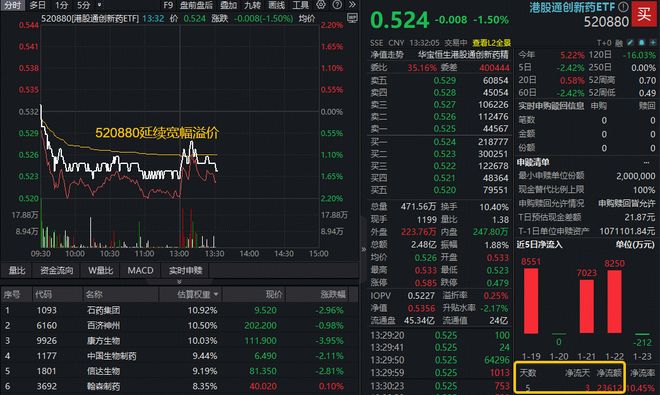
Core Viewpoint - The Hong Kong stock market is experiencing a downturn, particularly in the innovative drug sector, with the Hong Kong Stock Connect Innovative Drug ETF (520880) declining by 1.5% on January 26, despite a positive buying attitude reflected in high premiums [1][3]. Group 1: Market Performance - The Hong Kong Stock Connect Innovative Drug ETF (520880) has seen a cumulative decline of 3.2% over the past week, with over 236 million yuan in funds being used to buy on dips [1]. - Major stocks in the sector are experiencing widespread declines, with leading companies such as CSPC Pharmaceutical falling by 3%, and Innovent Biologics dropping nearly 4% [1]. Group 2: Industry Transactions - Several innovative drug business development (BD) transactions have been completed at the beginning of the year, indicating a positive trend for Chinese innovative drugs going overseas. Key transactions include: 1. Rongchang Biologics granting AbbVie overseas rights for RC148 (PD-1/VEGF) dual antibody, receiving a $650 million upfront payment and up to $4.95 billion in milestone payments [3]. 2. Haisco granting overseas rights for HSK39004 (PDE3/4) to AirNexis, with an upfront payment of $108 million and up to $955 million in milestone payments [3]. 3. Zai Lab granting AbbVie overseas rights for ZG006 (CD3xDLL3xDLL3 tri-antibody), receiving a $100 million upfront payment and milestone payments totaling $1.135 billion [3]. 4. Yilian Biologics granting Roche overseas rights for YL201 (B7-H3ADC), with upfront and near-term milestone payments totaling $570 million [3]. Group 3: Investment Opportunities - Investors are encouraged to consider core assets in innovative drugs during market dips, with a focus on the high elasticity T+0 tool, the Hong Kong Stock Connect Innovative Drug ETF (520880), and its associated funds [3]. - The index for the ETF (Hang Seng Hong Kong Stock Connect Innovative Drug Select Index) has three unique advantages: 1. 100% purity, covering only innovative drug R&D companies [3]. 2. A significant concentration of leading companies, with the top ten innovative drug leaders accounting for over 73% of the index [4]. 3. Better risk control through forced de-weighting of less liquid constituent stocks [5].

创新药出海BD仍然火爆!港股通创新药ETF(520880)跌1.5%延续高溢价,最新单周吸金2.36亿元
Xin Lang Cai Jing· 2026-01-26 05:47
Group 1 - The Hong Kong stock market is experiencing a downturn, with the innovative drug sector declining again, as evidenced by the Hong Kong Stock Connect Innovative Drug ETF (520880) falling by 1.5% [1][6] - Last week, the ETF accumulated a total decline of 3.2%, with over 236 million yuan in funds being used to buy on dips [1][6] - Major stocks in the sector are generally down, including CSPC Pharmaceutical Group down 3%, CanSino Biologics down nearly 4%, and China Biologic Products and Innovent Biologics both down over 2% [1][6] Group 2 - Multiple innovative drug business development (BD) transactions have been completed at the beginning of the year, indicating a positive trend for Chinese innovative drugs going overseas [8] - Key transactions include: 1) Rongchang Biologics granting AbbVie overseas rights for RC148 (PD-1/VEGF) dual antibody, receiving a $650 million upfront payment and up to $4.95 billion in milestone payments [8] 2) Haisco granting overseas rights for HSK39004 (PDE3/4) to AirNexis, receiving a $108 million upfront payment and up to $955 million in milestone payments [8] 3) Zai Lab granting AbbVie overseas rights for ZG006 (CD3xDLL3xDLL3 tri-antibody), receiving a $100 million upfront payment and milestone payments totaling $1.135 billion [8] 4) Yilian Biologics granting Roche overseas rights for YL201 (B7-H3ADC), with upfront and milestone payments reaching $570 million [8] Group 3 - The Hong Kong Stock Connect Innovative Drug ETF (520880) and its associated funds are highlighted as high-elasticity investment tools, with the underlying index (Hang Seng Stock Connect Innovative Drug Select Index) offering three unique advantages [9] - The ETF has a 100% purity, excluding CXO, and fully covers innovative drug R&D companies [9] - The top ten innovative drug leaders account for over 73% of the ETF, showcasing the strength of the innovative drug sector [9][10]

港股医药大幅下挫,恒生医药ETF跌超2%
Mei Ri Jing Ji Xin Wen· 2026-01-26 03:28
具体来看,CXO、创新药等概念集体下挫,晶泰控股、三生制药、微创机器人、药明合联、药明生 物、信达生物等领跌。 招商国际表示,在2025年创新药BD出海授权交易爆发式增长的基础上,2026年初已经有多个BD落地, 体现了中国创新药出海授权交易较高的景气度。 港股市场再度震荡调整,医药板块领跌,恒生生物科技指数跌超2%,聚焦创新药产业的恒生医药ETF (159892)、聚焦CXO+AI医疗的港股通医疗ETF(520510)均跌超2%。 ...
南向资金上周净流入235.2亿港元,阿里巴巴、小米集团、泡泡玛特、中芯国际净流入金额居前
Mei Ri Jing Ji Xin Wen· 2026-01-26 01:43
Group 1 - The core viewpoint of the article highlights that southbound capital inflow into the Hong Kong market reached 23.52 billion HKD last week, showing an increase compared to the previous week [1] - Year-to-date, the net inflow of southbound capital into Hong Kong has totaled 59.3 billion HKD, which represents 4.56% of the total net inflow for the entire previous year [1] - Key stocks that saw significant net inflows from southbound capital last week include Alibaba-W (3.349 billion HKD), Xiaomi Group-W (2.583 billion HKD), Pop Mart (1.691 billion HKD), and SMIC (1.683 billion HKD), indicating a strong focus on internet platforms and technology leaders [1] Group 2 - The article suggests monitoring technology-related ETFs in the Hong Kong market, specifically the Hang Seng Internet ETF (513330.SH) and the Hong Kong Stock Connect Technology ETF (159101.SZ) [1] - The Hang Seng Internet ETF (513330.SH) focuses on internet giants and includes companies not covered by the Stock Connect, such as Baidu Group-S, JD Group-S, and NetEase-S [1] - The Hong Kong Stock Connect Technology ETF (159101.SZ) targets hard technology, soft applications, smart driving, and CXO concepts, with constituent stocks including SMIC, Alibaba, Xiaomi, Li Auto, and Innovent Biologics, all of which are eligible for Stock Connect and not subject to QDII foreign exchange limits [1]

2026年中国心脑血管药物行业市场政策汇总、产业链图谱、市场规模、竞争格局及发展趋势分析:需求群体庞大[图]
Chan Ye Xin Xi Wang· 2026-01-26 01:40
Core Insights - The aging population in China is leading to an increase in cardiovascular diseases, with rising prevalence of chronic conditions such as hypertension and hyperlipidemia, driving demand for cardiovascular drugs [1][8] - There is a significant increase in health awareness among residents, leading to earlier screening and treatment of cardiovascular diseases, which expands the applicable population for cardiovascular medications [1][8] - The implementation of centralized drug procurement policies is causing a downward trend in drug prices, putting pressure on the overall market size, which is projected to decline to 954.1 billion yuan for traditional Chinese medicine and 1,415.8 billion yuan for chemical drugs by 2025 [1][8] Market Overview - Cardiovascular diseases encompass both cardiovascular and cerebrovascular diseases, primarily caused by conditions like hyperlipidemia, blood viscosity, atherosclerosis, and hypertension [2] - Cardiovascular drugs are classified into two main categories: cardiovascular system drugs and cerebrovascular system drugs, targeting various heart and brain-related conditions [2] Policy Environment - The pharmaceutical manufacturing industry, including cardiovascular drugs, is a key focus of national policy support, with various regulations aimed at correcting malpractices and promoting industry development [3][4] Industry Chain - The upstream of the cardiovascular drug industry includes chemical raw materials, traditional Chinese medicinal materials, and pharmaceutical packaging materials, while the midstream involves research, production, and registration processes [4][5] Demand Dynamics - Cardiovascular diseases are the leading cause of death in China, with hypertension cases expected to reach 370 million and coronary heart disease cases at 30 million by 2025, indicating a growing demand for cardiovascular medications [6][8] Competitive Landscape - The market has developed a dual competitive structure, with foreign companies dominating the chemical drug sector and local companies leading in traditional Chinese medicine, creating a competitive environment [10] - Notable domestic players include Shijiazhuang Pharmaceutical Group and Shandong Buchang Pharmaceutical, which have established strong market positions through unique products and effective distribution networks [10][11] Development Trends - The industry is shifting from reliance on generic drugs to innovation, focusing on high-value drug development, including targeted and biological drugs [12] - There is a growing integration of chronic disease management with digital tools, enhancing patient adherence and treatment precision [13] - Policy reforms are reshaping market dynamics, emphasizing high clinical value drugs and expanding the market for basic medications in primary healthcare [14] - The industry is moving towards a collaborative ecosystem, with increased internationalization efforts and participation in global clinical trials [15]




狂揽1357亿美元,谁是2025中国创新药出海“最贵”十单?
3 6 Ke· 2026-01-26 01:08
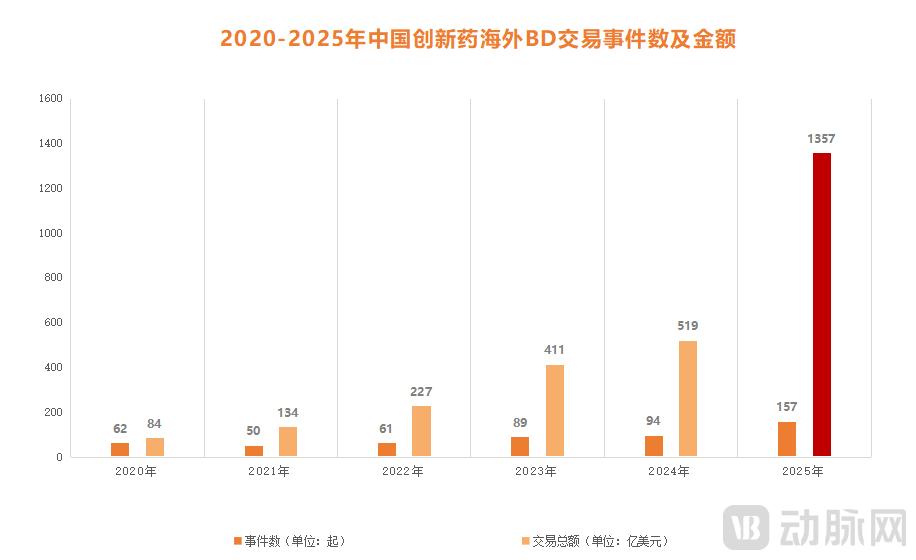
Core Insights - In 2025, China achieved a record high in overseas business development (BD) transactions for innovative drugs, with 157 deals totaling $135.655 billion, including an upfront payment of $7 billion [1][3][16] - The year 2025 marked a significant shift in the BD landscape, transitioning from a "1.0 era" of simple asset sales to a "2.0 era" characterized by deeper partnerships and higher value creation [5][16] Transaction Overview - The top three BD transactions in 2025 included a $13 billion deal between Qide Pharma and Biohaven & AimedBio, a $12.5 billion deal between Hengrui and GSK, and a $11.4 billion deal between Innovent Biologics and Takeda [2][11] - China accounted for 49% of the global total for BD transactions in 2025, surpassing the United States for the first time [2][11] Financial Metrics - The total upfront payments for BD transactions in China reached $7 billion in 2025, nearly doubling from $4.1 billion in 2024, with individual transaction upfront payment ratios increasing to approximately 5.2%-6.7% [7][16] - Milestone payments also saw significant activity, with at least 10 transactions triggering milestone payments in 2025, indicating a trend towards more structured financial agreements [9][16] Therapeutic Areas and Pipeline Stages - Oncology remained the primary focus of BD transactions, accounting for 51.4% of deals, although other areas such as immunology and metabolic diseases gained traction, rising to 34.1% [11][13] - The distribution of pipeline stages showed a shift towards later-stage projects, with 22% of transactions involving Phase III or marketed products, reflecting a preference for assets with established clinical data [13][16] Collaboration Models - The "Co-Co" model, which emphasizes joint development and commercialization, emerged as a new strategic direction in 2025, complementing traditional "License-out" and "NewCo" models [15][16] - This evolution in collaboration models indicates a trend towards deeper partnerships, allowing for shared risks and rewards, and enhancing the overall value proposition of BD transactions [15][16] Future Outlook - The demand for Chinese innovative drugs is expected to remain strong in 2026, driven by the approaching patent cliffs and increasing global competition, suggesting continued activity in BD transactions [21][22] - The industry is anticipated to further mature, focusing on quality and value in BD transactions, with an emphasis on long-term collaboration and mutual benefits [21][22]

2025年药品BD出海回顾:显著提速,关注双抗、ADC、GLP-1RA、小核酸等方向
Southwest Securities· 2026-01-26 00:45
Investment Rating - The report indicates a "Buy" rating for several companies within the pharmaceutical sector, including 恒瑞医药 (Hengrui Medicine), 百济神州-U (BeiGene), and others [22]. Core Insights - The pharmaceutical industry has seen a significant increase in BD (business development) activities, with Chinese pharmaceutical companies securing upfront payments exceeding $7.03 billion in 2025, marking a year-on-year growth of over 226.8% [15][20]. - The industry has a total market capitalization of approximately 544.85 billion yuan, with a TTM (trailing twelve months) P/E ratio of 38.5, significantly higher than the 14.1 P/E ratio of the CSI 300 index [3][6]. - The best-performing sub-sectors this week include offline pharmacies, hospitals, and medical R&D outsourcing, with year-to-date increases of 17.2%, 14.8%, and 10.7%, respectively [6][31]. Summary by Sections Industry Performance - The pharmaceutical index decreased by 0.39% this week, outperforming the CSI 300 index by 0.23 percentage points. Year-to-date, the pharmaceutical sector has risen by 6.66%, surpassing the CSI 300 index by 5.10 percentage points [6][24]. - The current valuation level (P/E-TTM) for the pharmaceutical industry stands at 30.31 times, with a premium of 65.36% over the entire A-share market [6][26]. Business Development Trends - In 2025, the domestic dual-antibody BD projects achieved upfront payments of $3.5 billion, a staggering increase of 414.7%, accounting for 49.8% of all BD upfront payments for the year [16]. - The ADC (Antibody-Drug Conjugates) sector has also seen substantial growth, with upfront payments reaching $1.63 billion, a 676.2% increase year-on-year [17]. - The GLP-1RA (Glucagon-Like Peptide-1 Receptor Agonists) segment reported upfront payments of $470 million, reflecting a 109.8% increase compared to 2024 [18]. Notable Collaborations - The report highlights significant collaborations, such as 舶望制药 (Bohua Pharmaceutical) partnering with Novartis to explore the potential of siRNA in hypertension treatment, securing an upfront payment of $160 million [19]. - The MNC (Multinational Corporation) procurement model remains dominant, with local companies securing $4.71 billion in upfront payments from MNCs, representing 67.0% of total BD upfront payments [20]. Recommended Companies - The report suggests a robust investment strategy focusing on companies like 恒瑞医药 (Hengrui Medicine), 百济神州-U (BeiGene), and others, which are expected to benefit from innovation and international expansion [20][21].
智通港股通持股解析|1月26日
智通财经网· 2026-01-26 00:32
Core Insights - The top three companies by Hong Kong Stock Connect holding ratios are China Telecom (00728) at 70.92%, Green Power Environmental (01330) at 69.34%, and Kaisa Group Holdings (01108) at 67.61% [1][2] - The largest increases in holding amounts over the last five trading days were seen in the following companies: Yingfu Fund (02800) with an increase of 4.041 billion, Hang Seng China Enterprises (02828) with 1.783 billion, and Alibaba - W (09988) with 1.455 billion [1][2] - The largest decreases in holding amounts over the last five trading days were recorded for China Mobile (00941) with a decrease of 2.395 billion, Innovent Biologics (01801) with 589 million, and UBTECH Robotics (09880) with 556 million [1][3] Group 1: Hong Kong Stock Connect Holding Ratios - China Telecom (00728) has a holding of 9.843 billion shares, representing 70.92% [2] - Green Power Environmental (01330) has a holding of 280 million shares, representing 69.34% [2] - Kaisa Group Holdings (01108) has a holding of 169 million shares, representing 67.61% [2] Group 2: Recent Increases in Holdings - Yingfu Fund (02800) saw an increase of 4.041 billion in holding amount, with a change of 14.9907 million shares [2] - Hang Seng China Enterprises (02828) increased by 1.783 billion, with a change of 1.8975 million shares [2] - Alibaba - W (09988) increased by 1.455 billion, with a change of 0.8637 million shares [2] Group 3: Recent Decreases in Holdings - China Mobile (00941) experienced a decrease of 2.395 billion, with a change of -3.01224 million shares [3] - Innovent Biologics (01801) saw a decrease of 589 million, with a change of -0.70319 million shares [3] - UBTECH Robotics (09880) had a decrease of 556 million, with a change of -0.38639 million shares [3]

3万亿赛道的估值锚点,彻底变了
虎嗅APP· 2026-01-26 00:15
Core Viewpoint - The innovative drug sector experienced a significant surge in 2025, with multiple innovative drug ETFs seeing annual gains exceeding 50% and several companies doubling their stock prices. However, since September 2025, both A-shares and Hong Kong stocks in this sector have faced notable corrections, with some stocks nearly halving in value. The market is now focusing on the quality of business development (BD) transactions rather than just their existence [5][6][7]. Group 1: Market Trends and Reactions - In 2025, the innovative drug sector's market capitalization reached approximately 3 trillion yuan, driven by significant BD transactions [5]. - The market's initial enthusiasm for BD transactions has waned, as investors realize that these transactions often provide only temporary cash flow improvements rather than sustainable profitability [6][7]. - The focus has shifted from merely having BD transactions to assessing their quality, which is crucial for investment decisions in innovative drugs [8]. Group 2: High-Quality BD Transactions - High-quality BD transactions are characterized by three main anchors: the certainty of target value realization, the feasibility of milestone payments, and the strength of the partner company, particularly multinational pharmaceutical firms [10]. - An example of a successful BD transaction is the collaboration between Rongchang Biopharmaceutical and AbbVie, which led to a significant stock price increase due to the validated target of the drug involved [11][13]. - Conversely, a BD transaction involving Haikang Pharmaceutical and AirNexis did not yield positive market reactions due to the lower credibility of the partner and the insufficient cash component of the upfront payment [18][20][21]. Group 3: Company Performance and Investment Opportunities - Companies like Baijie and Hengrui have shown promising performance, with Baijie leading in innovative drug revenue and expected to turn profitable in 2025, while Hengrui has successfully transitioned to an innovative drug-focused business model [34][37]. - Hansoh Pharmaceutical has also achieved profitability, with a significant portion of its revenue coming from innovative drugs, indicating a successful transformation [40]. - Companies such as Xinda Biopharmaceutical and Sanofi have potential for future profitability, with Xinda expected to launch a promising product that could significantly impact its financials [43][48]. Group 4: Selection Criteria for Investment - The selection process for investment should involve identifying companies with a high proportion of innovative drug revenue (at least 50%), assessing their profitability, and evaluating the quality of their BD collaborations and global competitiveness of their pipelines [30][31]. - The analysis of the top 15 companies by innovative drug revenue shows that 13 have over 50% of their revenue from innovative drugs, highlighting a strong focus on innovation within the sector [32]. Group 5: Future Outlook - The innovative drug industry remains attractive, but the market's valuation criteria have evolved to prioritize the quality of BD transactions and the underlying performance of companies [58]. - Continuous monitoring of companies' clinical pipeline progress and BD transaction outcomes will be essential for assessing future market activity and investment potential [58].