国泰基金

Search documents
这类ETF单周缩水超2000亿元,发生了什么?
Mei Ri Jing Ji Xin Wen· 2026-01-18 05:55
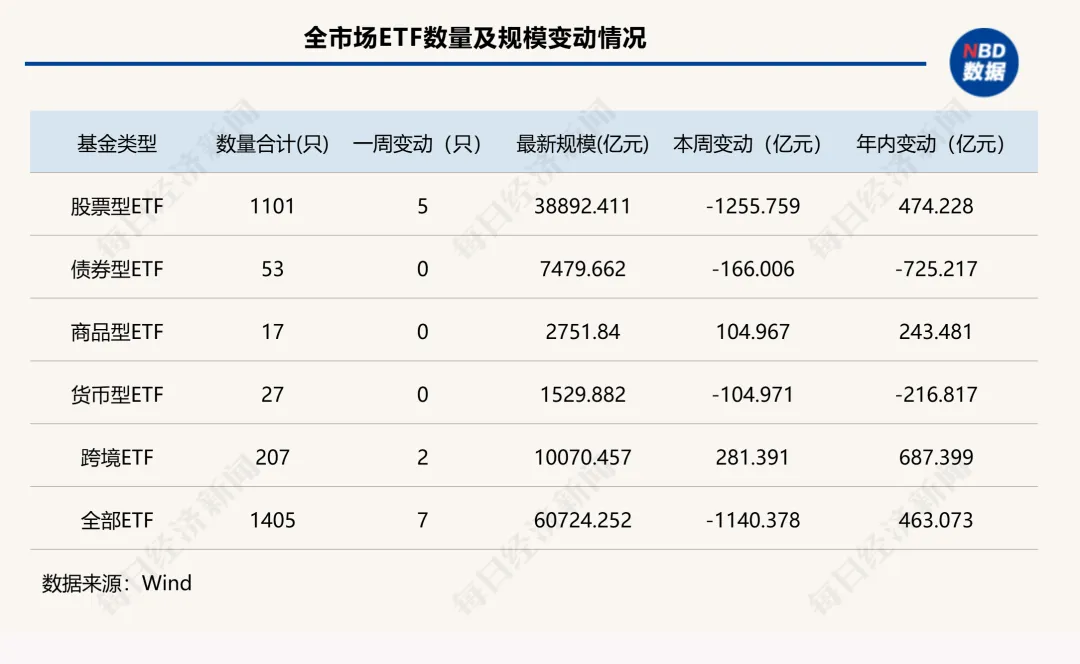
Market Overview - A-shares experienced volatility with the CSI 300 index declining by 0.57% and the ChiNext index increasing by 1% during the week of January 12 to January 16 [1][18] - The Hong Kong market rebounded, with the Hang Seng Index rising by 2.34% [1] ETF Market Dynamics - The ETF market faced a significant downturn, with a loss exceeding 200 billion yuan in a single week, leading to a total scale drop below 4 trillion yuan for stock ETFs [1][19] - Major ETF managers, including Huaxia, E Fund, and Huatai-PB, saw their management scales shrink by over 340 billion yuan due to the outflow of funds from broad-based ETFs [1][19] - Despite the downturn in stock ETFs, cross-border ETFs saw a historic increase, surpassing 1 trillion yuan in total scale for the first time [1][33] ETF Scale Changes - The total market ETF scale decreased by 1,140.38 billion yuan, with stock ETFs alone shrinking by 1,255.76 billion yuan [2][19] - Bond and money market ETFs also faced declines, with reductions of 166.01 billion yuan and 104.97 billion yuan, respectively [2][19] - Conversely, cross-border ETFs added 289.39 billion yuan, marking a significant growth [2][19] ETF Product Performance - The CSI 300 index-linked ETFs saw a dramatic scale reduction of 1,091.49 billion yuan, primarily due to a net outflow of 1,033.66 billion yuan [4][21] - In contrast, the Hong Kong Internet index-linked ETFs experienced a growth of over 100 billion yuan, becoming the "increment king" of the week [4][21] Fund Management Changes - Huaxia Fund's ETF management scale briefly surpassed 1 trillion yuan but fell back below this threshold due to significant fund outflows [15][32] - E Fund and Huatai-PB also reported substantial reductions in their ETF management scales, with E Fund's scale dropping below 900 billion yuan [7][27] Notable ETF Developments - The first gold ETF in the domestic market surpassed 1 trillion yuan, becoming a significant milestone [17][34] - The total number of listed ETFs reached 1,405, with 7 new ETFs launched during the week [1][20]

ETF市场跟踪与配置周报-20260117
Xiangcai Securities· 2026-01-17 12:21
Report Industry Investment Rating No relevant content provided. Core Views - PB-ROE framework's ETF rotation strategy recommends next week to focus on the communication, agriculture, forestry, animal husbandry, and transportation industries, corresponding to their industry ETFs; the ETF redemption sentiment indicator model suggests focusing on the Science and Technology Innovation 50 ETF, SSE 50 ETF, Medical ETF, Photovoltaic ETF, and Robot ETF [9][40] - Combining PB and ROE for industry configuration may be a better choice; the third quadrant's high PB high ROE and the fifth quadrant's low PB medium ROE are key focus areas; combining the third and fifth quadrants to construct a comprehensive PB-ROE strategy has an annualized return of 11.93% and an annualized excess return of 13.22% [32][33] Summary by Directory 1. Recent Market Overview (January 12 - January 16, 2026) - Index performance: Shanghai Composite Index closed at 4101.91, down 0.45% for the week; Shenzhen Component Index closed at 14281.08, up 1.14%; ChiNext Index closed at 3361.02, up 1.00%; Beijing Stock Exchange 50 closed at 1548.33, up 1.58%; Hang Seng Index closed at 26844.96, up 2.34%. The average daily trading volume of the Shanghai and Shenzhen stock markets was 34250.96 billion yuan, and the total trading volume for the week was 17.13 trillion yuan [12] - Industry performance: Among 31 Shenwan primary industries, 13 industries rose and 18 fell. The top three gainers were computer (up 3.82%), electronics (up 3.77%), and non-ferrous metals (up 3.03%); the top three losers were national defense and military industry (down 4.92%), real estate (down 3.52%), and agriculture, forestry, animal husbandry, and fishery (down 3.27%) [5][12] - Main funds: Main funds had net outflows for 5 trading days and no net inflows, with a total net outflow of 2752.39 billion yuan for the week. The industries with more net inflows were banks, public utilities, and coal; the industries with more net outflows were national defense and military industry, power equipment, and computer [5][13] 2. Recent ETF Market Performance (January 12 - January 16, 2026) - Overall situation: As of January 16, 2026, there were 1411 ETFs in the Shanghai and Shenzhen stock markets, with a total asset management scale of 60766.01 billion yuan. There were 1101 equity ETFs (38892.41 billion yuan), 53 bond ETFs (7479.66 billion yuan), 27 money market ETFs (1529.88 billion yuan), 17 commodity ETFs (2751.84 billion yuan), 207 cross-border ETFs (10070.46 billion yuan), and 6 unlisted ETFs (41.76 billion yuan) [20] - Newly listed and established ETFs: 8 ETFs were newly listed, all equity ETFs; 7 ETFs were newly established, with a total issuance scale of 51.24 billion yuan [21] - Equity ETFs: The median weekly increase or decrease was 0.59%. Science and technology semiconductor ETFs and semiconductor equipment ETFs performed well, with the Science and Technology Semiconductor ETF Peng Hua rising the most at 12.46%; aerospace and high-end equipment ETFs performed poorly, with the Aerospace ETF falling the most at 6.88%. The average weekly share change was a decrease of 19.4716 million shares. Software ETFs and media ETFs had more share increases, while the Science and Technology Innovation 50 ETF and CSI 300 ETF had more share decreases [24] - Bond ETFs: The median weekly increase or decrease of 53 bond ETFs was 0.12%. The convertible bond ETF had the highest increase of 0.91%, while the science and technology innovation bond ETF had the highest decrease of 0.00%. As of January 16, 2026, the Haifutong CSI Short-term Financing ETF had the largest scale of 631.50 billion yuan [27] - Cross-border ETFs: The median weekly increase or decrease was 1.18%. The China-South Korea Semiconductor ETF and Hong Kong Stock Connect Internet ETF had the highest increases, with the China-South Korea Semiconductor ETF rising 6.11%; the Hong Kong Securities ETF and Nasdaq Biotechnology ETF had the highest decreases, with the Hong Kong Securities ETF falling 2.28%. Since the beginning of the year, the median increase or decrease was 3.82%, with the China-South Korea Semiconductor ETF and Hong Kong Medical ETF having higher increases, and the Nasdaq ETF and Nasdaq Technology ETF having higher decreases [29] 3. PB-ROE Framework's ETF Rotation Strategy Tracking - Factor effectiveness: PB factor and PB quantile factor show certain stratification ability, and PB quantile factor is more effective; ROE factor's effectiveness declined after 2018; using ROE factor is better than ROE quantile factor; expected ROE factor is better than expected ROE year-on-year factor. Combining PB and ROE for industry configuration may be a better choice [32] - Key quadrants: The third quadrant's high PB high ROE and the fifth quadrant's low PB medium ROE are key focus areas. From 2017 to February 2024, the compound annualized excess returns of the third and fifth quadrant portfolios were 4.27% and 1.55% respectively [32] - Strategy improvement: After supplementing the PB-ROE framework with four dimensions, the annualized excess returns of the third and fifth quadrant strategies were 4.78% and 3.94% respectively. Combining the two strategies, the annualized return was 11.93% and the annualized excess return was 13.22% [33] - Recent performance: This week, the strategy focused on the communication, agriculture, forestry, animal husbandry, and transportation industries, with a cumulative return of -0.86%, and an excess return of -0.29% compared to the CSI 300 Index [8][34] - Performance since 2023: The cumulative return was 26.03%, with an excess return of 3.81% compared to the CSI 300 Index [8][36] - Performance since 2022: The cumulative return was 7.77%, with an excess return of 11.99% compared to the CSI 300 Index [39] 4. Investment Recommendations - PB-ROE framework: Focus on the communication, agriculture, forestry, animal husbandry, and transportation industries next week, corresponding to their industry ETFs [9][40] - ETF redemption sentiment indicator model: Focus on the Science and Technology Innovation 50 ETF, SSE 50 ETF, Medical ETF, Photovoltaic ETF, and Robot ETF next week [9][40]
公募基金能否接下这50万亿?
投中网· 2026-01-17 07:03
Core Viewpoint - The article discusses the significant inflow of funds into public offerings, particularly focusing on "fixed income +" and Fund of Funds (FOF) products, as a response to the upcoming maturity of a large volume of fixed deposits, estimated to be between 30 trillion to 60 trillion yuan by 2026, with an average forecast of around 50 trillion yuan [4]. Group 1: Performance of Multi-Asset Products - The "fixed income +" and FOF products have shown impressive performance, with the total management scale of public FOF funds reaching 238.3 billion yuan by the end of 2025, marking a historical high with an annual growth of 100 billion yuan [5]. - The "fixed income +" funds reached a scale of 2.53 trillion yuan, growing over 700 billion yuan within the year, indicating a strong market demand for these products [5][20]. - Notable performances include the "fixed income +" fund from China Universal, which achieved a return of 37% in 2025, and the FOF fund from Guotai, which returned 66.14% [6][17]. Group 2: Trends in Public Fund Products - There are two prominent trends in public fund products: the toolization of products, particularly ETFs, and the multi-asset allocation strategy that aims for stable performance across different market conditions [9][10]. - The toolization trend is evident in both equity and bond products, with a significant increase in bond ETFs, which have surpassed 700 billion yuan [9]. - The multi-asset allocation strategy seeks to balance investments between stocks and bonds based on market conditions, enhancing the potential for stable returns [10][12]. Group 3: Market Dynamics and Future Outlook - The growth of multi-asset products is expected to continue, driven by the increasing acceptance of "fixed income +" and FOF products among retail and institutional investors [22]. - The public fund industry is witnessing a shift towards more systematic and quantitative asset allocation strategies, moving away from reliance on subjective judgment [24][27]. - The competitive landscape is changing, with companies like China Universal and Invesco Great Wall rapidly expanding their multi-asset offerings, indicating a potential shift in market leadership [38][41].

黄金ETF规模狂飙突破2600亿 首只千亿基金诞生
2 1 Shi Ji Jing Ji Bao Dao· 2026-01-16 23:38
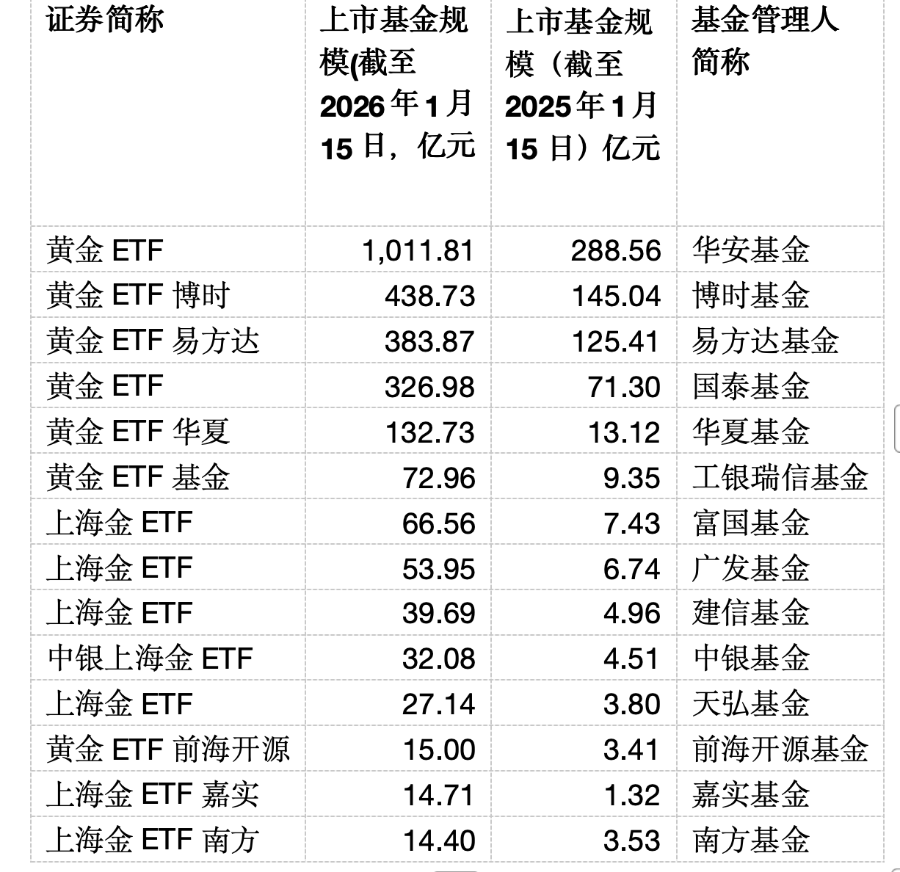
Core Insights - The surge in international gold prices has led to a significant increase in gold ETFs, with the largest domestic commodity ETF, Huaan Gold ETF, surpassing 100 billion yuan for the first time, reaching 101.81 billion yuan on January 15, 2026 [1][2][3] Group 1: Growth of Gold ETFs - The total scale of 14 gold ETFs in the domestic market has exceeded 260 billion yuan, nearly tripling compared to a year ago [2][5] - In the first half of January 2026, major gold ETFs attracted substantial net inflows, with Huaan Gold ETF, Guotai Gold ETF, and Bosera Gold ETF leading the way [4][19] - The overall scale of these 14 gold ETFs increased by over 210 million yuan from December 31, 2025, to January 15, 2026 [4][19] Group 2: Investment Trends and Performance - The past year has seen a net inflow of approximately 123.17 billion yuan into these gold ETFs, with Huaan Gold ETF being the primary contributor [7][21] - The average return rate for these gold ETFs exceeded 61% from January 15, 2025, to January 15, 2026, driven by rising international gold prices [9][24] - Factors such as declining real interest rates, geopolitical risks, and increasing demand for gold have supported the strong performance of gold ETFs [9][10][24] Group 3: Future Outlook and Adjustments - Fund managers are enhancing liquidity and risk management in response to ongoing market changes, with adjustments to minimum subscription and redemption units for certain gold ETFs [11][26] - Analysts suggest that while gold remains a valuable asset for hedging against inflation and systemic risks, the pace of gold price increases may slow down in the near future due to reduced uncertainties in international trade [14][28] - The long-term outlook for gold remains positive, with central banks increasing gold reserves and potential aggressive rate cuts by the Federal Reserve benefiting gold prices [14][29]
首只千亿黄金ETF诞生
Xin Lang Cai Jing· 2026-01-16 23:10
Core Insights - The surge in international gold prices has led to a significant increase in gold ETFs, with the largest domestic commodity ETF, Huaan Gold ETF, surpassing 100 billion yuan for the first time, reaching 101.81 billion yuan as of January 15, 2026 [1][4] - The total scale of 14 gold ETFs in the domestic market has exceeded 260 billion yuan, nearly tripling compared to the previous year [2][5] - Continuous capital inflow and rising fund net values have driven the explosive growth of gold ETFs, with institutions maintaining a positive outlook on gold's allocation value [3][6] Fund Inflows and Performance - From January 1 to January 15, 2026, major gold ETFs attracted significant net inflows, with Huaan Gold ETF, Guotai Gold ETF, and Bosera Gold ETF receiving 1.472 billion yuan, 1.378 billion yuan, and 1.086 billion yuan respectively [4][7] - The total net inflow for the 14 gold ETFs over the past year reached 123.17 billion yuan, with Huaan Gold ETF leading at 43.79 billion yuan [7][8] - The average return rate for these gold ETFs exceeded 61% from January 15, 2025, to January 15, 2026, driven by strong international gold prices [9][10] Market Dynamics and Future Outlook - The ongoing influx of funds into gold ETFs is attributed to rising geopolitical risks and the appeal of gold as a hedge against inflation and systemic risks [10][14] - Fund managers are enhancing liquidity and risk management in response to market changes, with adjustments to minimum subscription and redemption units for certain ETFs [11][12] - Looking ahead, while the demand for gold remains strong, analysts suggest that the pace of gold price increases may slow due to reduced uncertainties in U.S.-China trade relations and high short-term market congestion [13][14]
年初债基频现大额赎回 债市或延续震荡趋势
Xin Lang Cai Jing· 2026-01-16 14:57
Core Viewpoint - The bond market continues to face challenges at the beginning of 2026, with pure bond funds, especially medium to long-term ones, experiencing significant declines, while convertible bond funds show relatively strong performance [1][2]. Group 1: Market Performance - As of January 14, 2026, 20% of pure bond funds have reported zero or negative returns, with 477 out of 492 underperforming funds being medium to long-term pure bond funds [1][2]. - The average return for bond funds in 2025 was approximately 2.73%, a significant drop from 4.42% in 2024, indicating a nearly halved yield for bond funds [2]. - Notably, some pure bond funds have seen declines exceeding 0.5%, with specific funds like Guotai's Tianrui One-Year Open Bond Fund reporting a return of -0.82% [2][3]. Group 2: Fund Flows and Redemptions - The bond market's poor performance has led to significant capital outflows, with bond ETFs losing over 70 billion yuan since the start of 2026 [4]. - Specific bond ETFs, such as the Sci-Tech Bond ETF, have seen their scales shrink by over 12.1 billion yuan, while a few convertible bond ETFs have experienced net inflows [4][5]. - Several bond funds have announced increases in net asset value calculation precision due to large redemptions, a common measure to mitigate the impact of significant withdrawals [5][6]. Group 3: Market Outlook - Short-term factors contributing to the decline in pure bond fund yields include rising long-term bond rates, with the 10-year government bond yield reaching 1.89% [7]. - Analysts express caution regarding the short-term outlook for the bond market, anticipating continued volatility, but believe the long-term downside risk is limited [7][8]. - The overall economic environment suggests that while the bond market faces pressure, the risk of significant declines remains relatively low due to supportive monetary policies [8][9].
黄金ETF规模狂飙突破2600亿!首只千亿基金诞生
2 1 Shi Ji Jing Ji Bao Dao· 2026-01-16 13:04
21世纪经济报道记者 易妍君 在国际金价节节攀升的背景下,黄金ETF迎来高光时刻。 据统计,2026年1月1日—1月15日,华安黄金ETF、国泰黄金ETF、黄金ETF博时分别吸引了14.72亿元、13.78亿元、10.86亿元净 流入资金。黄金ETF华夏、黄金ETF易方达的净流入规模分别达到9.20亿元、6.77亿元。 2026年1月14日收盘后,国内市场上最大的一只商品型ETF——华安黄金ETF的规模达到1007.62亿元,为其首次突破千亿大关, 并成为国内首只迈上千亿台阶的商品型ETF。1月15日,这只黄金ETF的规模继续增长,达到1011.81亿元。 至此,国内市场上14只黄金ETF的总规模已超过2600亿元,较一年前增长了近3倍。 过去一年,资金持续流入和基金净值的上涨共同推动了黄金ETF规模爆发。 展望后市,机构依旧看好黄金的配置价值。有基金经理提醒,当前,投资者应回归黄金的资产配置本质,将其作为对冲通胀与 系统性风险、平滑组合波动的中长期工具。 近一年增幅接近3倍 近年来,黄金ETF已经成为广大投资者配置黄金资产的重要载体。2026年开年以来,资金涌入黄金ETF的趋势仍在延续。 2025年1月15 ...
国泰基金胡松:金牛实力,逆势笃行
Zhong Zheng Wang· 2026-01-16 09:48
Core Viewpoint - The article emphasizes the investment strategies and achievements of Hu Song, the Pension Investment Director at Guotai Fund, highlighting his ability to navigate market cycles and deliver consistent returns for investors through a value investment approach. Group 1: Investment Performance - Guotai Fund's Hu Song has demonstrated significant investment performance, with the Guotai Jinpeng Blue Chip Mixed Fund achieving a return of 70.03% from September 2020 to December 2025, compared to a 1.47% increase in the CSI 300 index, resulting in an excess return of nearly 70% [2] - In 2023, during a challenging market where the CSI 300 index fell by 11.38%, the Guotai Jinpeng Blue Chip Fund managed to secure a positive return of 1.13%, showcasing its resilience in a down market [2] - The Guotai Jinsheng Return Mixed Fund, launched in February 2024 during a market downturn, achieved a return of 46.33% by December 2025, further validating Hu Song's investment strategy [3] Group 2: Investment Philosophy - Hu Song's investment philosophy focuses on value investing with a margin of safety, emphasizing deep macroeconomic analysis, industry research, and stock selection to avoid high-risk speculative investments [4] - He prioritizes stocks with sustainable competitive advantages and reasonable valuations, employing a bottom-up approach for stock selection while considering macroeconomic factors [4] - Hu Song emphasizes the importance of Return on Invested Capital (ROIC) in identifying high-quality stocks, favoring those with expanding market shares and superior growth rates compared to industry averages [5] Group 3: Market Adaptability - Hu Song's investment strategy has proven effective in various market conditions, as evidenced by his timely focus on the energy storage sector in 2020 and his decision to reduce exposure to overvalued new energy stocks in mid-2022 [6] - His approach combines a cautious attitude towards emerging trends with a disciplined valuation strategy, allowing for proactive yet prudent investment decisions [6] - As the head of the Pension Investment Department at Guotai Fund, Hu Song integrates a long-term value creation mindset into his investment management, focusing on risk management and sustainable returns for investors [6][7]
爆量第三日:巨额资金,甩卖?
Ge Long Hui A P P· 2026-01-16 09:10
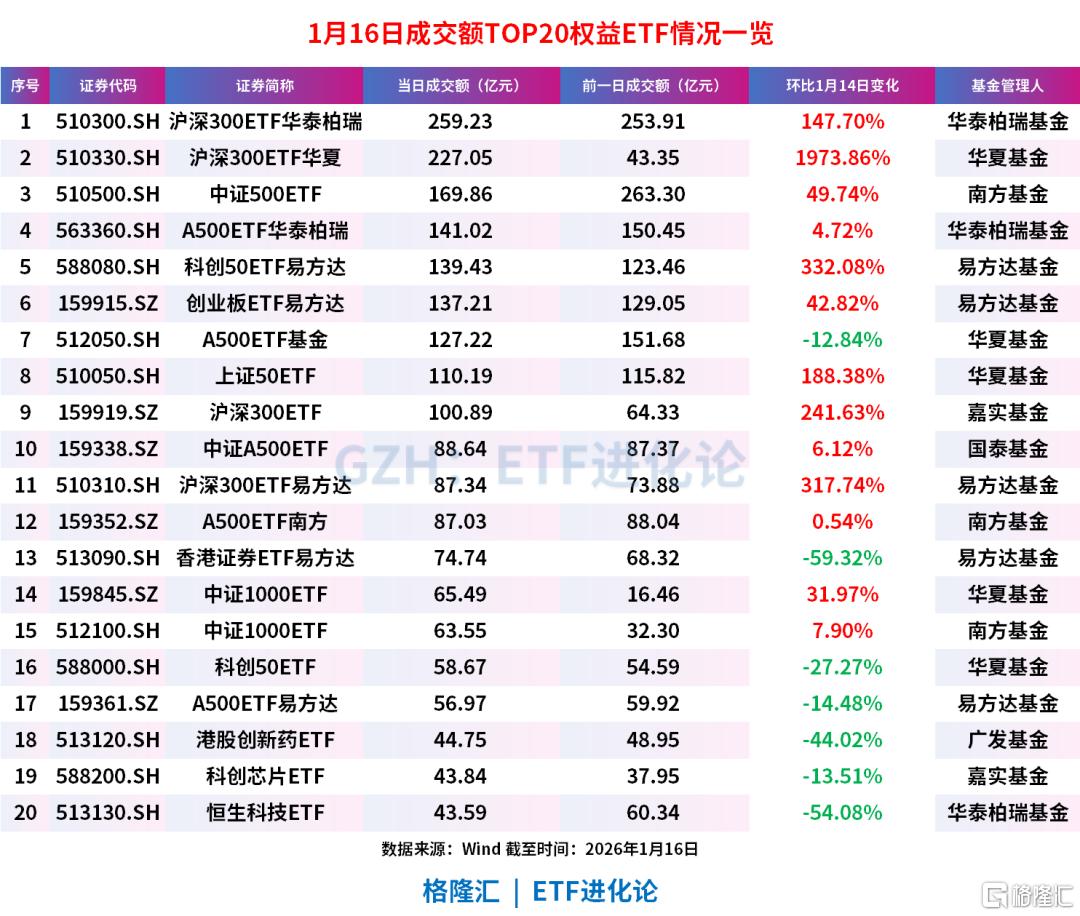
Core Viewpoint - The A-share market is experiencing an unprecedented tug-of-war between bulls and bears, highlighted by significant net outflows from major ETFs and a surge in leveraged funds [1][9][11]. Group 1: ETF Market Activity - Major broad-based ETFs saw a net outflow of 700 billion, with the total margin balance exceeding 2.7 trillion for the first time in history [1]. - The trading volume of ETFs reached a record high of 752.25 billion, marking the third consecutive day of record-breaking activity [1]. - Multiple broad-based ETFs, including the Huatai-PineBridge CSI 300 ETF and the Huaxia CSI 300 ETF, recorded transaction volumes exceeding 20 billion, with the latter seeing a nearly 20-fold increase compared to January 14 [2][4]. Group 2: Institutional Fund Flows - The top ten ETFs with the highest net outflows were all broad-based ETFs, totaling 715 billion in outflows, with the Huatai-PineBridge CSI 300 ETF alone experiencing a net outflow of 200 billion [9][10]. - Institutional funds showed a net outflow across nearly all major ETFs, indicating a trend of selling pressure despite high trading volumes [4][5]. Group 3: Leverage and Margin Trading - Leveraged funds have been aggressively buying, with net purchases of 206 billion on January 15, contributing to a total of 1.77 trillion in net purchases over the first nine trading days of the year [13][15]. - The current pace of leveraged fund inflows suggests that they could match last year's total net purchases in just over 25 trading days [15]. Group 4: Market Sentiment and Regulatory Environment - The market is showing signs of cooling, with regulatory measures aimed at tempering excessive speculation following a period of high trading volumes and bullish sentiment [11][19]. - The shift in regulatory stance is seen as a response to the rapid increase in trading activity, particularly after three consecutive days of trading volumes exceeding 3 trillion [19][20]. Group 5: Wealth Transfer and Investment Trends - A significant portion of the 160 trillion in household savings is being reallocated, which could have profound implications for the capital markets [21][30]. - The upcoming maturity of long-term deposits, estimated at 32 trillion, coincides with a bullish market environment, potentially leading to increased equity market participation [25][26].
帝科股份股价涨5.1%,国泰基金旗下1只基金重仓,持有1520股浮盈赚取6475.2元
Xin Lang Cai Jing· 2026-01-16 06:36
Core Viewpoint - The stock price of Dike Co., Ltd. has increased by 5.1% on January 16, reaching 87.87 yuan per share, with a total market capitalization of 12.08 billion yuan and a turnover rate of 11.00% [1] Group 1: Company Overview - Dike Co., Ltd. is located in Yixing City, Jiangsu Province, and was established on July 15, 2010, with its listing date on June 18, 2020 [1] - The company specializes in the research, production, and sales of high-performance electronic materials, with its main revenue sources being photovoltaic conductive paste (74.86%), material sales (21.31%), storage chips (2.26%), other (1.43%), and semiconductor packaging paste (0.14%) [1] Group 2: Fund Holdings - According to data, the Guotai Fund has a significant holding in Dike Co., Ltd., with the Guotai CSI 2000 ETF (561370) holding 1,520 shares, accounting for 0.32% of the fund's net value, making it the third-largest holding [2] - The fund has generated a floating profit of approximately 64,752 yuan today, with a total floating profit of 35,700 yuan during the three-day increase [2] - The Guotai CSI 2000 ETF was established on September 13, 2023, with a latest scale of 32.4956 million yuan, and has achieved a year-to-date return of 7.38% [2] Group 3: Fund Manager Performance - The fund managers of Guotai CSI 2000 ETF are Ma Yiwen and Liu Fangyuan, with Ma having a cumulative tenure of 2 years and 163 days and a total fund asset size of 10.148 billion yuan [3] - During Ma's tenure, the best fund return was 113.82%, while the worst was 0.35% [3] - Liu has a cumulative tenure of 281 days with a fund asset size of 563 million yuan, achieving a best return of 60.01% and a worst return of -7.87% during his tenure [3]