
大唐新能源

Search documents
港股概念追踪|看好银行长期投资价值 险资举牌潮进行时(附概念股)
智通财经网· 2025-06-04 00:50
Group 1 - Agricultural Bank of China was increased by China Ping An Life Insurance Company, acquiring 29.896 million shares at an average price of HKD 5.0291 per share, totaling approximately HKD 150 million, raising its stake from 11.93% to 12.03% [1] - In 2024, the insurance sector has initiated a third wave of shareholding increases, with 15 instances recorded by seven insurance companies, surpassing the total for the entire year of 2023 and the first nine months of 2024 [1] - The companies targeted for shareholding increases include Postal Savings Bank, China Merchants Bank, Agricultural Bank, and several others, with nine of these stocks being H-shares [1] Group 2 - The banking sector has been the most frequently targeted for shareholding increases, alongside public utilities, energy, and transportation sectors [2] - Research from Shenwan Hongyuan indicates that the banking sector has begun a valuation recovery in 2024, despite external economic pressures, suggesting a need to revise existing analytical frameworks [2] - Tianfeng Securities reports that the valuation recovery logic driven by dividend value is expected to continue, with limited downward pressure on net interest margins and a stable performance outlook for banks [2] Group 3 - Related Hong Kong stocks in the banking sector include Citic Bank, Minsheng Bank, Industrial and Commercial Bank of China, Agricultural Bank of China, Postal Savings Bank, China Construction Bank, and Bank of China [3]
龙源电力:存量资产优质,保障业绩稳定-20250603
Guoyuan International· 2025-06-03 08:23
Investment Rating - The report assigns a "Buy" rating to the company with a target price of HKD 8.00 per share, indicating a potential upside of 25% from the current price of HKD 6.41 [5][10]. Core Views - The company's Q1 2025 profit decline was influenced by poor wind resources and rising operating expenses, with revenue dropping by 19% year-on-year to HKD 81.40 billion and net profit decreasing by 22.07% to HKD 19.02 billion [7][8]. - The company plans to start new renewable energy projects totaling 5.5 GW in 2025, with 5 GW expected to be operational, including 3.2 GW of wind power and 1.7 GW of solar power [3][8]. - The company possesses high-quality existing assets that ensure stable performance, benefiting from favorable regulatory conditions in Shandong and Guangdong provinces [4][9]. Summary by Sections Financial Performance - In Q1 2025, the company achieved a revenue of HKD 81.40 billion, a 19% decrease year-on-year, and a net profit of HKD 19.02 billion, down 22.07% [7]. - The total power generation for Q1 was 202.86 billion kWh, a decline of 4.42% year-on-year, but a growth of 8.81% when excluding the impact of thermal power divestiture [7][8]. Project Development - The company aims to initiate 5.5 GW of new renewable energy projects in 2025, with 5 GW expected to be commissioned, including 3.2 GW of wind and 1.7 GW of solar [3][8]. - As of March 2025, the company’s total installed capacity reached 41.15 million kW, with wind power accounting for 30.44 million kW and solar power approximately 10.70 million kW [3][8]. Asset Quality - The company’s existing assets are of high quality, providing stable returns, supported by regulatory frameworks that ensure the profitability of existing projects [4][9]. - The company is positioned as a leader in the wind power sector, with a competitive advantage in market transactions due to its substantial existing asset base [4][9].

未知机构:XZ公用136号文实施现货市场加速推进电力市场化产生裂变效应-20250603
未知机构· 2025-06-03 01:50
Summary of Conference Call Records Industry Overview - The conference call discusses the electricity market in China, particularly focusing on the implementation of the New Energy 136 Document and the acceleration of the spot market, which signifies a shift towards market-oriented electricity pricing [1][1]. Key Points and Arguments - The New Energy 136 Document, effective from June 1, marks a significant step in the marketization of the electricity sector, particularly for new energy sources, which now account for the second-largest share of electricity generation [1][1]. - Over ten provinces have begun long-cycle trial operations of the electricity spot market this year, enhancing the supply-demand relationship in electricity pricing [1][1]. - The introduction of the spot market has led to increased price volatility, with some pilot provinces like Shandong and Shanxi experiencing intraday price fluctuations exceeding 50% [2][2]. - As renewable energy capacity continues to grow, it is expected that more trading cycles will be dominated by renewable sources, which will lower overall price levels. However, traditional thermal power will still play a crucial role during periods of insufficient renewable output, maintaining higher prices during those times [3][3]. - The volatility in price curves is leading to a compression of trading cycles, pushing for weekly, multi-day, and even daily trading to become mainstream [4][4]. - The comprehensive electricity price for thermal power has risen during periods of declining coal prices, indicating a shift towards a model where thermal power is not just about generation but also about price regulation [4][4]. Recommendations - The report recommends focusing on national comprehensive power companies and northern thermal power companies with performance elasticity, such as: - Jintou Energy - Datang Power (H) - Huaneng International (H+A) - Huadian International (H+A) - Continued recommendations for Waneng Power, Sheneng Co., Huaneng Hydropower, and Guodian Power [4][4]. - For green energy, companies like Xintian Green Energy, Datang New Energy, and Longyuan Power (H) are highlighted. - In the hydropower sector, recommended companies include Yangtze Power, Chuan Investment Energy, Guotou Power, and Huaneng Hydropower [4][4]. Risks - The report outlines several risks associated with the marketization of electricity trading, including: - Price volatility risks due to market fluctuations - Risks from variations in wind and water resources - Significant increases in thermal coal prices - Delays in resource approval for new energy projects - Risks from macroeconomic downturns affecting electricity demand [4][4].


6.3犀牛财经早报:私募机构重仓新上市ETF 28家公司“脱星”“摘帽”
Xi Niu Cai Jing· 2025-06-03 01:43
Group 1: Bond ETF Market - The bond ETF market has seen significant growth, with over 40 billion yuan in net inflows in May alone, reaching a new high in total scale [1] - On May 30, 10 out of the top 12 ETF products by trading volume were bond ETFs, indicating strong market participation [1] - Nine bond ETFs have been approved for use as collateral in general pledge-style repurchase agreements, which may accelerate the expansion of the bond ETF market [1] Group 2: Public Fund Issuance - In May, bond funds dominated the public fund issuance market with a 55.07% issuance ratio, while equity products faced uneven demand [1] - The issuance of ETFs has declined for four consecutive months, raising only 11.068 billion units in May [1] - The market reflects a struggle between stability and change, with bond funds providing a safety net while equity products seek growth in niche segments [1] Group 3: Private Equity and ETF Investment - Private equity firms have shown strong interest in newly listed ETFs, with 104 firms holding a total of 1.783 billion shares in 97 ETFs [2] - The preferred themes for private equity investments are technology innovation and free cash flow [2] Group 4: Insurance Companies' Stock Purchases - As of the end of May, seven insurance companies have made 15 stock purchases this year, surpassing the total for 2023 and the first nine months of 2024 [2] - The majority of these purchases have been in bank stocks, with additional investments in public utilities, energy, and transportation sectors [2] Group 5: Corporate Developments - 28 companies have successfully removed their ST (Special Treatment) status this year, primarily through financial improvements, internal control repairs, and bankruptcy restructuring [3] - The airline industry is expected to see improved profitability due to falling oil prices and recovering demand, with a projected net profit margin of 3.7% for 2025 [3] - Domestic new energy vehicle manufacturers reported significant sales growth in May, with several companies achieving monthly sales exceeding 40,000 units, driven by extended-range vehicles [4] Group 6: Tesla's Sales Decline - Tesla's sales in France plummeted by 67% in May, marking the lowest sales level in nearly three years, despite the launch of a new version of its Model Y [6]


第三次举牌潮持续!险资年内举牌15次,涉及这些股票
券商中国· 2025-06-02 09:11
举牌涉及这些股票 从险资举牌标的来看,保险公司今年举牌的股票包括北京控股、电投产融、东方物流,中国儒意、中国水务、 大唐新能源、中国神华、杭州银行以及邮储银行、招商银行、农业银行、中信银行等银行H股,其中9只股票 为H股。 险资持续举牌上市公司,引发市场广泛关注。 据券商中国记者统计,截至5月31日,7家保险公司共实施15次举牌,超过2023年全年举牌量,并接近2024年全 年举牌数。这场从2024年启动的举牌潮已经持续一年多,且丝毫没有减弱趋势,去年至今险资举牌已超30次。 第三次举牌潮持续 5月19日,平安人寿发布举牌公告,平安资管受托该公司资金投资农业银行H股股票,5月12日达到农业银行H 股股本的10%。 这是平安人寿今年第5次举牌。其他举牌保险公司还包括中国人寿,新华保险、阳光人寿、长城人寿、瑞众人 寿、中邮人寿等。 险资投资上市公司股票并不鲜见,但只有达到一定规模才能称得上"举牌"。根据相关规定,保险公司举牌上市 公司股票,是指保险公司持有或者与其关联方及一致行动人共同持有一家上市公司已发行股份的5%,以及之 后每增持达到5%时,按照相关法律法规规定,在3日内通知该上市公司并予以公告的行为。 近1 ...




传奇基金经理出手了!
Ge Long Hui· 2025-05-24 07:12
Group 1 - The core viewpoint of the article highlights the impact of Trump's threats to impose tariffs on the EU and Apple, which has led to a significant decline in the U.S. stock market, particularly affecting major tech stocks like Apple [1][2] - The S&P 500 index has experienced a four-day decline, with Apple leading the drop among the tech giants, marking an eight-day losing streak [1] - Bill Ackman, a prominent hedge fund manager, has taken advantage of the market dip by buying Amazon shares after a significant price drop due to tariff concerns, indicating a potential undervaluation of the company [1][2] Group 2 - Ackman's investment strategy is supported by two main reasons: the resilience of Amazon Web Services (AWS) as the core profit driver and the limited impact of tariffs on Amazon's retail business, as less than 15% of its self-operated products are imported [2] - Ackman is recognized for his legendary investment acumen, having predicted the subprime mortgage crisis in 2007 and profiting significantly during the COVID-19 pandemic [2] - The article notes Ackman's strategic timing in selling Nike shares before the tariff announcement, raising questions about his investment decisions and market timing [2][4] Group 3 - Yang Dong, another notable fund manager, has made significant adjustments to his investment portfolio in April, reducing exposure to convertible bonds while increasing investments in sectors like real estate, power, and chemicals [5] - Yang's focus on domestic demand growth and the stabilization of the real estate market is seen as a key strategy for future investments [5] - He emphasizes that stocks remain a favorable investment choice compared to fixed-income assets, citing the potential for structural opportunities in consumption, healthcare, and new infrastructure [5] Group 4 - The first batch of new floating-rate funds has been rapidly approved, reflecting regulatory attention to enhancing the public fund industry [6][10] - These funds will feature a performance-based fee structure, linking management fees to investment performance, which is expected to improve active management capabilities and align interests between fund managers and investors [10][14] - The floating-rate funds are designed to encourage long-term investment by requiring a minimum holding period of one year to benefit from fee adjustments, thereby reducing short-term speculation [14]

创新药暴涨后,接下来买哪个?5月分红官宣,港股红利ETF基金(513820)净流入暴增140%!险资600亿“子弹”即将落地,长线资金箭在弦上
Sou Hu Cai Jing· 2025-05-23 03:47
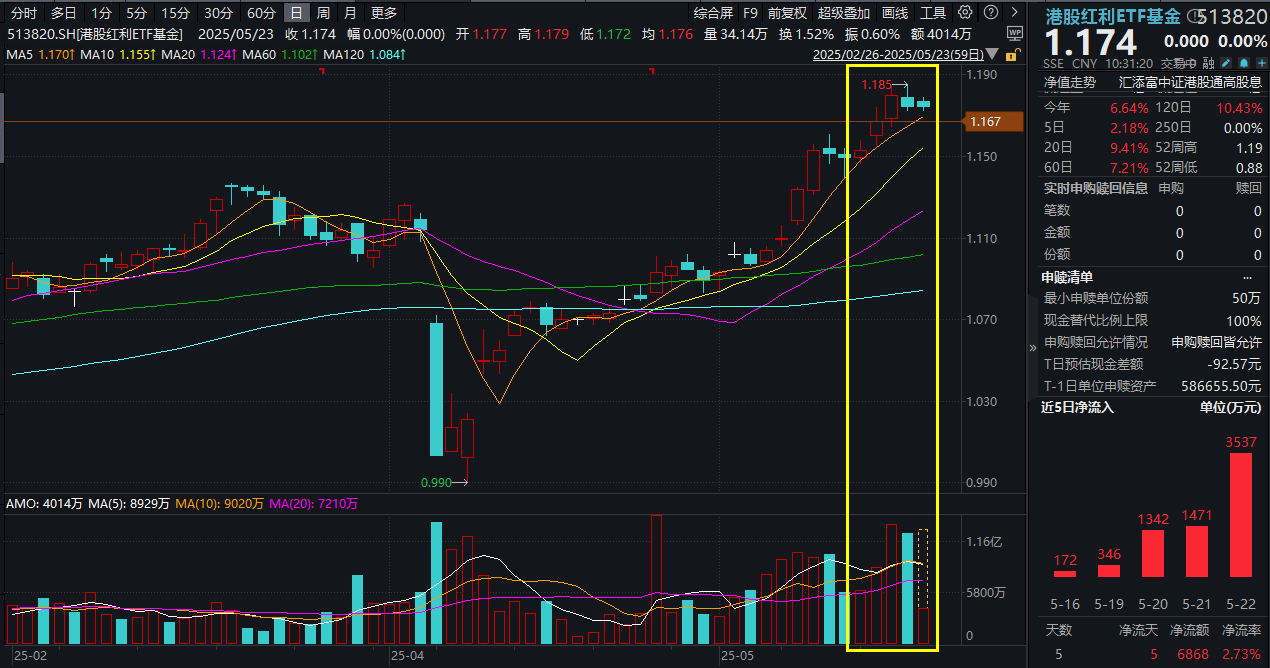
Group 1 - The Hong Kong stock market is experiencing a surge, with innovative drugs taking over from the technology sector, indicating a potential rotation in sectors as the market becomes more similar to the A-share market [1] - Zhang Yidong, Chief Strategist at Xingzheng Securities, suggests that investors should focus on both offensive and defensive strategies, with technology and dividends being the two core assets in the Hong Kong market [1] - The Hong Kong Dividend ETF (513820) has recently reached new highs since its listing, with the underlying index approaching last October's peak, and has seen a significant inflow of funds, with a 140% increase in net inflow compared to the previous period [1] Group 2 - The Hong Kong Dividend ETF (513820) has announced a series of dividends, with the first scheduled for July 2024, distributing 0.05 yuan per 10 fund shares [2] - The ETF has consistently paid dividends for 11 consecutive months since July 2024, with a total distribution of 0.30 yuan per 10 shares [5][14] - The ETF's underlying index has a leading dividend yield of 8.91% as of April 30, 2025, making it attractive compared to other dividend indices [13] Group 3 - Recent approvals for insurance funds to participate in long-term investment trials indicate a significant increase in the total scale of long-term stock investment trials to 222 billion yuan [3] - Insurance funds are showing a clear preference for high-dividend stocks, with 68% of their heavy holdings in stocks yielding over 3% [4] - The insurance sector has made 15 significant stock purchases this year, primarily in high-dividend sectors such as banking and public utilities [4][6] Group 4 - National team funds have slightly reduced their allocation to A-shares, with a focus on high-dividend sectors, particularly in banking and non-banking financials [7][10] - Social security funds have also shown a slight decrease in their allocation to A-shares, maintaining a strong focus on high-dividend sectors [10]
建议增配公用事业及电力设备 储能收益改善措施出台 | 投研报告
Zhong Guo Neng Yuan Wang· 2025-05-18 21:42
Group 1: Energy Sector Insights - The report highlights the uncertainty surrounding the entry of new energy sources under Document No. 136, but emphasizes that the dual carbon strategy remains a steadfast guiding principle for China's energy development, suggesting a preference for undervalued quality wind power operators [1] - The new regulations from the China Securities Investment Fund Industry Association and the China Securities Regulatory Commission are expected to significantly impact the asset management industry's behavior, particularly favoring public utilities as a major beneficiary [2][4] - The analysis indicates that the four major hydropower companies have consistently ranked in the top 4% of the entire A-share market in terms of risk-return ratio over the past five years, with leading thermal power companies also performing well [3] Group 2: Investment Recommendations - The report recommends focusing on hydropower companies with strong risk resistance and undervalued quality thermal power operators benefiting from declining coal prices, while also suggesting a preference for quality wind power operators [5] - Specific recommendations include: Hydropower: Guotou Power, Changjiang Power, Chuan Investment Energy; Wind Power: Longyuan Power (H), Goldwind Technology (H), Xintian Green Energy, Datang New Energy, China General Nuclear Power; Thermal Power: Waneng Power, Shanghai Electric, China Resources Power, Huadian International, Sheneng Shares [5] - The report also suggests monitoring companies that benefit from the construction of new power systems and those with high risk-return ratios, such as Guodian NARI, Siyi Electric, Pinggao Electric, and Dongfang Electronics [5] Group 3: Energy Storage Developments - The report notes a significant increase in domestic orders for energy storage systems, with a focus on improving the profitability of energy storage stations through various measures, particularly in Shandong province [6] - The overseas demand for energy storage remains strong, with a reported 756.72% year-on-year growth in overseas orders for the first quarter of 2025, approaching a total of 100 GWh [6] - Key suppliers in the energy storage sector, such as Sungrow Power Supply, CATL, and Aters, are expected to benefit from these trends [7]
大唐新能源(01798.HK):入市拖累短期业绩 看好风电运营商长期价值
Ge Long Hui· 2025-05-18 17:57
Core Viewpoint - The company reported a slight increase in revenue for Q1 2025, but a decline in net profit, attributed to falling electricity prices and increased depreciation costs [1][2]. Financial Performance - Q1 2025 revenue reached 3.558 billion yuan, a year-on-year increase of 0.93% - Net profit attributable to shareholders was 1.021 billion yuan, a year-on-year decrease of 4.44% - The decline in profit is linked to lower electricity prices and increased depreciation due to new projects [1][2]. Power Generation and Capacity - The company generated 9.905 billion kWh of electricity in Q1 2025, a year-on-year increase of 9.26% - Wind power generation was 8.921 billion kWh, up 8.57% year-on-year, while solar power generation was 984 million kWh, up 15.98% year-on-year - As of the end of 2024, the installed capacity for wind and solar power was 14.4818 million kW and 4.3645 million kW, respectively, representing year-on-year growth of 11.56% and 79.06% [1][2]. Market Conditions - The average wind speed at 10 meters nationwide in April 2025 was 0.98% higher than the same period over the past decade, contributing to a 16.68% increase in wind power generation for the month [2]. - The decline in revenue growth compared to power generation growth is attributed to lower electricity prices following the marketization of renewable energy [2]. Accounts Receivable and Valuation - Accounts receivable amounted to 23 billion yuan, approximately 1.54 times the company's current market value of 16.1 billion HKD - The receivables primarily consist of renewable energy subsidy payments, which have been a constraint on capital expenditure and dividends [3]. - The company has improved its dividend payout, with a total dividend of 0.09 yuan per share in 2024, representing 52% of the distributable profit [3]. Long-term Outlook - The company is viewed positively in the context of the wind power sector, which is expected to have higher investment value compared to solar power due to better operational efficiency and lower costs [3]. - The recent policy (Document No. 136) is seen as beneficial for existing assets, enhancing the long-term value of established wind power operators [3]. Profit Forecast - The company is projected to achieve net profits of 2.32 billion, 2.46 billion, and 2.52 billion yuan for the years 2025 to 2027, with corresponding price-to-earnings ratios of 6.5, 6.1, and 5.9 [4].
电力行业投资策略:高耗能行业绿电消纳要求有望提振绿电环境价值
KAIYUAN SECURITIES· 2025-05-18 08:25
Investment Rating - The industry investment rating is optimistic (maintained) [1] Core Insights - The report emphasizes the shift towards a more relaxed power supply and demand environment, highlighting the importance of stable profitability in the power industry [3] - The introduction of mandatory green electricity consumption ratios for high-energy-consuming industries is expected to stimulate the green certificate market and enhance its value [4][5] - The green certificate supply shock is anticipated to end by the end of 2025, leading to improved market conditions [12][13] Summary by Sections Supply - The supply shock caused by the issuance of green certificates is expected to conclude by the end of 2025, with a total of 47.34 billion green certificates issued in 2024, including 31.58 billion that are tradable [4][12] - The green certificate issuance is projected to grow, with estimates of around 25 billion in 2025 and reaching 40 billion by 2030 [20][21] Demand - The mandatory consumption policies for high-energy industries are likely to drive an increase in green certificate consumption, with only 14.12% of the issued certificates being traded in 2024 [5][24] - The electricity consumption of high-energy industries accounted for 27.32% of the total social electricity consumption in 2024, indicating significant potential for green certificate demand [5][27] Outlook - The green certificate market is expected to experience a recovery post-2025, with improved consumption policies likely to enhance trading volumes and prices [32] - The report suggests that the green certificate prices may return to reasonable levels, significantly boosting the profitability of renewable energy operators [6][34] Beneficiary Stocks - Recommended stocks include high-quality, low-valuation renewable energy operators such as Datang Renewable, Longyuan Power, China Power, and others [36][37]