
AWS

Search documents
花旗:GPUvsAI ASIC-不只是芯片设计,互操作性和系统集成是关键
花旗· 2025-07-07 15:45
Investment Rating - The report maintains a "Buy" rating for MediaTek and a "Neutral" rating for Alchip, while downgrading GUC to "Sell/H" [5][43][52]. Core Insights - The report emphasizes the increasing importance of system integration and interoperability in the semiconductor industry, particularly for AI ASICs and GPUs. It highlights that successful chip design alone is insufficient; cohesive and scalable systems are crucial for performance [1][9][18]. - The transition of AI chips from N5/4 to N3 nodes is expected to significantly increase average selling prices (ASP) and computing capabilities, despite a slowdown in overall AI chip shipment growth [2][16]. - Nvidia continues to dominate the AI server market, holding over 80% of market value, while Broadcom leads in the ASIC market driven by its Google TPUs [23][36]. Summary by Sections AI ASIC Market Dynamics - Broadcom holds the largest market share in the ASIC market, with stable trends expected for TPU v7 and growth anticipated for TPU v8 in late 2026 [3][36]. - The report estimates that AI ASIC shipments from major cloud service providers (CSPs) will reach approximately 4.5 million units in 2026, which is lower than consensus estimates [2][23]. System Integration and Design - The report stresses the need for advanced system design capabilities, including thermal management and network fabric design, to support the growing complexity of AI workloads [18][22]. - It notes that developing an HPC AI ASIC can take 3-4 years, necessitating partnerships with experienced semiconductor makers to expedite the process [20][22]. Company-Specific Insights - MediaTek is highlighted as a preferred choice due to its design expertise and expected revenue contributions from AI ASICs starting in late 2026 [5][43][45]. - Alchip's contribution is expected to begin in 2H26, with a cautious outlook due to potential redesign delays [52][53]. Financial Projections - The report provides revised financial estimates for MediaTek, projecting a revenue of NT$588.85 billion for 2025, with a YoY growth of 11% [46]. - Alchip's financial outlook is less optimistic, with a projected revenue of NT$41.96 billion for 2025, reflecting a decline [52][53].
野村证券:全球先进封装
野村· 2025-07-01 02:24
Investment Rating - The report initiates coverage of K&S (KLIC US) with a Buy rating, and BE Semiconductor (BESI NA) with a Neutral rating, while maintaining a Buy rating on ASMPT (522 HK) [3][6][11]. Core Insights - Advanced packaging (AP) is expected to evolve significantly from 2025 onwards, with a shift from CoWoS-S to CoWoS-L/R, increased adoption of SoIC driven by HBM5, and potential upgrades in InFO technology led by Apple [3][6]. - The semiconductor cycle's recovery is a key catalyst for K&S and ASMPT, given their substantial sales exposure to conventional packaging [3][6]. CoWoS Technology - CoWoS technology is transitioning from CoWoS-S to CoWoS-L, with TSMC expected to increase its CoWoS-L capacity from approximately 20% in 2024 to nearly 60% in 2025 [7][21]. - CoWoS-S is anticipated to face oversupply due to non-TSMC supply chain expansions, while CoWoS-L is expected to be in demand for high-end GPUs [7][28]. SoIC Technology - SoIC is projected to gain importance with the adoption of high-NA EUV technology, although headwinds are expected in 2025 due to limited new adopters and potential capex constraints from Intel [8][14]. - AMD is currently the major adopter of SoIC, with potential future demand driven by Apple and HBM technologies [8][14]. InFO Technology - Apple is likely to adopt upgraded InFO technology from 2026 onwards, necessitating capacity upgrades to accommodate new application processor designs [9][20]. - The transition from InFO-PoP to InFO-M is expected as the I/O count between DRAM and application processors becomes insufficient [9][20]. Company-Specific Insights - K&S is positioned to be the primary TCB supplier for TSMC's on-wafer process starting in 2025, benefiting from the shift towards CoWoS-L technology [3][6]. - ASMPT is expected to gain market share in the HBM market from a low base, with its TCB potentially adopted by TSMC and Apple in the future [3][6]. - BE Semiconductor faces challenges due to rich valuations and potentially disappointing hybrid bonding orders in 2025 [3][6].

瑞银:最新企业人工智能调查_英伟达、OpenAI 和微软保持领先
瑞银· 2025-07-01 00:40
Investment Rating - The report does not explicitly provide an investment rating for the industry Core Insights - The survey indicates that Nvidia, Microsoft, and OpenAI continue to dominate the AI landscape, with a focus on identifying potential tailwinds and headwinds for other players in the market [2][4] - 100% of surveyed organizations are in the AI investigation stage, but only 14% are in production at scale, highlighting a slow adoption curve [3][8] - The average AI spend per organization is $3.27 million, with larger companies spending more, indicating that AI investments are still in early stages [3][56] Overall Enterprise AI Adoption - 100% of respondents are investigating AI use cases, but only 14% are in production at scale, suggesting a slow adoption curve [3][8] - The average AI spend per organization is $3.27 million, representing only 0.4% of the average IT budget of $806 million [56] - The most frequently cited hurdle for AI adoption is "unclear ROI," with 72% of respondents indicating that AI spending would displace other IT budget items [8][62] Key Players and Market Dynamics - Nvidia remains the preferred platform for both training and inference, with 86% of respondents choosing Nvidia for training and 87% for inference [12][4] - Microsoft maintains a strong lead in hosting AI workloads, followed by AWS, with only 13% of enterprises reporting material GPU constraints [10][4] - OpenAI's models dominate the enterprise market, with Google Gemini emerging as a significant competitor [11][4] Application and Data Software Trends - Microsoft M365 Copilot and GitHub Copilot are leading applications in their respective markets, with significant adoption among enterprises [5][16] - The DIY option for AI solutions is gaining traction, indicating a shift away from third-party software [19][5] - Data software firms are expected to benefit from increased AI spending, particularly in cloud-based data warehouses [17][5] IT Spending Outlook - The average expected increase in IT budgets for 2025 is 4.4%, unchanged from the previous survey, indicating a stable spending outlook [38] - 72% of respondents expect AI spending to displace other IT budget items, with a notable increase in the desire to consolidate IT solutions [62][66] - The survey results suggest that enterprises are likely to defer back-office investments to fund AI initiatives [66][8]

ETF复盘资讯|急跌后逆转!中际旭创成交超百亿,新易盛新高不断!创业板人工智能六连涨,单月飙升17%领跑市场
Sou Hu Cai Jing· 2025-06-30 12:46
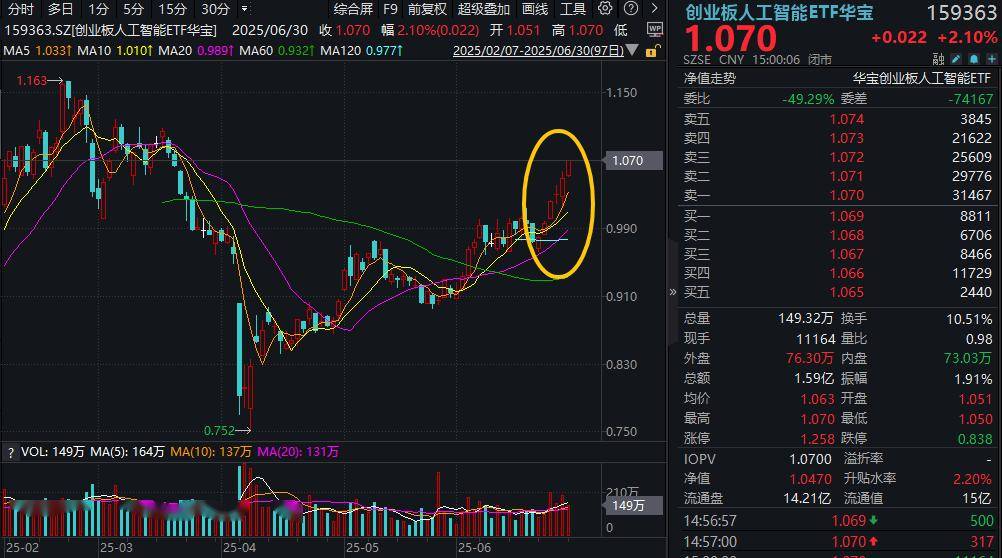
Core Viewpoint - The AI computing industry continues to show strong performance, with significant gains in related stocks and ETFs, particularly in the context of increasing demand for AI infrastructure and components [1][3][5]. Group 1: Stock Performance - On the last trading day of June, the AI computing sector remained active, with the ChiNext AI ETF achieving a six-day consecutive rise, closing up 2.1% [1]. - Notable stocks such as Zhongji Xuchuang and Tianfu Communication saw significant fluctuations, with Tianfu Communication leading with a rise of over 6% [1]. - The ChiNext AI ETF Huabao (159363) recorded a trading volume of 1.59 billion yuan, indicating strong market interest [1]. Group 2: Monthly Performance - The ChiNext AI ETF Huabao reported a monthly increase of 16.99%, outperforming the ChiNext Index, which rose by 8.02% [6]. - The ETF's performance was significantly better than other AI-themed indices, such as CS AI and Kexin AI [6]. Group 3: Industry Outlook - The investment strategy for July suggests continued high demand for AI computing infrastructure, particularly in light of the upcoming earnings forecast season [3]. - Key sectors to watch include optical modules and copper connection industries, which are expected to benefit from global AI development [3]. - The server manufacturing sector is experiencing robust growth, with Taiwanese AI server manufacturers reporting a year-on-year revenue increase of 162% in May [4]. Group 4: Market Trends - The A-share computing industry is viewed as a rare growth sector, with expectations that the commercialization of AI will enhance its market position [5]. - The report emphasizes the importance of focusing on leading companies in the optical module sector and related fields to capture opportunities in the AI market [5].


互联网云厂重视ASIC自研芯片投入,AI算力高景气度延续
2025-06-30 01:02
Summary of Conference Call Records Industry Overview - The optical module market is experiencing a positive outlook, driven by the new developments and optimistic forecasts from internet cloud companies. The demand for 800G and 1.6T optical modules is expected to reach 40 million and 6-8 million units respectively by 2026, primarily due to changes in CSB manufacturers' architectures and increased market demand [1][4]. Key Companies and Their Performance - **Leading Companies**: - **Xuchuang** maintains its leading position in the market, while **Xinyi** has rapidly increased its market share, collaborating closely with major clients like Meta and Amazon. Revenue for leading companies is projected to reach RMB 36-37 billion in 2025 and RMB 44-45 billion in 2026, with significant potential for profit margin improvement [1][5]. - **Second-tier Companies**: - Companies like **Sorshi**, **LianTe Technology**, and **Cambridge Technology** are expected to capture market share, with the overall industry beta being revised upwards. If Sorshi secures over a million 800G orders, its profitability could significantly improve [6][8]. - **Domestic Leaders**: - Domestic leaders such as **Huagong Technology** and **Guangxun Technology** are set to benefit from increased capital expenditure in the domestic CS market, with strong performance anticipated in the second half of 2025 [7][8]. Market Trends and Future Expectations - The optical module market is expected to grow, with 800G module demand projected to rise from 35 million to 40 million units, and 1.6T modules from 5 million to 6-8 million units. This growth is influenced by collaborations like that between Google and OpenAI, which may further boost demand [4][12]. - The optical module jumpers market shows significant potential, with an estimated demand of 20 million units for 800G jumpers, translating to a market space worth hundreds of billions of RMB. Companies like **Taisheng Guangbo**, **Hengtong Optic-electric**, and **Aikangde** are expected to benefit from this market [9]. Technological Developments - **Meta's New Architecture**: Meta's MTIA architecture increases the demand for OSFP 800G optical modules and copper DAC connections, significantly impacting the CSP field. This architecture utilizes a large number of optical modules, which is expected to drive demand from major internet companies [13]. - **Copper Connections**: The role of copper connections in data center interconnectivity is crucial, with companies like **Credo** showing substantial revenue growth and plans to double capital expenditures, indicating a healthy market for copper connections [14]. Conclusion - The optical module industry is poised for growth, with strong demand for high-end products like 800G and 1.6T modules. The collaboration between major tech companies and the increasing capital expenditure in the domestic market are key drivers of this growth. Companies in both the leading and second-tier categories are expected to benefit significantly from these trends, making them worthy of investment consideration [12][19].
独家丨AWS中国L8高管李晓芒或将离职,加入光环新网
雷峰网· 2025-06-30 00:51
Core Viewpoint - The rumors surrounding Li Xiaomang's departure from AWS China reflect a significant internal power reshuffle within the organization [1] Group 1: Li Xiaomang's Role and Departure - Li Xiaomang, a senior executive in AWS Greater China, is rumored to leave for Guanghuan Xinwang, having previously been responsible for nearly 80% of AWS China's revenue [2] - Following the appointment of Shuzhuo Song as the new head of AWS Greater China, Li was reassigned to oversee partner business, and later became a strategic advisor [2] - Li Xiaomang has nearly 30 years of experience in the IT industry, holding various senior positions at IBM, VMware, Microsoft, and AWS [2] Group 2: Guanghuan Xinwang's Position - Guanghuan Xinwang has gained attention as a prominent player in the data center sector, benefiting from favorable market conditions since late last year [3] - The company has a historical partnership with AWS, having operated AWS's Beijing region since around 2016 to meet compliance requirements [3] - AWS Greater China's core mission this year includes driving growth in the China region, with Guanghuan Xinwang being a key player in this strategy [3]


JP Morgan--台积电CoWoS和WMCM的客户和产能分析
傅里叶的猫· 2025-06-29 10:24
Core Viewpoint - The article provides an analysis of TSMC's CoWoS and WMCM technologies, focusing on customer demand, capacity forecasts, and investment outlooks, particularly in the semiconductor industry [1]. Customer Demand Analysis - For NVIDIA, JP Morgan forecasts a 25% increase in CoWoS demand by 2026, reaching 58% market share, driven by the migration to the Rubin platform, which will increase package size by 50% [2]. - AMD's CoWoS demand is expected to be weak in 2025 and 2026 due to restrictions on the MI300 series in the Chinese market, but there is optimism for the MI400 series in late 2026 and 2027 [3]. - Broadcom is projected to see stable growth in ASIC demand, particularly from Google TPU, with Meta expected to start mass production of its CoWoS-based AI accelerator in 2025 [4][5]. Capacity and Technology Analysis - TSMC's CoWoS capacity is expected to stabilize by 2027, with a slight slowdown in expansion plans due to reduced GPU demand in China [10]. - By 2026, CoWoS-L is anticipated to account for 64% of TSMC's total CoWoS output, driven by more customers migrating to this technology [13]. - WMCM technology is simpler than CoWoS and is expected to significantly expand, with production capacity projected to reach 27,000 wafers per month by the end of 2026 and 40,000 by the end of 2027 [15]. Overall Consumption Forecast - Total CoWoS consumption is projected to grow from 134,000 wafers in 2023 to 1,132,000 wafers by 2027, reflecting a compound annual growth rate of 32% [11]. - NVIDIA's CoWoS consumption is expected to increase significantly, with projections of 705,000 wafers by 2027, while AMD's consumption will remain modest [11]. - The overall market for CoWoS is expected to see a shift towards CoWoS-L, with a majority of customers adopting this technology by 2025 [11][12].


C3.ai Stock Slides 32% in 6 Months: Right Time to Buy the Dip?
ZACKS· 2025-06-25 15:36
Core Insights - C3.ai, Inc. (AI) shares have declined 32.2% over the past six months, significantly underperforming the industry decline of 12.5% and the S&P 500's drop of 1% [1] - The company's stock performance is impacted by high operational costs despite revenue growth, with a consumption-based pricing model leading to increased pilot costs and expensive customer acquisition [1][19] - C3.ai is expanding its operations through a growing direct salesforce and partnerships with major firms like Microsoft, AWS, and McKinsey's QuantumBlack, which is expected to drive long-term growth but may pressure near-term operating margins [2] Price Performance - In the last month, C3.ai's stock gained 6.4%, contrasting with a 0.4% decline in the industry, closing at $24.17, still below its 52-week high of $45.08 but above its low of $17.03 [5] - Competitors such as Asana, Inc. (ASAN) and Braze, Inc. (BRZE) experienced stock declines of 13% and 28.3%, respectively, during the same period [5] Financial Estimates - The Zacks Consensus Estimate for fiscal 2026 and 2027 loss per share has improved to 37 cents and 16 cents, respectively, from previous estimates of 47 cents and 45 cents [8] - Sales growth estimates for fiscal 2026 and 2027 are projected at 20.1% and 21.8%, respectively, while Asana and Braze are expected to see sales increases of 7.9% and 18.7% [9] Growth Drivers - C3.ai is gaining traction in the federal sector, highlighted by a $450 million contract with the U.S. Air Force for its PANDA predictive maintenance platform, indicating a growing role in national defense [10][19] - The company's AI-driven platforms are now integrated across various military branches, enhancing operational efficiency and providing real-time insights [11] - In Q4 fiscal 2025, 73% of agreements were made in collaboration with major cloud providers, leading to a 419% year-over-year increase in partner-driven bookings [12][13] Customer Expansion - C3.ai has expanded its customer base across commercial and government sectors, securing notable clients such as Flex, Sanofi, ExxonMobil, Shell, and the U.S. Department of Defense [14] - The company is leveraging its generative AI solutions for applications ranging from predictive maintenance to customer service enhancement [14] Valuation - Despite recent stock gains, C3.ai is trading at a discount compared to its industry, with a forward 12-month price-to-sales ratio of 6.64, lower than Asana's 3.83 and Braze's 3.77 [15] Long-term Outlook - The recent stock weakness does not reflect the operational progress and long-term potential of C3.ai, positioning it as a compelling investment opportunity for forward-looking investors [18] - The company is building a strong foundation through government contracts and partnerships, which are expected to lead to durable revenue growth and margin improvement over time [19][20]


2026年,99%的AI创业公司将会倒闭?
Hu Xiu· 2025-06-24 00:45
Core Insights - The article draws parallels between the dot-com bubble of the late 1990s and the current AI-driven startup landscape, highlighting that many AI tools are essentially rebranded OpenAI products without substantial innovation [6][7][12] - The dependency of AI startups on OpenAI's technology creates a fragile ecosystem where the failure of these startups could significantly impact OpenAI's revenue and market position [15][21][30] Group 1: AI Startup Landscape - Many so-called "AI tools" are merely sophisticated interfaces for OpenAI's API, lacking original technology or infrastructure [8][28] - The business model of these shell products relies on exploiting information asymmetry, charging users significantly more than the actual cost of API calls [11][22] - The relationship between OpenAI and these shell products is interdependent, with OpenAI needing the distribution channels provided by these startups [18][19] Group 2: Risks and Vulnerabilities - The reliance on shell products creates a risk for OpenAI, as the collapse of these companies could lead to a loss of customers and revenue streams [17][21] - The entire AI ecosystem is vulnerable to disruptions in the supply chain, particularly concerning NVIDIA, which provides the hardware necessary for AI model training and deployment [37][46] - Regulatory actions or geopolitical tensions could also pose significant risks to the AI infrastructure, potentially halting operations across the board [52][53] Group 3: Competitive Landscape - Companies like Jasper and Copy.ai illustrate the challenges faced by AI startups, with many struggling to maintain profitability and market relevance in the face of competition from larger players like OpenAI and Microsoft [31][32][34] - The article emphasizes that true survival in the AI space will depend on companies that can build genuine user experiences rather than relying solely on API calls [36][68] - The current trend of shell products is unsustainable, as they lack the foundational technology and infrastructure necessary for long-term success [62][69] Group 4: Infrastructure and Future Outlook - The article posits that foundational infrastructure providers like NVIDIA and AWS will ultimately prevail, as they are essential for the functioning of the AI ecosystem [62][65] - The future of AI will be shaped by companies that can innovate beyond mere API usage and create lasting value for users [66][68] - The cyclical nature of tech bubbles suggests that the current AI boom will eventually end, leading to a consolidation of power among those who control the underlying infrastructure [69][70]

瑞银:美国生成人工智能最新动态
瑞银· 2025-06-23 13:16
Investment Rating - The report does not explicitly state an investment rating for the industry or specific companies covered Core Insights - The Trump administration has increased the tax credit for chipmakers from 25% to 30%, incentivizing investment in US projects and new facilities [2] - Major tech companies are lobbying for a 10-year ban on state regulation of AI to prevent inconsistent regional rules that could hinder innovation [3] - The Taiwanese government is investing approximately $3 billion in 10 AI projects focusing on applications, new technologies, and infrastructure [4] - Texas Instruments plans to invest $60 billion in semiconductor plants in the US, including new factories in Texas [4] - SK Group and AWS are collaborating on a 60,000 GPU data center in South Korea, which will be the largest of its kind in the country [5] - A dozen Latin American countries are working together to launch Latam-GPT, an AI model tailored to the region's cultural and linguistic diversity [6] - Amazon is set to invest around $13 billion in data centers in Australia, alongside investments in solar farms to support this infrastructure [7] Summary by Sections US Enterprise Hardware and Networking - The increase in the tax credit for chipmakers is expected to boost investment in US semiconductor projects [2] AI and Technology Investments - Tech companies are advocating for a moratorium on state-level AI regulations to streamline innovation efforts [3] - Taiwan's investment in AI projects highlights a strategic focus on technology development and infrastructure [4] - The collaboration between SK Group and AWS on a GPU data center signifies a significant investment in AI infrastructure in South Korea [5] - The initiative to create Latam-GPT reflects a growing interest in AI tailored to specific regional needs [6] Data Center Investments - Amazon's substantial investment in Australian data centers indicates a strong commitment to expanding its cloud infrastructure [7] - Texas Instruments' investment in semiconductor plants underscores the ongoing demand for hardware in the tech sector [4]