
海底捞

Search documents
贾国龙:今晚10点将就罗永浩对西贝重大污蔑诽谤全面回应
2 1 Shi Ji Jing Ji Bao Dao· 2026-01-16 10:18
1月16日,西贝贾国龙发文: 各位好,我是贾国龙,一会儿上高铁。 今晚10点,我们将就罗永浩对西贝的重大污蔑诽谤一一全面回应。 在回应前,请罗永浩先就四个月来在冷冻有机西蓝花事情上欺骗全国网友(你总不能说自己是刚知道的吧),给西贝,给无数宝妈,给全国餐饮业造成的危 害,认真道歉,并赔偿相应损失。 同日早些时候,罗永浩通过个人社交平台再次发长文回应西贝贾国龙近日的言论。 他表示,锤子科技做了五年,集中被黑就有足足四年。锤子科技是被我做倒闭的,后期上千名同事的团队被裁、被转让,都是我的原因,跟被黑没什么关 系。我这辈子也没有见过一个企业没犯别的错误,仅仅是因为被黑,就能倒闭的。 近日,网传西贝会议中称将一次性关闭全国102家门店,占门店总数的30%。1月15日,西贝餐饮创始人贾国龙向红星新闻记者确认该消息属实。贾国龙朋 友圈发文再回应:很多朋友关心我、关心西贝,打电话来问,一并答复吧。截图信息基本是准确的,遭到铺天盖地的污蔑125天,一万七千西贝员工尽力 了。我们不求人,就靠自己,拼了整整125天。 对于近期离职的负责公关的西贝副总裁宋宣,他也在尽力周全。"一切最终决定都是我贾国龙做的,跟华与华无关,跟宋宣也无关 ...

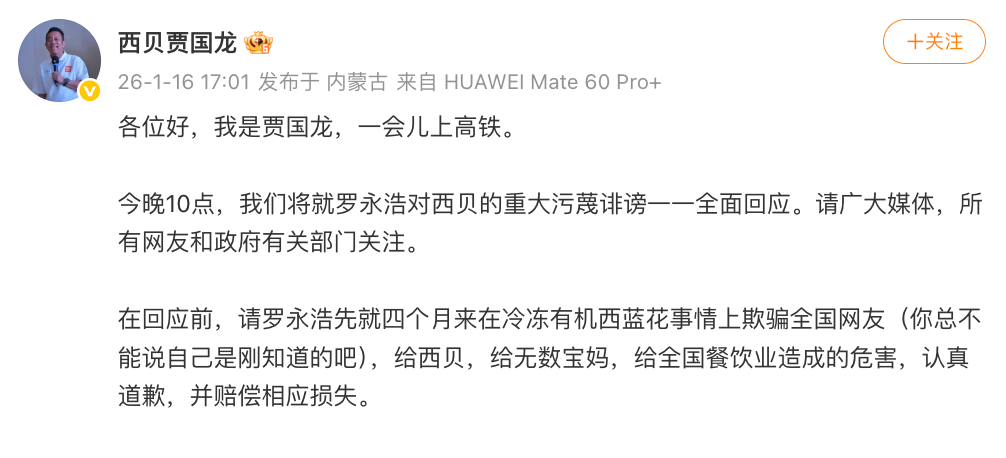
贾国龙:今晚10点将就罗永浩对西贝重大污蔑诽谤全面回应
21世纪经济报道· 2026-01-16 10:14
Core Viewpoint - The article discusses the ongoing public dispute between Xibei's founder, Jia Guolong, and entrepreneur Luo Yonghao, highlighting the challenges faced by Xibei in the restaurant industry amid negative publicity and operational difficulties [1][5]. Group 1: Company Response and Challenges - Jia Guolong confirmed that Xibei will close 102 stores, accounting for 30% of its total locations, due to ongoing challenges and negative publicity over the past 125 days [5]. - Jia emphasized that the company relies on its own efforts and has been working hard to navigate through the difficulties, indicating a commitment to the employees and the brand [5]. - The restaurant industry is experiencing increased competition and declining profits, with major players like Haidilao reporting a 3.0% year-on-year revenue decline to 20.703 billion [9]. Group 2: Public Relations and Management - Jia Guolong stated that Xibei does not engage in public relations, which raises questions about the effectiveness of its communication strategy, especially in light of recent controversies [9]. - The departure of Xibei's Vice President of Public Relations, Song Xuan, was framed as a personal decision, with Jia expressing support for him despite the ongoing challenges [8]. - Jia's approach to management reflects a belief in the company's operational success without reliance on public relations, which may be seen as naive given the current market conditions [9]. Group 3: Industry Context - The Chinese restaurant industry is projected to face a slowdown in revenue growth and profit margins, with many restaurant owners acknowledging the difficulty in maintaining revenue levels [9]. - Jia Guolong admitted that Xibei's revenue was already in a declining phase before the recent controversies, indicating pre-existing operational challenges [9]. - The overall market trend suggests that restaurants may need to either lower prices or abandon national markets to remain competitive, which poses a significant challenge for Xibei given its higher price point [9].
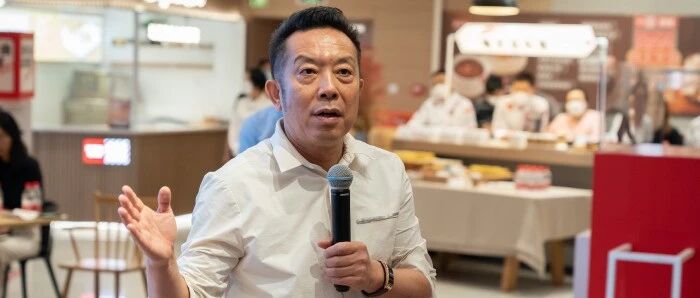
搜狐酒馆第51期|王冬明:预制菜并非根本矛盾,餐饮老板要回归生意人
Sou Hu Cai Jing· 2026-01-16 09:45
Core Insights - The high-end chain restaurant industry is transitioning from a phase of scale expansion to a new phase focused on "cost control and value reconstruction" [2] - Competition in the restaurant sector is evolving beyond taste and marketing to encompass supply chain efficiency, customer perception management, and sustainable brand operations [2] Group 1: Supply Chain and Cost Management - The primary challenge for restaurant businesses is cost management, especially in light of increasing food safety regulations and public scrutiny [3] - The adoption of pre-prepared dishes is seen as a cost-effective solution for addressing food safety concerns, despite consumer resistance [4] - Many domestic restaurant brands are mistakenly investing in self-owned factories, leading to heavy cost burdens that are ultimately passed on to consumers [5] Group 2: Consumer Expectations and Brand Positioning - Consumer decision-making prioritizes price, followed by taste, and then food safety, which contrasts with the business focus on ensuring safety and flavor first [6] - Successful brands like Haidilao manage to navigate the pre-prepared food controversy by aligning their product offerings with consumer expectations [8] - The future of high-end chain restaurants may require a clear positioning strategy, either targeting niche markets with higher price points or shifting to the mass market [9] Group 3: Industry Trends and Future Outlook - The restaurant industry is currently in a challenging cycle, with many businesses facing closures, yet some, like Haidilao, demonstrate structural health and long-term viability [7] - The next phase of the restaurant industry is expected to focus on precise customer acquisition rather than broad marketing strategies [10] - The survival of restaurant businesses hinges on understanding and meeting customer needs, with a shift in mindset from being restaurant operators to business operators [11]

贾国龙,依旧“天真”
2 1 Shi Ji Jing Ji Bao Dao· 2026-01-16 09:21
Core Viewpoint - The founder of Xibei, Jia Guolong, demonstrates a mix of idealism and self-reflection in managing the company's recent challenges, including the closure of 102 stores and the impact on employees and customers [1][3][10]. Company Management and Operations - Jia Guolong emphasizes responsibility by ensuring that all employees affected by the store closures receive their salaries and that customer prepaid cards remain valid at other locations [1]. - The company has faced significant operational pressures, with the restaurant industry experiencing a slowdown in revenue growth and profit margins, as highlighted by the China Cuisine Association [5][6]. - Xibei's revenue was already in decline before the recent controversies, with Jia admitting that the company was in a downward trend as of May 2025 [6][10]. Market Challenges - The restaurant sector is witnessing increased competition and declining customer spending, leading to a general trend of lower average transaction values across the industry [5][8]. - Xibei's higher price point has made it more vulnerable to market pressures, especially as consumer expectations shift towards value for money [8]. Public Relations and Brand Image - Jia Guolong's approach to public relations has been criticized as lacking, with his insistence that Xibei does not engage in public relations efforts raising concerns about the company's image management [4][11]. - The controversy surrounding the "pre-prepared dishes" debate has damaged Xibei's brand, with customers feeling misled about the quality and freshness of ingredients [7][9]. - The company has made efforts to address these issues by reducing prices on over 30 menu items by 20% in response to public sentiment [10]. Employee Impact - The closure of stores has resulted in job losses for employees, highlighting the real-world consequences of market dynamics and operational decisions [12]. - Jia Guolong's entrepreneurial success should come with an understanding that market conditions do not guarantee positive outcomes solely based on past achievements [12][13].
10家品牌荣膺“2025年度北京商业品质服务品牌”




Bei Jing Shang Bao· 2026-01-16 09:11
Group 1 - The 2026 Beijing Commercial Brand Conference and the announcement of the 2025 Top Ten Commercial Brands took place in Beijing, focusing on the theme "New Demand, New Supply" [1] - The event was guided by the Beijing Municipal Bureau of Commerce and co-hosted by Beijing Daily Media Group and Beijing Commercial Association, showcasing the highest level of commercial brands in Beijing [1] - Ten brands were recognized as the "2025 Beijing Commercial Quality Service Brands," including 58 Tongcheng, Chaoyang Joy City, Dingdong Maicai, Dongfang Zhenxuan, Haidilao, Juran Home, Jiuzhoutong, Lao Chuan Ban, Vipshop, and Yunda Express [1] Group 2 - The main list of the "2025 Top Ten Commercial Brands" reflects brands with significant market influence and leadership in industry development [4] - Four permanent sub-lists were introduced: "Beijing Commercial Quality Service Brands," "Beijing Commercial Model Innovation Brands," "Beijing Commercial Craftsmanship Brands," and "Beijing Commercial New Star Brands" [4] - Three new special annual lists were introduced for the first time, including "Outstanding Cases of Financial Product Innovation Empowering Consumption," "Outstanding Cases of Cultural, Business, Tourism, and Sports Integration in Beijing," and "Leading Brands in Beijing's Fashion Consumption Power" [4]

全球首个机器人租赁平台擎天租完成种子轮融资,上线三周用户突破20万
机器人圈· 2026-01-16 09:10
Core Insights - The article discusses the launch and rapid growth of the world's first robot rental platform, Qingtian Rental (Shanghai) Technology Co., Ltd., which has completed its seed round of financing led by GL Ventures and other investors [2][3]. Group 1: Company Overview - Qingtian Rental aims to expand its market presence and enhance its technology and service systems with the newly acquired funds [2]. - The platform was officially launched on December 22, 2025, and has quickly gained traction, surpassing 200,000 registered users within three weeks and maintaining over 200 daily rental orders [3]. Group 2: Business Model and Strategy - The platform utilizes an innovative model of "shared rental + platform scheduling," transforming high-cost robot products into on-demand, standardized service capabilities [3]. - Qingtian Rental's design logic positions robots as flexible, quickly deployable "production factors" rather than one-time sale devices, creating a service network that connects supply and demand [5]. Group 3: Industry Challenges and Solutions - The company addresses the industry's "last mile" challenge by systematically reducing barriers to entry and improving delivery efficiency, facilitating the transition from technology validation to commercial application [7]. - The platform's rapid growth is seen as a validation of its scalable model, with the potential to significantly enhance the commercialization of robots in the real economy [7]. Group 4: Market Applications and Partnerships - Qingtian Rental has established partnerships with various high-frequency commercial and restaurant brands, such as Meiyijia and Haidilao, to implement robot services in customer engagement and brand activities [11]. - The platform's standardized service system and operational support enable local service providers to participate in the robot industry's value chain, promoting scalability [11]. Group 5: Future Plans - The company has outlined a clear "1234 strategy" aiming to connect with over 10 robot manufacturers, develop 200 premium service providers, gather 3,000 content creators, and serve 400,000 rental customers by 2026 [13]. - Qingtian Rental plans to expand its service network to 200 cities nationwide, making robot services a fundamental capability in commercial and urban operations [13].

人形机器人板块发力上攻,人工智能AIETF(515070)持仓股奥比中光大涨超6%
Mei Ri Jing Ji Xin Wen· 2026-01-16 05:24
Group 1 - The A-share technology sector is experiencing mixed performance, with storage and humanoid robot sectors seeing fluctuations and gains, while AI application sectors continue to decline [1] - The largest AI ETF in the Shanghai market (515070) has narrowed its decline to 0.23%, with significant gains in holdings such as Aobo Zhongguang-UW, which surged over 6% [1] - The robot leasing platform "Qingtian Rental" announced the completion of its seed round financing, achieving over 200,000 registered users and maintaining an average of over 200 daily orders within three weeks of launch [1] Group 2 - Qingtian Rental has partnered with major brands like Meiyijia, Haidilao, and Yuyuan Group to utilize robots for store traffic and brand activities, shifting from traditional equipment sales to a callable service model [1] - Dongfang Securities indicates that the investment logic in the humanoid robot industry is shifting from "hardware mass production" to "AGI (Artificial General Intelligence) development," emphasizing the importance of AGI capabilities as a key investment focus [1] - Despite Chinese companies leading in manufacturing, the marginal impact of simple robot mass production on investment is expected to diminish, with future value lying in AGI capabilities [1] Group 3 - The AI ETF (515070) tracks the CS AI theme index (930713), selecting component stocks that provide technology, basic resources, and application end stocks, focusing on the midstream and upstream of the AI industry chain [2] - The top ten weighted stocks in the ETF include leading domestic technology companies such as Zhongji Xuchuang, Xinyi Sheng, Hanwha Technology, and Hikvision [2]


创始人张勇,“重新”掌舵870亿海底捞
Sou Hu Cai Jing· 2026-01-16 01:50
Core Insights - The changing consumer preferences are reflected in the shifts within the dining market, indicating that no single restaurant format can remain dominant indefinitely [1] - The current best solution for the restaurant industry is a focus on supply chain and standardization, which has led to higher valuations for supply chain companies compared to traditional restaurant businesses [1] - The capital market's preference has shifted towards tea beverage companies, which are currently valued higher than traditional dining establishments, a trend unlikely to reverse in the short term [1] Company Analysis - Despite achieving record performance, leading restaurant chain Haidilao has not seen a recovery in its valuation, indicating a disconnect between operational success and market perception [3] - Haidilao's rapid expansion from over 300 stores at its IPO to 1,300 stores by 2022 did not translate into proportional revenue growth, resulting in a net loss of 4.163 billion yuan in 2021 [6] - Under the leadership of Yang Lijuan, Haidilao shifted from aggressive expansion to a more conservative approach, leading to a revenue recovery to 41.453 billion yuan and a net profit of 4.499 billion yuan by 2023 [9] Market Dynamics - The restaurant industry is experiencing accelerated rotation effects, with the tea beverage sector expanding more easily and attracting more capital due to lower investment requirements compared to the hot pot industry [12] - Haidilao's attempts to diversify through the "Red Pomegranate Plan" and the introduction of multiple brands have not yielded the expected results, with revenue and net profit showing only slight increases and subsequent declines [10] - The valuation of tea beverage companies like Mixue Ice City is nearly double that of Haidilao, despite Haidilao's larger revenue scale, highlighting the market's preference for lighter asset models [12] Consumer Behavior - Changes in consumer preferences are causing significant impacts on the restaurant industry, with a noted decline in the performance of previously popular snack brands due to shifting tastes [14] - Haidilao's table turnover rate increased to 4.1 times per day in 2024 but fell to 3.8 times in the first half of 2025, indicating a decrease in customer traffic and average daily sales [14] - The higher price point of hot pot compared to tea beverages makes consumers more sensitive to pricing, contributing to the challenges faced by Haidilao [14]
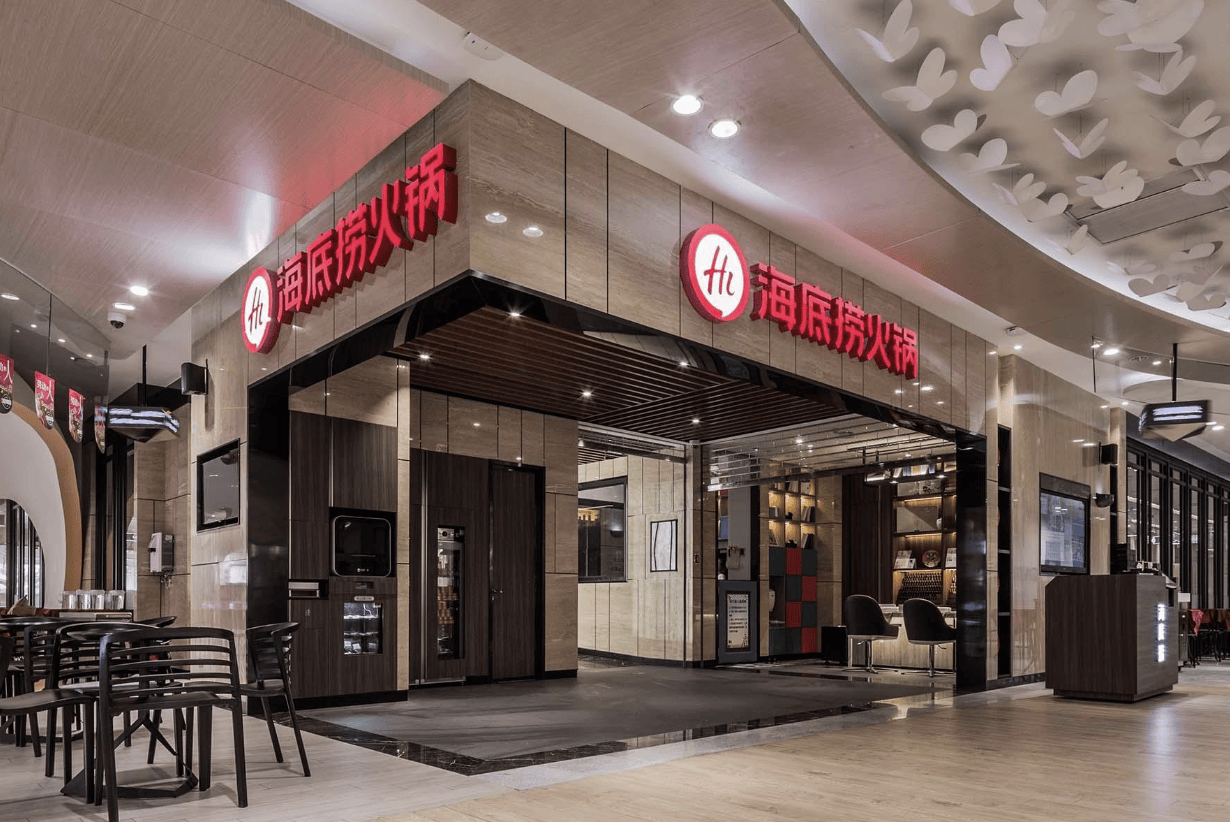
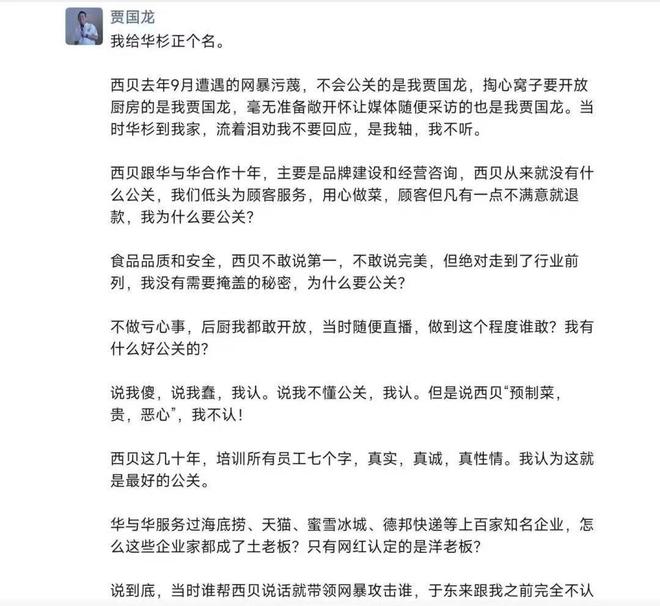
力挺华与华!西贝创始人贾国龙喊话有关部门:应监管网络乱象
Nan Fang Du Shi Bao· 2026-01-16 01:50
1月15日晚,贾国龙发布朋友圈称,西贝去年9月遭遇的"网暴污蔑",不会公关的是他本人,开放厨房、 敞开怀接受媒体采访也都是他本人的决定,华与华创始人华杉曾"流着泪"劝阻他不要回应,是他自己不 听劝。 贾国龙指出,西贝跟华与华合作十年,主要是品牌建设和经营咨询,他质疑称,"华与华服务过海底 捞、天猫、蜜雪冰城、德邦快递等上百家知名企业,怎么这些企业家都成了土老板?只有网红认定的是 洋老板?" 贾国龙力挺华杉,将继续合作 并喊话有关部门应监管网络乱象 贾国龙决定做自己。 1月15日晚,西贝创始人贾国龙再次通过朋友圈发声,力挺此前在西贝风波中备受争议的华与华,他认 为华与华正是因为帮西贝说话而遭到攻击。在1月15日这一天内,贾国龙已两度公开发声。稍早前,他 通过朋友圈长文详细回应了关店传闻和外界对西贝门店卖预制菜的质疑。 从两条朋友圈的发言来看,贾国龙对于被评价不懂公关颇为在意。在最新的朋友圈中,他再次表态,以 西贝的食品品质和安全,"有什么好公关的?"他称,"说我不懂公关,我认。但是说西贝'预制菜,贵, 恶心',我不认!西贝这几十年,培训所有员工七个字,真实,真诚,真性情。我认为这就是最好的公 关。" 贾国龙直言 ...
回眸2025丨探寻中国市场的活力与秩序
Jing Ji Ri Bao· 2026-01-16 00:19
Group 1: Economic Overview - In the past year, China's economy faced challenges, with retail sales exceeding 45.6 trillion yuan, growing by 4.0%, indicating consumer spending remains a stabilizing force [1] - By the end of December, the number of business entities reached 195 million, with over 100 million tax-related entities, reflecting robust market vitality [1] Group 2: Platform Economy Regulation - The competition among major platforms like JD, Taobao, and Meituan in the food delivery sector involved nearly 100 billion yuan in investments, leading to improved service quality and better treatment for delivery riders [2][3] - Regulatory bodies played a crucial role in maintaining fair competition, shifting the focus from subsidy wars to enhancing service quality and ensuring food safety [2][3] Group 3: Addressing Deep-rooted Issues - Regulatory efforts in 2025 targeted the "algorithmic hegemony" and unreasonable rules imposed by platforms, leading to the cancellation of controversial refund policies and promoting fairer trading practices [3] - Major platforms committed to creating a win-win ecosystem for consumers, merchants, and delivery riders, with initiatives like eliminating penalties for late deliveries and increasing social security coverage for riders [3][4] Group 4: Combating "Involution" Competition - "Involution" competition emerged as a significant challenge in 2025, characterized by price wars that compromised product quality and safety, as seen in the drastic decline of profit margins for brands like Laiyifen [6][7] - The government emphasized the need to shift competition from price-cutting to value creation, with regulatory measures aimed at addressing unfair practices and enhancing product quality [6][7][8] Group 5: Food Safety and Standards - The "pre-made dish" controversy highlighted public concerns over food safety, prompting regulatory bodies to accelerate the establishment of national standards for the industry [10][11] - Regulatory measures included comprehensive food safety oversight and the introduction of transparency in food production processes to restore consumer trust [11][12] Group 6: Market Dynamics and Innovation - The regulatory framework aims to create a balanced market environment where quality and innovation are prioritized over low prices, allowing businesses to thrive without compromising standards [9][12] - The response from the industry includes innovative dining experiences and significant investments in product development, indicating a shift towards higher quality offerings [9][12]

