
朗新集团

Search documents
每日投行/机构观点梳理(2025-07-28)
Jin Shi Shu Ju· 2025-07-28 12:18
Group 1: Currency and Economic Outlook - The Japanese yen is under pressure due to political uncertainty following the ruling coalition's loss of majority in the Senate elections, making a rebound difficult [1] - The US short-term yields are expected to support the dollar, with initial jobless claims data indicating a stable labor market despite some signs of weakness [1] - The Bank of Canada is likely to maintain interest rates unchanged due to sticky inflation and a resilient economy, despite soft economic data [3] Group 2: Monetary Policy and Market Reactions - Two Federal Reserve officials, Bowman and Waller, are expected to vote against the consensus in the upcoming meeting, which may lead to a mild bullish reaction in the interest rate market [2] - The Bank of Japan may signal a shift towards a less dovish stance in its upcoming policy meeting, influenced by a recent trade agreement with the US that reduces uncertainty [4] Group 3: Investment Opportunities in A-shares and Technology - CITIC Securities suggests that the A-share market is on an upward trajectory, with a focus on technology and non-bank financial sectors as potential beneficiaries of the bullish sentiment [5] - The report highlights sectors such as pharmaceuticals, semiconductors, non-bank finance, and renewable energy as key areas of interest [5] - The AI sector is expected to see accelerated adoption and integration into business operations, with significant growth potential in the coming years [8][11] Group 4: Automotive and Semiconductor Industry Insights - The automotive industry is poised to benefit from advancements in autonomous driving regulations, with Shanghai leading the way in high-level autonomous driving applications [9] - The semiconductor industry is experiencing increased demand for advanced processes due to the AI boom, with domestic manufacturers working to catch up amid supply chain challenges [10] Group 5: Market Trends and Consumer Behavior - The report indicates a shift towards industrialization in the restaurant supply chain, driven by efficiency demands and the rise of pre-prepared food products [16] - The Hong Kong stock market is expected to present opportunities, particularly in the technology sector, which is seen as having significant recovery potential [12]

中金:稳定币、金融市场和人民币国际化
中金· 2025-07-28 01:42
Investment Rating - The report does not explicitly provide an investment rating for the stablecoin industry Core Insights - Stablecoins are viewed as a new type of financial infrastructure with the potential to simplify payment processes and enhance the efficiency of financial markets [2][26] - The development of offshore RMB stablecoins is suggested as a priority for China to participate in the stablecoin evolution, while emphasizing that stablecoins are merely a tool for advancing RMB internationalization [1][5] Summary by Sections What are Stablecoins? - Stablecoins are defined as a bridge between the crypto world and the traditional financial system, characterized by a balance of centralization in operation and decentralization in technology [8][9] - They are not considered currency but rather tokens that derive their value from fiat currency reserves [11][12] Recent Attention on Stablecoins - Recent legislative advancements in the US and Hong Kong have heightened interest in stablecoins, alongside significant market events such as Circle's IPO [16][17] - The total market size of stablecoins has surpassed $260 billion, with transaction volumes projected to exceed $15.6 trillion in 2024, surpassing traditional payment platforms like Visa [17][21] Applications and Potential Impact in Financial Markets - Stablecoins enhance payment efficiency, particularly in cross-border transactions, by reducing costs and transaction times compared to traditional systems like SWIFT [40][45] - They also promote financial inclusion, especially in high-inflation economies, by providing a stable asset for savings and transactions [44][46] Impact on the International Monetary System - Stablecoins can increase the penetration of the US dollar while also posing challenges to capital controls in various countries due to their inherent anonymity [4][30] - The rise of stablecoins may lead to increased competition from non-USD stablecoins and central bank digital currencies (CBDCs) [4][5] China's Participation in Stablecoin Development - The report suggests that China should focus on developing offshore RMB stablecoins and creating real-world applications to build a robust ecosystem [5][6] - It emphasizes that the success of RMB as a trusted international currency depends on its legal and functional anchors, rather than solely on stablecoin technology [5][6] Mechanisms and Incentives in the Stablecoin Industry - The stablecoin ecosystem operates on a trust mechanism where the backing of fiat reserves is crucial for maintaining stability and transparency [30][31] - Participants in the stablecoin market, including users, issuers, and custodians, have aligned incentives that drive the ecosystem's growth [31][35] The "Impossible Triangle" of Stablecoins - Stablecoins face a trade-off between price stability, decentralization, and capital efficiency, with most successful stablecoins prioritizing price stability [37][39] - The report highlights that current leading stablecoins are primarily centralized, relying on institutional trust to maintain their value [37][39] Conclusion on Stablecoins as Financial Infrastructure - Stablecoins are positioned as a critical component of the next generation of cross-border digital finance, with the potential to reshape traditional financial systems [26][27] - The report concludes that while stablecoins offer significant advantages, they also introduce new risks and challenges that need to be managed [48][49]
民生证券:构建稳定币-RWA生态闭环 相关资产上链有望成为拉开Web3.0时代大幕
智通财经网· 2025-07-26 09:57
Core Viewpoint - The collaboration between government and enterprises is creating a stablecoin ecosystem anchored by high-quality Chinese assets, with RWA assets on-chain expected to usher in the era of Web 3.0 [1][5] Group 1: Stablecoin and RWA - Stablecoins focus on "fiat currency tokenization," while RWA emphasizes "asset tokenization," enhancing asset liquidity and providing low-risk, stable-return financial products in the Web 3.0 space [2] - Hong Kong is leading the world in stablecoin legislation, closely following the U.S. legislative progress [2] Group 2: Blockchain Layers - The progression from consortium chains to Layer 2 public chains and then to Layer 1 public chains highlights the advantages of each layer, including compliance with KYC/AML regulations and high transaction performance [3] - Layer 1 public chains serve as the foundational layer for consensus, data storage, and smart contract execution, while Layer 2 enhances performance and liquidity [3] Group 3: RWA Development Phases - The first phase of RWA focuses on foundational construction, with assets being tokenized and offering fixed returns similar to traditional investments [4] - The second phase activates liquidity through a layered architecture, enabling a closed-loop of "financing-splitting-circulation" for RWA [4] - The third phase aims to create a mature global RWA ecosystem with cross-chain transactions becoming the norm [4] Group 4: Investment Recommendations - The report suggests monitoring companies involved in RWA asset tokenization, such as Aorede, Longxin Group, and Xiexin Energy, during the foundational phase [5] - For the liquidity activation phase, attention should be given to trading platforms and internet brokerages like Yao Cai Securities and Dongfang Wealth [5] - In the global asset network integration phase, major internet giants like JD.com and Alibaba are recommended for observation [5]
全球第一!朗新九功数据智能体斩获权威评测BIRD-Bench双榜冠军
Sou Hu Cai Jing· 2025-07-26 03:47
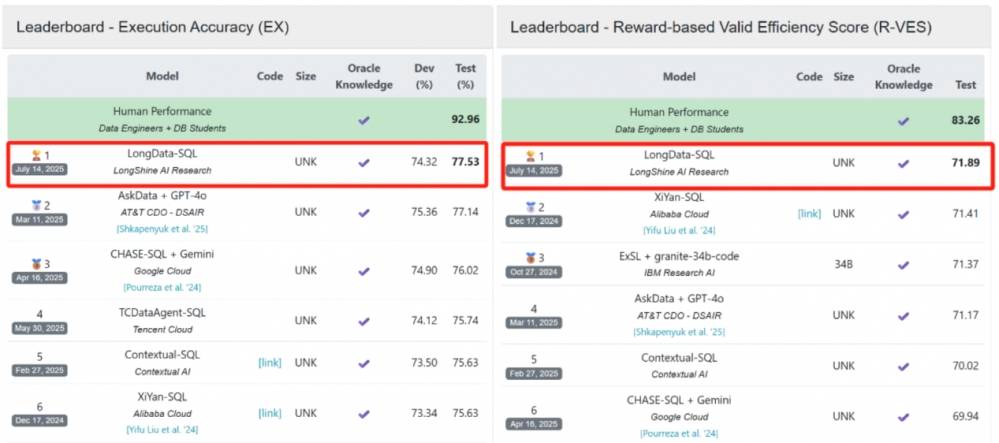
Core Insights - Longxin's AI energy model has achieved global recognition by winning two core categories in the BIRD-Bench evaluation, surpassing major competitors like Google and AT&T, indicating significant advancements in AI technology innovation in China [2][3] Group 1: BIRD-Bench Evaluation - Longxin's AI model won the global championship in execution accuracy (EX) and query efficiency reward (R-VES) at the BIRD-Bench evaluation [2] - The BIRD-Bench is recognized as the most authoritative natural language to SQL evaluation benchmark, covering 37 industry scenarios with a dataset of 33GB and over 10,000 complex query tasks [1] Group 2: Technological Innovations - Longxin developed a Schema Linking framework and a hierarchical data governance system to enhance the understanding of user intent and the generation of high-quality SQL queries [2] - The company introduced an intelligent optimization model based on "multi-path reasoning × scale law" and integrated reinforcement learning mechanisms to train SQL generation models [2] Group 3: Industry Applications - The AI model is being applied in core business scenarios within the energy sector, including power marketing, market transactions, and electric vehicle charging [3] - Longxin's end-to-end data intelligence chain enables rapid transformation from raw data to business insights, significantly improving decision-making efficiency and operational capabilities in the energy industry [3]

申万宏源:打破资产边界 关注RWA金融多元化应用
智通财经网· 2025-07-25 07:29
Core Insights - RWA (Real World Asset) is a blockchain-based digital asset securitization investment project that has seen rapid growth since the cryptocurrency bull market in 2020, with on-chain asset scale reaching $25.52 billion and 310,573 asset holders by July 16, 2025 [1][2] Group 1: RWA Overview - RWA utilizes blockchain technology to tokenize real-world physical or financial assets, significantly increasing liquidity and lowering investment thresholds [1][2] - RWA has various applications, including government bond tokenization, real estate tokenization, and stock tokenization, showcasing its versatility compared to traditional and general crypto assets [2][3] Group 2: Government Bond Tokenization - Government bond tokenization is a key application of RWA, enhancing secondary market liquidity and reducing cross-border transaction friction [3] - A notable example is BlackRock's tokenized fund BUIDL, which focuses on U.S. short-term government bonds and allows for 24/7 trading [3] Group 3: Real Estate Tokenization - RealT and Reinno are leading projects in real estate tokenization, with RealT distributing rental income to token holders and Reinno providing tokenized mortgage solutions [4] - For instance, RealT's property in Montgomery has a total price of $323,000, with individual tokens priced at $52.10 [4] Group 4: Stock Tokenization - xStocks and Robinhood are at the forefront of stock tokenization, with xStocks issuing tokens linked to actual stock prices and Robinhood adjusting token prices based on NASDAQ values [5] - Robinhood's product functions more like a price-linked financial derivative rather than granting ownership of the underlying stocks [5] Group 5: RWA Exploration in China - In 2024, Longxin Group and Ant Group completed a significant RWA financing deal in Hong Kong, marking a key step in the digitalization of China's renewable energy assets [6] - In mainland China, the Malu Grape RWA commemorative coin has been launched, integrating agriculture with the digital economy [6] Group 6: Regulatory Challenges - RWA poses significant challenges to financial regulation, particularly concerning asset ownership and collateralization [7][8] - The value of RWA relies on the clarity and stability of the underlying real-world assets, which may face legal and regulatory hurdles during the tokenization process [8]

中金缪延亮:稳定币、金融市场和人民币国际化
中金点睛· 2025-07-25 00:47
Core Viewpoint - Stablecoins have the potential to become a new type of financial infrastructure, bridging the gap between the crypto world and traditional finance, and their development should be strategically considered by China [2][3]. Group 1: What are Stablecoins? - Stablecoins are defined as "the most decentralized among centralized assets and the most centralized among decentralized assets," highlighting their dual nature of being rooted in blockchain technology while also requiring regulatory oversight [3][7]. - They are linked to fiat currencies, which means they must comply with traditional financial regulations, thus acting as a bridge between the crypto and real worlds [3][8]. - The potential applications of stablecoins include cross-border payments, asset preservation, and integration into decentralized finance (DeFi) ecosystems [3][22]. Group 2: Impact on Financial Markets - Stablecoins can enhance payment efficiency, offering low-cost and fast transactions, particularly beneficial for cross-border payments [38]. - They can improve financial inclusivity, especially in high-inflation economies, by providing a means for asset preservation [41][42]. - However, stablecoins may pose risks to monetary stability and sovereignty in countries with weak financial systems, potentially undermining local currencies and monetary policies [45][46]. Group 3: Influence on International Monetary System - Stablecoins depend on the credit of fiat currencies, primarily the US dollar, and their rise could reshape global capital flows and the international monetary system [54][56]. - They may create new demand in regions with weak financial infrastructure, acting as a substitute for traditional banking systems [55]. - The emergence of stablecoins could challenge the dominance of the US dollar, as they provide alternative payment channels and may facilitate the rise of non-US currencies [56]. Group 4: China's Participation in Stablecoin Development - China should consider issuing offshore RMB stablecoins as a priority to participate in the development of stablecoins, leveraging its position as a major global trade player [5][57]. - The development of stablecoins could enhance China's financial resilience and flexibility in international trade, providing alternatives to traditional payment methods [57]. - However, the potential for stablecoins to bypass capital controls poses significant regulatory challenges for China [4][57].

山西证券研究早观点-20250724
Shanxi Securities· 2025-07-24 06:03
Group 1: Industry Overview - The report highlights that a new round of "Ten Key Industries Stabilizing Growth Work Plan" is about to be released, which will accelerate capacity structure optimization in the chemical industry, suggesting a focus on cyclical recovery and supply-side optimization [6] - The opening of the Yarlung Tsangpo River downstream hydropower project, with a total investment of approximately 1.2 trillion yuan, is expected to significantly boost investment opportunities in various segments of the chemical industry, particularly in civil explosives, all-steel tires, cement, and specialty chemicals [6] - The TDI market is experiencing upward price pressure due to Covestro's forced production halt following an electrical fire, with TDI prices rising to 14,913 yuan/ton, reflecting a 30.82% increase compared to the previous month [6] Group 2: Investment Recommendations - The report recommends focusing on leading companies in the chemical sector such as Wanhua Chemical, Hualu Hengsheng, Juhua Co., Haohua Technology, Longbai Group, Yangnong Chemical, Hubei Yihua, and Tongyi Zhong [6] - In the civil explosives and all-steel tire sectors, companies like Sailun Tire, Linglong Tire, and Wind God Co. are highlighted as potential investment opportunities [6] - The report emphasizes the growth potential of the unmanned mining truck market, with a projected sales penetration rate increasing from approximately 6% in 2024 to over 50% by 2030, indicating explosive growth [10][12] Group 3: Market Trends - The report notes that the domestic market for unmanned mining trucks is entering a rapid scaling phase, with a compound annual growth rate of 305.8% expected from 2022 to 2024 [10] - The global market for unmanned mining solutions is projected to grow from 700 million USD in 2024 to 8.1 billion USD by 2030, with a compound annual growth rate of 51.0% [12] - The report indicates that traditional mining trucks are in a highly competitive field, with major international players holding over 90% of the market share, presenting a significant opportunity for domestic companies to replace traditional models with unmanned solutions [10]
全球货币体系重构与人民币国际化系列之四:打破资产边界:RWA和数字资产全解析
Shenwan Hongyuan Securities· 2025-07-23 06:43
Group 1 - RWA (Real World Asset) is a blockchain-based digital asset securitization investment project that significantly increases asset liquidity and lowers investment thresholds by tokenizing large, hard-to-trade assets [5][9][10] - As of July 16, 2025, the on-chain asset scale of RWA reached $25.52 billion, with 310,573 asset holders and 251 issuers [10] - RWA has various applications in overseas markets, including tokenized government bonds, REITs, stocks, and private credit [5][9] Group 2 - Tokenized government bonds are a key application of RWA, enhancing secondary market liquidity and reducing cross-border transaction friction through digital mapping of sovereign debt [35][36] - The tokenization of real estate is exemplified by projects like RealT and Reinno, which allow fractional ownership and provide liquidity to real estate investments [5][9] - RWA's relationship with traditional financial products like ABS and REITs shows both similarities and differences, with RWA offering broader asset scope and lower standardization [16][19] Group 3 - The regulatory landscape for RWA varies significantly across regions, with China maintaining strict regulations while regions like Hong Kong, the EU, and the US adopt more positive regulatory frameworks [22][23] - RWA's emergence poses challenges for financial regulation, particularly regarding asset ownership and collateralization risks [5][9] - The report highlights the importance of ensuring clear ownership and compliance with legal frameworks when mapping real-world assets onto blockchain [5][9]

能源绿色转型呼唤资金链创新
Zhong Guo Qing Nian Bao· 2025-07-23 01:12
Group 1 - ExxonMobil's Huizhou Ethylene Project has officially commenced operations with an investment exceeding $10 billion, focusing on green low-carbon technologies [1] - ExxonMobil plans to invest an additional $30 billion in low-carbon projects over the next five years to provide stable energy supply while reducing carbon emissions [1] - TotalEnergies aims to invest $60 billion in renewable energy by 2030, targeting a renewable energy generation capacity of 100 GW [1] Group 2 - The global energy industry is increasingly focusing on green low-carbon transformation, balancing the need for energy demand with carbon reduction [2] - The dynamic balance between "technology iteration speed" and "commercialization cost" is crucial for promoting clean energy development [2] - The contradiction between high R&D investment and low-cost requirements poses significant challenges for the clean energy sector [2] Group 3 - Global energy investment is shifting towards clean low-carbon energy, with an expected increase to $3.3 trillion by 2025, of which approximately $2.2 trillion will be directed towards renewable energy and related sectors [3] - Investment in clean energy has outpaced traditional fossil fuel investments, marking a transition to a new electrical era [3] - There is a critical issue of insufficient dynamic adaptation of funding allocation to innovation and industry chains in clean energy investment [3] Group 4 - Investment in emerging technologies such as electrification, hydrogen, and carbon capture is projected to decline by 23% in 2024, hindered by affordability and technology maturity [4] - Policies are needed to encourage long-term funding for innovative projects in the renewable energy sector, which often have lengthy development cycles [4] - Sustainable and transparent policies are essential for accelerating the development and iteration of new technologies in the energy transition [4] Group 5 - China is the largest clean energy market, with an investment scale of $625 billion in 2024, accounting for one-third of global investments [5] - The country has established the most complete renewable energy industry chain, producing 80% of global photovoltaic components and 70% of wind power equipment [5] - Geopolitical factors and the "de-China" trend are increasing costs for Chinese renewable energy companies, necessitating a positive cycle of technology, industry, and funding [5] Group 6 - Over 85% of charging pile operators are small and medium-sized enterprises, which face financing challenges compared to larger traditional energy operators [6] - A more innovative funding model is needed to promote rapid development in the energy sector [6] - Companies are encouraged to integrate ESG principles into their daily management and consider long-term investments in new low-carbon technologies [6]


朗新集团(300682) - 关于独立董事任期满六年离任的公告
2025-07-22 11:56
朗新科技集团股份有限公司 关于独立董事任期满六年离任的公告 本公司及董事会全体成员保证信息披露内容真实、准确、完整,没有虚假 记载、误导性陈述或重大遗漏。 朗新科技集团股份有限公司(以下简称"朗新集团"或"公司")董事会于 近日收到独立董事林中先生的书面辞职报告,林中先生自 2019 年 7 月 22 日起 担任公司独立董事及董事会专门委员会的相关职务,连续任职已满 6 年。根据 《上市公司独立董事管理办法》关于独立董事的任职年限等相关规定,林中先生 申请辞去公司独立董事及董事会相关专门委员会委员的职务,离任后将不再担任 公司任何职务。截至本公告披露日,林中先生未持有公司的股份,亦不存在应当 履行而未履行的股份锁定承诺事项。 朗新科技集团股份有限公司 证券代码:300682 证券简称:朗新集团 公告编号:2025-042 特此公告。 朗新科技集团股份有限公司 董事会 2025 年 7 月 22 日 1 鉴于林中先生辞任将导致公司董事会及相关专门委员会中独立董事的所占 比例不符合法定要求,根据《上市公司独立董事管理办法》等相关规定,林中先 生的辞职报告自公司股东大会选举出新任独立董事后生效。在公司召开股东大会 ...