
中国南方电网有限责任公司

Search documents
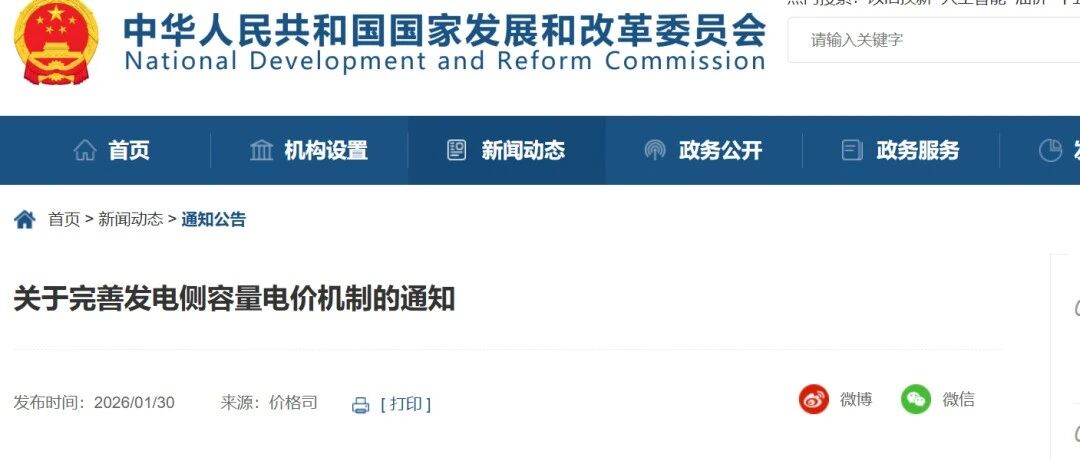
国家发展改革委 国家能源局关于完善发电侧容量电价机制的通知
国家能源局· 2026-01-30 09:29
Overall Thoughts - The notification aims to improve the capacity pricing mechanism on the generation side to ensure stable power supply, facilitate green development, and optimize resource allocation in the energy sector [4][5]. Classification of Capacity Pricing Mechanism - The capacity pricing mechanism for coal and natural gas power generation will be enhanced, with a recovery ratio of fixed costs for coal power plants increased to no less than 50% [5]. - The pricing mechanism for pumped storage power plants will continue to follow government pricing for plants that commenced construction before the issuance of the relevant guidelines, while new plants will have their capacity prices determined based on average costs [6]. - A new capacity pricing mechanism for independent new energy storage on the grid side will be established, with pricing based on local coal power capacity standards [7]. Establishing Reliable Capacity Compensation Mechanism - A reliable capacity compensation mechanism will be established to compensate power generation units based on their ability to provide stable power during peak demand periods [8]. - The compensation will cover coal, gas, and eligible independent new energy storage units, gradually expanding to include pumped storage [9]. Improving Supporting Policies - The adjustment of coal power long-term market trading prices will be allowed based on supply and demand, with flexibility in contract pricing mechanisms [10][11]. - The capacity fees and compensation will be included in local system operating costs, with specific pricing rules for energy storage facilities based on market conditions [12]. Implementation Organization - Provincial pricing authorities are tasked with coordinating the implementation of capacity pricing policies and establishing reliable capacity compensation mechanisms [13]. - An assessment system for users' economic capacity to bear electricity costs will be established to inform compensation standards [14].


新型储能的“保底工资”来了!容量电价水平参照煤电标准,结合放电时长和顶峰贡献
中关村储能产业技术联盟· 2026-01-30 09:11
Core Viewpoint - The article discusses the implementation of a new capacity pricing mechanism for power generation, aimed at enhancing the stability and efficiency of the electricity system while supporting the transition to a green and low-carbon energy structure [4][14][16]. Summary by Sections 1. Introduction of the Notification - The National Development and Reform Commission (NDRC) and the National Energy Administration (NEA) issued a notification to improve the capacity pricing mechanism for power generation, aligning with national energy reform and the construction of a new energy system [4][14]. 2. Reasons for Improvement - The rapid development of renewable energy in China necessitates the construction of flexible power sources to ensure stable electricity supply during periods of low renewable output. The existing capacity pricing mechanisms for coal, gas, and pumped storage power have been established to support this transition [5][6]. 3. Classification and Improvement of Capacity Pricing Mechanisms - The notification categorizes and improves the capacity pricing mechanisms for coal, gas, pumped storage, and independent new energy storage. For coal and gas, the fixed cost recovery ratio through capacity pricing will be raised to at least 50%, equating to 165 yuan per kilowatt annually [7][17]. - For pumped storage, existing projects will maintain current pricing, while new projects will adopt a unified capacity pricing based on average cost recovery principles [7][18]. - A new capacity pricing mechanism for independent new energy storage will be established based on local coal capacity pricing standards, considering peak contribution and discharge duration [8][19]. 4. Establishment of Reliable Capacity Compensation Mechanism - A reliable capacity compensation mechanism will be introduced to ensure that different types of power generation units are compensated fairly based on their peak capacity contributions, promoting healthy competition among technologies [9][20]. 5. Optimization of Market Trading and Pricing Mechanisms - The notification encourages fair participation of pumped storage and new energy storage in the electricity market, allowing for adjustments in coal power trading price limits based on local market conditions [10][22]. - It promotes flexible pricing mechanisms in long-term contracts to better reflect supply and demand dynamics [11][22]. 6. Impact on End Users - The policy will not affect electricity prices for residential and agricultural users, while commercial users may see a balanced impact due to the adjustments in capacity pricing and energy market costs [12][13]. 7. Positive Effects of the Improved Mechanism - The improvements are expected to enhance power supply security, support renewable energy utilization, and promote the healthy development of flexible power sources, ultimately facilitating the construction of a new energy system [13][16].
国家发改委、国家能源局重磅发布!
中国能源报· 2026-01-30 08:23
Core Viewpoint - The article discusses the implementation of a refined capacity pricing mechanism for power generation, aimed at enhancing the stability and efficiency of the electricity market while supporting the transition to a green energy system [1][2]. Group 1: Overall Strategy - The strategy aims to adapt to the needs of a new power system and market structure, balancing power supply security, green energy transition, and efficient resource allocation [3]. - It emphasizes the need to categorize and improve capacity pricing mechanisms for coal, natural gas, pumped storage, and new energy storage [3]. Group 2: Classification of Capacity Pricing Mechanisms - The capacity pricing mechanism for coal and natural gas power generation will be improved, with a target to recover at least 50% of fixed costs through capacity pricing [4]. - For pumped storage, existing projects will continue to use government pricing, while new projects will have their capacity pricing determined based on average cost recovery principles [5]. - A new capacity pricing mechanism for independent new energy storage on the grid side will be established, based on local coal power capacity pricing standards [6]. Group 3: Establishing Reliable Capacity Compensation Mechanism - A reliable capacity compensation mechanism will be established to compensate power generation units based on their ability to provide stable power during peak demand periods [7]. - The compensation will cover coal, gas, and qualifying new energy storage units, gradually expanding to include pumped storage [8]. Group 4: Supporting Policy Improvements - The article outlines the need to enhance electricity market trading and pricing mechanisms, allowing for flexible pricing in long-term contracts based on market conditions [9]. - It also discusses the need for improved electricity billing policies, ensuring that capacity fees and compensation are integrated into local system operating costs [10]. Group 5: Implementation and Coordination - The article emphasizes the importance of collaboration among provincial pricing authorities and energy departments to effectively implement the capacity pricing policies [11]. - It highlights the establishment of an economic capacity assessment system to guide the determination of reliable capacity compensation standards [12].

重磅!国家首次将新型储能纳入容量电价机制!关于完善发电侧容量电价机制的通知发布
中关村储能产业技术联盟· 2026-01-30 08:12
Core Viewpoint - The article discusses the implementation of a new capacity pricing mechanism for power generation, focusing on the establishment of an independent capacity pricing mechanism for grid-side new energy storage, aimed at ensuring the stable operation of the power system and promoting green development [6][8]. Group 1: Overall Strategy - The strategy aims to adapt to the needs of the new power system and market, balancing power supply security, green energy transition, and efficient resource allocation [8]. - It emphasizes the need to improve capacity pricing mechanisms for coal, natural gas, pumped storage, and new energy storage, optimizing the power market structure [8]. Group 2: Capacity Pricing Mechanism Improvement - The capacity pricing mechanism for coal and natural gas power generation will be enhanced, with a recovery ratio of fixed costs for coal power plants increased to no less than 50% [9]. - A capacity pricing mechanism for natural gas power generation will be established, determining prices based on a fixed cost recovery ratio [10]. - For pumped storage, the pricing will continue to be government-regulated for projects started before the issuance of relevant guidelines, while new projects will have their prices determined based on market participation [10]. Group 3: Establishment of New Energy Storage Pricing Mechanism - An independent capacity pricing mechanism for grid-side new energy storage will be established, with pricing based on local coal power capacity standards and adjusted according to peak capacity [11]. - The management of grid-side new energy storage projects will follow a list-based approach, with specific requirements set by the National Energy Administration [11]. Group 4: Reliable Capacity Compensation Mechanism - A reliable capacity compensation mechanism will be established to compensate power generation units based on their ability to provide stable power during peak demand periods [12]. - The compensation will consider fixed costs that cannot be recovered in energy and ancillary service markets, with adjustments based on supply-demand relationships and market progress [12]. - The compensation scope will include coal, gas, and eligible new energy storage units, gradually expanding to include pumped storage [12]. Group 5: Supporting Policies - The article outlines the need to improve electricity market trading and pricing mechanisms, allowing for flexible pricing in long-term contracts based on market conditions [14]. - It also discusses the integration of capacity fees and compensation into local system operating costs, with specific pricing rules for energy storage [15]. - A shared cost allocation method for regional pumped storage capacity fees will be established, promoting market-based optimization [15]. Group 6: Implementation and Coordination - The article emphasizes the importance of collaboration among provincial price authorities and relevant departments to implement capacity pricing policies effectively [16]. - It highlights the need for an assessment system to evaluate users' economic capacity to bear electricity costs, which will inform compensation standards [16]. - Strengthening capacity fee assessments will guide power generation units to enhance operational efficiency and peak output capabilities [17].

铜价上涨背后:供需偏紧格局延续 电力投资等推高铜需求
Zheng Quan Ri Bao Wang· 2026-01-29 13:19
近期,有色金属成为A股热点。其中,被称为"红色黄金"的铜,在2025年上涨34.34%之后,其价格在 2026年开年又实现新一轮上涨。据生意社披露数据,1月29日,铜最新价格达到10.16万元/吨,同比上 涨35.08%。 业内认为,整体来看,能源转型与数字革命构成了铜需求长期增长的保障。以电解铜为例,通惠期货研 报显示,2026年电解铜的终端需求呈现"传统企稳、新兴崛起"的格局,全球需求量预计超过2900万吨, 其中近一半来自电力投资。 据国家电网官网消息,投入资金将重点用于科技创新、新型电力系统建设等方面。建设内容包括,服务 经营区风光新能源装机容量年均新增2亿千瓦左右;初步建成主配微协同的新型电网平台,加快特高压 直流外送通道建设;加快推进城市、农村、边远地区配网建设,探索末端保供型、离网型微电网模式; 夯实数智基础设施。 与此同时,中国南方电网有限责任公司2026年将安排固定资产投资1800亿元,连续五年创新高,年均增 速达9.5%,将重点投向新型电力系统建设、战略性新兴产业发展、优质供电服务提升等领域。这些将 为铜市场长期需求提供坚实的"压舱石"。 宝城期货分析师龙奥明表示,特高压、配电网和新能源三 ...
中国电力企业联合会用户生态分会成立
Zhong Guo Dian Li Bao· 2026-01-29 09:25
Group 1 - The establishment of the User Ecology Branch of the China Electricity Council marks a new phase in the standardized and collaborative development of the energy user ecosystem in China, aimed at injecting strong new momentum into the green, low-carbon, and high-quality development of the energy and power industry [1][2] - The conference gathered nearly 200 representatives from various sectors, including government, industry, academia, research, and users, to witness the unveiling of the branch and the signing of agreements with 16 ecological partners [1] - The transition of users from being "receivers" of energy to "participants" and "co-builders" reflects a consensus in the industry to create an open, collaborative, intelligent, and win-win energy service ecosystem [1] Group 2 - The User Ecology Branch aims to create an open, integrated, and compliant collaborative platform to address challenges such as resource dispersion, incomplete mechanisms, and collaboration bottlenecks in the user-side ecosystem [2] - The branch's president emphasized the goal of transforming energy services from "one-way supply" to "two-way interaction" and from "single service" to "ecological empowerment" [2]

国家能源局:同意成立!
中国能源报· 2026-01-27 06:25
Core Viewpoint - The establishment of seven standardization technical committees in the energy sector aims to enhance the standardization framework in line with the Energy Law of the People's Republic of China, focusing on safety governance, greenhouse gas emissions management, carbon capture, hydrogen energy, and more [2][3]. Group 1: Establishment of Technical Committees - Seven standardization technical committees have been approved, including those for electricity safety governance, greenhouse gas emissions management, carbon capture, hydrogen energy basics, hydrogen production, hydrogen storage and transportation, and hydrogen applications [2][3]. - The committees will be responsible for developing and managing standards related to their respective fields, ensuring a coordinated and unified standard system [3]. Group 2: Management and Implementation - Energy industry standardization management organizations are required to guide and manage the newly established committees according to existing regulations, promoting an open standardization work platform [3]. - The committees are tasked with integrating efforts from enterprises, social organizations, educational institutions, and research institutions to advance technological innovation and standardization in their fields [3]. Group 3: Committee Composition - The first committee for electricity greenhouse gas emissions management consists of 46 members, with Wang Zhixuan as the chairperson and several vice chairpersons from various organizations [10][11]. - The carbon capture, utilization, and storage (CCUS) committee includes 50 members, with Yuan Shiyi as the chairperson, focusing on standards for carbon capture, transportation, and storage [15][19].



债基2025年Q4季报分析:2025Q4债基信用配置有何变化?
Hua Yuan Zheng Quan· 2026-01-26 09:52
1. Report Industry Investment Rating The report does not mention the industry investment rating. 2. Core Viewpoints of the Report - In Q4 2025, the scale of public - offering bond funds increased quarter - on - quarter, but the structure was significantly differentiated. The net asset value of first - level bond funds decreased significantly, while that of second - level bond funds increased significantly. The net asset value of medium - and long - term pure bond funds decreased significantly, while that of short - term pure bond funds and passive index bond funds increased significantly [4][52]. - The bond - holding market value of bond funds increased quarter - on - quarter in Q4 2025, but the bond - holding proportion of most types of bond funds decreased compared with the previous quarter, except for medium - and long - term pure bond funds [13]. - The market value of the top five heavy - holding bonds of active bond funds mostly decreased in Q4 2025 compared with Q3, mainly due to the significant decline in the market value of treasury bonds and policy - financial bonds [31]. 3. Summary by Relevant Catalogs 3.1 2025 Q4 Bond Fund Overall Changes - As of the end of Q4 2025, the total net asset value of public - offering bond funds (including pure bond funds, hybrid bond funds, index bond funds, and convertible bond funds) was 11.00 trillion yuan, an increase of 0.45 trillion yuan compared with Q3 2025, reaching a new high since Q1 2023 [8]. - In Q4 2025, the net asset value of medium - and long - term pure bond funds and first - level hybrid bond funds decreased significantly quarter - on - quarter, while the net asset value of short - term pure bond funds, second - level hybrid bond funds, and passive index bond funds increased significantly. Specifically, medium - and long - term pure bond funds had a net redemption of 76.9 billion shares, with a net asset value decrease of 70.4 billion yuan (a 1.2% decline); first - level hybrid bond funds had a net subscription of 400 million shares, with a net asset value decrease of 130.9 billion yuan (a 13.3% decline). Short - term pure bond funds had a net subscription of 24.7 billion shares, with a net asset value increase of 135 billion yuan (a 15.7% increase); second - level hybrid bond funds had a net subscription of 95.1 billion shares, with a net asset value increase of 205.9 billion yuan (a 15.4% increase); passive index bond funds had a net subscription of 52.6 billion shares, with a net asset value increase of 324.6 billion yuan (a 22.6% increase) [9]. - The net asset value of credit - bond index bond funds increased by 255.2 billion yuan quarter - on - quarter in Q4 2025, a 62.4% increase, continuing the scale - growth trend [10]. 3.2 Asset Allocation of Various Bond Funds - In Q4 2025, the market value of bond holdings of bond funds increased quarter - on - quarter, but the bond - holding proportion of most types of bond funds decreased compared with the previous quarter, except for medium - and long - term pure bond funds. As of Q4 2025, the total market value of bond holdings of bond funds was 11.97 billion yuan, an increase of 0.38 billion yuan compared with the previous quarter. The bond - holding proportion of short - term pure bond funds was 95.8%, a 0.2 - percentage - point decrease compared with Q3 2025; that of medium - and long - term pure bond funds was 97.1%, a 0.2 - percentage - point increase; that of first - level and second - level hybrid bond funds was 96.4% and 82.1% respectively, with decreases of 0.3 and 0.03 percentage points respectively; that of passive index bond funds was 92.7%, a 3.0 - percentage - point decrease; and that of convertible bond funds was 89.4%, a 0.2 - percentage - point decrease [13]. - In Q4 2025, the convertible - bond holding scale of first - and second - level bond funds increased. The total market value of convertible bonds held by first - level bond funds was 65.7 billion yuan, a 2.7 - billion - yuan increase quarter - on - quarter; that of second - level bond funds was 106.3 billion yuan, a 3.3 - billion - yuan increase. However, the proportion of convertible - bond market value to bond - holding market value of first - level bond funds increased slightly by 0.05 percentage points to 6.81%, while that of second - level bond funds decreased by 1.37 percentage points to 7.54% [27]. 3.3 Structural Changes in Heavy - Holding Bond Types of Bond Funds in Q4 2025 - Overall, the market value of the top five heavy - holding bonds of active bond funds mostly decreased in Q4 2025 compared with Q3, mainly due to the significant decline in the market value of treasury bonds and policy - financial bonds [31]. - **Interest - rate bonds**: In Q4 2025, the market value of heavy - holding interest - rate bonds (including quasi - interest - rate bonds such as Huijin bonds and railway bonds) was 1,896.4 billion yuan, a decrease of 237.6 billion yuan compared with Q3 2025. The decrease in the scale of interest - rate bond holdings was mainly due to the significant decline in the market value of treasury bonds and policy - financial bonds [31]. - **Financial bonds**: In Q4 2025, the market value of the top five heavy - holding commercial financial bonds was 178.5 billion yuan, a 46.1 - billion - yuan decrease quarter - on - quarter; the market value of bank secondary capital bonds was 125.8 billion yuan, a 31.2 - billion - yuan decrease; the market value of bank perpetual bonds was 34.3 billion yuan, a 14.8 - billion - yuan decrease [31]. - **Industrial bonds and urban investment bonds**: The market value of the top five heavy - holding industrial bonds was 85.2 billion yuan, a 28.2 - billion - yuan decrease (a 24.9% decline) compared with the previous quarter; the market value of urban investment bonds was 56.7 billion yuan, a 12.7 - billion - yuan decrease (an 18.3% decline) [32]. 3.3.1 Urban Investment Bonds - In Q4 2025, the market value of urban investment bonds in the top five heavy - holding bonds of active bond funds was 56.7 billion yuan, a 12.7 - billion - yuan decrease compared with the previous quarter. In terms of regions, the market value of urban investment bonds in the top five heavy - holding bonds of bond funds in regions such as Zhejiang, Shandong, and Jiangsu was relatively high, at 8.6 billion yuan, 6.8 billion yuan, and 6.0 billion yuan respectively in Q4 2025, with decreases of 2.39 billion yuan, 0.47 billion yuan, and 1.83 billion yuan respectively compared with the previous quarter. In terms of implicit ratings, the market value of urban investment bonds with different implicit ratings held by active bond funds decreased compared with the previous quarter. For example, the market value of the top five heavy - holding urban investment bonds with AA -, AA(2), AA, and AA + ratings decreased by 1.28 billion yuan, 3.78 billion yuan, 6.30 billion yuan, and 5.47 billion yuan respectively compared with the previous quarter [35]. - Overall, the issuers of urban investment bonds with relatively large holding scales by bond funds in Q4 2025 were still mainly AAA - rated provincial and prefecture - level state - owned enterprises, continuing the "high - grade, state - owned enterprise" holding - structure characteristics of the previous quarter. Bond funds preferred transportation - investment - type entities such as Shandong Hi - Speed Group, Hunan Hi - Speed Group, and Jilin Hi - Speed Group, as well as local comprehensive urban - investment entities such as Qingdao Urban Construction Investment Group, Zhuji State - owned Assets Management Co., Ltd., and Hanjiang State - owned Capital Investment Group [40]. 3.3.2 Industrial Bonds - In Q4 2025, the market value of industrial bonds in the top five heavy - holding bonds of active bond funds was 85.2 billion yuan, a 28.2 - billion - yuan decrease compared with the previous quarter. In terms of industries, the market value of the top five heavy - holding industrial bonds of active bond funds in industries such as public utilities, non - bank finance, and transportation was relatively high, at 19.3 billion yuan, 13.0 billion yuan, and 10.3 billion yuan respectively in Q4 2025. Except for a slight increase in the market value of non - bank finance industrial bonds compared with the previous quarter, the market value of industrial bonds in other industries decreased to varying degrees. For example, the market value of the top five heavy - holding industrial bonds of active bond funds in the comprehensive, transportation, and coal industries decreased by 6.4 billion yuan, 5.3 billion yuan, and 3.2 billion yuan respectively compared with Q3 2025. In terms of implicit ratings, the market value of the top five heavy - holding industrial bonds with AA, AA +, and AAA - ratings decreased significantly, with decreases of 7.7 billion yuan, 11.1 billion yuan, and 6.4 billion yuan respectively compared with the previous quarter [42]. - Overall, the industrial entities with relatively large holding scales by active bond funds were mainly central state - owned enterprises and some provincial or municipal - level industrial entities, all with AAA ratings. Active bond funds had relatively high market values of industrial bonds of entities such as State Grid Corporation of China, China Everbright Group, China Southern Power Grid, Sinomach Holdings, and China Chengtong Holdings. In terms of changes in the scale of holding market value, the holding scales of active bond funds for China Everbright Group and China Southern Power Grid increased significantly in Q4 2025, with increases of 3.4 billion yuan and 1.5 billion yuan respectively compared with Q3 2025 [45]. 3.3.3 Financial Bonds - In Q4 2025, the market value of financial bonds in the top five heavy - holding bonds of active bond funds was 396.0 billion yuan, a 103.1 - billion - yuan decrease compared with the previous quarter. In terms of bond types, the market value of commercial financial bonds and bank secondary capital bonds in the top five heavy - holding bonds of active bond funds decreased significantly, with decreases of 46.1 billion yuan and 31.2 billion yuan respectively compared with the previous quarter. In terms of implicit ratings, the market value of the top five heavy - holding financial bonds with AA + and AAA - ratings decreased significantly, with decreases of 22.7 billion yuan and 61.7 billion yuan respectively compared with the previous quarter [47]. - Overall, the financial bonds with relatively large holding scales by active bond funds were mainly concentrated in national - share large - scale banks and some large - scale city commercial banks. In Q4 2025, active bond funds had relatively high market values of financial bonds of the five major state - owned banks [50]. 3.4 Investment Suggestions - In Q4 2025, the scale of public - offering bond funds increased quarter - on - quarter, but the structure was significantly differentiated. The significant decrease in the net asset value of first - level bond funds and the significant increase in that of second - level bond funds may be mainly due to the high sentiment in the equity and commodity markets in Q4 2025, which diverted funds from the bond market, and bond funds sought returns in "fixed - income plus". The significant decrease in the net asset value of medium - and long - term pure bond funds and the significant increase in that of short - term pure bond funds and passive index bond funds may be mainly due to the disturbance of the new redemption - fee regulations in Q4 2025 and the demand of institutions to realize floating profits, resulting in a generally limited willingness of bond funds to extend the duration [52].
研判2026!中国农村电网改造行业发展历程、政策、市场规模、重点企业及前景展望:政策助推农村电网改造升级,为乡村振兴“充足电”[图]
Chan Ye Xin Xi Wang· 2026-01-26 01:27
关键词:农村电网改造行业发展历程、农村电网改造行业相关政策、农村电网改造行业产业链、变压器 行业产量、农村电网改造行业市场规模、农村电网改造行业发展存在的问题、农村电网改造行业发展趋 势 内容概况:农村电网作为支撑农村经济社会发展的核心基础设施,承担着保障农业现代化、乡村产业升 级及居民生活品质提升的关键任务。其改造升级不仅涉及电力供应的稳定性与可靠性,更关乎农村能源 结构优化、城乡融合发展及"双碳"目标的实现。近年来,随着农村经济结构转型加速、居民生活水平提 升及新能源技术的快速发展,农村电网改造行业迎来历史性机遇。从"十三五"期间国家启动新一轮农网 改造,到"十四五"规划明确农村电网智能化升级目标,行业政策支持力度持续加大,技术革新与市场需 求共同驱动行业向绿色化、智能化方向演进。数据显示,2024年中国农村电网改造行业市场规模为1862 亿元,同比增长8%。2025年中国农村电网改造行业市场规模约为1988亿元。未来,随着国家对农村电 力基础设施投资的持续加大与相关支持政策的不断落地,叠加智能电网、物联网、大数据等关键技术在 配用电环节的深度融合与规模化应用,农村电网改造行业的市场容量将持续扩大,其发展 ...

2025年信用债发行情况回顾:乘势扩容续创新,高结构分化态势延续
Dong Fang Jin Cheng· 2026-01-23 01:10
Report Industry Investment Rating No information provided in the content. Core Views of the Report - In 2025, the credit bond issuance interest rate center further declined. After the launch of the science - technology board in the bond market in May, the issuance of science - innovation bonds significantly increased. The continuous growth of industrial bond issuance drove the overall credit bond issuance to reach a new historical high. The net financing of credit bonds increased significantly year - on - year, with only a net financing gap in March [2]. - The financing differentiation pattern between urban investment bonds and industrial bonds intensified in 2025. Urban investment bond issuance continued to shrink, while industrial bond issuance increased significantly driven by the surge in central enterprise bonds. From the perspective of issuer qualifications, high - grade bonds expanded, while medium - and low - grade bonds contracted [2]. - In 2025, the industrial bond issuance scale grew steadily. Most industries saw an increase in industrial bond issuance, and the issuance was concentrated in a few industries. The issuance was also concentrated among leading enterprises, and large central enterprises contributed significantly to net financing [2][4]. - In 2025, urban investment bond issuance remained in a contraction trend, and the net financing gap widened year - on - year. Most regions saw a decline in issuance and an expansion of the net financing gap. The net financing gap of AA - rated urban investment bonds narrowed due to the decrease in maturity volume, but the net financing of medium - and high - grade urban investment bonds in some regions turned negative [4]. Summary According to Related Catalogs 1. Credit Bond Issuance in 2025 1.1 Overall Credit Bond Issuance - In 2025, the credit environment was loose, and the bond market yield was low. With policy dividends, industrial bond issuance increased significantly, driving the continuous expansion of credit bond issuance and a substantial increase in net financing. The total credit bond issuance was 13.9 trillion yuan, a year - on - year increase of 1.7%. The net financing was 2.3 trillion yuan, an increase of 4924 billion yuan year - on - year [7]. - The monthly issuance rhythm showed a "low - front, stable - back" characteristic. Most months had a year - on - year increase in issuance, and only March had a significant net financing gap due to interest rate hikes [12]. 1.2 Issuance Interest Rate - In 2025, the average credit bond issuance interest rate fluctuated at a low level, and the center moved down. The average issuance interest rate was 2.15%, a year - on - year decrease of 35.96bps. The main reasons were the loose monetary policy and the narrowing of credit spreads [15][16]. - Throughout the year, the issuance interest rates of major - term and all - grade credit bonds showed two rounds of rising and then falling. The interest rate was affected by factors such as the tightening of the capital market, policy adjustments, and the stock - bond seesaw effect [22]. 1.3 Issuance Term - In 2025, the weighted - average issuance term of credit bonds was 3.43 years, a year - on - year decrease of 0.17 years. It showed an upward trend in the first half of the year and a downward trend in the second half, mainly due to the increase in financing costs and the significant shortening of the issuance term of central enterprises [23]. 1.4 Cancellation of Issuance - In 2025, the scale of cancelled credit bond issuance was 276.16 billion yuan, a year - on - year increase of 0.34%. The cancellation was mainly due to market interest rate fluctuations and the adjustment of the financing strategies of central and local state - owned enterprises [28]. 2. Credit Bond Financing Structure in 2025 2.1 Financing Performance of Different - Grade Issuers - In 2025, the credit bond market showed a differentiation trend of high - grade expansion and medium - and low - grade contraction. The issuance of AAA - rated, AA + - rated, and AA - rated credit bonds was 9.80 trillion, 2.95 trillion, and 1.10 trillion yuan respectively [35]. 2.2 Financing Performance of Different - Nature Issuers - The credit bond market continued the differentiation trend of shrinking urban investment bond issuance and increasing industrial bond issuance. In 2025, the issuance of urban investment, industrial local state - owned enterprises, central enterprises, and private enterprises was 3.27 trillion, 5.44 trillion, 4.56 trillion, and 0.68 trillion yuan respectively [38]. 2.3 Financing Performance of Different Bond Types - In 2025, the bond types with large issuance scales were medium - term notes, ultra - short - term financing bills, private placement bonds, and general corporate bonds. The issuance of general corporate bonds and private placement bonds increased by more than 10% year - on - year [45]. - Low - grade issuers had a significantly higher proportion of private placement bond issuance. AAA - rated credit bonds were mainly issued in public - offering varieties, while AA + - rated and AA - rated credit bonds had a high proportion of private placement bonds [48][49]. 3. Industrial Bond Issuance in 2025 3.1 By Industry - In 2025, industrial bond issuance showed the characteristics of growth in most industries, contraction in some industries, and high industry concentration. Four industries had issuance exceeding one trillion yuan, and the public utility industry contributed the most to the increase in issuance [50]. 3.2 From the Issuer Dimension - Industrial bond issuance was concentrated among leading enterprises, and central enterprises became the core force of bond financing. The top 100 issuers contributed 43.6% of the issuance scale, and large central enterprises had a significant increase in issuance and net financing [55]. 4. Urban Investment Bond Issuance in 2025 4.1 Regional Financing Performance - In 2025, most regions saw a contraction in urban investment bond issuance and an expansion of the net financing gap. Only a few regions had an increase in issuance or positive net financing [61]. 4.2 Grade - Based Financing Performance - In 2025, the net financing of medium - and high - grade urban investment bonds in many places turned negative, while the net financing gap of AA - rated urban investment bonds narrowed due to the decrease in maturity volume [62].