
江苏银行

Search documents
银行周报:25Q4银行监管指标:25年银行净利润增速回正-20260223
GUOTAI HAITONG SECURITIES· 2026-02-23 14:55
Investment Rating - The report assigns an "Overweight" rating for the banking sector [4]. Core Insights - The banking sector's net profit growth has turned positive, with a year-on-year increase of 2.33% in Q4 2025, showing an improvement compared to the previous quarters [4][10]. - The net interest margin has stabilized at 1.42%, with expectations of a narrowing decline in 2026 due to the re-pricing of high-cost long-term deposits and a slowdown in the reduction of new loan rates [4][10]. - The non-performing loan (NPL) ratio decreased to 1.50%, indicating a positive trend in asset quality [4][10]. - The capital adequacy ratio improved slightly to 15.5%, reflecting a marginal increase in capital levels [4][10]. Summary by Sections 1. Key Regulatory Indicators for Q4 2025 - Total assets of commercial banks grew by 9.0% year-on-year, with large banks showing a growth rate of 10.8% [7]. - The average capital return rate was 7.78%, and the average asset return rate was 0.60% [10]. 2. Industry and Company Dynamics - The report highlights the ongoing implementation of a moderately loose monetary policy by the central bank, aimed at stabilizing economic growth and ensuring adequate liquidity [10]. - The banking sector's focus for 2026 includes identifying banks with potential for performance growth, particularly recommending Ningbo Bank, China Merchants Bank, and Nanjing Bank [4][10]. 3. Weekly Data Tracking - The report includes weekly tracking of stock performance, with notable fluctuations in bank stock prices, indicating market volatility [18].





陆家嘴财经早餐2026年2月23日星期一
Sou Hu Cai Jing· 2026-02-23 00:50
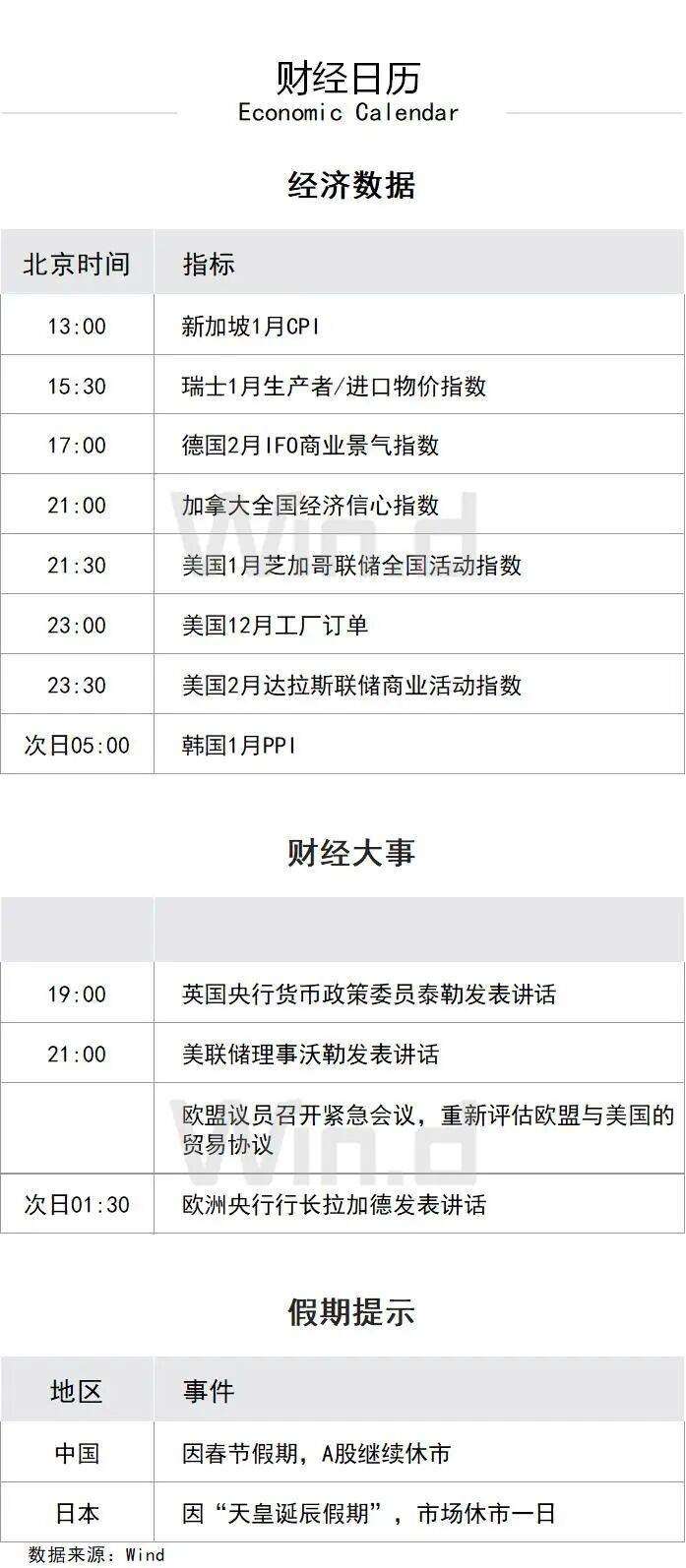
Group 1 - The global market is focused on the new 15% tariffs announced by President Trump, which may face legal challenges, while bilateral trade agreements remain valid [4][10] - The A-share market is set to open for trading after the Spring Festival, with public funds prepared for investment, anticipating a balanced market structure with a focus on "technology growth" and "Chinese advantages" [5] - The Spring Festival box office has exceeded 5 billion yuan, marking the eighth consecutive year of over 100 million viewers [6] Group 2 - The Chinese government is pushing for modernization in agriculture, emphasizing the integration of various sectors and the development of technology-driven agriculture [2] - The steel industry in China has achieved significant reductions in energy consumption and emissions, with over 80% of crude steel capacity meeting ultra-low emission standards [6] - The AI industry is experiencing strong demand, with companies like SK Hynix and Huagong Technology reporting full order books and operational capacity [8] Group 3 - The global investment landscape is seeing a surge in capital inflow into Latin American markets, with the MSCI Emerging Markets Latin America Index reaching an eleven-year high [11] - The Chinese yuan has been appreciating against the US dollar, driven by favorable external conditions and increased corporate demand for currency exchange [11]


1月以来机构扎堆调研优质股曝光 大金重工获318家机构调研居首
Mei Ri Jing Ji Xin Wen· 2026-02-22 04:57
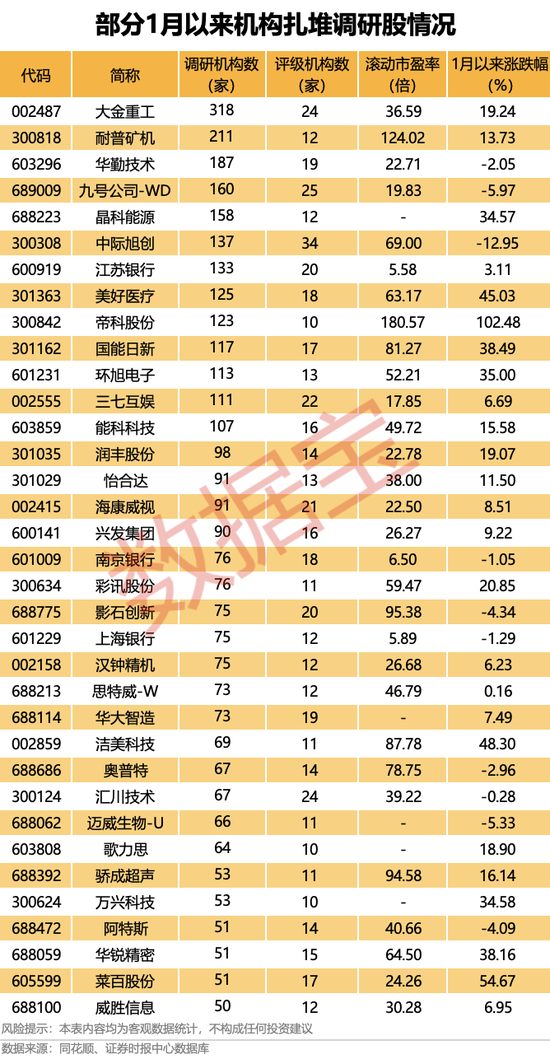
Group 1 - In January, a total of 35 companies had more than 50 research institutions and over 10 rating agencies involved [1] - Dajin Heavy Industry received the highest attention with 318 research institutions conducting investigations [1] - Among rating agencies, Zhongji Xuchuang topped the list with 34 ratings from different institutions [1] Group 2 - Three bank stocks, Jiangsu Bank, Shanghai Bank, and Nanjing Bank, made it to the list, with Jiangsu Bank receiving investigations from as many as 133 institutions [1] - The average increase in stock prices for the listed companies this year has exceeded 16%, significantly outperforming the broader market [1] - Notable stocks such as Dike Co., Caibai Co., Jiemai Technology, and Meihao Medical have all seen increases of over 40% [1]



机构扎堆调研的优质股曝光!
Xin Lang Cai Jing· 2026-02-22 04:21
Core Viewpoint - The article discusses the potential market trends following the Chinese New Year, emphasizing the importance of institutional investor research as a leading indicator for stock selection and investment opportunities [2][6]. Group 1: Institutional Research Insights - Institutional investors are expected to conduct thorough research, including site visits and conference calls, to assess companies' operational status and industry outlook before making investment decisions [2][7]. - A total of 35 companies have been identified that received significant attention from institutions, with at least 50 institutions conducting research and 10 rating agencies involved [2][7]. Group 2: Notable Companies and Their Performance - 大金重工 (Dajin Heavy Industry) received the highest attention with 318 institutional research engagements, benefiting from the UK AR7 auction of 8.4GW offshore wind projects, which exceeded market expectations [3][8]. - 中际旭创 (Zhongji Xuchuang) led in ratings with 34 agencies, with expectations for rapid growth in demand for 1.6T optical modules by 2026 and 2027 [3][8]. - 江苏银行 (Jiangsu Bank) was researched by 133 institutions, with management actively increasing their shareholdings, indicating confidence in the bank's growth prospects [4][9]. Group 3: Financial Projections and Market Performance - 奥比中光 (Obi Zhongguang) is projected to achieve a net profit of approximately 1.23 million yuan in 2025, marking a turnaround to profitability [4][9]. - 思特威 (Siwei) anticipates a net profit between 9.76 billion to 10.31 billion yuan in 2025, reflecting a year-on-year increase of 149% to 162% [4][9]. - The average stock price increase for the highlighted companies has exceeded 16% this year, significantly outperforming the broader market, with some stocks like 帝科股份 (Dike Co.) and 菜百股份 (Cai Bai Co.) rising over 40% [4][9]. Group 4: Detailed Company Research Data - A summary of companies with significant institutional research includes: - 大金重工: 318 institutions, 24 ratings, 19.24% increase [5][10] - 耐普矿机 (Naipu Mining): 211 institutions, 12 ratings, 13.73% increase [5][10] - 江苏银行: 133 institutions, 20 ratings, 3.11% increase [5][10] - 美好医疗 (Meihao Medical): 125 institutions, 18 ratings, 45.03% increase [5][10] - 帝科股份: 123 institutions, 10 ratings, 102.48% increase [5][10]

当流量退潮 民营银行为何“消失”在TOP50?
Jing Ji Guan Cha Wang· 2026-02-19 10:12
2025年的中国手机银行市场,出现了一个值得玩味的现象:曾经被视为"鲶鱼"的民营银行,集体从主流 视野中消失了。艾瑞咨询最新发布的《2025年中国手机银行APP监测报告》(下文简称"报告")显示, 以微众银行、网商银行为代表的民营银行遭遇重挫,2025年集体淡出行业月活TOP50榜单。 这一"消失"并非偶然。当手机银行用户规模在7亿量级筑顶,当单机单日有效使用时长从4.93分钟骤降 至2.70分钟,当用户行为从"长时浏览"转向"即用即走",曾经靠流量红利和互联网光环撑起的民营银行 故事,正迎来新局。 报告认为,当传统银行全面完成数字化补课后,民营银行纯线上模式在获客、信任度和综合服务能力上 的短板暴露无遗,缺乏独特生态场景和稳固根基成为其发展瓶颈。 从"双子星"到"无人上榜" 根据报告,中国手机银行月度总独立设备数在6.48亿至7.39亿区间波动后企稳,市场正式进入存量深耕 阶段。在残酷的存量博弈中,竞争格局呈现出显著的结构性分化。然而,引人注目的并非头部玩家的座 次微调,而是一个曾经活跃的群体,民营银行的集体退场。 民营银行从TOP50榜单"消失",并非一夜之间。 报告数据显示,2025年MAU排名靠前的银 ...
股份制银行差异化竞争,头部效应显著
Xin Lang Cai Jing· 2026-02-18 05:56
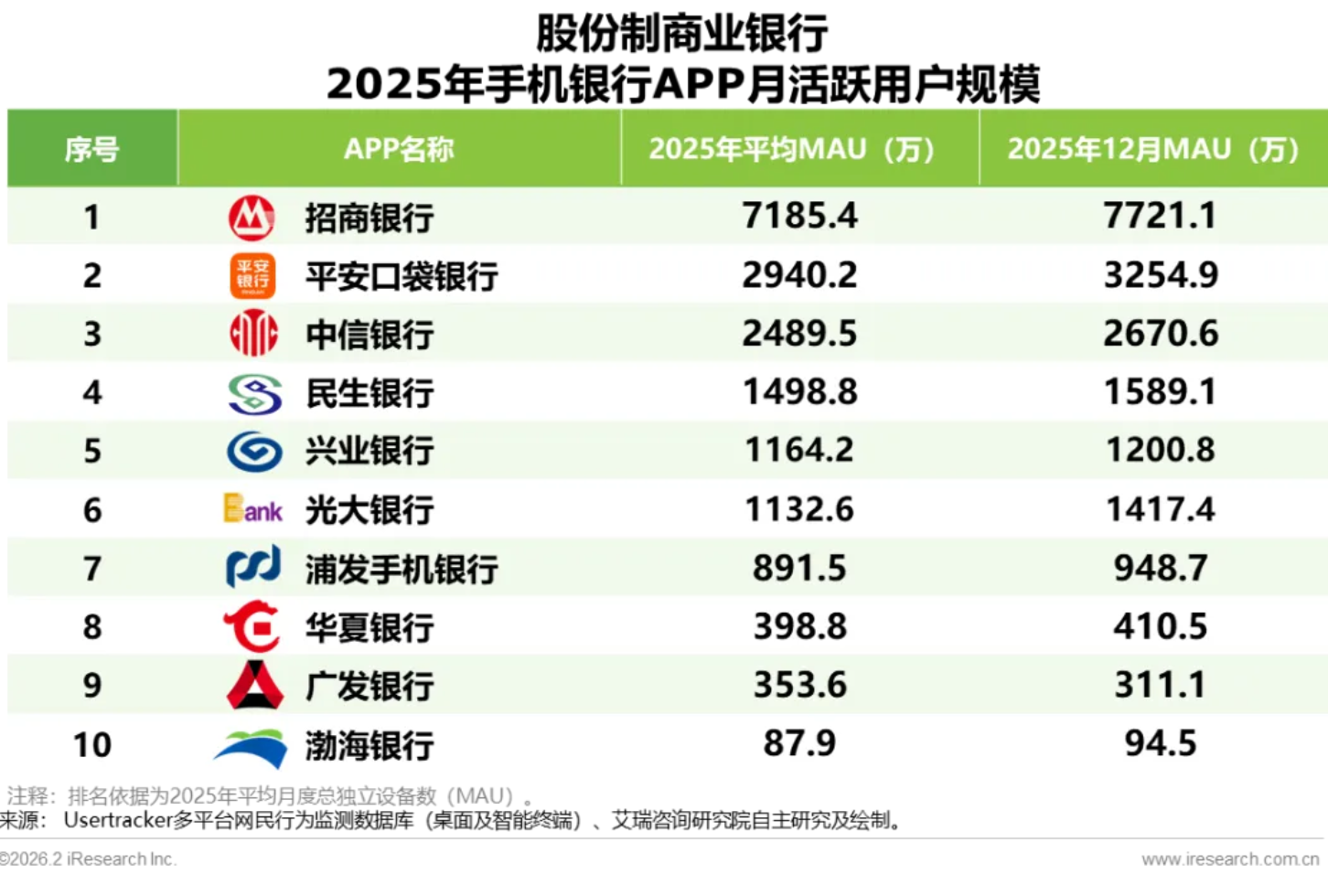
Core Insights - The mobile banking user base in China is expected to peak in 2025, shifting the industry focus from acquiring new users to enhancing existing user engagement [1] - Financial institutions must achieve extreme efficiency and precision in their ecosystems to survive in this new environment [1] Industry Overview - According to an iResearch report, joint-stock banks are adopting differentiated survival strategies, leading to significant head effects [1] - China Merchants Bank leads joint-stock banks with 71.854 million monthly active users (MAU), surpassing some state-owned banks due to its focus on wealth management and intelligent interaction [1] - Ping An Bank and CITIC Bank form the second tier, maintaining MAUs between 20 million and 30 million, with Ping An Bank leveraging AI to reconstruct service chains and CITIC Bank integrating consumer ecosystems [1] Competitive Landscape - Third-tier institutions, such as Minsheng Bank and Everbright Bank, have seen their MAUs drop to between 10 million and 20 million, indicating a tightening survival space [1] - Local banks are experiencing growth by focusing on their local markets, with city commercial banks like Jiangsu Bank and Beijing Bank maintaining MAUs above 3 million [1] - Among rural commercial banks and rural credit cooperatives, Fujian Rural Credit has surpassed 4.5 million MAUs, capturing traffic in county and rural areas [1] Challenges for Private Banks - The situation for private banks is dire, with the top 50 list for 2025 nearly extinct due to a lack of physical branches, local living ecosystems, and high customer acquisition costs, leading to a loss of competitiveness in the mobile banking sector [1] - In the era of stock competition, ecological and regional capabilities are becoming the key to success [1]



国有大行主导手机银行市场,生态嵌入构筑护城河
Jing Ji Guan Cha Wang· 2026-02-18 05:47
Core Insights - The Chinese mobile banking market is entering a stage of stock competition in 2025, with monthly active users (MAU) stabilizing between 648 million and 739 million [2] - State-owned commercial banks dominate the market due to their ecological embedding advantages, with Agricultural Bank of China leading at 249 million MAU, followed by Industrial and Commercial Bank of China (194 million) and China Construction Bank (109 million) [2] - Private banks are expected to collectively exit the top 50 MAU rankings in 2025 due to a lack of offline branch support and local living ecosystems [2] Group 1: Major Players - Agricultural Bank of China has the highest MAU at 249 million, followed by Industrial and Commercial Bank of China with 194 million and China Construction Bank with 109 million, forming the first tier of banks [2] - China Bank and Postal Savings Bank have MAUs exceeding 50 million, constituting the second tier [2] - China Merchants Bank leads the joint-stock banks with 71.85 million MAU, while Ping An Bank and CITIC Bank form the second tier, with other joint-stock banks generally below 20 million MAU [2] Group 2: Market Dynamics - The core advantage of state-owned banks lies in their "full-scenario integration" capabilities, embedding services deeply into high-frequency life scenarios such as government affairs, social security, healthcare, and education [2] - Agricultural Bank of China extends its services to rural areas through intelligent service matching and customer customization, while Industrial and Commercial Bank of China utilizes its "Gong Xiao Zhi" model for interactive service [2] - Regional banks like Jiangsu Bank, Beijing Bank, and Ningbo Bank show stable performance by focusing on local markets, with some rural commercial banks like Fujian Rural Credit exceeding 4.5 million MAU, indicating the sustainability of localized operations in the stock market [2]



手机银行TOP50再无民营 生态壁垒高筑草根绝迹
Jing Ji Guan Cha Wang· 2026-02-18 05:47
Core Insights - The monthly active users (MAU) of mobile banking apps in China have stabilized between 648 million and 739 million, indicating that user growth has reached a ceiling, marking the end of a decade-long traffic dividend period [2] - User behavior has shifted significantly, with average session duration decreasing from 4.9 minutes in 2023 to approximately 2.7 minutes by mid-2025, reflecting a preference for high-frequency, short-duration, and function-oriented usage [2] - Major state-owned banks have solidified their market dominance, with all six major state-owned banks ranking in the top ten for MAU, led by Agricultural Bank of China with 249 million MAU [2] Industry Dynamics - The core competitive advantage of state-owned banks lies in their "full-scenario integration" capabilities, providing financial services deeply embedded in public services such as government, social security, healthcare, and education [3] - Joint-stock banks are adopting specialized development strategies, with China Merchants Bank leading its peers with 71.85 million MAU, while Ping An Bank and Citic Bank are leveraging AI technology to enhance service processes and maintain user engagement [3] - Local banks are experiencing polarization, with some city commercial banks maintaining MAU above 3 million due to their deep understanding of local markets, while private banks like WeBank and MYbank have fallen out of the top 50 due to challenges in customer acquisition and retention [3] Future Trends - As the industry standard for single-session usage time becomes 3 minutes, banks must rethink their value creation strategies [4] - AI-driven service process optimization, real-time risk control systems, and multi-device collaboration within ecosystems are reshaping the competitive landscape [4] - Key factors for institutional success in the future will include precise user insights, prudent risk management, and robust ecosystem integration capabilities [4]



2.7分钟定生死 手机银行存量厮杀谁在“断臂”,谁在“吃肉”?
Jing Ji Guan Cha Wang· 2026-02-18 04:57
Core Insights - The report by iResearch indicates that the monthly active users (MAU) of mobile banking apps in China have stabilized after fluctuating between 648 million and 739 million, signaling a ceiling in user growth and a shift from acquiring new users to enhancing existing user engagement [2] - User behavior is undergoing a structural reversal, with the effective daily usage time per device dropping from 4.9 minutes in 2023 to around 2.7 minutes by mid-2025, leading to a focus on high-frequency, short-duration, and functional usage [2] - Financial institutions are compelled to streamline operations and focus resources on core transaction scenarios to survive in this competitive landscape, where efficiency and precision are paramount [2] Mobile Banking Market Overview - The top three banks in terms of MAU are Agricultural Bank of China (2.49 billion), Industrial and Commercial Bank of China (1.94 billion), and China Construction Bank (1.09 billion), with all six major state-owned banks ranking in the top ten [3][5][6] - Private banks, represented by WeBank and MYbank, have faced significant setbacks, with many dropping out of the top 50 MAU rankings by 2025 [4] Competitive Landscape - State-owned banks are solidifying their dominance through extensive customer bases and integrated ecosystems, leveraging services embedded in high-frequency life scenarios such as government services and healthcare [7] - Joint-stock commercial banks are adopting a "specialized and precise" survival strategy, with China Merchants Bank leading among them with 71.85 million MAU, focusing on wealth management and intelligent interaction [8][10] - Regional banks are thriving by deeply engaging with local markets, while private banks struggle due to high customer acquisition costs and lack of local ecosystem support [13][14] Future Outlook - The mobile banking market is transitioning from a phase of scale expansion to one of value cultivation, with state-owned banks building moats through ecosystems, joint-stock banks seeking niches through specialization, and regional banks solidifying their local roots [14] - The ability to create irreplaceable value in a limited user engagement environment will be crucial, with technology applications such as AI reshaping service processes and enhancing risk management [15][16]

银行行业2026年1月金融数据点评:政府债发力明显,股市活跃推动存款搬家
Zhong Guo Yin He Zheng Quan· 2026-02-15 06:24
Investment Rating - The report maintains a "Recommended" rating for the banking sector, highlighting its high dividend and low valuation attributes that continue to attract long-term capital [5]. Core Insights - The banking sector is experiencing a significant contribution from government bonds to social financing growth, with a notable increase in government bond issuance in January 2026 [5]. - The report indicates that while social financing has increased year-on-year, the growth rate has decreased compared to the previous month, primarily due to weaker RMB loans and fluctuating demand from the real economy [5]. - The capital market's activity is driving a "deposit migration" process, as increased market engagement leads to higher liquidity in the banking sector [5]. Summary by Sections Banking Industry - In January 2026, new social financing reached 7.22 trillion yuan, an increase of 165.4 billion yuan year-on-year, with government bonds being the main contributor [5]. - RMB loans increased by 4.9 trillion yuan, which is a decrease of 319.4 billion yuan year-on-year, influenced by demand fluctuations and debt restructuring [5]. - The report notes that short-term loans in the real sector have increased, while medium and long-term loans remain weak, particularly in the real estate sector, which saw a 28.5% decline in sales for major developers [5]. Market Activity - The report highlights that M1 and M2 growth rates are at 4.9% and 9% respectively, indicating an increase in liquidity [5]. - Financial institutions' RMB deposits increased by 9.9% year-on-year, with a monthly increase of 8.09 trillion yuan, driven by both household and corporate deposits [5]. - The report emphasizes the role of an active capital market in attracting deposits, with a 58% increase in average daily trading volume in January [5].