
美光

Search documents
2026年Q1 NAND闪存价格环比涨幅超40%,AI算力需求爆发带动半导体设备、存储赛道景气度上行
Mei Ri Jing Ji Xin Wen· 2026-02-04 03:23
Group 1 - The semiconductor materials and equipment theme index on the STAR Market has seen a decline of 0.95% as of February 4, 2026, with mixed performance among constituent stocks [1] - The semiconductor equipment ETF, Huaxia, has decreased by 0.74%, with a latest price of 1.88 yuan, while the STAR Market semiconductor ETF has dropped by 0.96%, priced at 1.75 yuan [1] - The trading volume for the STAR Market semiconductor ETF was 3.21 billion yuan, with a turnover rate of 3.99%, indicating significant liquidity [1] Group 2 - The latest net outflow for the STAR Market semiconductor ETF is 227 million yuan, but over the past five trading days, there has been a net inflow of 389 million yuan, averaging 77.86 million yuan per day [2] - Counterpoint's report indicates that NAND flash prices are expected to rise by over 40% this quarter due to reduced consumer-grade capacity by major manufacturers to meet the growing demand from AI servers [2] - The price of low-end 128GB PC SSDs has increased by 50%, reflecting the tightening supply in the NAND market [2] Group 3 - AI computing demand is driving the semiconductor equipment and storage sectors upward, with ASML expected to see steady growth in 2025 due to significant technological barriers in EUV lithography [3] - Samsung Electronics and SK Hynix are benefiting from tight supply and rising prices in the storage chip market, while continuing to advance high-end storage product development [3] - The domestic semiconductor equipment and storage industry presents investment opportunities, particularly in the context of the AI revolution and ongoing technological advancements [3]
未知机构:开源电子AI早餐会2602041行情催化美股科技股存-20260204
未知机构· 2026-02-04 01:55
Key Points Summary Industry Overview - The technology sector in the US stock market, particularly storage stocks, continues to lead gains with notable increases: SanDisk up 4.55%, Western Digital up 7.40%, and Teradata up 13.41%. However, Micron experienced a decline of 4.19%, and AMD's guidance fell short of expectations, leading to a significant drop in after-hours trading [1][1]. Smartphone Market Insights - According to a recent report by Counterpoint Research, the smartphone market is unlikely to recover before 2027, with normalization expected in the second half of 2027 or early 2028 [1][1]. AMD Developments - AMD reported that demand for server CPUs is "very strong," with AI business accelerating. The company anticipates a 60% annual growth in data center revenue over the next three to five years, projecting AI revenue to reach "hundreds of billions" by 2027 [1][1]. Lumentum Expansion - Lumentum is rapidly expanding in the Optical Communications Solutions (OCS) sector to meet significant customer demand, with backlog orders exceeding $400 million. Additionally, the company has secured several hundred million dollars in new orders in the Chip-on-Board (CPO) sector, with expected deliveries in the first half of 2027 [1][1]. Samsung Electronics Update - Samsung Electronics plans to initiate a "conversion investment" for advanced NAND flash in the second quarter of this year. The X2 production line in Xi'an, China, will be converted to produce 280-layer V9 NAND, aiming to increase monthly production capacity by 40,000 to 50,000 wafers. The P1 facility in Pyeongtaek, South Korea, is also preparing for capacity enhancements [2][2].
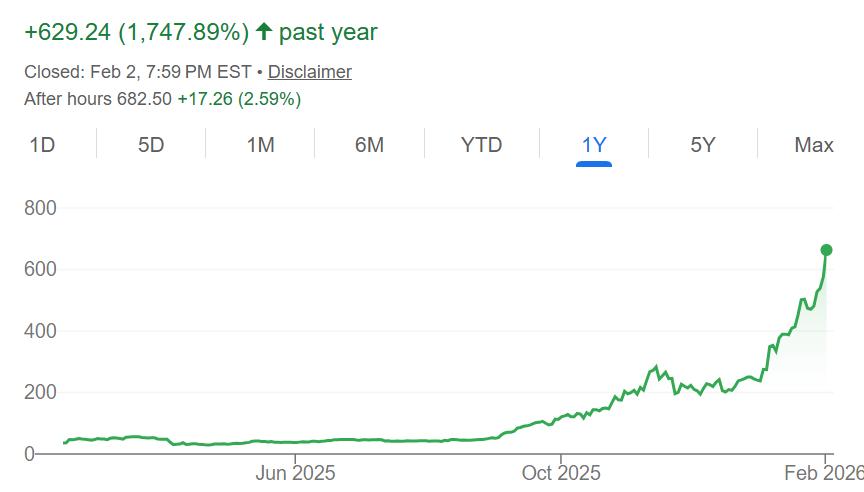
飙涨1700%,又一“AI宠儿”诞生
3 6 Ke· 2026-02-03 08:11
美东时间周一,在美股市场尚未完全走出贵金属抛售风暴带来的恐慌情绪之际,"存储四巨头"却集体迎来强劲涨势——闪迪、美光、希捷科技和西部数据 集体大幅收涨。 在这其中,NAND巨头闪迪更是以15.44%的惊人涨幅成为整个市场"最靓的仔"。 事实上,自上周五闪迪公布了强劲的业绩和展望报告后,就立即受到了华尔街的热捧。 美东时间周一,华尔街分析师们纷纷出手,大幅上调对闪迪的未来盈利和股价预期,其中伯恩斯坦甚至喊出了1000美元的目标价,相较于当前665美元的 股价,意味着还有超过50%的上涨空间。 闪迪股价在过去一年已经飙升十余倍 首先支撑华尔街信心的,就是闪迪拿出的坚实财报数据。 北京时间上周五,闪迪公布了一份亮瞎眼的财报:公司第二财季(截至1月2日)营收为 30.3 亿美元,环比增长 31%,高于市场预期的 26.4 亿美元。调整 后每股收益为6.20美元,几乎是市场普遍预期3.33美元的两倍。 按美国通用会计准则(GAAP)计算,公司净利润飙升至8.03亿美元,较去年同期的1.04亿美元增长672%;毛利率提升至51.1%,反映出更高的定价和有 利的产品组合;自由现金流同比增长超过1000%。 而公司对于第三财 ...

伏击“物理短板”,鹤禧投资的科技方法论
聪明投资者· 2026-02-03 07:02
Group 1 - The core logic of technology investment is based on "first principles," emphasizing that the performance of AI systems is determined by the shortest supply chain segments rather than the most powerful components [2] - The investment strategy focuses on identifying bottleneck segments in the supply chain, particularly in storage, as demand for storage is expected to grow significantly due to the increasing size of AI models and their requirements [4][12] - The investment approach is characterized by a shift from macro capacity considerations to micro-level KPIs and contract details, highlighting the importance of operational efficiency and management practices in the supply chain [5][6] Group 2 - The storage sector is identified as a critical bottleneck in the AI supply chain, with demand growth outpacing that of GPUs, driven by the evolution of multi-modal models and increased data throughput [8][11] - The supply constraints in the storage market are attributed to high capital expenditure requirements and technological barriers, making it difficult for new capacity to meet the surging demand [14][16] - The expected structural changes in the storage market indicate that by 2026, over half of storage procurement will come from AI data centers, with a significant shift towards customized and long-term contracts [15][16] Group 3 - The investment philosophy emphasizes the importance of understanding industry dynamics and avoiding speculative behaviors based on price movements, advocating for a focus on fundamental industry truths [7][12] - The narrative economy is highlighted as a significant factor influencing asset pricing, where trends and narratives can drive valuations faster than actual earnings growth [27][28] - The competitive landscape in the AI sector is evolving, with companies like Google and Nvidia driving demand for optical devices and storage, indicating a shift in value distribution within the supply chain [23][29]

存储芯片遭重挫,2000亿兆易创新跌停
Huan Qiu Lao Hu Cai Jing· 2026-02-02 11:49
Group 1 - The storage chip sector experienced a significant decline, with companies like Zhaoyi Innovation hitting the daily limit down, closing at 283.39 yuan per share, resulting in a market capitalization drop to 197.5 billion yuan [1] - Major manufacturers such as Samsung, SK Hynix, and Micron have tightened order reviews and conducted stricter due diligence on customers, indicating potential weakness in downstream demand for storage products [1] - The tightening of orders is a response to previous supply constraints in the storage chip market, driven by the large-scale construction of AI infrastructure, leading manufacturers to shift over 70% of advanced capacity towards enterprise-level storage products [1] Group 2 - The global storage market is expected to see price increases starting from Q3 2025, with NAND flash prices projected to rise by 33%-38% and general DRAM prices by 55%-60% in Q1 of this year [2] - Zhaoyi Innovation reported a revenue of 6.832 billion yuan for the first three quarters of 2025, a year-on-year increase of 20.92%, and a net profit of 1.083 billion yuan, up 30.18%, despite a slight decline in gross margin to 38.59% [2] - The company anticipates a full-year revenue of approximately 9.203 billion yuan for 2025, representing a 25% year-on-year growth, with a net profit forecast of around 1.61 billion yuan, a 46% increase [2]

港股收盘(02.02) | 恒指收跌2.23%失守两万七 有色股再遭重创 三大运营商全天承压
智通财经网· 2026-02-02 08:44
智通财经APP获悉,沃什获美联储主席提名引爆鹰派预期,全球资产遭遇剧烈波动。港股三大指数全天 下行,恒指失守两万七大关,恒科指数午后一度跌超4%。截至收盘,恒生指数跌2.23%或611.54点,报 26775.57点,全日成交额为3478.86亿港元;恒生国企指数跌2.54%,报9080.19点;恒生科技指数跌 3.36%,报5526.31点。 华泰证券表示,当前市场回调更多是上涨过快的背景下,偏鹰派美联储主席提名导致的技术性回撤。该 行认为,经历了如此调整后,当前的核心问题是波动的持续性和会不会终结市场表现。当前情绪已在乐 观区间,且拥挤度尚未明显回落,波动短期或持续,但更多是回撤而不是反转。一季度市场空间的三个 驱动因素——流动性改善、资金面共振与盈利预期上修仍然成立。 蓝筹股表现 金沙中国(01928)逆市上扬。截至收盘,涨4.05%,报17.72港元,成交额7.76亿港元,贡献恒指2.66点。 澳门博彩监察协调局公布数据显示,1月博彩毛收入226.33亿澳门元,同比增长24%,较前一个月升 8.4%。摩根士丹利研报指出,澳门今年一月博彩总收入优于市场预期。又因农历新年8日假期全落在二 月,预计该月应能 ...



财通证券:配套内存模组向MRDIMM发展 看好MRCD芯片与MDB芯片环节
智通财经网· 2026-02-02 06:40
Core Viewpoint - MRDIMM is a new memory module architecture designed for high-performance computing and data-intensive applications, achieving a data transfer rate of 8800 MT/s, which is nearly a 40% increase in peak bandwidth compared to standard DDR5 RDIMM [1][2] Group 1: MRDIMM Technology Overview - MRDIMM is suitable for high-performance computing and artificial intelligence applications, addressing the bandwidth decline per core due to the increasing number of processor cores [2] - The first generation of MRDIMM supports a data transfer rate of 8800 MT/s, with the third generation expected to reach 14000 MT/s [2] - The architecture of MRDIMM includes 1 MRCD (Memory Register Clock Driver) and 10 MDB (Memory Data Buffer) chips, indicating significant growth potential in the market [3] Group 2: Market Demand Projections - By 2030, the demand for MRCD and MDB is projected to increase significantly, with estimates under pessimistic, neutral, and optimistic scenarios suggesting demand for MRCD could reach 274 million, 456 million, and 593 million units respectively, while MDB demand could reach 2.736 billion, 4.560 billion, and 5.928 billion units [4] - The penetration rates for MRDIMM are estimated to be 30%, 50%, and 65% under pessimistic, neutral, and optimistic scenarios respectively [4] Group 3: Industry Implications - The adoption of MRDIMM technology is expected to drive demand for MRCD and MDB chips, particularly as it becomes compatible with Intel's sixth-generation CPUs [1][3] - Key companies in the market include 澜起科技 (Lanke Technology) and 聚辰股份 (Juchen Technology), which are involved in the production of MRCD/MDB chips and DDR5 memory modules respectively [1]


CPU专题报告一:配套内存模组向MRDIMM发展,看好MRCD芯片与MDB芯片环节
CAITONG SECURITIES· 2026-02-02 04:30
Investment Rating - The report maintains a "Positive" investment rating for the industry [1]. Core Insights - The transition of server-level CPU memory modules towards MRDIMM technology is highlighted, with a focus on MRCD and MDB chips as key growth areas. MRDIMM is suitable for high-performance computing and AI applications, achieving data transfer rates of up to 8800MT/s, with future generations expected to reach 14000MT/s [3][5][11][12]. - The report anticipates significant demand growth for MRCD and MDB chips, projecting that by 2030, the demand could reach 5.93 billion and 59.28 billion units respectively under optimistic scenarios [5][20][22]. Summary by Sections 1. Development of Server CPU Memory Modules Towards MRDIMM - The report discusses the evolution of memory modules in servers, emphasizing the importance of stability, error correction, and low power consumption as data storage and processing loads increase [8][9]. - Current mainstream memory module technologies include UDIMM, RDIMM, and LRDIMM, with MRDIMM emerging as a new architecture designed to enhance memory bandwidth and performance [10][11]. 2. Core Incremental Growth from MRCD and MDB Chips - MRDIMM utilizes a "1+10" architecture, consisting of one MRCD and ten MDB chips, which are crucial for its performance enhancements. The technology is already compatible with Intel's sixth-generation CPUs, and major memory manufacturers have begun producing MRDIMM products [5][17]. - The report outlines potential penetration rates for MRDIMM by 2030, estimating demand for MRCD and MDB chips under various scenarios [20][22]. 3. Demand Projections for MRCD and MDB Chips - Under optimistic assumptions, the report forecasts that by 2030, the demand for MRCD and MDB chips could reach 5.93 billion and 59.28 billion units respectively, driven by the increasing adoption of MRDIMM technology in server environments [20][23].
芯片股早盘走低 传多家厂商严控存储芯片订单 防止客户过度囤积
Zhi Tong Cai Jing· 2026-02-02 03:47
Group 1 - Semiconductor stocks experienced a decline, with Huahong Semiconductor down 9.53% to HKD 105.4, and other companies like Zhaoyi Innovation, Shanghai Fudan, and SMIC also reporting significant drops [1] - The South Korean stock market saw a sharp decline of 4%, with major players Samsung and SK Hynix facing losses [1] - Samsung, SK Hynix, and Micron have tightened order reviews and are conducting stricter due diligence on customers to mitigate potential market fluctuations caused by over-ordering and stockpiling [1] Group 2 - Jensen Huang recently stated that no orders for the H200 chip have been received from Chinese customers, indicating a wait-and-see approach [1] - First Shanghai noted that the impact of the H200 release on the domestic computing power industry chain is limited, primarily due to the differing application scenarios between H200 and domestic computing power, which focuses on small to medium models and inference applications [1]

港股异动 | 芯片股早盘走低 传多家厂商严控存储芯片订单 防止客户过度囤积
智通财经网· 2026-02-02 03:38
Group 1 - Semiconductor stocks experienced a decline, with notable drops including Huahong Semiconductor down 9.53% to HKD 105.4, GigaDevice down 8.06% to HKD 308, Shanghai Fudan down 5.08% to HKD 49.36, and SMIC down 4.18% to HKD 72.25 [1] - The South Korean stock market saw a significant drop of 4%, impacting major companies like Samsung and SK Hynix [1] - Major chip manufacturers, including Samsung, SK Hynix, and Micron, have tightened order reviews and are conducting stricter due diligence on customers to mitigate potential market fluctuations caused by excessive orders or stockpiling [1] Group 2 - Jensen Huang recently stated that no orders for the H200 chip have been received from Chinese customers, indicating a wait-and-see approach [1] - First Shanghai noted that the impact of the H200 chip release on the domestic computing power industry chain is limited, primarily due to the differing application scenarios between H200 and domestic computing power, which focuses on small to medium models and inference applications [1]