
腾讯云

Search documents
巨人网络:《超自然行动组》推出AI大模型玩法,AI与真人玩家对局数超2500万次
Xin Lang Ke Ji· 2026-01-19 01:49
Core Insights - The article discusses the launch of a new "AI Model Challenge" in the game "Supernatural Action Group" by Giant Network, marking the first deep integration of AI models in a high DAU game in China [1] - The AI-driven NPCs in the game can now interact with players in real-time, enhancing gameplay by acting as direct opponents rather than scripted characters [1] - After one week of launch, AI participation in matches exceeded 25 million [1] Industry Collaboration - To facilitate the large-scale implementation of AI-native gameplay, Giant Network has partnered with major AI model providers such as Alibaba Cloud, Volcano Engine, and Tencent Cloud [1] - The collaboration focuses on key issues such as model capability adaptation, real-time inference efficiency, and high concurrency stability [1] - "Supernatural Action Group" serves as a pioneering example in the industry for integrating multiple AI model capabilities into a high DAU product [1]

20亿!中国移动大单结果出炉,国产厂商的\"春天\"来了!
Xin Lang Cai Jing· 2026-01-13 11:32
5G通信 数十万5G与信息领域关注者的头部科技媒体 近日,中国移动2025年至2026年集中网络云资源池七期工程计算型服务器超大采购订单中标候选人结果 正式公示,本次采购涉及计算型服务器总计8581台,仅目前已公布的两个标包不含税总金额就已达到约 20亿元。 文 赵哲超/5G通信 移动的算力"加码"逻辑 作为行业老兵,我见证了太多运营商的投资周期变化。这次移动的大手笔采购,绝非一时兴起,而是有 着清晰的战略考量。 从财务数据看,2024年中国移动算力领域投入475亿元,同比增长21.5%,占资本开支比重从21.7%提升 至27.5%。这个比例变化很有意思——在总体资本开支下降4%的情况下,算力投资逆势上扬,说明移动 已经把算力当作下一个增长极来布局。 从集采规模看,今年移动的算力采购确实"疯狂"。先是191亿元的AI训练服务器集采,紧接着50亿元的 AI推理服务器集采,现在又来了20亿元的网络云资源池服务器。短短一年内,仅服务器采购就超过260 亿元,这在运营商历史上都是罕见的。并且目前,标包3、4、5的中标候选人尚未公布,意味着此次大 规模集采的最终总金额仍有上升空间。 更关键的是,中国移动时任董事长、党组 ...



2025信创产业发展趋势及50强报告
Sou Hu Cai Jing· 2026-01-05 15:58
Core Insights - The Xinchuang industry and generative AI security are in a rapid development phase, with technological innovation and compliance becoming the core development themes [1] - The Xinchuang industry has established a complete industrial chain covering basic hardware, software, cloud services, and application software, focusing on key areas such as chips, servers, databases, and industrial software [1] - Generative AI models are evolving from "call-type" to "intelligent agent" integration, embedding deeply into critical processes across various industries, while facing multiple risks [1] - A comprehensive compliance system based on three major data security laws has been formed in China, with global regulatory frameworks being established through laws like the "Artificial Intelligence Act" [1] Industry Development Status - By 2025, the Xinchuang industry is expected to enter a deep-water phase, with standards becoming more refined and product varieties continuously enriching [6] - The industry is characterized by a stepwise advancement in construction, led by state-owned enterprises with collaboration from SMEs [6] - The application of AI, particularly large models, is driving the growth of the Xinchuang industry, becoming a new growth engine [6] Key Focus Areas - The Xinchuang industry is seeing rapid growth in sectors such as finance, telecommunications, transportation, and energy, with significant advancements in core systems and standards [10][11] - AI is driving structural adjustments in Xinchuang products, with large models accelerating their application in government, telecommunications, finance, and education [12][17] Technological Insights - The Chinese CPU market is projected to reach 250 billion by 2025, with a competitive landscape evolving [25][26] - The demand for domestic databases is increasing, with a significant rise in the production of data and a growing need for non-relational databases [31][41] - The integration of AI with Xinchuang cloud services is becoming a key trend, enhancing the capabilities of various sectors [42][46] Ecosystem Development - The open-source community is playing a crucial role in enhancing the technological ecosystem of Xinchuang, facilitating faster integration of AI capabilities [19][23] - The ability of Xinchuang products to go global is improving, supported by the growing digital infrastructure investments in regions like Southeast Asia and Africa [19][23] Application Software Trends - Application software is transitioning from basic adaptation to value creation, with a focus on accelerating scene-based implementation and intelligent upgrades [44][47] - Industrial software is identified as a core area for Xinchuang, with increasing demand driven by manufacturing upgrades and smart manufacturing initiatives [44][47]

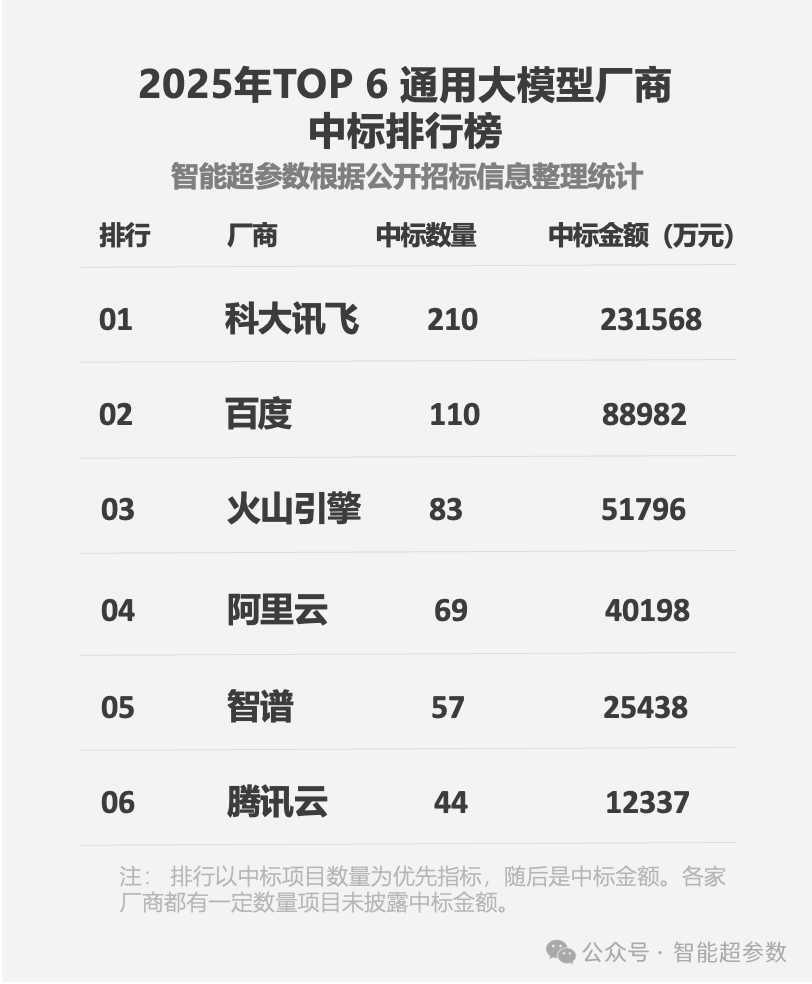
谁拿走最多大模型项目?2025年中标排行榜出炉,科大讯飞蝉联“标王”
Jing Ji Guan Cha Wang· 2026-01-05 03:16
Core Insights - The report highlights a significant increase in the number of large model-related bidding projects in 2025, with a total of 7,539 projects, marking a 396% growth compared to 2024. The disclosed bid amounts reached 29.52 billion yuan, reflecting a 356% increase [1][2]. Group 1: Market Overview - Large models have emerged as a new hotspot in the technology market, with many institutions reallocating budgets towards purchasing large model technology stacks [2]. - A few companies have begun to dominate the bidding landscape, with general large model vendors being the primary winners in the bidding market [3]. Group 2: Leading Companies - The top 30 bidding companies include major general large model vendors such as iFLYTEK, Baidu, Volcano Engine, Alibaba Cloud, Zhiyuan, and Tencent Cloud, all of which rank highly in terms of project numbers [3][4]. - Telecommunications operators have also secured a significant number of large model projects, with 10 out of the top 30 companies having a telecom background, as clients in sectors like government and healthcare prefer these firms for compliance reasons [3]. Group 3: Performance of Major Vendors - iFLYTEK led the bidding performance in 2025 with 210 projects and a disclosed bid amount of 2.31568 billion yuan, dominating various sectors including education, healthcare, finance, and government [6][7]. - Baidu followed with 110 projects and a bid amount of 889.82 million yuan, primarily in the finance sector, showcasing its comprehensive AI capabilities [8]. - Volcano Engine secured 83 projects with a bid amount of 517.96 million yuan, focusing on financial and governmental applications [9]. - Alibaba Cloud achieved 69 projects with a bid amount of 401.98 million yuan, emphasizing standardized solutions in AI [10]. - Zhiyuan reported 57 projects with a bid amount of 25.438 million yuan, mainly in energy and government sectors [11]. - Tencent Cloud completed 44 projects with a bid amount of 123.37 million yuan, focusing on media and content generation [11].

140亿,清华校友干出“大模型 Data Agent第一股”,腾讯押注
创业邦· 2025-12-30 10:11
Core Viewpoint - Xunce Tech, recognized as the first "Data Agent" stock in Hong Kong, has recently gone public, focusing on real-time data infrastructure and analytics solutions, primarily serving the asset management industry and expanding into other sectors [2][3]. Company Overview - Founded in 2016, Xunce Tech started in the asset management sector and has since expanded its client base to include financial services (excluding asset management), urban management, production management, and telecommunications [2]. - The company ranks first in China's real-time data infrastructure and analytics market within the asset management industry, holding a market share of 16% as of 2024 [2]. IPO Details - Xunce Tech issued 22.5 million H-shares at a price of HKD 55.0 per share, raising approximately HKD 1.2 billion, with a current market capitalization of HKD 15 billion [2]. - The IPO attracted nine cornerstone investors, collectively subscribing to about USD 40 million [2]. Funding History - Over its 10 years, Xunce Tech has completed seven rounds of external financing, raising over RMB 2.1 billion, with notable investors including Tencent, KKR, and Yunfeng Capital [3][6]. Leadership Background - The founder and CEO, Liu Zhijian, has extensive experience in financial institutions, having worked at the Royal Bank of Scotland and as an executive director at a Hong Kong investment company before establishing Xunce Tech [5]. - Liu's father, Liu Chengxi, is the largest shareholder through various entities, holding 28.86% of the shares [5]. Product and Service Offering - Xunce Tech's core product is a cloud-native unified data platform that collects, cleans, manages, analyzes, and governs heterogeneous data from multiple sources [9]. - The company focuses on developing trading management systems and trading robots for the asset management industry, targeting institutional investors and large individual investors [9]. Financial Performance - Xunce Tech is currently in a "burning cash" phase, with revenues of approximately RMB 288 million, RMB 530 million, RMB 632 million, and RMB 198 million for the years 2022, 2023, 2024, and the first half of 2025, respectively [10][12]. - The company reported net losses of RMB 96.5 million, RMB 63.4 million, RMB 97.8 million, and RMB 108 million for the same periods [10][12]. R&D Expenditure - The company attributes its net losses to significant R&D expenditures, which accounted for 89.9%, 71.5%, 71.3%, and 85.0% of revenue from 2022 to the first half of 2025 [13]. - The gross margin for the asset management business has decreased from 82.5% in 2022 to 71.1% in 2023, primarily due to increased equipment deployment costs [13][14]. Market Position and Competition - The real-time data infrastructure and analytics market in China is rapidly growing, with over 400 participants and a market size of RMB 18.7 billion by the end of 2024 [19]. - Xunce Tech ranks fourth in the overall real-time data infrastructure and analytics market and first in the asset management sector [19]. - The company faces competition from major cloud service providers like Alibaba Cloud and Tencent Cloud, which offer comprehensive product lines [20][22]. Future Outlook - Xunce Tech is at a critical juncture in its profitability model transition, needing to effectively manage resource allocation for customized projects and convert initial investments in new industries into sustainable revenue [17].

普洛斯中国,选定港股IPO了?
Sou Hu Cai Jing· 2025-12-22 04:05
Core Viewpoint - GLP China is moving forward with its IPO plans in Hong Kong, potentially becoming one of the largest real estate and logistics infrastructure IPOs in Asia for 2026, with an estimated valuation around 200 billion RMB [3][4][7]. Group 1: IPO Details - GLP has selected a group of top international investment banks for its IPO, including Citigroup, Deutsche Bank, Jefferies, and Morgan Stanley, with the IPO expected in the first half of 2026 [4]. - The public offering is anticipated to raise between 3 to 5 billion USD, corresponding to a valuation range of approximately 25 to 30 billion USD (around 200 billion RMB) [6]. - If the upper limit of the valuation is achieved (over 210 billion RMB), it would rank among the top five new listings on the Hong Kong stock exchange in the past five years [7]. Group 2: Business Operations - The core asset package for the IPO will focus on GLP's operations in China, which includes around 450 logistics and industrial parks across 70 regional markets, with an operational area exceeding 55 million square meters and an occupancy rate between 83% and 90% [8]. - For the first three quarters of 2024, GLP reported revenues of 8.17 billion USD, an EBITDA of approximately 1.22 billion USD, and operating cash flow of 390 million USD, indicating a solid short-term liquidity position [8]. - GLP is also integrating data centers and renewable energy into its business model, with a total IT load of about 1,400 megawatts and solar installations generating 2 gigawatts of power, aligning with ESG funding trends [9]. Group 3: Historical Context - GLP China, originally part of ProLogis, had its first IPO in Singapore in 2010, raising approximately 3 billion USD, which was the largest real estate IPO at that time [13]. - After being privatized in 2018 by a consortium led by Hillhouse Capital, Vanke, and others, GLP has since adopted a dual strategy of mature park injection into REITs and maintaining a robust asset management approach [14]. - The potential IPO could signify a doubling of GLP's valuation since its privatization, providing substantial returns for its private equity investors [14].

联想与Alat“联姻”,沙特资本从“买股票”进阶“建产业”
智通财经网· 2025-12-19 07:43
Group 1 - Tesla's convertible bond issuance in 2014, amounting to approximately $2 billion, was a significant debt financing event that supported the construction of its Gigafactory and the development of new vehicle models, transitioning Tesla from a niche sports car manufacturer to a mass-market automaker [1] - The successful execution of this financing strategy led to substantial business improvements for Tesla, with explosive growth in delivery volumes and revenue, ultimately boosting investor confidence and resulting in a long-term bull market for its stock [1] - The 1.25% bonds maturing in 2021 saw significant conversion by investors, yielding profits of 800%-840% due to the stock price exceeding the conversion price [1] Group 2 - Lenovo Group announced a strategic partnership with Saudi Arabia's Public Investment Fund (PIF) in May 2024, involving a $2 billion investment in the form of three-year zero-coupon convertible bonds, with a conversion price set at HKD 10.42 per share [2] - This partnership aims to establish Lenovo's regional headquarters and advanced manufacturing facilities in Saudi Arabia, marking a shift in PIF's investment strategy towards enhancing local industrial capabilities rather than merely seeking financial returns [2][4] - The collaboration is expected to contribute approximately $10 billion to Saudi Arabia's non-oil GDP by 2030, creating 15,000 direct jobs and 45,000 indirect jobs, while also focusing on local talent development [4] Group 3 - The partnership between Lenovo and Alat represents a long-term collaboration that binds capital with industry, aiming to build a sustainable technology manufacturing hub in Saudi Arabia, moving away from reliance on oil [4][10] - Lenovo's investment in local production is anticipated to enhance supply chain resilience, benefiting from tax incentives and reduced tariffs, while also addressing the growing demand for servers and AI infrastructure in the region [7] - The global demand for AI servers is projected to reach $252 billion by 2025, with Lenovo positioned to capitalize on this trend through its strategic initiatives in Saudi Arabia [6][7] Group 4 - Lenovo's issuance of $2 billion in zero-coupon convertible bonds and 1.15 billion warrants at a price of HKD 1.43 per share reflects a strategic move to improve its balance sheet while minimizing immediate equity dilution [5] - The partnership is seen as a critical step for Lenovo to leverage Saudi capital in preparation for the anticipated surge in AI hardware demand, with the company aiming to expand its AI server and edge computing business [5][6] - The establishment of a regional headquarters in Riyadh and a manufacturing facility with an annual capacity of millions of PCs and servers is expected to significantly enhance Lenovo's market position in the Middle East and Africa [7]

全球重点区域算力竞争态势分析报告(2025年)
Sou Hu Cai Jing· 2025-12-18 13:07
Core Insights - Computing power has become the core engine driving global economic development, with the competition landscape characterized by multi-dimensional comprehensive games, where the US and China lead the first tier, while the EU, ASEAN, Middle East, and India showcase unique characteristics [1][7] Group 1: Global Computing Power Landscape - The US has built a complete industrial ecosystem in chip design, AI foundational software, and technical talent, focusing on protecting innovation and national security, with tech giants increasing capital expenditure on high-performance computing and AI applications [1][7] - China ranks second globally in computing power, leveraging the "East Data West Computing" project to establish a national integrated computing network, supported by a strong policy framework and abundant green energy resources [1][7] - The EU emphasizes policy integration, focusing on green low-carbon initiatives and data security, aiming to enhance local semiconductor industry capabilities [1][7] Group 2: Emerging Economies and Trends - Emerging economies like ASEAN are leveraging digital economic growth to attract international investments, while the Middle East is creating green computing hubs, and India is experiencing explosive growth in computing demand driven by its population dividend [1][7] - The global computing power industry is witnessing rapid expansion, technological upgrades, diversification of application scenarios, supply chain restructuring, business model innovation, and a focus on sustainable development [1][7] Group 3: Strategic Importance of Computing Power - Computing power has evolved into a strategic resource comparable to oil and rare earths, influencing national competitiveness and global order [1][30] - The global computing power scale reached 1397 EFLOPS in 2023, a 54% year-on-year increase, with projections indicating it could exceed 16 ZFlops by 2030 [1][31] - The demand for computing power is driven by technological innovation, particularly in AI, and the rapid growth of the digital economy, with significant investments from major tech companies [1][35][36]



研判2025!中国负载均衡器行业分类、产业链及市场规模分析:凭借软件定义与云原生架构创新突破,推动国产化替代进入规模化应用与份额提升新阶段[图]
Chan Ye Xin Xi Wang· 2025-12-17 01:41
Core Insights - The Chinese load balancer industry is undergoing rapid technological iteration and accelerated domestic substitution, driven by digital transformation, cloud computing becoming mainstream, and the surge in demand for 5G and edge computing scenarios. The market size is expected to reach approximately 18.65 billion yuan in 2024, reflecting a year-on-year growth of 6.88% [1][6]. Industry Overview - Load balancers are network devices, software, or services that intelligently distribute network or application traffic across multiple servers. They ensure balanced server load distribution and enhance system performance, availability, and fault tolerance [2][3]. Industry Development History - The development of the Chinese load balancer industry has evolved through four key stages, closely aligned with the rise of the internet, cloud computing, and digital transformation [3]. Industry Supply Chain - The upstream of the load balancer industry includes processors, chips, network interface modules, and various software and system components. The midstream involves the manufacturing of load balancers, while the downstream applications span finance, IT, telecommunications, government, public services, IoT, edge computing, and healthcare [4][5]. Market Size - The load balancer market in China is expanding, with a projected market size of approximately 18.65 billion yuan in 2024, marking a 6.88% increase year-on-year. This growth indicates a strong demand for traffic scheduling and high availability solutions, as domestic manufacturers advance in software-defined and cloud-native architectures [6][7]. Key Companies' Performance - The market is characterized by a dual oligopoly in hardware led by Deepin Technology and Sangfor Technologies, with cloud services dominated by Alibaba Cloud, Tencent Cloud, and Huawei Cloud. Sangfor has penetrated government and financial sectors, while Deepin excels in customized services for telecom operators and large enterprises [7][8]. Industry Development Trends 1. **Integration of Cloud Native and AI Technologies**: Load balancers are transitioning from traditional hardware to intelligent cloud-native solutions, utilizing AI-driven algorithms for dynamic resource allocation [10]. 2. **Accelerated Domestic Substitution**: Domestic manufacturers like Sangfor and Huawei are gaining market share through the use of domestic chips and operating systems, supported by policy and market demand [11]. 3. **Diversified Market Demand**: Emerging technologies such as 5G, IoT, and AI are driving the growth of load balancer demand across various sectors, including finance, healthcare, and education [12].



2025年AI精准医疗市场专题分析
易观分析· 2025-12-16 07:47
Investment Rating - The report rates the AI precision medicine industry as having a positive investment outlook, with significant growth potential driven by technological advancements and policy support [10][39]. Core Insights - AI precision medicine is transforming healthcare from experience-based to data-driven approaches, emphasizing personalized treatment through genetic testing and big data [9][10]. - The market for AI precision medicine is expected to grow rapidly, with projections indicating a market size of 351 billion RMB by 2024 and 760 billion RMB by 2028, reflecting a compound annual growth rate (CAGR) of 21.49% [39]. - The integration of AI technologies into healthcare is enhancing diagnostic accuracy, treatment efficiency, and patient experience, addressing the challenges of uneven resource distribution in the healthcare system [17][40]. Summary by Sections Evolution of AI Precision Medicine - The evolution of AI precision medicine has progressed from research achievements to clinical applications, with significant advancements in technology and policy frameworks supporting this transition [8][9]. Policy Support - Policies are driving the development of a comprehensive and accessible precision medicine framework, enhancing regulatory systems and approval processes to facilitate the integration of AI in healthcare [10][11]. Market Trends - The AI precision medicine market is expanding rapidly, with a projected CAGR of 19.8% from 2022 to 2024 and 21.49% from 2024 to 2028, indicating strong growth potential [37][39]. Technological Advancements - AI technologies are significantly improving diagnostic capabilities, with advancements in multi-modal data integration and real-time health monitoring enhancing patient care and treatment outcomes [26][71]. Application Scenarios - AI is being applied in various healthcare settings, including personalized treatment plans, early disease detection, and long-term health management, thereby transforming traditional healthcare models [43][40]. Industry Collaboration - The report highlights the importance of collaboration across the healthcare ecosystem, leveraging data and AI to create a more integrated and efficient healthcare delivery system [78][79].