联发科

Search documents
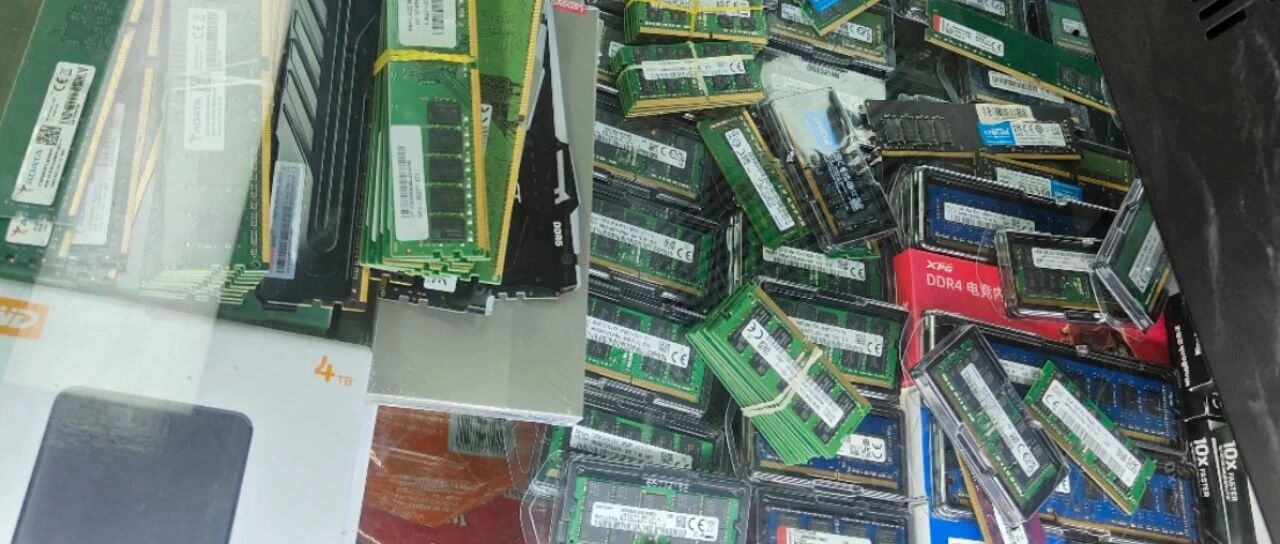
更多存储产品涨价,影响或波及手机、PC厂商
第一财经· 2025-09-26 13:28
Core Viewpoint - The article discusses the significant price increases in various storage products, particularly DRAM and NAND Flash, driven by rising demand from the AI sector and supply constraints from manufacturers [3][4][5]. Price Increases in Storage Products - DDR4 prices have more than doubled since the beginning of the year, with some products increasing by over five times due to limited market supply [3][4]. - DDR5 prices have also been rising, with the average price for DDR5 16G (4800/5600) increasing from $6.02 to $7.349 within a month [4][7]. - NAND Flash prices have seen a nearly 10% increase since early September, with enterprise and mobile markets being significantly affected [4][11]. Market Demand and Supply Dynamics - Despite the reduction in production of LPDDR4X, demand has surged, with contract prices increasing by 24% to 36% in Q3 [6][9]. - Major manufacturers are shifting production capacity towards higher-margin products like HBM and DDR5, leading to tighter supply for older technologies [6][7]. - The demand for DDR5 is expected to remain strong as cloud service providers prepare for future infrastructure needs, although supply remains uncertain due to prioritization of HBM production [7][9]. Data Center Storage Solutions - The transition from HDD to SSD in data centers is accelerating due to HDD shortages, with SSDs being favored for their efficiency and lower operational costs in AI applications [11][12]. - The demand for high-capacity SSDs is expected to rise, with predictions indicating that SSDs will account for 20% of AI server storage by 2028 [12][13]. Impact on End-User Products - The rising costs of storage components are putting pressure on manufacturers of consumer electronics, with companies like Xiaomi reporting declines in profit margins due to increased memory prices [16][17]. - Mid-range smartphones are particularly affected by the reliance on LPDDR4X, and manufacturers are exploring alternative suppliers and adjusting product specifications to manage costs [17][20]. Manufacturer Strategies - Companies are increasing inventory and diversifying supplier bases to mitigate the impact of rising prices on production costs [19][20]. - Some manufacturers are also planning to gradually transition to DDR5, although this process is contingent on compatibility with existing hardware [19][20].

50多岁还在闯,雷军硬刚iPhone 17
Xin Lang Cai Jing· 2025-09-26 12:03
Core Insights - The annual speech by Lei Jun emphasized Xiaomi's commitment to high-end transformation, showcasing the launch of the Xiaomi 17 series alongside the company's strategic shift towards becoming a "hardcore technology company" [1][3][12] - Xiaomi's recent challenges include a recall of 117,000 SU7 vehicles and a decline in smartphone shipments, indicating a critical turning point in the company's development [1][2][12] Group 1: High-End Strategy - Lei Jun's speech highlighted Xiaomi's focus on high-end products, directly competing with Apple and Tesla, and underscored the importance of core technology investment [3][4][12] - The company has committed to investing 50 billion yuan annually in chip development over the next decade, aiming to establish a strong technological foundation [4][5][12] Group 2: Product Launch and Features - The Xiaomi 17 series was introduced with a starting price of 4,499 yuan, positioning it as a direct competitor to the iPhone 17, with significant emphasis on performance and features [10][11] - The Xiaomi 17 Pro features a unique back screen design and advanced camera technology, showcasing the company's innovative approach to smartphone design [9][10] Group 3: Market Position and Challenges - Xiaomi's smartphone shipments fell to 10.4 million units in Q2 2025, marking a decline in market position, with the company dropping from first to fourth place in the domestic market [12][13] - The overall smartphone market in China saw a 4.1% year-on-year decline, highlighting the competitive pressures Xiaomi faces [12][13] Group 4: Future Directions - Xiaomi aims to enhance its brand competitiveness through technological advancements and is under pressure to deliver more innovative products, particularly in AI and smart hardware [15] - The company is also focusing on expanding its automotive business, with a recent introduction of customization options for its vehicles, indicating a strategy to attract a broader customer base [14]
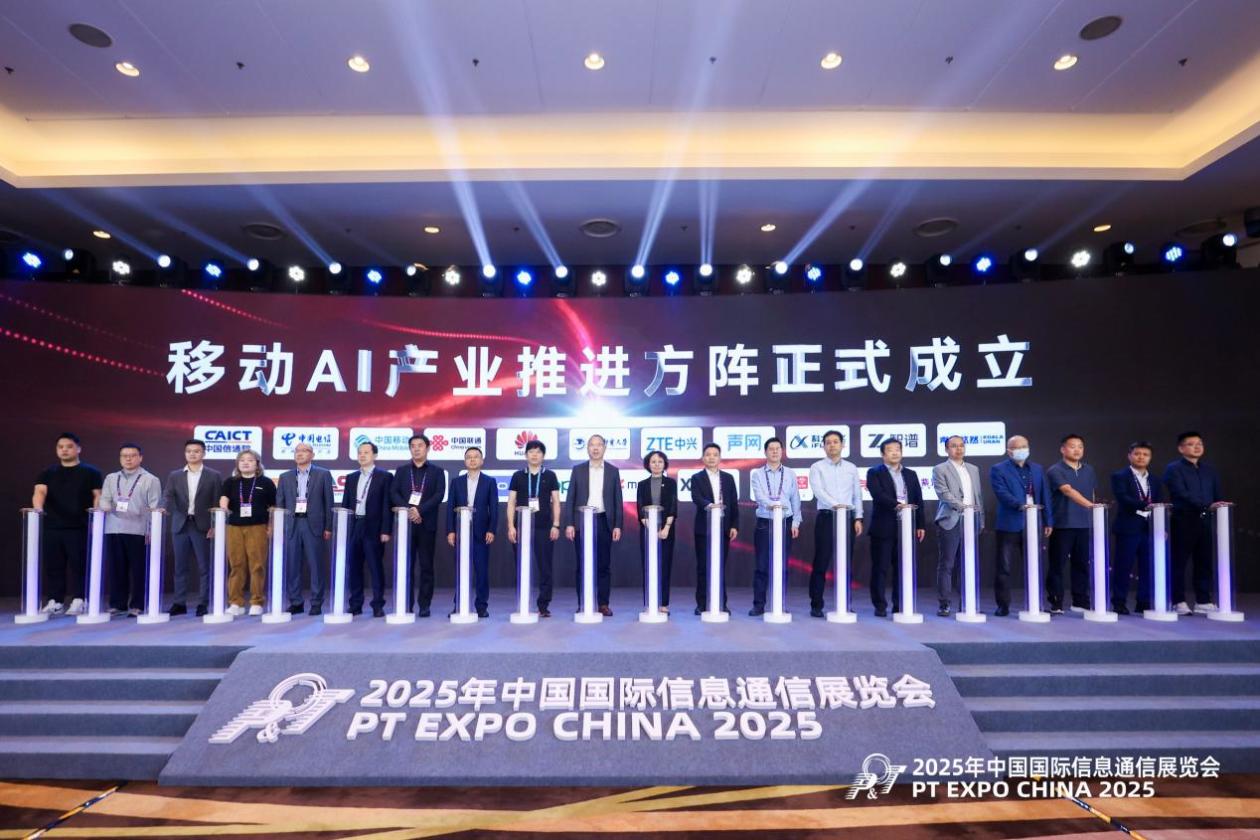
“移动AI产业推进方阵”在京成立,推动“人工智能+”战略落地
Huan Qiu Wang· 2025-09-26 10:49
Core Insights - The establishment of the "Mobile AI Industry Promotion Alliance" marks a new development phase for China's mobile communication industry, focusing on intelligent integration and ecosystem co-construction [1][3] Group 1: Industry Developments - As of July 2023, China has built a leading global 5G network infrastructure with 4.598 million 5G base stations and 1.137 billion 5G mobile phone users [3] - The scale of intelligent computing power reached 788 EFlops, indicating significant advancements in technology [3] - Monthly active users of mobile AI applications reached 680 million, accounting for over 50% of all mobile users [3] Group 2: Government Initiatives - The Ministry of Industry and Information Technology has emphasized the need for high-quality development in the information and communication industry to maintain competitive advantages [4] - The State Council's recent opinion on implementing the "Artificial Intelligence +" initiative aims to foster new infrastructure, technology systems, and industry ecosystems by 2027, with a goal of achieving over 70% application penetration in six key areas by 2030 [4] Group 3: Challenges and Focus Areas - Despite rapid growth, mobile AI faces challenges such as insufficient computing power in edge devices and limited battery capacity [4] - The "Mobile AI Industry Promotion Alliance" will focus on enhancing the collaborative capabilities of mobile network infrastructure, developing new low-power and low-latency communication devices, and promoting advanced AI applications like multimodal data communication on mobile terminals [4][5] Group 4: Future Directions - The alliance will leverage resources from the IMT-2020 (5G) and IMT-2030 (6G) promotion groups to submit industry demands to standardization organizations and provide development suggestions to government authorities [5] - The establishment of the alliance is expected to strengthen China's leading position in mobile communications and support the implementation of the national "Artificial Intelligence +" strategy [5]
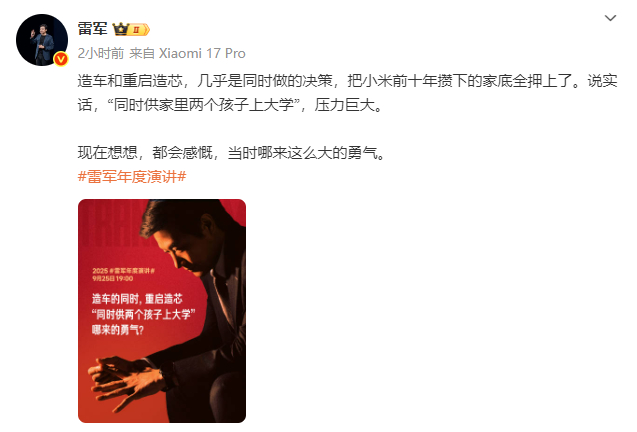
雷军:押上小米全部家底,只为“两个孩子上大学”!135亿元砸芯片,1020亿搞研发,小米赌上未来!
Xin Lang Cai Jing· 2025-09-25 15:22
Core Viewpoint - Xiaomi is heavily investing in two major sectors: electric vehicles and self-developed chips, which are seen as critical for the company's future competitiveness and survival in a rapidly evolving market [4][17]. Investment in Electric Vehicles - Xiaomi's electric vehicle project, initiated in 2021, has shown promising results with the SU7 model achieving over 250,000 deliveries within a year and a half, making it the sales champion in the 200,000 yuan and above price segment [9]. - The company plans to ramp up production capacity, with the Beijing factory expected to reach an annual output of 300,000 vehicles by the second half of 2025, alongside a new factory in Wuhan [9]. Investment in Chip Development - Xiaomi restarted its chip development in 2021, aiming to produce its own 3nm SoC chip, the玄戒O1, by 2025, positioning itself as the fourth company globally to achieve this milestone [7]. - The company has invested a total of 1,020 billion yuan in core technology research from 2021 to 2025, with plans to invest an additional 2,000 billion yuan over the next five years [13]. Strategic Importance - The dual focus on electric vehicles and chip development is seen as essential for Xiaomi to maintain its competitive edge against established players like Tesla and Qualcomm [17]. - This strategy is viewed as a significant move to enhance China's position in the global technology landscape, potentially reshaping the narrative around domestic tech companies [17][18]. Leadership Perspective - CEO Lei Jun describes the pressure of these investments as akin to funding two children through college, emphasizing the high stakes involved [4][11]. - The company's shift from being known for cost-effectiveness to becoming a "hardcore tech player" reflects a bold strategic pivot in response to market challenges [17].

小摩:AI驱动台积电(TSM.US)业绩“火箭式”增长 N2/N3制程贡献显著
Xin Lang Cai Jing· 2025-09-25 08:45
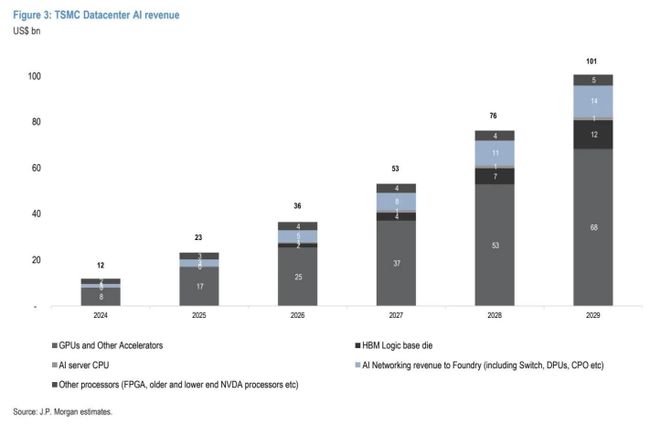
Core Viewpoint - Morgan Stanley maintains an "Overweight" rating on TSMC, raising its target price for TSMC's stock from NT$1,275 to NT$1,550, while also increasing earnings per share expectations for 2025-2026 and revenue growth forecasts for 2026 due to strong AI demand in data centers, advanced process capacity release, and sustained high gross margins [1] Group 1: Revenue Growth Drivers - TSMC's revenue in USD is expected to grow by 24% in 2026, driven by four main factors: strong demand for N3 process, N2 process demand from iPhone models and new flagship SoCs from Qualcomm and MediaTek, an increase in average selling prices (ASP) for advanced processes by 6%-10%, and a 60% growth in CoWoS wafer shipments in advanced packaging [1] - The data center AI business is highlighted as TSMC's core long-term growth engine, with a revised compound annual growth rate (CAGR) of 53% for data center AI revenue from 2024-2029, and an expectation to further raise the five-year CAGR guidance from the current midpoint of 40% [2] Group 2: Demand Structure and Market Trends - AI accelerators (GPUs and ASICs) are projected to account for 68% of TSMC's data center AI total demand by 2029, with sustained high demand from large cloud service providers, emerging cloud companies, AI labs, and sovereign AI projects driving GPU demand [2] - The demand for networking equipment and HBM (High Bandwidth Memory) chips is also expected to contribute significantly, with a CAGR of 58% for TSMC's AI networking equipment revenue from 2024-2029, and a forecasted revenue of $12 billion from HBM chips by 2029, representing 12% of total data center AI revenue [3] Group 3: Capital Expenditure and Capacity Expansion - To meet strong demand, TSMC's capital expenditure for 2026 is projected to increase from $45 billion to $48 billion, focusing on N2 and N3 advanced process capacity and advanced packaging [5] - TSMC plans to add approximately 50,000 wafers per month of N2 process capacity by the end of 2026, with N3 capacity potentially being accelerated in Arizona to meet unexpected AI accelerator demand [5] Group 4: Financial Performance Expectations - TSMC's revenue for Q4 2025 is expected to remain flat quarter-over-quarter, with a projected 35% growth in USD revenue for the fiscal year 2025, benefiting from better-than-expected demand from Apple and AI data centers [5] - The gross margin for TSMC is anticipated to remain at a high level of 50% in Q4 2025 and throughout 2026, supported by stable exchange rates, capacity dilution from U.S. factories, price increases in advanced processes, and strong demand for leading processes, despite a 25% increase in depreciation costs [5]

库克尴尬了,苹果A芯片从曾经的领先安卓一年,到现在全面落后
Sou Hu Cai Jing· 2025-09-25 03:51
Group 1 - Qualcomm has launched its flagship mobile SoC, Snapdragon 8 Elite Gen5, utilizing TSMC's N3P process technology, joining Apple and MediaTek in releasing their top chips for the year [1] - In terms of performance, Apple's A19 Pro is now the weakest among the three, with MediaTek's Dimensity 9500 slightly outperforming it in single-core and multi-core tests, while Qualcomm's Snapdragon 8 Elite Gen5 surpasses both [3] - Apple's A-series chips, which previously led the market, are now lagging behind, indicating a shift in competitive dynamics within the mobile chip industry [5] Group 2 - The decline in Apple's chip performance is attributed to its shift in focus towards developing multiple chip lines, including M-series chips, which has diluted resources and attention from the A-series [8] - Qualcomm has transitioned to using its own Oryon CPU cores, while MediaTek has adopted ARM's latest C1 cores, allowing them to catch up to Apple's performance [8] - Despite the performance metrics, there is a perception that real-world usage of Qualcomm and MediaTek chips may not match their benchmark scores, with Apple's iOS still being a significant advantage [10]



国内晶圆制造及配套产业加速半导体行业发展,数字经济ETF(560800)涨近1%
Xin Lang Cai Jing· 2025-09-25 03:33
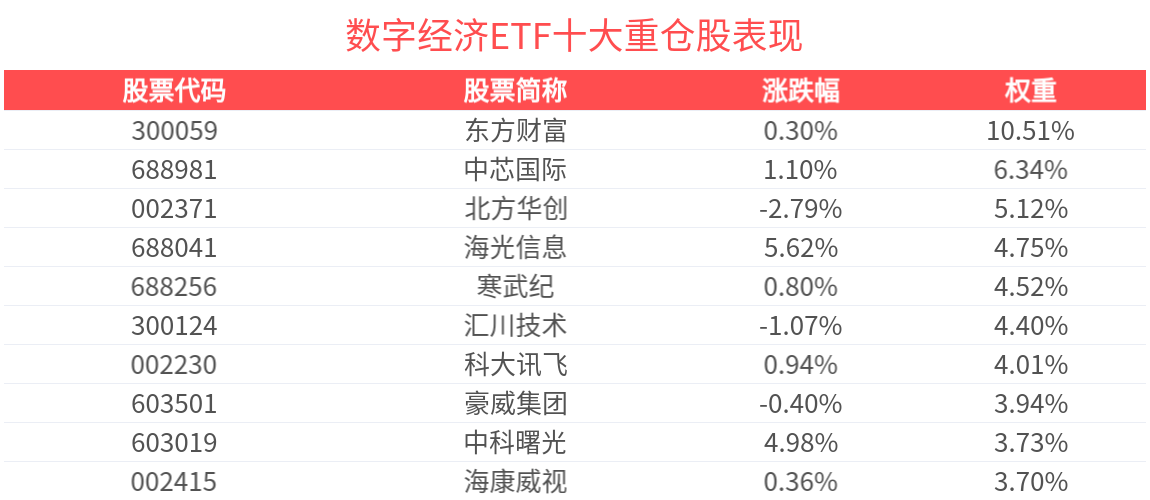
Core Viewpoint - The digital economy theme index and related ETFs are showing positive performance, driven by strong stock price movements in semiconductor companies and the growing demand for advanced manufacturing processes in the semiconductor industry [1][2][3]. Group 1: Digital Economy Index Performance - As of September 25, 2025, the CSI Digital Economy Theme Index (931582) increased by 0.98%, with notable gains from stocks such as Jinghe Integrated (688249) up 11.03%, and Yonyou Network (600588) up 8.63% [1]. - The Digital Economy ETF (560800) also saw an increase of 0.93% [1]. Group 2: Market Liquidity and Trading Activity - The Digital Economy ETF had a turnover rate of 1.67% during the trading session, with a total transaction value of 11.9467 million yuan [2]. - Over the past month, the average daily trading volume for the Digital Economy ETF was 37.0221 million yuan [2]. Group 3: Semiconductor Industry Insights - There is a rising expectation of price increases in the semiconductor wafer market, with significant stock price increases observed among major international suppliers [2]. - TSMC is reportedly adjusting its pricing for advanced processes, with a 24% increase for the 3nm process node charged to MediaTek, and a 16% cost increase for Qualcomm's upcoming Snapdragon 8 Elite Gen 5 chip [2]. - Long-term demand for advanced logic chip foundry capacity in China is projected to reach 34,000 wafers per month, with actual demand likely exceeding this estimate due to capacity ramp-up and R&D needs [2]. Group 4: Domestic Semiconductor Development - The push for domestic semiconductor manufacturing is accelerating, driven by trade tensions highlighting the importance of supply chain security and self-sufficiency [3]. - The penetration of semiconductors in sectors such as automotive electronics, new energy, IoT, big data, and artificial intelligence is becoming a significant growth driver for the semiconductor sector [3]. Group 5: Index Composition - As of August 29, 2025, the top ten weighted stocks in the CSI Digital Economy Theme Index accounted for 53.36% of the index, with companies like Dongfang Caifu (300059) and Cambricon (688256) being the most significant contributors [3].
芯片涨价潮来了,台积电被曝2nm价格至少上调50%,三星、SK海力士已先行涨价
3 6 Ke· 2025-09-25 03:19
Group 1: Semiconductor Price Increases - The global semiconductor industry is experiencing a new wave of price increases, with TSMC's 2nm process prices rising at least 50% compared to the 3nm process, and the last generation 3nm CPU prices increasing by approximately 20% [1] - TSMC's latest 2nm process is set to begin mass production this quarter, but due to high capital expenditures, the company has no discount or negotiation strategy in place [1] - The flagship chips using the 2nm process are expected to have a unit price of around $280 [1] Group 2: Memory Chip Price Adjustments - Samsung has significantly raised prices for memory and flash products, with DRAM prices increasing by up to 30% and NAND flash prices rising by 5-10% due to supply constraints and surging demand from cloud enterprises [4] - Micron and SanDisk have also announced similar price increases, with Micron's prices rising by 20-30% and the company halting new orders [4] - The current price surge reflects the deep impact of AI applications on the semiconductor supply chain, with data center construction driving up storage procurement volumes [4] Group 3: Competitive Landscape - Apple has increased its reservation share for TSMC's 2nm capacity from nearly 50% to over 50%, contributing 22% of TSMC's revenue in 2024, amounting to $19.4 billion [2] - Qualcomm and MediaTek plan to launch their first 2nm chip products by the end of 2026, but Apple's capacity monopolization strategy may create supply constraints for these competitors [3] - This concentration of capacity allocation is likely to widen the technology gap between Apple and the Android ecosystem [3]
高通新旗舰芯片亮相,雷军确认小米17首发:确实强
Guan Cha Zhe Wang· 2025-09-25 02:45
Core Viewpoint - Qualcomm has launched its new flagship mobile SoC, Snapdragon 8 Elite Gen5, claiming it to be the "world's fastest mobile SoC" [1] Group 1: Product Features - Snapdragon 8 Elite Gen5 features a third-generation Oryon core with a "2+6" CPU cluster architecture, where two super-large cores operate at 4.6GHz and six large cores at 3.62GHz [1] - The integrated Adreno 840 GPU utilizes a "sharded" architecture with dedicated cache for developers, reducing power consumption by up to 10% [1] - Compared to its predecessor, the third-generation Oryon CPU offers a 20% performance increase, while the Adreno GPU enhances graphics performance by 23% [1] Group 2: AI Capabilities - The Snapdragon 8 Elite Gen5 emphasizes personalized AI experiences, featuring a faster Hexagon NPU with a 37% performance improvement over the previous generation, achieving an AI inference speed of 220 tokens per second [1] Group 3: Benchmark Performance - During the Snapdragon Summit, Qualcomm showcased the Snapdragon 8 Elite Gen5's benchmark scores, achieving a single-core score of 3832 and a multi-core score of 12329 on Geekbench 6.4 [2] - The multi-core performance surpasses that of MediaTek's Dimensity 9500 and Apple's A19 Pro, which scored 11217 and approximately 11000, respectively [2] Group 4: Product Launch and Partnerships - The flagship devices featuring the Snapdragon 8 Elite Gen5 are set to launch soon, with Xiaomi's 17 series being the first to debut [2] - Other confirmed devices include iQOO 15 series, OnePlus 15 series, Red Magic 11 series, Nubia Z80 series, and Honor Magic8 series and MagicPad3 Pro [2][3] Group 5: Strategic Collaboration - Xiaomi's executives highlighted Qualcomm as a crucial partner in their high-end strategy, with the Xiaomi 17 series being the first to feature the Snapdragon 8 Elite Gen5 [3]
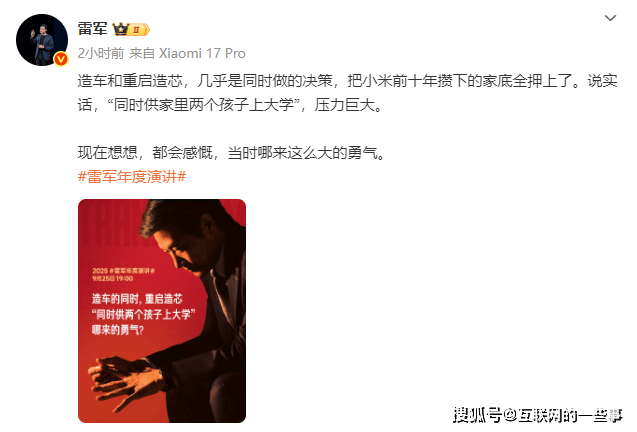
雷军:押上小米全部家底,只为“两个孩子上大学”!
Sou Hu Cai Jing· 2025-09-24 15:25
Core Insights - Xiaomi has heavily invested its resources into two major projects: electric vehicles and self-developed chips, which are seen as critical for the company's future success [2][12][14] - The company aims to create a comprehensive ecosystem that integrates vehicles and smart technology, with significant financial commitments planned for the coming years [12][14] Investment in Electric Vehicles - Xiaomi's electric vehicle project, the SU7, has seen impressive sales, delivering over 250,000 units within a year and a half, making it a leader in the 200,000 yuan price segment [7] - The company has established a highly automated production facility in Beijing, capable of producing a new vehicle every 76 seconds, with plans to reach an annual production capacity of 300,000 vehicles by the second half of 2025 [7][12] Investment in Chip Development - Xiaomi restarted its chip development efforts in 2021 after a previous attempt in 2017 failed to gain traction, now introducing several chips including the C1 imaging chip and P1 charging chip [5][12] - By 2025, Xiaomi plans to achieve mass production of its 3nm SoC chip, becoming the fourth company globally to do so, following Apple, Qualcomm, and MediaTek [5][12] Financial Commitment - From 2021 to 2025, Xiaomi has committed to investing 102 billion yuan in core technology research and plans to invest an additional 200 billion yuan over the next five years [12] - This dual investment strategy in chips and vehicles is expected to deplete much of Xiaomi's accumulated resources from the past decade [12][14] Strategic Importance - The company's founder, Lei Jun, emphasizes that without entering the chip market, Xiaomi risks losing its core competitiveness, and without venturing into the automotive sector, it may become obsolete [14] - The success of Xiaomi's initiatives in chip and vehicle production could significantly impact the development of China's high-end chip and smart vehicle industries, potentially altering the global influence of Chinese tech companies [14]