欣旺达

Search documents
储能产业迈向价值增长新阶段
Zheng Quan Ri Bao· 2026-01-12 17:13
Core Insights - The global energy transition is entering a critical phase, with energy storage becoming a core infrastructure to balance the volatility of renewable energy and ensure energy system security [1] - The storage industry is experiencing a fundamental transformation driven by AI computing power and energy structure changes, marking a key turning point for value growth [1] - By 2025, China's energy storage industry is expected to initiate a high-quality transformation cycle, with structural growth opportunities emerging in 2026 [1] Group 1: Technological Foundations - Technological innovation is the core engine for high-quality development in the energy storage industry, with three main characteristics emerging in battery cell technology by the second half of 2025: large cells over 500Ah becoming mainstream, stacking technology accelerating to replace winding technology, and breakthroughs in long-duration storage technology [2] - The industry consensus indicates that by 2026, the development characteristics will include large cells, liquid cooling, long-duration capabilities, and multiple technological routes coexisting [2] - Major companies are leading the technological iteration wave, establishing a solid technical foundation for industry value enhancement [2] Group 2: Demand Drivers - The global energy storage market demand is expected to maintain strong growth, with projections of 150GWh and 203GWh of new installations in China for 2025 and 2026, respectively, and approximately 290GWh globally in 2025 [4] - AI computing infrastructure is becoming a new growth engine, with significant electricity demand from AI data centers, which also increases the need for renewable energy and storage solutions [5] - The share of long-duration storage systems (≥4 hours) is expected to rise significantly by 2026, driven by increasing demand for cross-day and cross-season adjustments in renewable energy [5] Group 3: Value Enhancement - The energy storage industry is transitioning from "scale expansion" to "value growth," with optimized business models and improved supply-demand dynamics driving continuous value elevation [6] - The mainstream business model of "spot arbitrage + capacity compensation + ancillary services" is becoming replicable in regions like Guangdong and Shandong, enhancing investment return capabilities [6] - By 2026, the market is anticipated to enter a new phase of "volume and price increase + quality supremacy," with a focus on smart solutions for various application scenarios and a more diverse business model [6] Group 4: Global Market Opportunities - The global energy storage market is entering an explosive growth phase, with predictions of lithium battery shipments for data centers exceeding 69GWh by 2027 and reaching 300GWh by 2030 [7] - Companies like CATL, Haicheng Energy, and others are accelerating their internationalization strategies, with overseas markets becoming a core growth engine [7] - The focus on localization in overseas markets is expected to enhance customer responsiveness and loyalty, transitioning from "Made in China" to "localized global operations" [7]



解码“新茂名”:5年吸引290个超亿元项目,工业投资翻番
2 1 Shi Ji Jing Ji Bao Dao· 2026-01-12 14:04
Core Insights - Maoming, located in Guangdong Province, is recognized for its significant contributions to the lychee and petrochemical industries, with a projected lychee production of over 620,000 tons by 2025 and a total output value of the petrochemical sector stabilizing around 180 billion yuan [2][6][9]. Economic Development - Since the start of the 14th Five-Year Plan, Maoming's economic total has surpassed 400 billion yuan, ranking first in the western part of Guangdong, with 290 new projects worth over 100 million yuan introduced [3]. - The urbanization rate of the permanent population has increased by 4.55 percentage points from 2020 to 2024, the highest in the province [3]. Agricultural Innovation - Maoming has developed a "frozen dormancy" technology for lychees, allowing for a stable supply of raw materials year-round and establishing the largest lychee puree processing base in the country [5]. - The local government has shifted from traditional selling methods to innovative models, increasing the value of lychees by over 30% and achieving a 15% higher price through e-commerce channels [5][6]. Tourism and Cultural Integration - The city is leveraging its agricultural resources to create tourism experiences, attracting over 5 million visitors annually through initiatives like the "520 I Love Lychee" cultural tourism IP [6]. - The integration of agriculture, culture, and tourism is seen as a core strategy for rural value enhancement, with various themed service areas and demonstration villages established [6]. Industrial Diversification - To address the dominance of the petrochemical industry, Maoming is promoting a "five-chain co-construction" strategy, focusing on upgrading petrochemical processes and developing new energy and materials sectors [7][9]. - Significant investments are being made in projects such as the 30 billion yuan petrochemical upgrade, which is expected to increase chemical product output by over 2 million tons annually [9]. Technological Advancements - The city has seen a 56.9% increase in the number of national high-tech enterprises during the 14th Five-Year Plan, with substantial growth in high-tech manufacturing and new energy sectors [10]. - Maoming is actively pursuing emerging industries such as new energy vehicles and artificial intelligence, with annual growth rates of 46.9% in high-tech manufacturing investments from 2021 to 2024 [10].


A股现天量,两市成交超3.6万亿元创新高!电池50ETF(159796)逆市爆量收跌,电池出口退税政策调整,影响几何?
Xin Lang Cai Jing· 2026-01-12 08:55
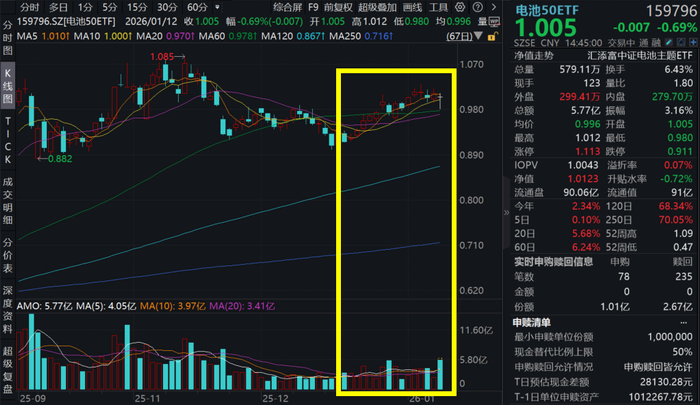
Core Viewpoint - The A-share market experienced a significant surge on January 12, with over 4,100 stocks closing in the green and a record trading volume of 3.64 trillion yuan, surpassing the previous high on October 8, 2024. The adjustment of export tax rebate policies for batteries has influenced market dynamics, leading to a notable increase in trading activity for the Battery 50 ETF (159796), which closed down 0.69% despite a trading volume nearing 600 million yuan [1][3]. Group 1: Market Performance - The Battery 50 ETF (159796) saw most of its constituent stocks decline, with notable drops including Sunshine Power and Xian Dao Intelligent, both down over 3%, while Ningde Times and Guoxuan High-Tech fell over 2% [3]. - The trading volume of the Battery 50 ETF (159796) surged to nearly 600 million yuan, indicating heightened investor interest despite the ETF's decline [1][3]. Group 2: Policy Impact - On January 9, two departments announced adjustments to export tax rebate policies, effective from April 1, 2026, which will reduce the VAT export rebate rate for battery products from 9% to 6%, and eliminate it entirely by January 1, 2027 [4][5]. - The previous reduction in export tax rebates for certain photovoltaic and battery products from 13% to 9% in November 2024 had already triggered a rush in exports, and the latest adjustments may lead to a similar surge, benefiting the lithium carbonate sector [5]. Group 3: Industry Outlook - Global demand for energy storage is expected to grow steadily, with projections indicating that global energy storage installations will reach 404 GWh by 2026, representing a 38% year-on-year increase [5]. - The battery sector is experiencing a sustained upward trend, driven by the growth of the global electric vehicle market, with domestic battery installations expected to maintain high growth rates through 2026 [5][6]. - Solid-state battery technology is advancing, with potential for significant industry upgrades, as companies that can provide stable supply and mature processes are likely to benefit [6]. Group 4: Investment Strategy - The Battery 50 ETF (159796) is positioned to benefit from its high content in energy storage (18.7%) and solid-state batteries (45%), making it a strong candidate for investors looking to capitalize on these growing segments [7][9]. - The ETF's focus on battery chemicals, which account for 31% of its weight, positions it well to benefit from the recovery of upstream material prices, enhancing the overall industry outlook [9][12].




宁德时代、比亚迪等企业被约谈 警示非理性竞争|ESG热搜榜
2 1 Shi Ji Jing Ji Bao Dao· 2026-01-12 05:14
Group 1 - The Ministry of Industry and Information Technology, along with other regulatory bodies, held a meeting to discuss the regulation of the power and energy storage battery industry, involving 16 companies including major players like CATL and BYD [1] - The meeting aimed to address and mitigate irrational competition within the battery sector, highlighting the need for industry self-discipline [3] Group 2 - Emmanuel Faber, the ISSB Chair, welcomed the release of the "Corporate Sustainable Disclosure Standards No. 1 - Climate (Trial)" by the Chinese Ministry of Finance and ten other ministries, marking a significant step towards enhancing global comparability in ESG disclosures [2] - The Hong Kong Accounting and Financial Reporting Council has introduced a consultation document for a sustainable information assurance framework, indicating a move towards standardized and regulated sustainability disclosures in Hong Kong [4] Group 3 - Long-term implications for airlines are highlighted as EVA Air faces scrutiny after an incident involving a physical altercation between the captain and co-pilot during taxiing, leading to an internal investigation and the suspension of the captain [5] - Quartz Co., a subsidiary of Quartz Holdings, was fined 2.7 million RMB for violating trade secrets, which may impact its operational integrity and market position [6] Group 4 - The China Securities Association has issued a warning regarding the lack of effective management mechanisms in certain brokerage firms, which could lead to penalties in future evaluations [7] - Estée Lauder reported that two-thirds of its management positions are held by women, reflecting the company's commitment to diversity and inclusion within its workforce [8]
二线电池厂,活在巨头阴影下
首席商业评论· 2026-01-12 04:08
Core Viewpoint - The article discusses the financial and operational challenges faced by second-tier battery manufacturers in the context of a lawsuit involving XWANDA, highlighting the disparity in profitability and market power between leading companies and their competitors [5][13][22]. Group 1: Financial Challenges - XWANDA's subsidiary is facing a lawsuit from Geely's subsidiary, claiming 2.314 billion yuan due to alleged quality issues with battery cells, which could significantly impact XWANDA's financial health and market reputation [5][6]. - Despite XWANDA's annual revenue exceeding 50 billion yuan, its power battery segment has incurred losses exceeding 3.4 billion yuan over the past two years, indicating a reliance on consumer battery profits to sustain its operations [7][9]. - Other second-tier battery manufacturers, such as EVE Energy and Guoxuan High-Tech, are also struggling with profitability, with EVE's net profit declining by 11.7% despite a revenue increase of 32.2% [8][9]. Group 2: Market Dynamics - The current market structure is dominated by two major players, CATL and BYD, which together hold over 65% of the market share, leaving second-tier manufacturers to compete for a shrinking portion of the market [22][25]. - The profitability gap is stark, with CATL earning 0.09-0.12 yuan per watt-hour, while second-tier companies like EVE earn only 0.02 yuan per watt-hour, highlighting the challenges in pricing power and cost control [22][25]. - The article emphasizes that second-tier manufacturers are often forced to lower prices to maintain orders, which further erodes their profit margins and limits their ability to invest in research and development [19][20]. Group 3: Customer Relationships - Second-tier manufacturers often rely heavily on a few major clients, which can lead to a loss of bargaining power and increased vulnerability to market fluctuations [15][20]. - The strategy of binding to large clients can backfire, as seen with XWANDA's dependency on Geely, which has resulted in significant risks when quality issues arise [15][20]. - The trend of automakers increasingly developing their own battery technologies poses a threat to second-tier manufacturers, as they may lose market share and pricing power [20][29]. Group 4: Future Outlook - The article suggests that the future of the battery industry may only accommodate a few key players, with second-tier manufacturers needing to establish unique advantages in specific technologies or markets to survive [29]. - Potential strategies for second-tier manufacturers include focusing on niche technologies, expanding into international markets, or forming deeper partnerships with larger clients, though each comes with its own set of risks [28][29].
欣旺达电池问题事件继续发酵,沃尔沃EX30因电池问题多国召回
Ju Chao Zi Xun· 2026-01-12 03:33
Group 1 - The core issue involves the recall of Volvo EX30 models in the US and Canada due to fire risks associated with batteries supplied by Sunwoda, affecting 10,440 vehicles in the UK [2] - Volvo's internal quality tracking system identified potential defects in the 69 kWh battery packs used in single-motor long-range and dual-motor high-performance versions of the EX30, covering models from 2024 to 2026 [2] - Volvo has advised UK EX30 owners to limit charging to 70% to mitigate the risk of thermal runaway, which has led to dissatisfaction among vehicle owners due to reduced practical range [2] Group 2 - Sunwoda is currently involved in a legal dispute with Geely-affiliated companies, with a lawsuit claiming quality issues in battery cells delivered between June 2021 and December 2023, seeking compensation of 2.314 billion yuan [3] - Financial data indicates that Sunwoda's revenue for 2024 is projected at 56.021 billion yuan, with a net profit of 1.605 billion yuan, making the lawsuit amount significant at 4.1% of its revenue and exceeding its annual profit [3] - Geely's subsidiary, Weirui Power, which initiated the lawsuit, has been a partner with Sunwoda since 2021, focusing on battery cell development for Geely's PMA platform, which is used across multiple brands [4] Group 3 - The lawsuit against Sunwoda has been accepted by the Ningbo Intermediate People's Court, and the company is currently unable to assess the impact of the lawsuit on its current and future profits [5] - Sunwoda is actively seeking a reasonable resolution to the lawsuit and is enhancing communication with relevant parties to expedite a solution [5]
储能大电芯迎来规模化量产元年—CNESA年终盘点
中关村储能产业技术联盟· 2026-01-12 03:32
Core Viewpoint - The energy storage industry is transitioning from a focus on "paper parameters" to practical applications, with large capacity battery cells achieving mass production and delivery, indicating a significant shift towards commercial viability and cost efficiency in energy storage systems [2]. Group 1: Mass Production of Large Capacity Battery Cells - Since 2025, several battery companies have reported significant progress in the mass production of 500Ah+ battery cells, with production capacity and delivery rates accelerating [4]. - CATL has initiated mass production of its 587Ah energy storage battery in June, with a production capacity exceeding 22,000 units per day, aiming for 3GWh of shipments by the end of the year [4]. - EVE Energy plans to start mass production of its 628Ah battery by the end of 2024, with a target of 750,000 units in 2025, and has successfully applied it in a 200MW/400MWh independent energy storage project [4]. - Envision AESC has achieved mass production of its 500+Ah battery cells, with plans for next-generation 700Ah+ products [4]. - Hicharge Energy has launched the world's first 1175Ah battery cell and has completed deliveries of its 587Ah battery [4]. - A number of other companies, including Chuang Neng New Energy and Penghui Energy, are also announcing timelines for the mass production of 500Ah+ and 600Ah+ products, indicating a competitive landscape by 2026 [5]. Group 2: Strategic Collaborations and Supply Chain Dynamics - The relationship between system integrators and battery manufacturers is evolving towards long-term, large-scale, and deeply integrated collaborations [7]. - By the end of 2025, significant orders of over 100GWh highlight the importance of supply chain stability and cost control in market competition [7]. - CATL has signed a procurement agreement for no less than 200GWh with a partner, with its 587Ah battery already applied in a 400MW/2400MWh energy storage project [7]. - EVE Energy has established a three-year collaboration for 20GWh with a partner, including 10GWh of large battery cells [7]. - These long-term agreements not only secure production capacity but also indicate a trend towards early collaborative development between systems and battery cells, enhancing overall product performance and safety [7]. Group 3: Global Market Expansion - The competitiveness of China's energy storage industry is being tested globally, with significant progress in the export of 500Ah+ battery cells [9]. - CATL delivered its 587Ah battery for a project in Abu Dhabi, while EVE Energy secured orders in Australia and signed a project agreement for 1GWh [9]. - Hicharge Energy has partnered with a Saudi power company for a 1GW/4GWh energy storage project, utilizing its 1175Ah battery cell [9]. - The export of large battery cells represents not only product output but also the extension of system solutions and standards, opening new opportunities for Chinese energy storage companies in the global long-duration energy storage market [9]. Group 4: Industry Trends and Future Directions - The 500Ah+ battery cells are still in a rapid development phase characterized by diverse sizes and specifications, but there is a consensus that 6MWh+ energy storage systems will accelerate the replacement of previous 5MWh+ solutions, driving down energy storage costs [10]. - The year 2025 is positioned as a pivotal year for large battery cells transitioning from laboratory settings to practical applications in energy storage systems [10].

锂电回收行业迎来转机 能源金属涨价推升“城市矿山”价值
Zheng Quan Shi Bao· 2026-01-12 03:03
Core Viewpoint - The lithium battery recycling industry is transitioning from a rough development phase to a more refined, standardized, and globalized stage, driven by rising prices of lithium and cobalt, supportive policies, and increasing demand for energy metals [1][2][6]. Industry Overview - Lithium battery recycling is likened to the development of "urban mines," converting waste batteries into valuable, recyclable resources [1]. - The industry is witnessing a transformation, with a market size exceeding 100 billion yuan, reshaping the resource supply landscape in the new energy sector [1][7]. Profitability and Market Dynamics - The profitability of lithium battery recycling businesses has improved significantly, with a reported 59% year-on-year increase in battery dismantling volume, reaching 36,000 tons in the first three quarters of 2025 [2]. - The rise in prices of lithium, cobalt, and nickel has enhanced cash flow for recycling companies, shifting the profit model from reliance on subsidies to the intrinsic value of recycled materials [2][3]. Policy and Regulatory Environment - The Chinese government has relaxed import policies for recycled materials, allowing certain types of black powder to be imported, which addresses previous challenges in the industry [3]. - This regulatory change is expected to secure domestic strategic resource supply and integrate China's battery recycling industry into global resource allocation [2][3]. Capacity Expansion and Capital Operations - Leading companies are adopting a dual strategy of capacity expansion and capital operations to capture market opportunities, with significant investments in new facilities and technology partnerships [4][5]. - Companies like Grinmei and Tianqi are actively pursuing acquisitions and financing to enhance their operational capabilities and market presence [4][5]. Technological Advancements and Lifecycle Integration - The industry is evolving from merely end-of-life disposal to playing a crucial role in the entire battery lifecycle, with companies developing comprehensive value chains from recycling to remanufacturing [6]. - Grinmei has achieved a lithium recovery rate exceeding 96.5% through innovative technologies, establishing partnerships with over 1,000 automotive and battery manufacturers [6]. Future Outlook - The lithium battery recycling market is projected to grow at an annual rate exceeding 50% over the next 3 to 5 years, with the domestic market expected to surpass 100 billion yuan by 2030 [7]. - The industry is moving towards a more regulated and competitive environment, with non-compliant players gradually exiting the market, signaling a positive trend for sustainable practices [7].

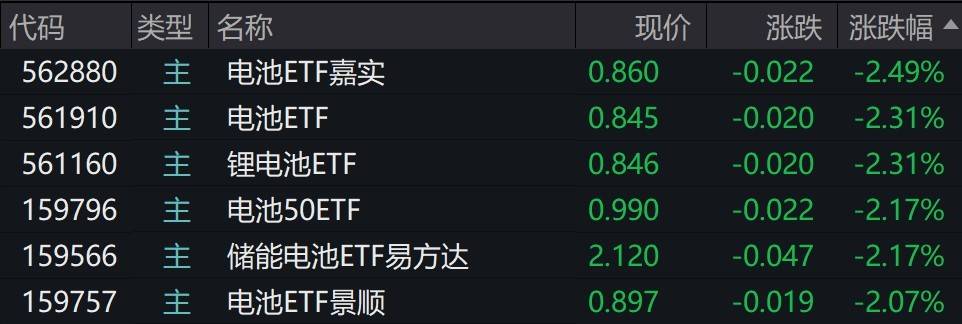
电池概念股走弱,多只电池相关ETF跌超2%
Sou Hu Cai Jing· 2026-01-12 02:50
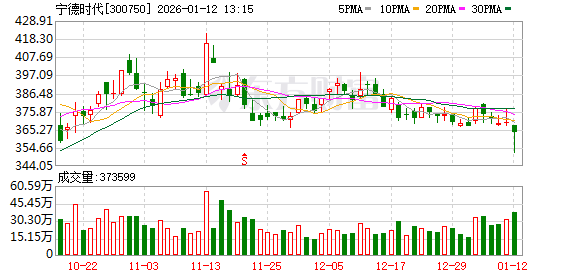
Group 1 - Battery concept stocks weakened, with major players like Sunshine Power and CATL dropping over 4%, while companies such as Yiwei Lithium Energy, Xianlead Intelligent, Guoxuan High-Tech, and Xinwanda fell more than 3% [1] - Several battery-related ETFs declined by over 2% due to the impact of heavy-weight stock declines [1] Group 2 - Recent analysis indicates that policy support has injected strong momentum into the battery industry, with the government continuously launching encouraging policies for new energy vehicles, including trade-in programs, charging infrastructure development, and promoting new energy in rural areas, which further releases consumer potential [2] - The gradual implementation of "anti-involution" policies is leading to more rational competition within the industry, suggesting an improvement in the overall profitability environment [2]