
思摩尔国际

Search documents
智能眼镜系列:传统到智能,镜片制造龙头有望提份额
Changjiang Securities· 2025-08-03 08:04
Investment Rating - The industry investment rating is "Positive" and maintained [11] Core Insights - The report focuses on the traditional lens industry and the emerging trend of smart glasses, highlighting the growth potential for light industry companies [2][8] - The traditional lens market in China is expanding steadily, with youth defocus lenses rapidly gaining market share as a mature myopia treatment solution [6][25] - Smart glasses are positioned to "free hands," with technology and ecosystem maturing, supported by favorable policies [8][44] Summary by Sections Traditional Lenses - **Scale**: The lens industry in China is continuously expanding, with a 5-year CAGR of approximately 5% for retail revenue, 3% for volume, and 2% for average price from 2019 to 2024. The retail revenue is projected to reach 38.2 billion yuan in 2024 [6][16] - **Structure**: Youth defocus lenses are rapidly increasing in market share, with a projected retail sales revenue of 16 billion yuan in 2024, accounting for 42% of total lens sales [25][28] - **Pattern**: Domestic manufacturers lead in production, with foreign brands maintaining a premium. The largest domestic supplier is 康耐特光学, holding an 8.5% market share [7][31] - **Channels**: Sales are primarily through offline optical stores and e-commerce, with offline stores accounting for 73% of sales in 2024 [35][38] Smart Glasses - **Market Potential**: The smart glasses market is expected to grow significantly, with global sales projected to reach 5.5 million units in 2025 and 90 million units by 2030 [8][47] - **Manufacturing**: Smart glasses require higher technical specifications for lenses, particularly XR lenses, which presents an opportunity for leading domestic manufacturers to increase their market share [48][50] - **Distribution**: Offline retail channels are crucial for smart glasses, with major players like 博士眼镜 leading in store numbers [48][50] Weekly Insights - The report notes strong performance in sectors like trendy toys, personal care, and export chains, with a clear trend in the new tobacco industry and stable performance in home and packaging sectors [9][51]
英美烟草发布2025H1财报,整体表现略超预期,期待GloHilo下半年在关键市场逐步推出
Changjiang Securities· 2025-08-03 03:14
Investment Rating - The investment rating for the industry is "Positive" and is maintained [9] Core Insights - British American Tobacco (BAT) reported a revenue of £12.069 billion for H1 2025, a year-on-year decrease of 2.2% (an increase of 1.8% at constant exchange rates) [2][6] - Revenue from combustible tobacco decreased by 3.5% to £9.515 billion (an increase of 0.8% at constant exchange rates), with total cigarette sales down by 8.7% to 229 billion sticks [2][6] - Revenue from new tobacco products remained flat at £1.651 billion (an increase of 2.4% at constant exchange rates), accounting for 13.7% of total revenue, an increase of 0.3 percentage points year-on-year [2][6] - The company expects a revenue growth of 1%-2% for 2025 (closer to the upper limit) and mid-single-digit growth for new tobacco products, with a projected revenue growth of 3%-5% for 2026 [2][6] Summary by Sections Combustible Tobacco - Revenue decreased by 3.5% to £9.515 billion, driven by price increases, while total cigarette sales fell by 8.7% to 229 billion sticks [2][6] New Tobacco Products - Revenue remained flat at £1.651 billion, with a 2.4% increase at constant exchange rates. The modern oral tobacco segment showed strong growth, while heated tobacco products (HNB) performed steadily, and vaping products faced pressure from illegal markets [2][6] Future Outlook - The company anticipates a revenue increase of 1%-2% for 2025 and mid-single-digit growth for new tobacco products, with expectations of 3%-5% growth in 2026 [2][6] Product Performance - Vaping products saw a revenue decline of 15.3% due to illegal market impacts, while heated tobacco products showed a 0.8% revenue increase. Modern oral tobacco revenue surged by 38.1% [12]
英美烟草:新型烟草盈利修复,HNB产品Hilo表态积极
Xinda Securities· 2025-08-02 09:41
Investment Rating - The industry investment rating is "Positive" [2] Core Viewpoints - The report highlights that British American Tobacco's (BAT) new tobacco products are showing signs of profitability recovery, particularly the HNB product Hilo, which is expected to drive future earnings growth [2][3] - For the first half of 2025, BAT reported revenues of £12.069 billion, a year-on-year decrease of 2.2%, but a 1.8% increase when adjusted for fixed exchange rates. New tobacco product revenues remained stable at £1.651 billion, accounting for 13.7% of total revenue [2][3] - The adjusted gross margin for new tobacco products increased by 2.5 percentage points to 59.6%, which is 10 percentage points higher than traditional cigarettes, indicating a potential for continued profitability improvement [2][3] Summary by Sections Revenue Performance - In H1 2025, BAT's revenue from new tobacco products was £1.651 billion, with a stable year-on-year performance and a 2.4% increase when adjusted for fixed exchange rates. This segment accounted for 13.7% of total revenue, up 0.3 percentage points year-on-year [2] - The overall tobacco market is expected to see a 2% decline in sales volume globally in 2025, while BAT anticipates its own growth to be between 1% and 2%, with new tobacco products expected to achieve mid-single-digit growth [2] Product Performance - The vaping segment saw revenues of £740 million in H1 2025, down 15.3% year-on-year, with a volume of 250 million units sold, a decrease of 12.9%. The decline in the US was attributed to illegal disposable products and inventory disruptions, while the European market is recovering due to improved regulatory conditions [2][3] - The HNB segment generated £440 million in revenue, with a slight year-on-year increase of 0.8%. Sales volume was 10.1 billion units, up 1.6%. The APMEA region showed an 8.7% increase in HNB sales, driven by significant contributions from Japan and Kazakhstan [3] - The oral tobacco segment experienced a revenue increase of 38.1% year-on-year, reaching £470 million, with a global market share increase of 4.4 percentage points. The US market saw a remarkable revenue growth of 372% year-on-year, driven by the successful nationwide launch of Velo Plus [4] Market Outlook - The report emphasizes the potential for HNB products to continue driving growth, with a focus on product iteration and market expansion. Key companies to watch include Smoore International, China National Tobacco Corporation, and core suppliers like Xianhe Co. and Yingqu Technology [4]
思摩尔国际(06969):大客户英美烟草发布25H1业绩,GloHilo日本销售反馈乐观
ZHESHANG SECURITIES· 2025-08-01 12:30
Investment Rating - The investment rating for the company is "Buy" (maintained) [6] Core Insights - The new tobacco products from British American Tobacco (BAT) contributed significantly to profits in the first half of 2025, with revenues of £1.651 billion, a year-on-year increase of 2.4%, and an adjusted gross profit of £1.006 billion, up 6.8% [1] - BAT expects accelerated growth in its new tobacco business in the second half of 2025, projecting a mid-single-digit revenue growth for the full year [1] - The Glo Hilo product received positive feedback from its trial in Sendai, Japan, and there are plans for further promotion in Europe [2] - The heated tobacco segment saw a slight revenue increase of 0.8% in the first half of 2025, although market share declined due to increased competition [2] - The vaping segment faced challenges, with Vuse sales down 12.9% and revenues down 15.3% due to the proliferation of illegal products [3] - The oral tobacco segment, particularly Velo, experienced significant growth, with sales up 42.2% and revenues up 38.1% in the first half of 2025 [4] - The company is optimistic about the future growth of Glo Hilo and the oral tobacco segment, while the vaping segment may recover due to regulatory actions against illegal products [5] Financial Summary - Projected revenues for the company from 2025 to 2027 are £13.161 billion, £15.590 billion, and £18.633 billion, representing year-on-year growth rates of 11.55%, 18.45%, and 19.52% respectively [5] - Projected net profits for the same period are £1.311 billion, £2.040 billion, and £2.763 billion, with growth rates of 0.57%, 55.68%, and 35.40% respectively [5] - The current market capitalization is approximately HK$131.19 billion [6]
较高点蒸发超1500亿港元!港股“新消费势力”遭遇深度回调,南向资金撤离成关键推手
Di Yi Cai Jing Zi Xun· 2025-08-01 08:53
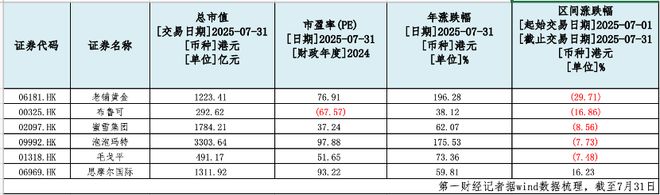
Core Viewpoint - The new consumption sector in Hong Kong has experienced a significant downturn despite the overall rise of the Hang Seng Index since June, with major stocks like Lao Pu Gold, Mixue Group, and Pop Mart seeing substantial market value losses and price declines exceeding 30% from their peak [1][2][3]. Market Performance - The Hang Seng Index rebounded from a low of 23185.58 points on June 19 to a high of 25735.89 points on July 24, while the new consumption sector faced collective declines [2]. - Lao Pu Gold's stock price fell from a peak of 1108 HKD per share on July 8 to 690 HKD by August 1, marking a cumulative drop of over 37% [2]. - Mixue Group's stock price decreased from 618.5 HKD on June 5 to 463 HKD by August 1, a decline of 25% [2]. - The combined market value of Lao Pu Gold, Mixue Group, and Pop Mart dropped by over 150 billion HKD from their highs [3]. Capital Flow - A significant outflow of southbound funds has been identified as a key driver of the downturn in the new consumption sector, with a net outflow of 41.09 billion HKD from these stocks between July 2 and July 30 [5][6]. - In contrast, local Hong Kong intermediaries continued to increase their holdings, indicating a shift in investment strategy [6]. Company-Specific Issues - Lao Pu Gold and Mixue Group are facing scrutiny regarding their business models and operational sustainability, with concerns about high production costs and declining capacity utilization [10][11]. - Lao Pu Gold's production outsourcing increased from 36% in 2021 to 41% in 2023, while its R&D investment ratio decreased [10]. - Mixue Group's capacity utilization rates for key ingredients have been declining, raising questions about its operational efficiency [10]. Future Outlook - Industry analysts express divided opinions on the long-term potential of the new consumption sector, with some optimistic about its growth driven by consumer upgrades, while others caution against high valuation risks [11][12]. - The market is expected to see structural opportunities, with leading companies likely to outperform while weaker concepts may face challenges [13].

思摩尔国际一度跌超9% 市场关注Glo Hilo日本表现
Zhi Tong Cai Jing· 2025-08-01 07:10
Core Viewpoint - Smoore International (06969) experienced a significant stock decline, dropping over 9% at one point, and currently trading down 5.94% at HKD 19.94, with a trading volume of HKD 1.095 billion [1] Group 1: Company Performance - Core client British American Tobacco reported a 12.9% year-on-year decline in global sales of its vaping products (Vuse), with a 13.0% decrease in revenue when adjusted for constant currency [1] - The launch of the new HNB product, glo Hilo, in Japan's Miyagi Prefecture, was priced at JPY 3,980, with nationwide sales set to begin on September 1 [1]
天风证券晨会集萃-20250801
Tianfeng Securities· 2025-07-31 23:45
Group 1 - The report emphasizes a shift from "expected anti-involution" to "actual anti-involution," focusing on cost investigation and price monitoring to address chaotic low-price competition in industries [3] - It suggests that the market will evolve from speculative phases to actual pricing improvements, with key indicators being product prices and performance stability [3] - The report highlights the importance of distinguishing between seasonal and cyclical logic in industry performance, with different indicators being crucial for various cyclical sectors [3] Group 2 - The July Politburo meeting confirmed a resilient economic performance, while also acknowledging pressures such as insufficient effective demand and ongoing real estate challenges [4] - The meeting emphasized maintaining policy continuity and stability while enhancing flexibility and foresight, indicating a balanced approach to macroeconomic policy [4] - The bond market is expected to remain favorable due to a stable policy base and adequate liquidity, despite potential fluctuations from equity and commodity market strength [4] Group 3 - The July FOMC meeting maintained the federal funds target rate at 4.25%-4.5%, aligning with market expectations, and indicated a delay in rate cuts [5] - The probability of a September rate cut has fallen below 50%, with expectations shifting towards a potential cut in the fourth quarter [5] - The report notes that inflationary pressures remain uncertain due to tariffs, impacting the likelihood of immediate rate cuts [5] Group 4 - The report on the liquor industry indicates a significant transformation due to economic and policy influences, with a focus on quality-price competition among leading brands [9] - It suggests that leading liquor companies are well-positioned to capitalize on recovery trends, with a potential for value reassessment as consumer demand stabilizes [9] - The report recommends focusing on strong brands with resilient demand and attractive dividend returns, such as Kweichow Moutai and Wuliangye [9] Group 5 - The report on the livestock industry highlights the need for policy implementation to control production capacity and improve profit stability [21] - It warns of potential profit declines due to high inventory levels and low demand, alongside rising feed costs and disease interference [21] - The report suggests investment opportunities in leading livestock companies as the industry enters a new phase of recovery [21] Group 6 - The report on Honghua Wisdom Energy indicates significant revenue growth, with a projected increase in core profits for 2024 [22] - It notes improvements in the city gas industry's gross margin and the company's successful transition to renewable energy, achieving profitability in this segment [22] - The report anticipates continued growth in net profits for the coming years, with a favorable valuation compared to peers [22]
“链”战东南亚: 投资印尼、泰国、越南的比较分析
Sou Hu Cai Jing· 2025-07-31 14:16
Core Insights - Southeast Asia is becoming a central battleground for global industrial chain restructuring, with Indonesia, Thailand, and Vietnam showing significant foreign direct investment (FDI) growth rates of 8.2%, 6.7%, and 12.4% respectively from 2020 to 2023, surpassing the global average [1] - Chinese enterprises have invested over $80 billion in these three countries, but the investment logic varies significantly due to differences in resource endowments, policy directions, and investment risks [1] Indonesia: Dual Drivers of Resources and Population Dividend - Indonesia, the largest country in ASEAN by land area and population, has a young demographic (average age 29) and rich natural resources, driving economic growth [2] - The government has improved the business environment through the Job Creation Law and tax incentives, with GDP growth projected between 4.8% and 5.6% by 2025 [2] - Indonesia holds 22% of the world's nickel reserves, making it a key player in the electric vehicle battery supply chain, with significant investments from Chinese firms like CATL [2] - The middle class in Indonesia reached 52 million in 2023, supporting an e-commerce market exceeding $62 billion, with companies like J&T Express expanding rapidly [3] - However, logistical inefficiencies due to underdeveloped infrastructure pose challenges, with port clearance times averaging 4.2 days, significantly longer than Vietnam's 2.1 days [3] Thailand: Upgrading Opportunities in High-End Manufacturing - Thailand, with a stable political environment and favorable investment policies, is a hub for manufacturing, tourism, and agriculture, with GDP growth expected between 3.5% and 4.2% by 2025 [6] - The country has a mature automotive supply chain with a localization rate of 65%, and companies like BYD are investing heavily in electric vehicle production [6] - Thailand's electronic payment system is advanced, with an 82% adoption rate, facilitating financial technology growth [7] - Rising labor costs, currently between $450 and $600 per month, are prompting companies to adopt automation and training initiatives to mitigate expenses [7] Vietnam: Core Undertaker of Global Supply Chain Restructuring - Vietnam is rapidly becoming a hotspot for manufacturing, with GDP growth projected at 6.5% to 7.0% by 2025, benefiting from low labor costs and strategic trade agreements [8] - The country has seen a significant increase in local suppliers, with Samsung moving over 60% of its smartphone production to Vietnam [8] - Manufacturing costs in Vietnam are approximately 30% lower than in China, with a minimum wage of $190 per month [8] - However, frequent changes in foreign investment policies pose risks, as seen with the recent regulation on e-cigarettes affecting ongoing projects [8] Investment Risk Analysis - Political and policy risks exist in all three countries, with Indonesia experiencing significant policy shifts that could impact long-term investments [11] - Labor costs are rising in all three nations, with Vietnam's minimum wage increasing by 6% in 2023, while Indonesia's labor rights protections are tightening [12] - Cultural and legal adaptability is crucial, as business practices differ significantly from China, requiring local partnerships and compliance with local regulations [12][13] Investment Strategy Recommendations - For Indonesia, companies should strengthen government relations, optimize supply chain management, and focus on employee training to navigate the complex regulatory environment [14] - In Thailand, leveraging free trade agreements and investing in high-end manufacturing sectors are recommended, along with local management to enhance market understanding [14] - In Vietnam, focusing on high-tech manufacturing and building local supply chains while staying updated on legal changes is essential for success [15] Conclusion - Southeast Asia remains a vital region for Chinese enterprises' globalization strategies over the next decade, necessitating robust risk management and flexible investment approaches to ensure sustainable growth [16]



金融制造行业8月投资观点及金股推荐-20250730
Changjiang Securities· 2025-07-30 14:06
Investment Rating - The report maintains a "Buy" rating for several key stocks in the financial and manufacturing sectors, including Beike-W, China Resources Land, New China Life Insurance, Qilu Bank, Sungrow Power Supply, and others [54]. Core Insights - The report highlights the investment outlook for the financial and manufacturing industries, emphasizing the recovery of corporate earnings and the potential for stock price appreciation in the context of macroeconomic conditions and policy expectations [5][10][11]. Financial Sector Summary - The financial sector is expected to see a continuation of performance recovery in Q2, with a focus on high-elasticity stocks. The insurance sector is projected to benefit from improved new business value and investment returns [20][21]. - Qilu Bank is noted for its strong growth in credit market share and improving asset quality, with a projected net profit growth of 16.5% in the first half of 2025 [22][26]. Real Estate Sector Summary - The real estate sector is anticipated to experience a rebound due to policy easing and potential for price recovery. Key companies like Beike-W and China Resources Land are highlighted for their strong fundamentals and growth potential [11][12][19]. Manufacturing Sector Summary - The manufacturing sector, particularly in machinery and electrical new energy, is expected to benefit from global competitiveness and accelerated overseas expansion. Companies like Haitian International are positioned to gain from increased export demand [27][35]. - The report emphasizes the importance of new technologies and market trends in the electrical new energy sector, with a focus on storage and solar energy [27][29]. Environmental Sector Summary - The environmental sector, particularly waste incineration and water services, is highlighted for its long-term investment value, with companies like Hanlan Environment and Beijing Water Group recommended for their stable cash flow and growth potential [46][50].





6000人跨市,珠海招了个纳税大户
3 6 Ke· 2025-07-30 08:59
Core Insights - The article highlights the emergence of Zhuhai's Qisi Smart Park as a significant contributor to the local economy, particularly in the electronic cigarette industry, under the leadership of Zhang Shengwei, a prominent figure in the sector [1][2][5]. Group 1: Company Overview - Qisi Smart Park, operated by Zhuhai Qisi Intelligent Manufacturing Co., is a subsidiary of the electronic cigarette manufacturer Geekna, providing comprehensive OEM/ODM services [1][2]. - Zhang Shengwei, known for his role in the electronic cigarette market, has successfully developed popular brands such as GEEKVAPE and ELF BAR, contributing to the global electronic cigarette landscape [2][11]. Group 2: Economic Impact - The Qisi Smart Park has quickly become a "pillar" of Zhuhai High-tech Zone, with its operations significantly boosting local employment and tax revenues [3][4][5]. - In 2024, the industrial output value of Zhuhai High-tech Zone is projected to exceed 60 billion yuan, with a remarkable 46.8% year-on-year growth in high-tech manufacturing value added in the first quarter of 2025 [4][5]. Group 3: Market Dynamics - The electronic cigarette market in China is characterized by rapid growth, with Geekna and its brands capturing substantial market shares internationally, particularly in the U.S. [6][12]. - Despite regulatory challenges, Geekna's products have gained significant traction, with GEEK BAR and RAZ accounting for 25.1% of the U.S. electronic cigarette market as of April 2023, showcasing impressive growth rates of 729.2% and 232.6% respectively [6][7]. Group 4: Strategic Development - Zhang Shengwei's strategy includes building manufacturing capabilities to meet innovation demands and ensure quality control, positioning Qisi Smart Park as a key strategic asset for Geekna [13][14]. - The park is designed to have a monthly production capacity of 10 million units, reflecting a significant investment exceeding 1 billion yuan and covering over 220,000 square meters [12][13]. Group 5: Industry Challenges - The electronic cigarette industry faces increasing regulatory scrutiny, with potential bans on disposable e-cigarettes in various countries, prompting companies to adopt sustainable practices and enhance compliance [15][16]. - Zhang Shengwei's companies are beginning to disclose ESG reports, indicating a shift towards regulatory compliance and sustainable business practices to mitigate legal risks [15][16].