
航发动力

Search documents
【兴证策略】25Q3险资持仓权益比例接近历史新高
Xin Lang Cai Jing· 2025-11-18 11:57
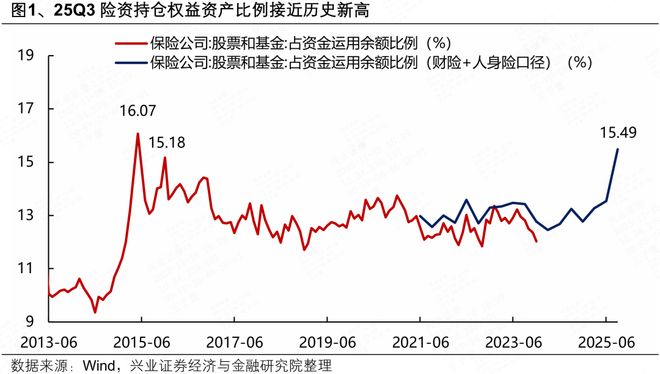
Core Insights - Insurance capital continues to increase its allocation to equity assets, with the proportion of equity assets reaching near historical highs in Q3 2025 [1] - The allocation structure shows a significant increase in technology and a reduction in high-end manufacturing sectors [5][6] - Insurance capital has accelerated its stake acquisitions in listed companies, particularly in Hong Kong stocks, with a notable increase in the number of acquisitions compared to previous years [9] Allocation Trends - In Q3 2025, the allocation of insurance capital to various asset classes is as follows: bank deposits (7.9%), bonds (50.3%), stocks (10.0%), funds (5.5%), long-term equity investments (7.9%), and other assets (18.4%) [1] - The investment proportions in bank deposits and bonds decreased by 0.7 percentage points and 0.8 percentage points, respectively, while the investment in stocks and funds surged to 15.5%, approaching the historical peak of 16.1% in H1 2015 [1] Sector and Stock Preferences - Insurance capital has significantly increased its allocation to banks, steel, and textile sectors, while reducing holdings in high-end manufacturing sectors such as new energy and military [5] - Key stocks that saw increased investment include Agricultural Bank of China, Postal Savings Bank, Industrial and Commercial Bank of China, and Hikvision, while reductions were noted in stocks like Goldwind Technology and Aviation Industry Corporation of China [6][8] Shareholding Activities - In 2025, insurance capital has made 30 stake acquisitions in listed companies, surpassing the total for the entire years of 2020 and 2024, with 25 of these acquisitions in Hong Kong stocks [9] - The trend indicates a shift towards acquiring dividend-yielding assets in Hong Kong due to declining bond yields and rising traditional dividend assets [9]




航发动力(600893.SH):联合飞机T1400未配装AES100发动机
Ge Long Hui· 2025-11-18 08:44
Core Viewpoint - The company clarified that the United Aircraft T1400 is not equipped with the AES100 engine, despite having signed sales and leasing contracts for the AES100 engine with United Aircraft Group and others [1] Group 1: Company Information - The company's wholly-owned subsidiary, China Aviation Engine Southern Industry Co., Ltd., has entered into sales and leasing contracts for the AES100 engine [1] - The company's engine products are expected to enter the market alongside flight platforms as the national low-altitude environment gradually opens up [1] Group 2: Industry Outlook - The development of the company's engine products is anticipated to promote the growth of the low-altitude economy and the general aviation industry [1]

事件催化!军工题材备受关注!航空航天ETF天弘(159241)跟踪指数全市场军工含量最高
Sou Hu Cai Jing· 2025-11-18 02:01
Group 1 - The aerospace sector showed strong performance on November 17, with the aerospace index rising by 1.76%, driven by key events and market sentiment [1] - Notable stock performances included Tianhe Defense up 10.71%, Great Wall Military Industry up 10.00%, and Aerospace Development up 9.99% [1] - The Tianhong Aerospace ETF (159241) saw significant capital inflow, with a total of 17.91 million yuan over four out of the last five trading days [1] Group 2 - China's defense spending is projected to reach 1,784.7 billion yuan in 2025, marking a 7.2% year-on-year increase, which is expected to drive growth in military orders [2] - The military industry is transitioning from event-driven to fundamental-driven growth, with a clear improvement in performance indicators [2] - In Q1 2025, military enterprises reported a more than 40% year-on-year increase in advance payments, indicating strong downstream order demand [2] Group 3 - The aerospace industry is expected to maintain a favorable outlook in 2026, benefiting from both domestic and international demand [3] - The Tianhong Aerospace ETF (159241) focuses on commercial aerospace investment opportunities, covering sectors such as satellite internet and low-altitude economy [3] - The ETF's component stocks include leading state-owned enterprises in the aerospace sector, aligning with key themes in defense and aerospace technology [2][3]



重大催化!逆势上涨
Ge Long Hui A P P· 2025-11-17 09:31
Core Viewpoint - The military industry sector is experiencing a significant rise due to increasing geopolitical risks, with the aerospace index leading the gains among military-themed indices [1][2]. Group 1: Short-term Catalysts - The military sector's strength is primarily driven by geopolitical factors, including recent provocative statements from Japan and renewed large-scale airstrikes by Russia on Ukraine, which have heightened global uncertainty [4]. - The upcoming maiden flight of China's reusable rocket "Zhuque-3" in mid-November is also a notable event that could attract market attention [4]. Group 2: Long-term Catalysts - The "14th Five-Year Plan" laid the groundwork for the military industry, achieving significant milestones in weapon systems development, transitioning from research to small-scale production [8]. - The "15th Five-Year Plan" focuses on large-scale production and systematic combat capabilities, indicating a shift towards mass production of previously developed equipment [9]. - The emphasis on "high-quality transformation" in the military sector will drive demand for advanced technologies and materials, particularly in critical areas like high-end chips and aerospace engines [11][12]. Group 3: Performance Metrics - The military sector has shown a recovery trend, with a reported 16.99% year-on-year increase in revenue and a 14.01% increase in net profit for the third quarter of 2025 [15]. - Various sub-sectors, including defense information, aerospace, and commercial space, are also showing signs of recovery [15]. Group 4: Institutional Holdings - Institutional investment in the military sector remains at historical lows, with a total market value of 101.36 billion yuan, ranking 14th among primary industries [21]. - There is a notable structural adjustment within institutional holdings, with active funds reducing their total positions while passive funds maintain stable increases [22]. Group 5: Strategic Opportunities - The military trade sector is expected to provide substantial growth opportunities, with exports of military equipment showing significant increases, such as a 30.6% year-on-year growth in September 2025 [20]. - The diversification of weapon procurement sources by various countries presents a strategic opportunity for China's military exports [20]. Group 6: Focus Areas - The aerospace index is highlighted as a key area of focus, with the aerospace ETF (159227) showing significant inflows and a strong performance in the market [34]. - The ETF's top holdings reflect the core supply chain of the aerospace industry, aligning with national strategic needs in defense and aerospace [34].
多个首次!“中国力量”组团亮相迪拜航展
Huan Qiu Wang· 2025-11-17 08:37
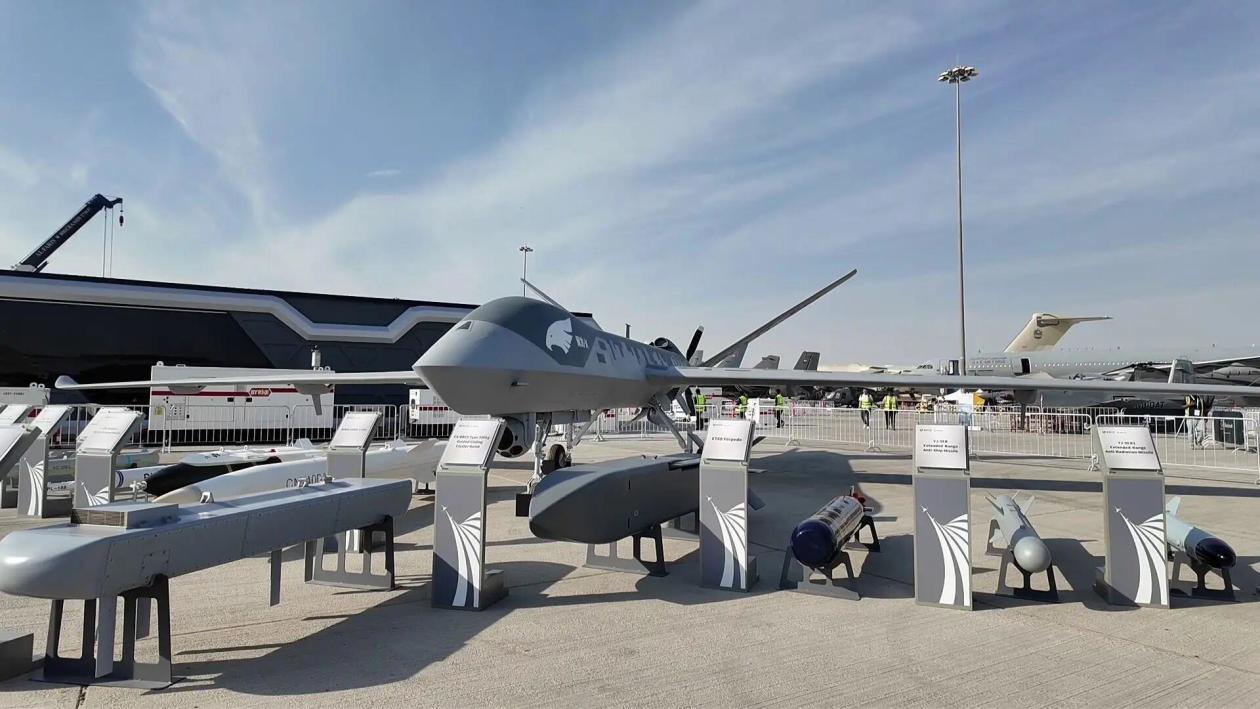
Group 1 - The 2025 Dubai Airshow features a strong presence of Chinese aerospace products, showcasing various models and technologies for the first time internationally [1][3][5] - The Wing Loong-X drone made its debut in an outdoor static display, marking its first appearance at an overseas airshow [1] - The J-10CE fighter jet, equipped with "PL" series air-to-air missiles, attracted significant attention at the China Aviation Technology booth [3] Group 2 - China Aviation Engine Corporation (AECC) participated for the first time, presenting 19 types of power products across five exhibition areas, highlighting the most comprehensive display of Chinese-made aircraft engines abroad [7] - The L-15 advanced trainer aircraft performed a flight demonstration, showcasing its capabilities after being adopted by the UAE Air Force [7] - The C919 aircraft made its first appearance in the Middle East, alongside the C909, marking a significant milestone for Chinese aviation in the region [8][10] Group 3 - The Russian Su-57E fighter jet also made its debut in the Middle East, performing various maneuvers and showcasing its advanced capabilities [10] - The airshow attracted over 1,500 global aerospace companies and institutions, featuring more than 200 commercial and military aircraft, as well as unmanned aerial vehicles [11] - Notable unmanned combat aircraft concepts were presented, including the YFQ-42A by General Atomics and a collaborative drone by Korea Aerospace Industries [11]
军工行业周复盘、前瞻:迪拜航展即将开幕,四川舰顺利完成首次航行试验
CMS· 2025-11-17 08:02
Investment Rating - The report maintains a "Strong Buy" rating for several key companies in the military industry, including 中航西飞, 中航光电, 航天彩虹, and others, indicating a strong expectation for their stock price to outperform the benchmark index by over 20% [8]. Core Insights - The military industry is highlighted as a crucial area for investment, particularly in aerospace and defense sectors, with a focus on companies that are positioned to benefit from increased military spending and technological advancements [2][3]. - The report emphasizes the potential of commercial aerospace, particularly low-orbit satellite applications, which are expected to have significant military and civilian applications [3]. - The upcoming Dubai Airshow is anticipated to be a major event, showcasing over 200 aircraft and new technologies, which could serve as a catalyst for the industry [20][22]. Industry Overview - The military industry index has shown a performance of -3.8% over the past month, but a positive trend of 12.1% over six months and 13.2% over twelve months, indicating a recovery and growth potential [5][11]. - As of November 14, 2025, the SW National Defense and Military Industry Index has increased by 13.35% year-to-date, although it has underperformed the Shanghai and Shenzhen 300 Index by 4.27% [11][12]. - The report notes that the industry consists of 119 listed companies with a total market capitalization of approximately 2060.9 billion [3]. Key Events and Catalysts - Significant geopolitical events, such as Japan's escalating rhetoric regarding Taiwan, are noted as influencing factors in the military sector, potentially impacting defense spending and strategic priorities [18][19]. - The successful completion of the first sea trial of the Navy's 四川舰 (Sichuan Ship) is highlighted as a key development, showcasing advancements in naval capabilities [22]. - The report identifies several key companies that are expected to benefit from increased demand in military trade and domestic military needs, including 中航沈飞, 中航西飞, and others [7].


超60亿元资金抢筹!三重逻辑共振,这一赛道迎来价值重估
Zheng Quan Shi Bao Wang· 2025-11-17 07:53
Core Viewpoint - The military industry is positioned as a high-potential investment sector driven by national security needs, military trade exports, and technological innovation through civil-military integration [1][3][4] Industry Dynamics - The military industry is experiencing a positive trend characterized by "economic recovery, value reassessment, and event-driven catalysts" [3] - The defense industry reported a revenue growth of 6.7% year-on-year in the first three quarters, reversing a decline of 0.57% in the first half of the year [3] - The net profit attributable to shareholders improved from -8.59% in the first half to 0.02% in the third quarter, indicating a recovery in industry performance [3] Investment Opportunities - The military trade export structure has shifted from reliance on imports to high-value exports, with a significant decrease in import share from 4.3% in 2015 to 0.2% in 2024 [4] - The 2025 defense budget is projected at 1.78 trillion yuan, with a consistent growth rate of 7.2%, indicating a stable growth foundation for defense investments [3] Valuation Insights - The current price-to-earnings ratio (TTM) for the military industry is approximately 85.77, significantly higher than the overall market average of 22.59 [5][6] - The valuation premium in the military sector is attributed to high barriers to entry and the long-term investment required for core technology development [6] Investment Tools - The military industry presents complexities and information asymmetries, making it challenging for ordinary investors to participate directly [8] - The military leader ETF (code: 512710) offers a transparent and accessible investment vehicle, tracking the military leader index that focuses on leading companies across the military supply chain [8][9] Market Sentiment - As of October 30, the military leader ETF has seen a net inflow of 6.413 billion yuan this year, with a total scale of 13.735 billion yuan, reflecting strong market recognition [2][10] - The investment in the military sector is viewed as a long-term confidence in national technological strength and security, aligning with national strategies [10]
超60亿元资金抢筹!三重逻辑共振,这一赛道迎来价值重估
券商中国· 2025-11-17 07:43
Core Viewpoint - The military industry is positioned as a high-potential investment sector, driven by national security needs, military trade exports, and technological innovation through military-civilian integration, highlighting its long-term investment value as the country transitions from the "14th Five-Year Plan" to the "15th Five-Year Plan" [1] Group 1: Industry Dynamics - The military industry is experiencing a positive trend characterized by "economic recovery, value reassessment, and event-driven catalysts" [4] - The defense and military sector's revenue for the first three quarters showed a year-on-year growth of 6.7%, reversing a decline of 0.57% in the first half of the year [4] - The 2025 national defense budget is projected at 1.78 trillion yuan, with a consistent growth rate of 7.2%, indicating a stable foundation for continued investment [4] Group 2: Military Trade and Technological Integration - Military trade exports are a key variable for value reassessment, with China's military trade export structure shifting towards high-value areas such as drones and stealth fighters [5] - The integration of military and civilian technologies is creating new growth paths, with military high-tech accelerating its transition into civilian sectors like commercial aerospace and logistics [5] Group 3: Valuation and Market Perception - The current price-to-earnings ratio (TTM) for the A-share military industry is approximately 85.77, significantly higher than the overall market average of 22.59, raising concerns about overvaluation [7] - The valuation of military enterprises should consider their strategic importance, technological barriers, and profit certainty, rather than relying solely on traditional metrics [7] - The global military industry valuation logic is being restructured, with a shift from traditional manufacturing to technology-driven platforms, emphasizing long-term growth potential [8] Group 4: Investment Strategies for Ordinary Investors - The military industry presents significant complexity and information asymmetry, making direct investment challenging for ordinary investors [11] - The military leader ETF (code: 512710) offers a transparent and accessible investment tool, tracking the military leader index that focuses on leading enterprises across the military supply chain [11][13] - The military leader index includes key players from all segments of the military industry, providing a diversified investment approach that mitigates individual stock risks [12][13]

军工板块三季度归母净利润同比增长73.2%!军工ETF龙头(512680)盘中涨超2%,外部环境不确定性带动国际军贸需求增长
Xin Lang Cai Jing· 2025-11-17 03:09
Group 1 - The A-share military industry sector experienced a significant surge, with companies like Great Wall Military and Jianglong Shipbuilding seeing substantial gains, indicating strong market interest and potential growth in the sector [1] - The military industry is benefiting from the "14th Five-Year Plan" completion and preparations for the "15th Five-Year Plan," with key drivers including high-end military trade, state-owned enterprise reforms, and large-scale AI deployment [1] - The upcoming launch of China's reusable rocket "Zhuque-3" is expected to lower launch costs and accelerate the development of domestic satellite internet constellations, marking a milestone for commercial aerospace [1][2] Group 2 - The military sector reported a notable increase in performance, with net profit reaching 24.453 billion yuan in the first three quarters of 2025, a 17.29% increase year-on-year [2] - The third quarter alone saw a net profit of 8.927 billion yuan, reflecting a significant 73.2% year-on-year growth, indicating a positive trend in quarterly performance [2] - The military ETF index showed strong performance, with a 2.10% increase on November 17, 2025, and a 12.88% rise over the past six months, highlighting investor confidence in the sector [2][3] Group 3 - The leading military ETF reached a scale of 7.571 billion yuan as of November 14, 2025, with a substantial increase in shares by 70.4 million over the past two weeks [3] - The ETF has seen continuous net inflows, with a peak single-day inflow of 41.8467 million yuan, totaling 1.25 billion yuan in net inflows recently, indicating strong investor interest [3] Group 4 - Investors can access military ETF opportunities through various off-market connection classes, providing additional avenues for investment in the military sector [4]
军工含量第一的航空航天ETF涨超2%,近20日“吸金”超7亿元
Ge Long Hui A P P· 2025-11-17 02:33
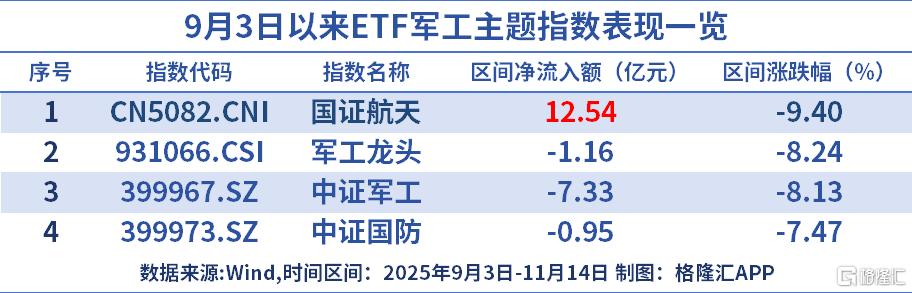
Group 1 - The military industry sector continues its strong performance, with aerospace development achieving two consecutive trading limits and Great Wall Aerospace hitting the daily limit, driving the Aerospace ETF up by 2.51% [1] - Recent geopolitical tensions, including inappropriate remarks from Japan's Prime Minister and military exercises in the Yellow Sea, have increased uncertainty in the global landscape, acting as direct catalysts for the sector [2] - The defense and military sector has shown significant profit growth, with a year-on-year increase of 17.29% in net profit attributable to shareholders in the first three quarters, and a remarkable 73.2% increase in the third quarter alone [2] Group 2 - The National Aerospace Index has experienced a cumulative decline of over 9% since September 3, indicating a technical demand for rebound [3] - The "14th Five-Year Plan" has established "building a strong aerospace nation" as an independent goal, marking a shift from technological breakthroughs to systematic national construction, positioning the aerospace industry as a core support for modernization and technological self-reliance [3] - The Aerospace ETF (159227) has attracted over 700 million yuan in capital over the past 20 days, with a high concentration of military-related stocks, accounting for 98.2% of the index [4]