
珀莱雅

Search documents
化妆品医美行业周报:品牌端渐入淡季积极备新,策略会共商未来发展-20251123
Shenwan Hongyuan Securities· 2025-11-23 14:41
Industry Overview - The cosmetics and medical beauty sector has shown stronger performance than the market, with the Shenwan Beauty Care Index declining by 4.5% from November 14 to November 21, 2025, outperforming the Shenwan A Index by 1.9 percentage points [3][4] - The cosmetics sales are expected to gradually decline as the peak shopping season ends, with domestic brands actively preparing new products for the off-season [9][10] Key Insights - The 2026 cosmetics and medical beauty strategy report indicates that brand growth is crucial, with upstream and downstream margins improving. Domestic brands are expected to grow against the trend during the industry consolidation phase [10][11] - The National Medical Products Administration has introduced 24 reform measures aimed at enhancing the regulatory framework for cosmetics, promoting high-quality industry development [26] Company Focus - Qingmu Technology (301110) is highlighted as a full-domain operation service expert, leveraging data and technology to drive growth. The company has established a strong brand matrix across various sectors, including fashion and beauty [15][16] - Investment recommendations include brands with strong channel and brand matrices such as Maogeping, Shangmei Co., and Proya, as well as companies in the medical beauty sector like Aimeike [12][14] Market Trends - The retail sales of cosmetics in October 2025 grew by 9.6%, driven by the Double 11 shopping festival, with a total retail sales of 381.3 billion yuan for cosmetics in the first ten months of 2025, reflecting a 4.6% year-on-year increase [21][23] - The domestic market for skincare products is expected to see further growth, with domestic brands gaining market share due to their competitive pricing and localized strategies [31][34]

——美容护理行业25Q3业绩回顾:需求端稳健发展,业绩端分化加剧
Shenwan Hongyuan Securities· 2025-11-23 09:11
Investment Rating - The report maintains a "Positive" outlook on the beauty and personal care industry, highlighting robust demand and the continued rise of domestic brands [2]. Core Insights - The beauty care industry is experiencing a stable demand phase, with domestic leading brands expected to grow during the industry consolidation period [3]. - The cosmetics sector showed resilience during the off-peak season, with retail sales reaching 98.2 billion yuan from July to September, reflecting a single-digit year-on-year growth and an acceleration compared to the first half of 2025 [2][3]. - The report emphasizes the strong performance of domestic brands during the Double 11 shopping festival, with Proya ranking first in Tmall's beauty sales [2][11]. Summary by Sections Cosmetics Sector Performance - The cosmetics sector's key A-share companies reported an average revenue growth rate of around 3% in Q3 2025, with overall improvement in net profit [2]. - Proya's cumulative revenue for the first three quarters of 2025 was 7.098 billion yuan, a year-on-year increase of 1.89%, while its Q3 revenue was 1.736 billion yuan, down 11.63% year-on-year [16]. - Other notable performances include: - Ruifucheng: Q1-Q3 revenue of 2.138 billion yuan, up 85.3% year-on-year, with Q3 revenue of 819 million yuan, up 123.4% year-on-year [16]. - Marubi: Q1-Q3 revenue of 2.45 billion yuan, up 25.5% year-on-year, with Q3 revenue of 686 million yuan, up 14.28% year-on-year [16]. Medical Aesthetics Sector Performance - The medical aesthetics sector showed slight fatigue but experienced marginal improvements in Q3 2025 [2]. - Notable performances include: - Aimeike: Q1-Q3 revenue of 1.865 billion yuan, down 21.49% year-on-year, with Q3 revenue of 566 million yuan, down 21.27% year-on-year [2]. - Longzi: Q1-Q3 revenue of 4.328 billion yuan, up 0.9% year-on-year, with Q3 revenue of 1.539 billion yuan, up 11.9% year-on-year [2]. Investment Recommendations - The report recommends focusing on companies with a well-established channel and brand matrix, such as Maogeping, Shangmei, and Shanghai Jahwa, which are expected to see high GMV growth [2][20]. - Companies anticipated to show marginal improvements in performance include Proya, Marubi, and Ruifucheng [2]. - In the medical aesthetics sector, the report highlights Aimeike as a key recommendation, with Longzi suggested for further observation [2]. Market Trends - The domestic market share of leading brands is increasing, with the top ten domestic brands capturing 16.6% of the market share in skincare, up from 11.8% in 2023 [4]. - The report notes that the cosmetics retail sales in October 2025 grew by 9.6% year-on-year, indicating a recovery in demand driven by promotional events [10][11].


脱发90后撑起一个IPO
3 6 Ke· 2025-11-23 08:19
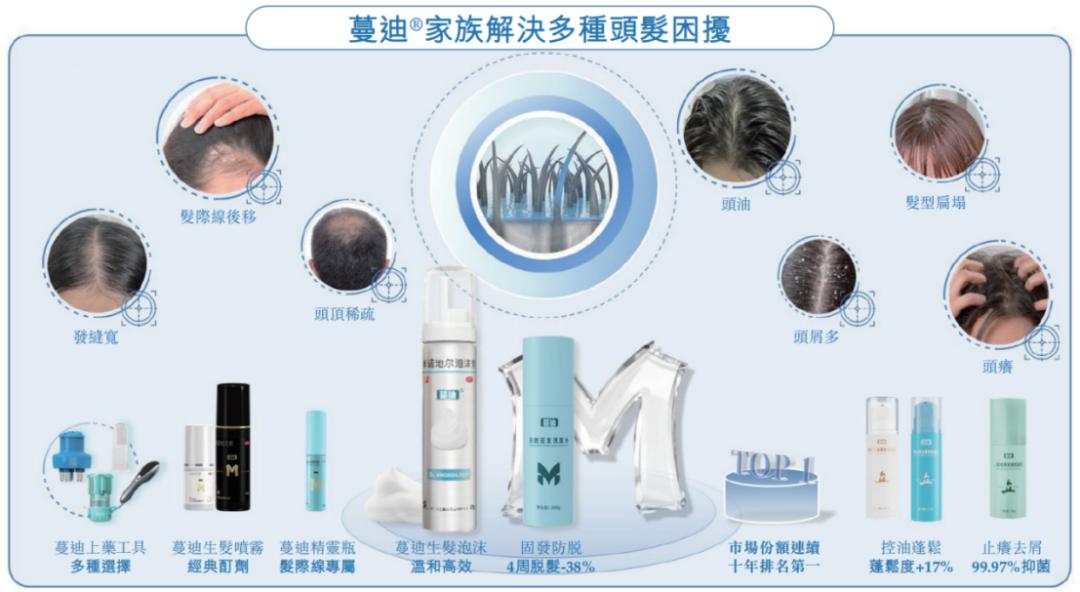
Core Viewpoint - The hair loss treatment market in China is rapidly growing, with Mandis International preparing for an IPO, highlighting the increasing demand for hair loss solutions among the younger population [1][10]. Company Overview - Mandis International, originally founded as a pharmaceutical company in 2001, gained market traction with its minoxidil solution and has been a leader in the hair loss treatment sector for the past decade [2][4]. - The company was acquired by 3SBio in 2015, which has since expanded its portfolio and market presence [3][4]. Market Potential - Over 330 million people in China suffer from hair loss, with more than 60% of them being under 35 years old, indicating a significant market opportunity [1][10]. - The market for hair loss treatments is projected to be worth hundreds of billions, with major cities like Beijing, Shanghai, Guangzhou, and Shenzhen being the top markets [1][10]. Financial Performance - Mandis International reported revenues of 982 million RMB in 2022, with projections of 1.23 billion RMB in 2023 and 1.45 billion RMB in 2024, reflecting a compound annual growth rate (CAGR) of 21.7% [6][8]. - The gross profit margins have remained high, with figures of 80.3% in 2022, 82.0% in 2023, and 82.7% in 2024 [6]. Product Portfolio - The company's product lineup includes first-generation 5% minoxidil solution, second-generation minoxidil foam, and various anti-hair loss shampoos, holding a market share of 57% and 71% in the domestic hair loss and minoxidil markets, respectively [4][7]. - The revenue from the Mandis® series products accounts for over 90% of total income, with the minoxidil foam's revenue share increasing significantly from 10.6% in the first half of 2024 to 38.7% in the same period of 2025 [7][8]. Competitive Landscape - The hair loss treatment market is becoming increasingly competitive, with rising customer acquisition costs and price reductions impacting profit margins [9]. - The company faces risks from competitors who may develop or commercialize products more successfully, potentially hindering growth targets [9]. Distribution Channels - Mandis International primarily sells through third-party distributors to hospitals and pharmacies, although the number of distributors has decreased from 220 in 2022 to 106 recently, indicating potential customer attrition risks [9]. Industry Trends - The hair loss treatment industry is witnessing a surge in interest, with various brands entering the market and a growing ecosystem of products ranging from shampoos to hair transplants [10][11]. - The increasing prevalence of hair loss among younger demographics is driving demand for effective treatments, with social media playing a significant role in spreading awareness and sharing experiences [10][11].

脱发90后撑起一个IPO
投资界· 2025-11-23 08:04
Core Viewpoint - The article discusses the growing market for hair loss treatments in China, highlighting the upcoming IPO of Mandi International and the significant market potential driven by a large population suffering from hair loss, particularly among younger individuals [2][11]. Company Overview - Mandi International, originally founded in 2001, has established itself in the hair loss treatment sector with its Minoxidil products, including a 5% Minoxidil solution and foam [3][6]. - The company was acquired by 3SBio in 2015, which has since expanded its market presence and product offerings [3][4]. Market Potential - Over 330 million people in China suffer from hair loss, with more than 60% of this demographic being under 35 years old, indicating a substantial market opportunity [2][11]. - Mandi's Minoxidil products hold a market share of 57% in the domestic hair loss medication sector and 71% in the Minoxidil category, maintaining a leading position for ten consecutive years [6]. Financial Performance - Mandi International's revenue has shown a compound annual growth rate (CAGR) of 21.7% from 2022 to 2024, with revenues of 982 million RMB, 1.228 billion RMB, and 1.455 billion RMB for those years respectively [8]. - The gross profit margins have remained high, with figures of 80.3%, 82.0%, and 82.7% for the same period [8]. Product Portfolio - The product lineup includes first-generation and second-generation Minoxidil products, as well as a range of shampoos with various benefits [6][8]. - The company is also developing additional products for acne treatment and weight management, with plans for regulatory submissions in the coming years [8]. Distribution Channels - Mandi International's online sales have increased significantly, with online sales accounting for 74% of total sales by mid-2025, up from 55.2% in 2022 [9]. - However, the number of offline distributors has decreased by 51.8% over three years, indicating potential risks in customer retention [10]. Competitive Landscape - The hair loss treatment market is becoming increasingly competitive, with rising customer acquisition costs and price reductions impacting profit margins [10]. - The article notes the emergence of various brands entering the market, including those from established companies like Proya and Vichy, which are launching their own anti-hair loss products [12].

美容护理行业25Q3业绩回顾:需求端稳健发展,业绩端分化加剧
Shenwan Hongyuan Securities· 2025-11-23 07:43
Investment Rating - The report maintains a positive outlook on the beauty and personal care industry, indicating a "Buy" rating for key players in the sector [2]. Core Insights - The demand side of the beauty industry is showing robust growth, with domestic brands gaining market share and performing well during promotional events like Double 11 [3][4]. - The overall performance of the cosmetics sector is mixed, with some companies showing strong growth while others face challenges [3][4]. - The report highlights the increasing market share of domestic brands, with significant improvements in their competitive positioning against international brands [5][9]. Summary by Sections Industry Overview - The beauty industry is entering a stable growth phase, with domestic leading brands expected to grow during the industry consolidation period [4]. - The retail sales of cosmetics reached 98.2 billion yuan from July to September, showing a high single-digit year-on-year growth, and continued strong performance in October with a growth rate exceeding 9% [3][4]. Company Performance - **Polaire**: For the first three quarters of 2025, Polaire reported a cumulative revenue of 7.098 billion yuan (up 1.89% year-on-year) and a net profit of 1.026 billion yuan (up 2.65%) [18]. - **Ru Yuchen**: The company achieved a revenue of 2.138 billion yuan (up 85.3% year-on-year) in the first three quarters, with a net profit of 105 million yuan (up 81.6%) [18]. - **Marubi**: Reported a revenue of 2.45 billion yuan (up 25.5% year-on-year) for the first three quarters, with a net profit of 240 million yuan (up 2.1%) [19]. - **Shanghai Jahwa**: Revenue for the first three quarters was 4.961 billion yuan (up 10.8% year-on-year), with a net profit of 405 million yuan (up 149%) [20]. Market Trends - The report notes that domestic brands are increasingly capturing market share, with the top ten domestic brands holding five spots and a combined market share of 16.6%, up from 11.8% the previous year [5]. - The cosmetic sector's gross margin continues to improve, although rising sales expenses are impacting net profit margins [3][4]. Investment Recommendations - Key recommendations include focusing on companies with strong channel and brand matrices, such as Mao Ge Ping and Shangmei, and those expected to see marginal improvements in performance, like Polaire and Marubi [3][4]. - In the medical beauty sector, companies with high barriers to entry and strong profitability, such as Aimeike, are highlighted as potential investment opportunities [3][4].

行业周报:六福集团业绩预告高增,美丽田园战略升级-20251122
KAIYUAN SECURITIES· 2025-11-22 11:35
Investment Rating - The report maintains a "Positive" investment rating for the retail industry [1] Core Insights - The retail industry is experiencing a significant transformation, with a focus on emotional consumption and innovative product offerings driving growth [6][32] - Companies like Liufu Group and Meili Tianyuan are implementing strategic upgrades to enhance brand value and market presence [27][29] Summary by Sections Retail Market Overview - The retail index reported a decline of 7.24% during the week of November 17-21, 2025, underperforming the Shanghai Composite Index by 3.34 percentage points [5][14] - The retail index has increased by 0.58% year-to-date, lagging behind the overall market performance [14][18] Company Performance Highlights - Liufu Group anticipates a revenue increase of approximately 20%-30% and a net profit growth of 40%-50% for the six months ending September 30, 2025, driven by effective product differentiation and sales strategies [27] - Meili Tianyuan is focusing on three major strategic initiatives: building a super brand through acquisitions, establishing a super chain for quality growth, and enhancing digital capabilities for precise marketing [29] Investment Themes - **Gold and Jewelry**: Focus on brands with differentiated product offerings and consumer insights, recommending companies like Laopuhuang and Chaohongji [6][35] - **Offline Retail**: Emphasize companies adapting to market changes, recommending Yonghui Supermarket and Aiyingshi [6][32] - **Cosmetics**: Highlight domestic brands that cater to emotional value and safety innovations, recommending companies like Maogeping and Pola [6][33] - **Medical Aesthetics**: Target differentiated product manufacturers and expanding medical chains, recommending Aimeike and Kedi-B [6][34] Key Company Updates - Chaohongji reported a revenue increase of 28.4% year-to-date, with a focus on expanding its franchise model and product innovation [38][40] - Yonghui Supermarket's revenue decreased by 22.2% year-to-date, but the company is undergoing a transformation to improve its supply chain and store optimization [41][43]



进入深水区:双11后,「猫抖狗」的生态博弈与品牌生存新法则
Sou Hu Cai Jing· 2025-11-22 00:03
Core Insights - Tmall achieved its best growth in four years during this year's Double 11, emphasizing the importance of excluding unshipped refunds from transaction figures [2] - JD.com made significant strides in the facial skincare category, leading mainstream platforms with a growth rate of 12.1% [2] - Douyin continued to leverage its content-driven approach, creating numerous growth cases for domestic brands [2] Group 1: Tmall's Strategy - Tmall is reinforcing its position as a "value fortress" for high-end beauty brands, shifting its growth logic from mere traffic competition to deep integration of membership economy and AI tools [4][5] - The 88VIP membership program has become crucial, with 53 million members contributing over 70% of transaction volume for top beauty brands, and the average spending of these members being nine times that of non-members [5][7] - Tmall's new discount strategy for 88VIP members simplifies the shopping experience, allowing direct discounts on single items without complex calculations, enhancing user trust and focus on product value [7][9] Group 2: Douyin's Evolution - Douyin's beauty brand rankings show a balanced representation of domestic and international brands, with domestic brand Han Shu topping the list, indicating a shift in market dynamics [10][12] - The platform has transitioned from "interest e-commerce" to "immersive content e-commerce," integrating content and commerce to create a unique consumer ecosystem [14] - Successful domestic brands on Douyin focus on deep integration of content and sales, building their own live-streaming systems, and developing standout products to drive sales [14][15] Group 3: JD.com's Positioning - JD.com is targeting female consumers, particularly mothers with purchasing power, by leveraging its PLUS membership system to recommend high-end beauty products [18][20] - The platform's focus on genuine product assurance, service experience, and alignment with high-value user demographics has made it a key online channel for international beauty brands in China [19][20] - JD.com is enhancing its service capabilities through AI technology, providing efficient operational tools for brands while also opening up to domestic brands like Pechoin [20][21] Group 4: Ecosystem Integration - The 2025 Double 11 highlighted the solidified ecological positions of Tmall, Douyin, and JD.com, each evolving in depth: Tmall as an "AI-driven innovation engine," Douyin as an "immersive experience showcase," and JD.com as a "smart supply chain fortress" [21][22][23] - Future success for beauty brands will depend on their ability to integrate into these ecosystems, requiring data integration, strategy alignment, and organizational adaptation [23][24][25] - The ability to adapt to platform ecosystems will be a critical factor in determining brand success beyond the Double 11 sales period [26][27]


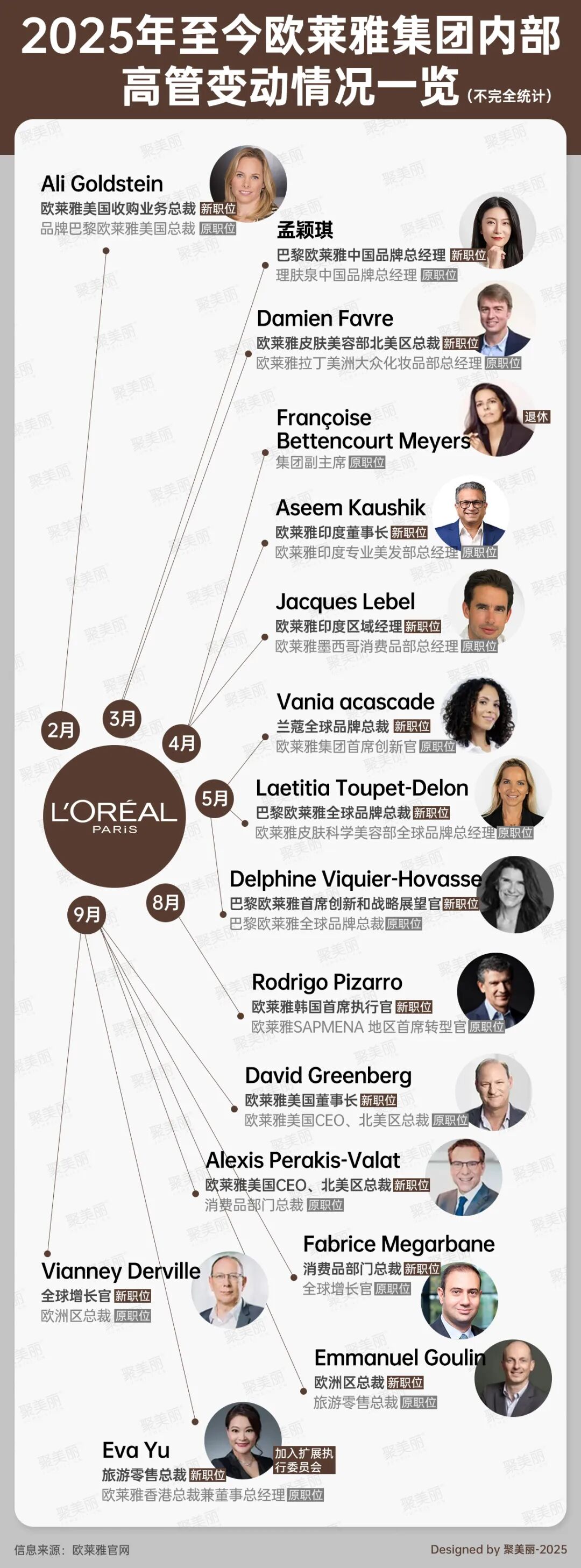
宝洁系频出老板,欧莱雅量产高管?
3 6 Ke· 2025-11-21 00:46
Core Insights - The movement of top talents from Procter & Gamble (P&G) and L'Oréal serves as a barometer for changes in the beauty industry landscape [1][4] - L'Oréal has experienced significant internal executive turnover, with over ten changes since 2025, which is nearly three times that of P&G [1][4] - Former L'Oréal executives tend to pursue more stable career paths, often taking on key management roles in other multinational or leading domestic beauty companies [4][12] Group 1 - The trend shows that L'Oréal executives are more suited for corporate roles, while P&G alumni are more inclined to start their own businesses [4][12] - The beauty industry faces challenges in brand development and internationalization, making L'Oréal-trained executives valuable assets for companies seeking to navigate these complexities [6][36] - Recent appointments of former L'Oréal executives in domestic beauty companies like Perlay and Betaini highlight the ongoing trend of talent migration [8][10] Group 2 - The executive rotation mechanism at L'Oréal fosters a diverse skill set among its leaders, preparing them for high-level decision-making roles [18][22] - L'Oréal's systematic approach to talent development emphasizes cross-functional and cross-regional experiences, which enhances the adaptability of its executives [22][23] - The influx of L'Oréal executives into competitor companies is reshaping the power dynamics within the global beauty industry [17][36] Group 3 - Women hold a significant proportion of leadership roles within L'Oréal, with 58% of board members and 54% of leaders being female, reflecting a broader trend in the beauty industry [33][34] - The competition for top talent in the beauty sector is intensifying, with companies like Estée Lauder and Johnson & Johnson actively recruiting from L'Oréal [34][35] - The strategic hiring of L'Oréal executives by companies like Perlay and Kering underscores the demand for their expertise in brand management and global operations [36][37]

天风证券:双十一美妆大促总体增长稳增 头部国货美妆加大投入积极寻求转型
Zhi Tong Cai Jing· 2025-11-21 00:21
Core Insights - The 2025 Double Eleven shopping festival for beauty products shows a clear trend of "steady overall growth, with high growth concentrated in specific subcategories and core channels" [2] Group 1: Market Performance - E-commerce retail sales during the 2025 Double Eleven period reached nearly 2.4 trillion yuan, with a year-on-year growth of over 10% [2] - Tmall, JD.com, and Douyin ranked as the top three comprehensive platforms, with Tmall holding a significant market share of 37% [2] - The beauty and personal care category ranked second in Douyin's industry share, with skincare and makeup becoming core growth drivers on JD.com and Tmall [2] Group 2: Trends in Brand Performance - Domestic brands and high-end foreign brands are gaining market share, with the top 20 beauty products on Tmall showing an upward trend for both [3] - Proya ranked first among domestic brands, while Estee Lauder rose to second place among foreign brands, with several high-end brands experiencing significant growth rates [3] Group 3: Channel Dynamics - Tmall's channel accounted for 61.3% of the GMV in the beauty market during Double Eleven, indicating a strong performance [4] - Leading domestic beauty brands such as Aoyuan, Maogeping, and Shanghai Jahwa showed substantial growth rates on Tmall, with increases of 65.5%, 86.2%, and 21.1% respectively [4] Group 4: Brand Strategy Shifts - The number of brands achieving over 10 million yuan in sales through Douyin live streaming increased by 313% year-on-year during Double Eleven [5] - Leading brands like Han Shu and Run Ben have significantly increased their self-broadcasting ratios, indicating a shift from traffic-driven to brand-driven growth strategies [5]

刘亦菲、易烊千玺等代言,知名国货品牌冲刺港交所!去年收入超百亿元,如今却业绩下滑,股价疲软!85后“二代”已接班
Mei Ri Jing Ji Xin Wen· 2025-11-20 14:21
Core Viewpoint - Proya, a leading Chinese beauty brand, has submitted an application for H-share listing on the Hong Kong Stock Exchange after eight years of being listed on A-shares, despite facing challenges such as declining net profits [1][10]. Company Development - Proya was founded in 2003 by Hou Junchen and his brother-in-law Fang Youyou, launching its first brand in 2006 [2]. - The company went public on the Shanghai Stock Exchange in 2017, marking a significant milestone in its growth trajectory [2]. - Proya has expanded its brand portfolio from a single brand to multiple brands, including Proya, Yefuti, Kuirufu, Caitang, Yuansheng Bota, and Off&Relax, with four key brands projected to exceed 500 million yuan in retail sales by 2024 [2][3]. Market Position - Proya ranked 15th among domestic cosmetics groups in 2019, became the largest domestic cosmetics group in 2021, and is projected to rank 5th in 2024, maintaining its position as the top domestic cosmetics group for four consecutive years [3]. - In 2024, Proya became the first Chinese cosmetics group to surpass 10 billion yuan in sales revenue [3]. Sales Channels - The rapid growth in Proya's retail sales is attributed to its focus on online sales channels, which accounted for over 90% of revenue since 2022, reaching 95.4% in the first half of 2024 [4]. - Online direct sales made up 75.5% of total online revenue, while online distribution accounted for 19.6% [4]. Financial Performance - In Q3 2023, Proya reported revenue of 1.736 billion yuan, a year-on-year decline of 11.63%, with net profit dropping by 22.30% [14][15]. - The company's stock price has been on a downward trend, with a decline of over 12% since the beginning of the year [10]. Leadership Transition - In September 2024, Hou Yameng, born in 1988, succeeded Fang Youyou as the general manager, marking a generational shift in leadership [9]. - Under Hou Yameng's leadership, Proya aims to implement a "Double Ten" strategy to enter the top ten global cosmetics companies within the next decade [9]. IPO Objectives - Proya's H-share IPO aims to enhance global brand visibility, attract international investors, and support its international expansion strategy [16]. - The funds raised will be allocated to R&D, brand building, and digital transformation initiatives [16].
