
南山智尚

Search documents
广发证券:灵巧手受益于人形机器人放量预期 建议关注触觉传感器等环节
Zhi Tong Cai Jing· 2025-04-03 03:12
Group 1 - The core components of dexterous hands include three systems: drive, transmission, and perception [1] - The driving solution has shifted to electric drives, with hollow cup motors and brushless gear motors being the preferred choices [1] - The transmission solutions are categorized into linkages, tendon-driven, and worm gear/gear systems, with tendon-driven applications being the most widespread [1] Group 2 - The third generation of Optimus dexterous hands features an upgraded transmission structure and enhanced tactile sensing, significantly increasing degrees of freedom from 11 to 22 [2] - The active control degrees of freedom have increased from 6 to 17, allowing for more complex movements [2] Group 3 - Key components in the dexterous hand market include brushless DC motors, micro lead screws, tactile sensors, and tendons [3] - Major companies involved in brushless DC motors include Mingzhi Electric, Zhaowei Electromechanical, and Weichuang Electric [3] - Micro lead screws are critical for precision linear motion, with companies like Hengli Hydraulic and Zhejiang Rongtai leading in this area [3] Group 4 - Emerging players in the dexterous hand sector include unicorns such as Yinshi Robotics and Aoyi Technology, along with listed companies like Jiechang Drive and Leisai Intelligent [4] - These companies are positioned to benefit from the accelerated industrialization of dexterous hands [4]

机器人腱绳:材料革命背后的产业链机遇与挑战
Zheng Quan Zhi Xing· 2025-03-26 08:37
Core Insights - The article discusses the emerging opportunities and challenges in the robotic tendon market, highlighting the importance of materials in enhancing the performance of robotic hands [1] Technological Evolution - Traditional robotic joints relied on torque springs, which had limitations such as size, response time, and energy consumption. The introduction of tendons, mimicking human muscle mechanisms, significantly improved the lightweight and flexibility of robotic hands [2] - Mainstream tendon materials include high-strength steel wire and ultra-high molecular weight polyethylene (UHMWPE) fibers. High-strength steel wire is known for its load-bearing capacity, while UHMWPE is preferred for lightweight designs due to its low density and high wear resistance [2][3] - Companies like Daye Co. (大业股份) and Jiangsu Jiuzhou Star (江苏九州星际) are key players in the tendon material market, with Daye Co. focusing on steel wire and Jiuzhou Star leading in UHMWPE production [2][4] Industry Chain Landscape - Daye Co. is transitioning into the tendon market with plans to establish a subsidiary for tendon research and development, although their products have not yet been mass-produced [4] - Henghui Security (恒辉安防) is expanding its UHMWPE capacity, with a current production of 3,000 tons and plans for an additional 4,800 tons, although they have not yet secured orders for robotic applications [5] - Tongyi Zhong (同益中) has a near-full capacity of 8,000 tons of UHMWPE and is positioned to respond quickly to customized demands despite not having direct orders from robot manufacturers [7] - Nanshan Zhishang (南山智尚) has a production capacity of 3,600 tons and is in discussions with multiple robot manufacturers, with their products meeting basic requirements for robotic applications [8] Market Outlook - The cost of tendons represents about 10% of the total cost of robotic hands, with UHMWPE being significantly cheaper than steel wire, potentially accelerating the replacement of traditional materials [9] - The demand for tendon materials is expected to grow exponentially as humanoid robots become more prevalent, with UHMWPE also applicable in various other robotic components [9] - Current tendon business contributions to company revenues are minimal, with most companies still in the research and testing phase [9] Conclusion - The competition in the robotic tendon market is fundamentally about material innovation and industry chain collaboration, with UHMWPE likely to become mainstream while high-strength steel wire remains irreplaceable in specific scenarios [10] - Key factors for investors to monitor include technological breakthroughs, production capacity expansions, and order validations from leading manufacturers like Tesla [10]


纺织服饰行业周报:体育服饰龙头稳增长,1-2月内需企稳
中国银河· 2025-03-26 05:30
Investment Rating - The report maintains a "Recommended" rating for the textile and apparel industry [1]. Core Insights - The leading domestic sports brands, including Anta Sports, Xtep International, and 361 Degrees, have shown resilient growth in 2024, with revenues of 70.826 billion, 13.577 billion, and 10.074 billion yuan respectively, reflecting year-on-year growth rates of 13.6%, 6.5%, and 19.6% [3][6]. - The retail sales of clothing in China for January-February 2025 reached 262.4 billion yuan, a year-on-year increase of 3.3%, indicating a steady recovery in consumer demand supported by favorable policies [7][15]. - The report anticipates a quarterly improvement in clothing consumption throughout 2025, driven by ongoing consumer policy support and the effects of a low base in 2024 [7][15]. Summary by Sections 1. Industry Overview - The textile and apparel industry is experiencing stable growth, with a focus on domestic consumption recovery in early 2025 [1]. 2. Key Industry Data Review (a) Stock Market Review - The Shanghai Composite Index fell by 1.6%, while the textile and apparel sector saw a decline of 1.29% during the week of March 17-21, 2025 [11][12]. (b) Retail Performance - The total retail sales of consumer goods in China for January-February 2025 amounted to 83,731 billion yuan, with clothing retail sales contributing 2,624 billion yuan [15]. (c) Upstream Textile Exports - In February 2025, textile yarn, fabric, and related products exported amounted to 6.219 billion USD, a year-on-year decrease of 25.3% [22]. (d) Upstream Raw Materials - As of March 21, 2025, the domestic cotton price index was 14,905 yuan per ton, showing a slight increase from the previous week [31][32]. 3. Key Company Announcements - Anta Sports, Xtep International, and 361 Degrees reported significant revenue growth for 2024, with net profits increasing by 52.4%, 20.2%, and 19.5% respectively [3][6].

纺织服装与轻工行业周报解读
2025-03-25 14:31
Summary of Key Points from the Conference Call Industry Overview - The textile and apparel industry is currently facing mixed performance, with the Shenyuan Textile and Apparel Index declining by 1.28% from March 17 to March 21, 2025, underperforming compared to the Shanghai Composite Index and the ChiNext Index [2][4] - The industry’s current price-to-earnings ratio (P/E) stands at 18.90, indicating a relatively high valuation attractiveness compared to historical highs of 57.80 and lows of 14.07 [4] Investment Recommendations - **Upstream Textile Manufacturing**: Companies involved in ultra-high molecular weight polyethylene fibers, which are applicable in robotics, are recommended. Notable companies include Nanshan Zhishang, Henghui Anfang, Kangyongda, and Yunzongma [2] - **Downstream Home Textiles**: Leading companies in the home textile sector, such as Mercury Home Textiles and Fuanna, are expected to benefit from a stabilizing real estate market, increased wedding demand in 2025, and local subsidy policies [2] - **Children's Apparel**: Leading companies in the children's clothing sector are anticipated to benefit from childcare subsidy policies [2] - Companies with resilient performance in 2024 and positive outlooks for 2025 include Semir Apparel, Stable Medical, Yinglian Co., Baoxiniang, Jin Hong Group, as well as Hong Kong-listed Anta Sports and Li Ning [2] Market Performance and Trends - Retail sales of clothing, shoes, and textiles in China grew by 3.3% year-on-year in January and February 2025, while online retail sales of clothing experienced a decline of 0.6% [2][5] - The real estate market shows a significant divergence, with new housing transaction areas in major cities increasing by 344% year-on-year, while second-hand housing transactions decreased by 103% [2][11][12] - The paper industry is experiencing internal differentiation, with cultural paper prices remaining strong, while low-end corrugated box prices are declining [2][16] Challenges and Risks - Nike reported a 7% year-on-year decline in revenue for Q3 of fiscal year 2025, with net profit down by 32%. The company anticipates continued revenue decreases and a drop in gross margin in the upcoming quarter [2][9] - The textile industry faces challenges in online sales strategies, as evidenced by the negative growth in online clothing sales [2][5] Additional Insights - The export price of Chinese cashmere showed a mixed trend, with January prices at $98.97 per kilogram (down 3.33% year-on-year) and February prices at $90.48 per kilogram (up 3.86% year-on-year) [6] - Swiss watch exports to China have seen a significant decline, with January and February exports down by 29.12% and 23.43% year-on-year, respectively [7] This summary encapsulates the key insights and recommendations from the conference call, highlighting the current state and future outlook of the textile and apparel industry.
特斯拉机器人量产突破渐行渐近,积极把握产业趋势机
2025-03-24 08:14
Summary of the Conference Call Industry Overview - The humanoid robot industry is currently in its early stages, primarily at Level 1 (L1) capabilities, with some exploring Level 2 (L2) capabilities. Tesla plans to produce 5,000 units in 2025 and 50,000 units in 2026, indicating rapid industry iteration [2][3][6]. Key Companies and Investment Opportunities - **Zhejiang Rongtai**: Expected to benefit from European electrification with a projected growth rate of 20%-30%. It is a first-tier supplier to Tesla and has entered the robot market with orders for joint assemblies [2][5]. - **Fuling Precision**: Strong collaboration with Huawei and a solid position in the robot sector [2][5]. - **Weichuang Electric**: Expanding its growth curve through partnerships in the actuator space [2][5]. - **Top Group and Zhongding股份**: Both companies are positioned well within the core supply chain, with Zhongding预计利润 of 1.7 billion yuan, corresponding to a current market value of about 16 times earnings [2][14][15]. Industry Trends and Catalysts - The industry is experiencing continuous catalysts, including Tesla's Optimus robot production and advancements in AI technology, as highlighted by Huang Renxun at the GTC conference [2][6]. - The automotive industry is expected to see growth due to the demand for components like reducer housings and joint assemblies driven by humanoid robots [2][13]. Technological Focus Areas - Key focus areas for humanoid robots include dexterous hands, brain capabilities, and battery life. Companies like Nanshan Zhishang and Daye Co. are noted for their automation equipment, while Hanwei Technology is recognized for flexible sensors [2][8][9]. Chemical Industry Impact - The chemical industry stands to benefit from the demand for wear-resistant and lightweight materials, with companies like KJ Intelligent leading in research and innovation [2][10]. Market Dynamics - The humanoid robot sector is expected to create new markets for traditional parts manufacturers, leading to a reassessment of their valuations as they adapt to the new demand landscape [2][13]. Long-term Outlook - The humanoid robot industry is transitioning from a breakthrough phase to large-scale production, with significant growth potential for companies already integrated into the core supply chain [2][14]. Conclusion - The overall sentiment towards the humanoid robot industry remains positive, with numerous catalysts expected to drive growth in the coming years. Companies with stable automotive business bases and potential for growth in the robot sector are recommended for investment [2][18].


深海经济蓬勃兴起,新材料纤维迎来发展关键期
Jin Tou Wang· 2025-03-24 06:41
UHMWPE制造商南山智尚表示,在战略聚焦层面,南山智尚锁定超高分子量聚乙烯纤维与锦纶纤维新 材料作为破局点,构建"技术壁垒+场景深耕"的竞争护城河,立足打破国外垄断。面向未来,公司着力 构建"1+2+N"新材料产业生态,逐步形成以超高分子量聚乙烯纤维为核心的战略支柱,锦纶纤维提供增 长引擎,其他新材料纤维成为前沿方向的发展格局,持续提升新材料业务发展动能,打造"第二成长曲 线",构建公司成为全球化新材料一站式平台企业 除了南山智尚,其他新材料纤维企业也在深海经济领域有所布局。中复神鹰、江苏恒神等碳纤维企业产 品也被用于深海装备的关键部件,这些新材料的应用,不仅提高了深海装备的性能,也推动了深海经济 的可持续发展。 MACD金叉信号形成,这些股涨势不错! 深海经济蓬勃兴起,新材料纤维迎来发展关键期 深海经济作为海洋经济的重要组成部分,正迎来前所未有的发展机遇。2024年我国海洋经济总量首次突 破10万亿元,占GDP的7.8%,其中深海经济在海洋油气开发、矿产资源开采、生物资源开发等领域展 现出巨大潜力。政策层面,2025年政府工作报告首次明确将深海科技纳入新兴产业规划,推动其安全健 康发展。上海市海洋局等地方 ...
31个交易日股价大涨逾120% 机器人“灵巧手”材料龙头官宣:签单了!
Zheng Quan Shi Bao Wang· 2025-03-19 12:19
Group 1 - The robot industry chain is currently favored, with key materials like tendon ropes being crucial for the flexibility of robotic "hands" [1] - The mainstream tendon rope solutions are ultra-high molecular weight polyethylene (UHMWPE) fibers and steel wires, with UHMWPE fibers meeting the requirements for robotic hand power transmission due to their high strength and wear resistance [1] - Nanshan Zhishang (300918) has a production capacity of 3,600 tons and is expanding its business in this area, with recent sales orders for UHMWPE fiber tendon rope products amounting to 40,000 yuan, representing 0.002% of the company's projected revenue for 2024 [1][2] Group 2 - Nanshan Zhishang's production capacity for UHMWPE fibers is currently at full capacity, with a first phase of 600 tons launched in 2022 and a second phase of 3,000 tons launched in 2023, achieving a first-class product rate of over 95% [2] - The company is actively exploring applications related to robotics [3] Group 3 - Nanshan Zhishang has signed a strategic cooperation agreement with Wuhan University Industrial Science Research Institute and Handzhi Innovation Technology Co., Ltd., establishing a long-term partnership for mutual support in research and development [4] - The agreement includes a patent cooperation agreement aimed at promoting the application of UHMWPE fibers in the robotics field and advancing industry technology [4] Group 4 - Liu Sheng, the executive director of Wuhan University Research Institute, is frequently associated with robotics topics and has led the establishment of the "Tianwen" robot project, which aims to produce 1,500 humanoid robots annually with a projected annual output value of 300 million yuan [5] - The "Tianwen" robot features advanced capabilities in complex environment manipulation and is designed for applications in retail, elderly care, and medical services [5]
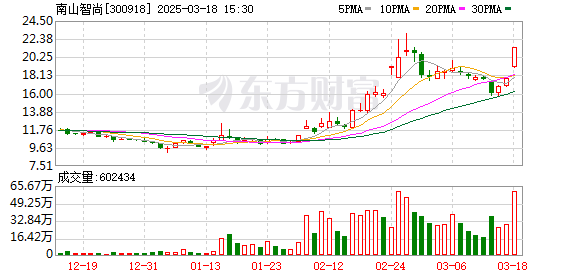
南山智尚3月18日龙虎榜数据
Zheng Quan Shi Bao Wang· 2025-03-18 09:02
Core Viewpoint - Nanshan Zhishang experienced a significant increase in stock price, reaching a daily limit of 20% on March 18, with notable trading activity and institutional buying [2]. Trading Data Summary - The stock had a turnover rate of 14.24% and a total transaction value of 1.206 billion yuan, with a price fluctuation of 12.37% [2]. - Institutional investors net bought 69.2462 million yuan, while brokerage seats collectively net bought 16.6177 million yuan [2]. - The stock was listed on the trading board due to its closing price increase of 20% [2]. Institutional Activity - The top five trading departments accounted for a total transaction value of 327 million yuan, with a buying amount of 206 million yuan and a selling amount of 121 million yuan, resulting in a net buying of 85.8639 million yuan [2]. - Six institutional special seats were involved in trading, with a total buying amount of 155 million yuan and a selling amount of 85.5301 million yuan, leading to a net buying of 69.2462 million yuan [2]. Fund Flow Analysis - The stock saw a net inflow of 94.5141 million yuan from major funds, with a significant inflow of 93.0438 million yuan from large orders and 1.4703 million yuan from smaller orders [2]. - Over the past five days, the net inflow of major funds amounted to 78.8382 million yuan [2]. Analyst Ratings - In the past five days, seven institutions rated the stock as a buy, with the highest target price set at 17.46 yuan by CICC on March 17 [2].

山西证券纺织服装行业周报(20250309-20250315):Puma披露2024年度业绩,预计2025年收入增长低至中单位数-2025-03-18
Shanxi Securities· 2025-03-18 05:13
Investment Rating - The textile and apparel industry maintains a rating of "In line with the market" [1] Core Insights - Puma disclosed its 2024 performance, expecting revenue growth in 2025 to be in the low to mid-single digits [3][7] - In 2024, Puma's sales grew by 4.4% to €8.817 billion, while net profit decreased by 7.6% to €282 million due to increased net financial expenses and minority interests [4][16] - The Americas region saw a growth of 7.0%, Asia-Pacific 3.8%, and EMEA 2.1% [4][16] - Direct-to-consumer (DTC) sales grew by 16.6%, increasing its share from 24.8% in 2023 to 27.5% in 2024 [4][16] - The overall market performance of the textile and apparel sector showed a 3.95% increase this week, outperforming the broader market [19][20] Summary by Sections Industry Performance - The textile and apparel sector's stock index increased by 3.95%, while the light industry manufacturing sector rose by 1.76% [19] - The SW textile manufacturing PE-TTM is at 21.47, which is in the 44.08% percentile over the past three years [23] - The SW apparel and home textiles PE-TTM is at 23.58, in the 73.68% percentile over the past three years [23] Company Performance - Puma's Q4 2024 sales grew by 9.8% to €2.289 billion, with net profit increasing by 2897.6% to €24.5 million [5][17] - The DTC business in Q4 2024 grew by 16.1%, with its share rising from 31.6% in Q4 2023 to 33.4% [5][17] - The top five companies in the textile and apparel sector this week included Mingpai Jewelry (+47.93%) and Diya Co. (+28.5%) [27] Market Data Tracking - In January-February 2025, the export value of textiles and clothing decreased by 2.0% and 6.9%, respectively [36] - The retail sales of clothing in major retail enterprises fell by 7.9% year-on-year [49] - The consumer confidence index in January was 87.5, indicating a weak recovery in the domestic consumption market [12]
轻工制造、纺织服饰行业周报:提振消费新政出台,家居、服饰估值修复可期-2025-03-17
BOHAI SECURITIES· 2025-03-17 11:46
Investment Rating - The report maintains a "Neutral" rating for the light industry manufacturing and textile apparel sectors [4][29] - The report recommends "Increase" ratings for specific companies: Oppein Home, Sophia, Explorer, Semir Apparel, and Guibao Pet [4][29] Core Insights - The introduction of the "Consumption Boosting Special Action Plan" by the government aims to significantly stimulate domestic demand, benefiting sectors such as home furnishings, apparel, and pets [3][28] - From a valuation perspective, as of March 14, 2025, the PE-TTM for the home goods sector is 26.65 times and for the apparel sector is 28.06 times, both significantly lower than their historical averages, indicating potential for valuation recovery [3][28] Industry News - A major paper company in the Middle East has launched the largest paper production line in the region, enhancing its global market position [9] - Gap Inc. reported strong fourth-quarter results with a net income of $206 million, reflecting the success of its transformation strategy [9] Company Announcements - Tianyuan Pet plans to acquire Taotong Technology through a combination of stock issuance and cash payment [21] - Nanshan Zhishang reported a 5.82% decline in net profit year-on-year, attributed to increased interest expenses and weak performance in its fine woolen fabric business [22] Market Review - From March 10 to March 14, the light industry manufacturing sector outperformed the CSI 300 index by 0.18 percentage points, with notable performances in home goods and packaging printing [23] - The textile and apparel sector outperformed the CSI 300 index by 2.36 percentage points during the same period, driven by strong performance in the jewelry segment [25] Weekly Strategy - The report emphasizes the importance of the government's consumption boosting policies and their expected positive impact on the recovery of domestic consumption trends in related sectors [28]