
德赛西威

Search documents
专家谈中国智能车出海:“千载难逢的机会”
第一财经· 2025-12-02 04:58
Core Insights - The article emphasizes that the time difference and generational gap in the automotive intelligence sector between China and overseas markets present a unique opportunity for Chinese automotive companies to expand internationally [3][4]. - The shift from product-based exports to a comprehensive industry chain going global is highlighted as a significant trend, driven by increasing competition in the domestic market [3][4]. Industry Trends - At the 2025 Munich Auto Show, various Chinese automotive intelligence companies showcased their capabilities, indicating a full-chain approach to global expansion [4]. - China's penetration rates in smart cockpits and advanced driver-assistance systems (ADAS) are leading globally, with over 80% and 65% respectively, compared to around 50% in Europe [4]. Market Opportunities - The global autonomous driving market is projected to reach $4.4 billion by 2025 and grow to over $18 billion by 2034, with a compound annual growth rate exceeding 50% [5]. - Chinese companies are accelerating their global strategies, focusing on regions like the Middle East, Southeast Asia, and Europe [5]. Challenges and Strategies - Despite favorable market conditions, the complexities of international expansion in automotive intelligence, including service integration and regulatory challenges, are significant [7]. - Collaboration with local partners is recommended as a strategy to navigate uncertainties and enhance market entry success [7][8]. Local Adaptation - Companies must adapt their products and operations to local market conditions, emphasizing the importance of understanding regional differences in regulations and consumer behavior [8].


专家谈中国智能车出海:“千载难逢的机会”
Di Yi Cai Jing· 2025-12-02 02:52
Core Insights - The article emphasizes the significant opportunity for Chinese automotive companies to expand internationally in the field of smart vehicles, driven by the technological advancements and competitive advantages in the domestic market [1][2][3] Industry Overview - Chinese automotive intelligence has surpassed global standards, with smart cockpit penetration exceeding 80% compared to 50% in Europe, and advanced driver assistance systems (ADAS) penetration over 65%, outperforming Europe and Japan [2] - The cost of key technologies, such as LiDAR, has dramatically decreased from 200,000 yuan in 2017 to the current price in the thousands, indicating a trend towards affordability and scalability in the industry [2] Market Trends - The global market for autonomous driving services is projected to reach $4.4 billion by 2025 and grow to over $18 billion by 2034, with a compound annual growth rate exceeding 50%, highlighting a substantial growth opportunity [2] - 2025 is recognized as a pivotal year for the globalization of Chinese autonomous driving, with companies like RoboTaxi and Momenta actively expanding their international presence [3] Strategic Recommendations - To navigate the complexities of international expansion, collaboration with local partners is essential, as the challenges of smart vehicle deployment include regulatory, cultural, and operational differences [4][5] - Companies are advised to avoid internal competition and focus on building partnerships that enhance their market entry strategies, ensuring they do not disrupt local ecosystems [5]


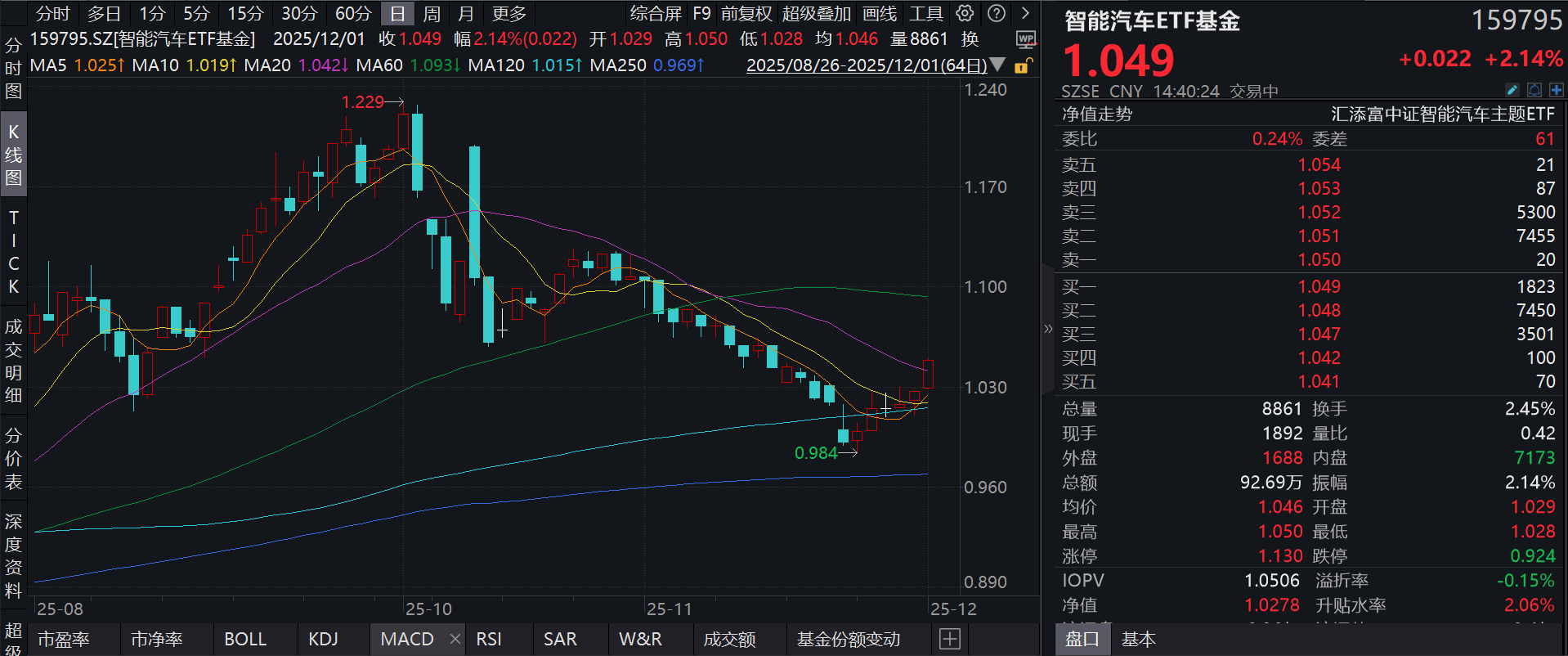
智能车板块走强,广和通20cm涨停,拓普集团涨超4%,智能汽车ETF基金(159795)涨超2%冲击3连涨,中国智能汽车产业链迎来全球化机遇
Sou Hu Cai Jing· 2025-12-01 07:03
Group 1: Market Performance - The China Securities Intelligent Vehicle Theme Index (930721) rose by 2.20% as of December 1, 2025, with component stocks such as Guanghetong (300638) increasing by 20.01% and Beijing Junzheng (300223) by 17.04% [1] - The Intelligent Vehicle ETF Fund (159795) also saw a rise of 2.14%, marking its third consecutive increase, with a latest price of 1.05 yuan [1] - Over the past week, the Intelligent Vehicle ETF Fund has accumulated a rise of 3.63% [1] Group 2: Company Developments - Leap Motor reported a record high delivery of 70,327 units in November, representing a year-on-year growth of over 75%, maintaining a growth trend for nine consecutive months [3] - Xiaomi Group announced the launch of its embodied AI model MiMo-Embodied, which integrates autonomous driving and embodied intelligence, with Xiaomi's vehicle deliveries exceeding 40,000 units in November [3] - Great Wall Motors introduced the VLA auxiliary driving model and previewed a new generation of the auxiliary driving system, CPMaster [3] Group 3: Investment Insights - Ideal Auto plans to invest 12 billion yuan in R&D for 2025, with over 6 billion yuan allocated to AI [4] - According to GF Securities, as overseas automakers lose market share, they are accelerating their smart technology advancements to enhance competitiveness, while Chinese brands are positioned to benefit from global opportunities in the intelligent vehicle supply chain [4] - The integration of intelligent vehicles and robotics is expected to expand the valuation ceiling of the sector, with the Intelligent Vehicle ETF Fund closely tracking the performance of leading companies in intelligent vehicle applications [4] Group 4: Index Composition - As of September 9, 2025, the top ten weighted stocks in the China Securities Intelligent Vehicle Theme Index (930721) include Chipone (688521), Luxshare Precision (002475), and Top Group (601689), collectively accounting for 48.47% of the index [4][5]





信达证券:计算机板块“牛市旗手”属性凸显 基本面与流动性共振
智通财经网· 2025-12-01 03:18
Core Viewpoint - The computer sector has shown a four-phase trend in 2023: initial buildup, peak in February, mid-year adjustment, and breakthrough in September, influenced by the continuation of the 924 market, phenomenon-level catalysts like DeepSeek, and structural improvements in fundamentals [1] Group 1: AI+Coding - The global AI coding tools market is projected to grow from $6.7 billion in 2024 to $25.7 billion by 2030, with a compound annual growth rate (CAGR) of 25.2% from 2024 to 2030 [2] - In China, the AI code generation market is expected to increase from 6.5 billion RMB in 2023 to 33 billion RMB by 2028, with a CAGR of 38.4% [2] - High penetration rates in the internet and gaming industries are attributed to the characteristics of industry development, such as intensive project-based work and rapid iteration [2] Group 2: AI+Office - The AI+office software market in China is forecasted to reach 30.864 billion RMB in 2024 and grow to 191.137 billion RMB by 2028, reflecting a CAGR of 57.75% [3] - The core user base for AI office products is stabilizing, with a trend towards integrated product forms [3] - Quark leads the market with over 80 million visits, followed by major players like Tencent Docs and WPS AI, indicating a concentration of over 80% of top products in the hands of internet companies [3] Group 3: AI+Cybersecurity - Major manufacturers are increasingly utilizing machine learning and natural language processing to enhance security detection efficiency and accuracy, transitioning from traditional to proactive defense strategies [4] - The market for AI-driven security applications in China is expected to reach $1.6 billion by 2028, with a CAGR exceeding 230% [4] Group 4: Intelligent Driving - The VLA architecture is a new technology that translates visual information into understandable logic for vehicle operation, aiming for Level 5 full autonomous driving [5] - Sales of highway NOA (Navigation on Autopilot) are projected to rise from 363,000 units to 2.65 million units from January 2023 to January 2025, with penetration increasing from 8.7% to 35.7% [5] Group 5: Industrial Software - The capital expenditure in downstream industries is declining, with the steel sector showing a stabilization in growth at 0.8% year-on-year [6] - High-end design software, particularly those leveraging physical AI for advanced simulation, is emerging as a breakthrough direction with strong valuation elasticity [6] Group 6: Investment Recommendations - Companies to watch in AI+Coding include Zhuoyi Information; in AI+Office: Kingsoft Office, Foxit Software, Zhiyuan Interconnection, and Fanwei Network; in AI+Finance: Jiufang Investment and Tonghuashun; in AI+Cybersecurity: Deepin Technology and Anheng Information; in intelligent automotive: Horizon Robotics, Desay SV, and Zhongke Chuangda; in industrial software: Zhongkong Technology, Rongzhi Rixin, and Saiyi Information [8]

做人民美好生活“共建者” 建行深圳市分行助经济再添活力
Zhong Guo Ji Jin Bao· 2025-12-01 03:03
Core Viewpoint - The article emphasizes the importance of consumption in driving high-quality economic development and improving people's lives, highlighting the initiatives taken by China Construction Bank (CCB) in Shenzhen to boost consumer spending and support local economic growth [1] Group 1: CCB's Initiatives to Promote Consumption - CCB Shenzhen Branch has implemented five key measures to enhance consumer spending, including promoting installment consumption, strengthening government-bank collaboration for trade-in activities, offering personal consumption loan benefits, implementing interest subsidy policies, and creating consumption scenarios [2][3] - The bank has provided over 5 billion yuan in credit card installment services for residents in Shenzhen from January to October, with nearly 2 billion yuan allocated to the new energy vehicle sector, making it the largest service provider in the region [2] - CCB has partnered with over 5,000 merchants to facilitate trade-in activities, resulting in over 102 million yuan in consumer spending, benefiting residents with tangible financial incentives [2] Group 2: Personal Consumption Loans and Interest Subsidies - CCB has optimized personal consumption loan policies, reducing average loan interest rates by over 30 basis points, and has served over 400,000 loan customers with a total loan support exceeding 30 billion yuan, marking a 21% year-on-year increase [3] - The bank was among the first to launch interest subsidy features for consumption loans, serving over 32,000 customers and facilitating more than 91,600 transactions within two months of the policy's implementation [3] Group 3: Green Consumption and New Consumption Ecosystem - CCB has focused on supporting green consumption, particularly in the new energy vehicle sector, with a comprehensive financing service that covers all major brands, allowing customers to complete the financing process online [4][5] - The bank has also introduced promotional activities for green home appliances, benefiting 14,000 residents and driving over 100 million yuan in green appliance consumption [5] - CCB aims to deepen collaboration with major commercial partners to create a vibrant consumption ecosystem, moving beyond being a mere payment channel to actively participating in marketing and consumer engagement [5]

AI全域赋能,业绩周期与技术周期同步向上
Xinda Securities· 2025-12-01 03:03
Core Insights - The report emphasizes the upward synchronization of performance cycles and technology cycles in the computer industry, driven by AI empowerment and structural improvements in fundamentals [1][2][3] - The computer sector is characterized as a "bull market leader," with a significant resonance between fundamentals and liquidity, reflecting strong market recognition of revenue expansion potential [3][20] - The report forecasts substantial growth in various AI applications, including AI Coding, AI in office software, AI in finance, network security, intelligent driving, and industrial software, indicating a broad market opportunity [3][11][12][13][14][16][17] Group 1: AI Applications - AI Coding is projected to reshape software development paradigms, with a global market value expected to grow from $6.7 billion in 2024 to $25.7 billion by 2030, reflecting a compound annual growth rate (CAGR) of 25.2% [3][11][12] - The Chinese AI code generation market is anticipated to expand from 6.5 billion RMB in 2023 to 33 billion RMB by 2028, with a CAGR of 38.4% [3][12] - AI in office software is expected to reach a market size of 30.86 billion RMB in 2024, growing to 191.14 billion RMB by 2028, with a CAGR of 57.75% [3][12] - The network security market is projected to grow to $1.6 billion by 2028, with a CAGR exceeding 230%, driven by the integration of AI technologies [3][14] - Intelligent driving technologies are evolving towards L3 commercial applications, with significant growth in high-speed NOA penetration from 8.7% to 35.7% between 2023 and 2025 [3][16] Group 2: Investment Recommendations - The report suggests focusing on companies involved in AI Coding, such as Zhuoyi Information, and those in AI office software like Kingsoft Office and Foxit Software [3][11][12] - In the AI finance sector, companies like Tonghuashun and Jiufang Zhitu are highlighted for their innovative applications [3][13] - For network security, firms such as Deepin and Anheng Information are recommended due to their advancements in AI-driven security solutions [3][14] - In the intelligent driving space, companies like Desay SV and Zhongke Chuangda are noted for their leadership in high-performance driving solutions [3][16] - Industrial software firms like Zhongkong Technology and Rongzhi Rixin are recognized for their contributions to AI-driven industrial transformations [3][17]


研判2025!中国音圈电机行业分类、产业链及市场规模分析:制造业智能化升级推动应用场景持续深化,行业迎来广阔增长空间[图]
Chan Ye Xin Xi Wang· 2025-11-30 01:09
Core Insights - The voice coil motor (VCM) market in China is projected to reach approximately 2.231 billion yuan in 2024, reflecting a year-on-year growth of 9.52% driven by the increasing demand in various sectors such as smartphones, industrial automation, and medical devices [1][9][10]. Industry Overview - VCM operates based on the Lorentz force principle, converting electrical energy directly into linear mechanical energy without the need for gears or screws, making it suitable for high-precision positioning and rapid linear motion [2][4]. - The VCM technology encompasses three main types: linear, swing, and multi-axis, each designed for specific applications ranging from autofocus in cameras to complex movements in semiconductor equipment [4][5]. Industry Supply Chain - The upstream supply chain includes raw materials such as magnetic materials, coil materials, and electronic components, while the midstream focuses on the manufacturing of VCMs, and the downstream applications span consumer electronics, automotive electronics, and medical devices [6]. Key Components - The core components of VCM include the permanent magnet assembly, the moving coil, and the guiding mechanism, which collectively ensure rapid response and precise control [7][8]. Market Dynamics - The demand for VCMs in smartphones is expected to remain stable, with the number of VCMs per device increasing from 2-3 to 5-8 due to the trend of multi-camera setups and higher pixel counts [9]. - The penetration of high-end smartphone models is driving the increase in VCM prices and profit margins [9]. Key Companies - Shenzhen Xinyi Chang focuses on semiconductor equipment and has achieved over 90% yield in its VCM applications, while Jiangsu Leili specializes in medical and automotive applications, with its VCMs being used in ventilators and laser radars [10][11]. Industry Trends 1. The application of new materials, such as high-temperature superconducting coils and neodymium iron nitrogen magnets, is reshaping performance boundaries and cost structures, particularly in high-demand sectors like automotive and medical [12]. 2. The integration of AI algorithms and edge computing is transitioning VCMs from passive execution to autonomous decision-making, leading to new business models that combine hardware and software services [13]. 3. The trend towards multi-dimensional integration is transforming VCMs from standard components to comprehensive system solutions, enhancing product value and profit margins [14][15].



计算机行业周报:AI Infra:重点关注数据层软件及MaaS-20251129
Shenwan Hongyuan Securities· 2025-11-29 15:20
Investment Rating - The report rates the industry as "Overweight," indicating a positive outlook for the sector's performance compared to the overall market [61]. Core Insights - The report emphasizes the importance of AI Infrastructure (AI Infra) as a foundational system for AI workloads, which includes computing power, storage, and networking [5][11]. - The AI Infra market in China is projected to grow significantly, reaching CNY 3.45 billion in 2024 and CNY 6.73 billion in 2025, representing a year-on-year growth of 95.1% [7][10]. - Key players in the AI Infra space include both domestic and international companies, with a focus on data layer software and models [4][36]. Summary by Sections AI Infra Overview - AI Infra is defined as the hardware and software systems designed to support AI workloads, aiming for efficient and large-scale AI model training and inference [5][11]. - The infrastructure consists of several layers, including computing, storage, and networking, with a focus on optimizing AI model performance [8][11]. Market Growth and Trends - The AI Infra market is expected to see rapid growth, with a significant increase in the number of AI applications anticipated in 2024 [29][32]. - The demand for private deployment and data integration solutions is rising, particularly in sectors with stringent data security requirements [29][36]. Key Players and Technologies - Major players in the AI Infra market include Alibaba Cloud, Huawei Cloud, and various startups focusing on Machine as a Service (MaaS) [12][13]. - Technologies such as virtualization and containerization are central to the computing management layer, enhancing resource utilization and efficiency [12][22]. Investment Opportunities - The report identifies several investment targets across different categories, including AIGC applications, digital economy leaders, and data infrastructure [52][53]. - Companies like Snowflake and MongoDB are highlighted as international benchmarks for data layer software, with strong revenue growth trends [36][38]. Future Outlook - AI infrastructure providers are expected to maintain high growth potential due to their critical role in supporting AI applications and the increasing integration of AI into traditional industries [51].



金融工程日报:沪指窄幅震荡上行,两市成交额创近4个月以来新低-20251129
Guoxin Securities· 2025-11-29 08:04
- The report does not contain any specific quantitative models or factors for analysis[1][2][3] - The report primarily focuses on market performance, sector analysis, concept themes, market sentiment, and institutional activities without detailing quantitative models or factors[4][5][6] - No quantitative model construction, factor development, or backtesting results are provided in the report[7][8][9]
车联天下冲刺港股:营收暴增523%背后 客户集中度99.5%与24.97亿流动负债隐忧
Xin Lang Cai Jing· 2025-11-29 03:30
Core Viewpoint - The company, as a leading player in the smart cockpit domain controller sector, is experiencing explosive revenue growth but faces significant structural risks due to high customer and supplier concentration, ongoing losses, and a precarious financial situation [11]. Business and Business Model - The company focuses on providing vehicle computing solutions based on Qualcomm chip platforms, holding an 8% market share in China's smart cockpit domain controller industry, ranking second [1]. - The business model is highly concentrated, with 100% of revenue in 2024 coming from vehicle computing solutions, and no significant revenue from regional controllers [1]. Financial Data Overview - Revenue surged from 369 million yuan in 2022 to 2.298 billion yuan in 2023, a year-on-year increase of 523.3%, but growth is expected to slow to 15.6% in 2024 and decline by 0.7% in the first half of 2025 [2]. - Gross margin improved from 9.5% in 2022 to 17.5% in 2023 but is projected to drop to 16.2% in 2024, significantly below the industry average of 22.8% [3]. Debt and Liquidity - The company's net current liabilities surged by 397% to 2.497 billion yuan by June 2025, indicating a severe liquidity crisis with a current ratio of only 0.42 [4]. - Operating cash flow has been negative, with a net outflow of 1.011 billion yuan in 2024, and cash reserves are critically low at 150 million yuan [4]. Customer and Supplier Concentration - Customer concentration is extremely high, with the top five customers accounting for 99.5% of revenue in 2023, and the largest customer contributing 59.0% [5]. - Supplier concentration is also a concern, with 89% of purchases coming from the top five suppliers, and Bosch alone accounting for 80.3% of procurement in 2024 [6]. Governance and Equity Structure - The company is controlled by a single major shareholder group holding 30.76% of the equity, raising concerns about governance stability and decision-making processes [7]. - There is a lack of equity incentive plans for key executives, which may affect team stability and performance [7]. Risks and Challenges - The company faces significant risks related to technological iteration and compliance, with existing products potentially becoming obsolete due to evolving automotive E/E architectures [8]. - Compliance issues have arisen from improper social insurance payments for employees and unregistered leasing of production facilities, posing legal risks [9]. - The competitive landscape is intensifying, with over 50 participants in the smart cockpit domain controller market, leading to price wars that could further squeeze profit margins [10].