
长安汽车

Search documents
2026车企目标大“PK”
Guo Ji Jin Rong Bao· 2026-01-29 12:48
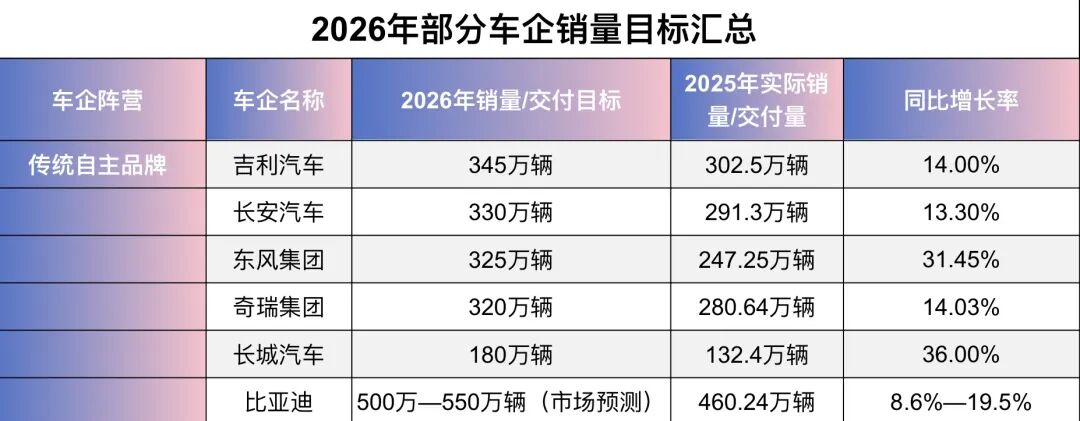
Core Insights - The Chinese automotive industry has shown impressive growth, with production and sales reaching 34.53 million and 34.40 million units respectively in 2025, marking a year-on-year increase of 10.4% and 9.4% [1] - New energy vehicle (NEV) sales reached 16.49 million units, achieving a penetration rate of 47.9% [1] - Major automakers have set ambitious sales targets for 2026, amidst challenges from policy changes, technological advancements, and global competition [1] Company Targets - Geely aims for a sales target of 3.45 million units in 2026, up 14% from 2025's 3.025 million units, with 64.3% of sales coming from NEVs [4] - Changan targets 3.3 million units, with NEV sales projected at 1.4 million units, reflecting a 26.2% increase [5] - Dongfeng Group's target is 3.25 million units, a 31.45% increase from 2025, with NEVs making up 52% of sales [6] - Great Wall Motors aims for 1.8 million units, a 36% increase, focusing on NEV and export markets [6] - BYD's projected sales for 2026 are between 5 million and 5.5 million units, with a growth rate of 8.5% to 19.5% [6] New Entrants and Growth - New entrants like Leap Motor and Hongmeng Zhixing are targeting sales of 1 million units, with significant growth rates of over 67% [7][9] - Leap Motor's sales target is 1 million units, up from 596,600 units in 2025 [9] - Hongmeng Zhixing is expected to reach between 1 million and 1.3 million units, with a growth rate of 70% to 120% [11] Industry Trends - The penetration rate of NEVs is expected to exceed 60% in 2026, driven by policy support and technological advancements [12] - The export model is shifting from "complete vehicle export" to "localized production and full industry chain layout," with significant growth in NEV exports [13] - The competitive landscape is transitioning from price wars to value-driven strategies, with a focus on technological innovation [15] - Market concentration is increasing, with leading brands capturing a larger market share, while weaker brands are likely to exit the market [15] Challenges and Uncertainties - The market faces uncertainties due to policy changes, such as the reduction of NEV purchase tax, which may affect consumer purchasing behavior [16] - Economic recovery is slower than expected, impacting consumer spending and demand for traditional vehicles [17] - Trade barriers and compliance risks are increasing for Chinese automakers expanding overseas, necessitating a balance between global operations and local compliance [17] Conclusion - The Chinese automotive market in 2026 is poised for significant transformation, emphasizing the shift towards NEVs and smart technologies, while navigating various uncertainties and competitive pressures [19]


智能网联汽车场景对接会举办,多项产学研合作项目落地顺义
Bei Jing Ri Bao Ke Hu Duan· 2026-01-29 12:38
Core Insights - The event "Towards New Directions" focused on empowering new productive forces in the intelligent connected vehicle sector, aiming to create a supply-demand matching platform and accelerate the transformation of innovative achievements [1] Group 1: Industry Trends and Innovations - Industry experts shared insights on technological innovation and industrial development, with presentations from key figures such as Feng Shuo from BAIC and Professor Lu Qi from Tsinghua University [3] - The event marked significant progress in collaborative innovation with the signing of two major cooperation agreements on key automotive materials and digital twin technologies [3] Group 2: Collaborative Projects - A partnership between Xianggu Wisdom (Beijing) Technology Co., Ltd. and Tsinghua University was announced to establish a national center for fragrance science and technology innovation, promoting high-quality development in the olfactory economy [5] Group 3: Project Matching and Demonstrations - The event featured precise matching of new technologies with application scenarios through three main categories: technology demand projects, capability projects, and demonstration projects [7] - BAIC and Changan Automobile jointly announced four technology demands, including intelligent chassis control and next-generation vehicle range extender systems [7] - Several companies showcased their capabilities and demonstration projects, sharing experiences in building innovative scenarios [7] Group 4: Continuous Empowerment and Ecosystem Development - The Deputy Director of the Shunyi District Science and Technology Committee emphasized the district's commitment to becoming a global hub for intelligent connected vehicles, leveraging its industrial foundation and innovation resources [7] - The event organizers indicated that services will continue online, with the Beijing-Tianjin-Hebei Intelligent Connected Vehicle Innovation Center facilitating the transformation of technological achievements in the region [9]


开特股份(920978):执行器业务快速增长,积极布局新赛道
Dongguan Securities· 2026-01-29 09:36
Investment Rating - The report maintains a "Buy" rating for the company, indicating an expectation that the stock will outperform the market index by more than 15% in the next six months [3][64]. Core Insights - The company is experiencing rapid growth in its actuator business and is actively expanding into new markets, particularly in the six-dimensional force sensor sector. The demand for its main actuator and sensor products is expected to remain strong, leading to anticipated revenue growth [3][59]. Summary by Sections Company Overview - The company, Hubei Kait Electronics, was established in 1996 and initially focused on automotive temperature sensors. It has since expanded its product range to include controllers, actuators, and power modules. The company went public on the Beijing Stock Exchange in September 2023, raising 133 million yuan [11][14]. Recent Performance - In 2024, the company reported revenue of 826 million yuan, a year-on-year increase of 26.50%. The compound annual growth rate (CAGR) from 2020 to 2024 was 31.29%. The net profit attributable to shareholders for 2024 was 138 million yuan, up 21.24% year-on-year [33][34]. Product Growth - Sales revenue from actuator products increased from 67 million yuan in 2020 to 327 million yuan in 2024, significantly increasing its share of total revenue from 24.03% in 2020 to 44.91% in the first half of 2025. Sensor product sales also grew from 128 million yuan in 2020 to 295 million yuan in 2024 [34][39]. Automotive Market Trends - Global automotive sales have been recovering since 2021, with total sales increasing from 83.64 million units in 2021 to 95.31 million units in 2024. China has become the largest automotive market, accounting for 32.98% of global production in 2024 [4][48]. Future Projections - The company is projected to achieve net profits of 184 million yuan, 234 million yuan, and 310 million yuan for the years 2025, 2026, and 2027, respectively, with corresponding price-to-earnings (PE) ratios of 31, 24, and 18 [3][63].
“向新而行”智能网联汽车领域场景对接会在京举办
Xin Lang Cai Jing· 2026-01-29 09:27
来源:环球网 2026年1月28日下午,"向新而行"场景赋能新质生产力系列活动——智能网联新能源汽车领域场景发布 及供需对接会在北京市顺义区环普国际科创园举办。该活动作为中关村论坛系列活动,旨在支持关键核 心技术、底层技术、新技术新产品验证应用与迭代创新,推动科技应用场景开放,搭建供需对接平台, 推进智能网联新能源汽车技术与多元应用场景深度融合,加速实现创新成果转化落地。 同时,香谷智慧(北京)科技有限公司与清华大学联合发布规划,双方将共建国家香料香精科学与技术 创新中心,搭建开放协同的关键技术攻关平台和产业协同创新平台,共同推动嗅觉经济产业发展。 活动聚焦智能网联汽车领域新技术与应用场景的精准对接。通过"科技新场景需求项目""科技新场景能 力项目"和"科技新场景示范项目"三大板块,为供需双方提供了"面对面"交流平台,有效促进了创新链 与产业链的深度融合,让场景成为驱动产业发展的核心引擎。 活动现场,北京汽车研究总院有限公司、重庆长安汽车股份有限公司发布了"多域融合的智能底盘控制 技术""下一代高集成高性能车用增程器系统"及"基于多模态交互技术的智能座舱""基于多模态健康感知 大模型的智能健康座舱"四项场景需 ...
菜鸟入股九识智能 无人车市场“大变天”?
Xin Lang Cai Jing· 2026-01-29 09:08
Core Insights - The unmanned logistics vehicle industry is entering a critical phase where ecological integration is becoming the new core competitive point, replacing the previous focus on single technology competition [1] Company Developments - Jushi Intelligent and Cainiao have announced a deep strategic integration in the unmanned vehicle business, with Cainiao becoming a shareholder of Jushi through cash investment and business injection [1][2] - Jushi will receive the "Cainiao Unmanned Vehicle" brand authorization and will operate under a dual-brand model, while Cainiao will focus on enhancing the application of unmanned vehicles in logistics without producing or directly selling unmanned vehicles [1][2] - The management and technical leaders from Cainiao Unmanned Vehicles will join Jushi to participate in future strategic planning and operational management [1] Market Positioning - Jushi Intelligent will focus on developing fully self-researched autonomous driving technology and providing comprehensive smart transportation solutions, while Cainiao Unmanned Vehicles will concentrate on deep service in specific logistics scenarios [2] - The combined unmanned vehicle fleet of Jushi and Cainiao will exceed 20,000 units, making it the largest RoboVan fleet in the country [2] - Jushi has deployed unmanned vehicles in over 300 cities, while Cainiao operates in over 200 cities for safety operations and support [2] Industry Trends - The unmanned logistics vehicle industry is experiencing rapid development driven by policy, technology, and market resonance, with a clear differentiation in market competition emerging [3] - By 2025, the global unmanned logistics vehicle market is expected to exceed 35,000 units in delivery volume, with China contributing significantly to this growth [3] - Major players in the industry include Jushi Intelligent and New Stone, both delivering over 10,000 units, while Cainiao and White Rhino have delivered over 4,000 and 2,000 units, respectively [3] Financial Considerations - Despite the industry's high growth, profitability remains a common challenge, with RoboVan offering a cost-effective solution compared to traditional delivery models [4] - RoboVan's operational advantages, such as city-based operations and mature technology, allow for a significant reduction in costs, potentially helping to expand the user base and achieve profitability [4] - The market for RoboVan is expected to grow significantly, with micro vans in China being a core replacement market, and unmanned devices projected to account for 20% of urban logistics equipment shipments by 2030 [4]
乘用车板块1月29日涨0.12%,上汽集团领涨,主力资金净流出7.09亿元
Zheng Xing Xing Ye Ri Bao· 2026-01-29 09:03
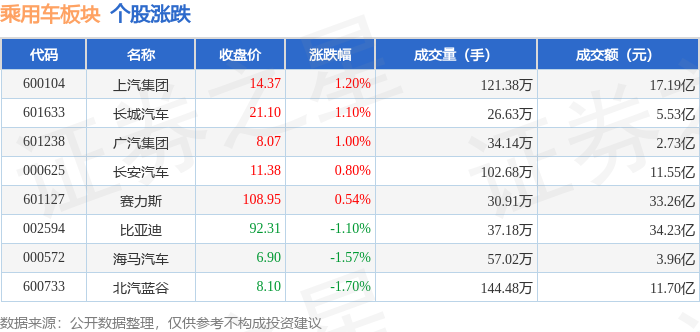
Group 1 - The passenger car sector increased by 0.12% on January 29, with SAIC Motor leading the gains [1] - The Shanghai Composite Index closed at 4157.98, up 0.16%, while the Shenzhen Component Index closed at 14300.08, down 0.3% [1] - Key stocks in the passenger car sector showed varied performance, with SAIC Motor closing at 14.37, up 1.20%, and BYD closing at 92.31, down 1.10% [1] Group 2 - The net outflow of main funds in the passenger car sector was 709 million yuan, while retail investors saw a net inflow of 501 million yuan [1] - Detailed fund flow data indicates that major stocks like GAC Group and Great Wall Motors experienced significant net outflows from main funds [2] - Retail investors showed positive net inflows in several stocks, including GAC Group and Haima Automobile, despite overall sector outflows [2]





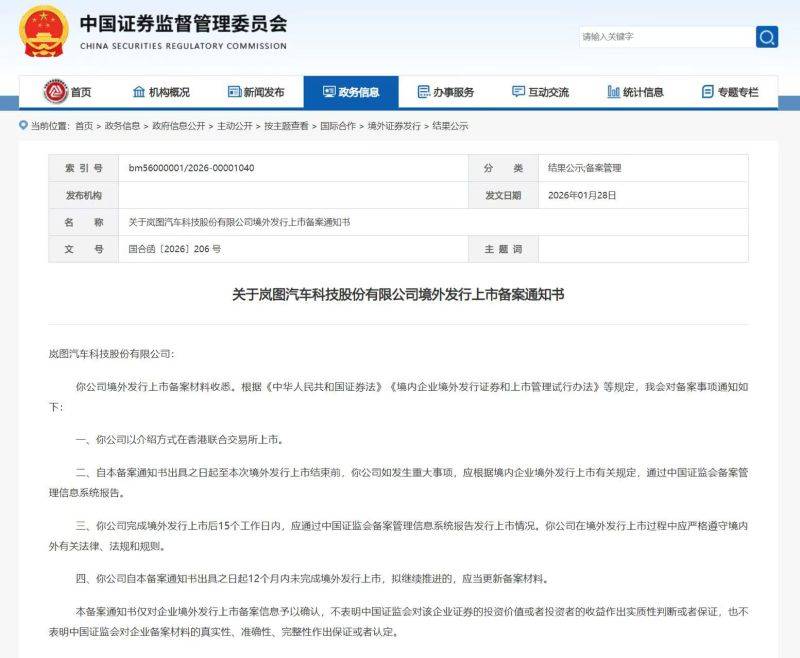
半年完成核心流程,岚图获港股上市“通行证”
Sou Hu Cai Jing· 2026-01-29 08:10
Core Viewpoint - Lantu is making a strong push into the high-end new energy vehicle market with a dual strategy of "capital foundation building + product showcasing" [1] Group 1: Listing Process - Lantu has received the overseas listing approval from the China Securities Regulatory Commission (CSRC) for its introduction listing on the Hong Kong Stock Exchange [1] - The listing process has been efficient, with key steps completed in under six months, including the restructuring into a joint-stock company and obtaining necessary approvals from various government bodies [1][2] Group 2: Listing Methodology - The introduction listing method does not involve new share issuance, avoiding dilution of equity and aligning with Lantu's current shareholder structure [2] - This approach supports Dongfeng Group's capital strategy, optimizing resource allocation and reshaping valuation logic [2] Group 3: Product Planning - Lantu announced its product plan for 2026, which includes four new models: the Lantu Taishan Ultra (China's first mass-produced L3-level SUV), the five-seat SUV Lantu Taishan X8, a new FUV (code-named "FE"), and an MPV (code-named "Zhu Feng") [2] - The product lineup aims to cover various segments, including SUVs, MPVs, and FUVs, addressing market gaps and reinforcing existing advantages [4] Group 4: Technological Strategy - Lantu's advancement relies on a "self-research + collaboration" technology strategy, with 2,692 patents showcasing its R&D capabilities [5] - Collaboration with Huawei enhances Lantu's access to advanced driving and cabin technologies, creating a synergistic effect [5] Group 5: Global Expansion - Lantu has exported products to over 40 countries and is actively penetrating the European market, achieving compliance with stringent EU certifications [5] - The upcoming listing on the Hong Kong Stock Exchange is expected to enhance Lantu's international brand influence, positioning it favorably in the global high-end new energy market [5] Group 6: Market Challenges - The challenge for Lantu will be to continuously realize value in the Hong Kong market and convert its new product matrix into tangible market share [7] - The company is recognized for its combination of systemic advantages and technological vitality, aiming to reshape the competitive landscape of the high-end new energy market [7]
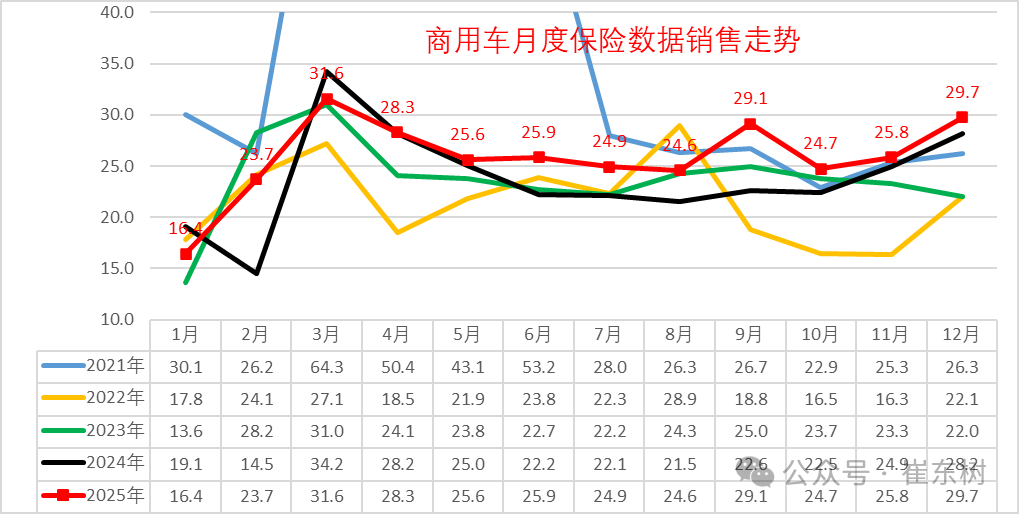
崔东树:2025年国内商用车交强险数据强势增长 12月商用车国内销量同比增5%
智通财经网· 2026-01-29 07:46
Core Insights - The commercial vehicle market in China is expected to see significant growth in 2025, driven by the strong performance of new energy vehicles (NEVs) and supportive policies for vehicle upgrades [1][7][12] - In December 2025, the sales of commercial vehicles reached 300,000 units, marking a 5% year-on-year increase and a 15% month-on-month increase [7][12] - The penetration rate of new energy commercial vehicles is projected to reach 46% by December 2025, a substantial increase from 29% in December 2024 [12][14] Commercial Vehicle Market Analysis - The total sales of commercial vehicles in China for 2025 are forecasted to be 3.1 million units, representing a 9% year-on-year growth compared to the stable period since 2022 [1][7] - The market showed a strong upward trend from March to December 2025, with December achieving a historical high for the month [5][7] - The sales of new energy commercial vehicles in December 2025 are expected to hit 140,000 units, reflecting a 71% year-on-year increase and a 49% month-on-month increase [1][8] New Energy Vehicle Performance - The penetration rate of new energy commercial vehicles has increased significantly, from approximately 3% in 2019-2021 to 46% in December 2025 [12][14] - The sales of new energy commercial vehicles for the entire year of 2025 are projected to reach 910,000 units, a 57% increase compared to the previous year [1][8] - The growth in new energy vehicle sales is attributed to strong demand and government incentives, particularly in the commercial vehicle sector [10][12] Market Structure and Competition - The market for commercial vehicles is characterized by a stable structure, with significant contributions from light and heavy-duty trucks [14][18] - Key players in the commercial vehicle market include Beiqi Foton, SAIC-GM-Wuling, and China National Heavy Duty Truck Group, which dominate the light truck, heavy truck, and bus segments respectively [15][18] - The performance of heavy-duty trucks has improved significantly due to subsidy policies, with notable growth in electric heavy-duty trucks in regions like Beijing, Tianjin, and Shanghai [16][17] Regional Market Dynamics - The light truck market is particularly strong in regions such as East China and South China, with increasing sales in these areas [18][19] - The penetration of new energy vehicles in the truck segment reached 38% in December 2025, while the bus segment saw a penetration rate of 78% [14][18] - The market for new energy light trucks is primarily concentrated in East China and South China, with significant growth observed in these regions [19][21]


2025年信贷资产证券化市场年度报告:发行放量企稳回升,格局重塑持续进行
Da Gong Guo Ji· 2026-01-29 07:02
Report Industry Investment Rating - Not provided in the content Core Viewpoints of the Report - In 2025, the issuance of credit ABS showed a stable recovery trend, featuring "small but numerous" characteristics. The non-performing loan ABS had a high growth rate and became the main growth engine. The concentration of the top ten sponsoring institutions decreased, and the average issuance interest rate declined year-on-year [2][4]. - In 2026, under the policy guidance of preventing and resolving financial risks, non-performing loan ABS is expected to continue to be the core engine for the expansion of the credit ABS market, and the continuous improvement of the regulatory framework will enhance market standardization and attract diversified investors [3][33]. - In the context of the increasing penetration rate of new energy vehicles, green auto loan ABS is expected to become an important growth point in the market, but attention should be paid to potential asset quality risks [34]. - With the maturity of AI technology, its application in the risk identification and management of the credit ABS market will deepen, which is expected to improve asset pricing accuracy and management efficiency [35]. Summary by Relevant Catalogs Issuance Overview - In 2025, a total of 238 credit ABS products were issued, with a total issuance scale of RMB 291.522 billion, a year-on-year increase of 7.82%. The average issuance scale per product was RMB 1225 million, a year-on-year decrease of 13.02%. The issuance scale accounted for 12.80% of the asset securitization market, a slight year-on-year decrease [4]. - The non-performing loan ABS issued 178 products, with a scale of RMB 82.057 billion, a year-on-year increase of 61.31%. The personal auto loan ABS had the same number of issuances as in 2024, with a scale of RMB 118.543 billion, accounting for 40.66% of the total. The issuance of micro-enterprise loan ABS declined, with 10 products issued and a scale of RMB 58.645 billion. The credit card installment loan ABS issued 2 products, with a scale of RMB 939 million. The bank/internet consumer loan ABS had a slightly lower number of issuances, but the scale reached RMB 31.338 billion, a year-on-year increase of 28.84% [5]. - There were 47 sponsoring institutions in the credit ABS market in 2025, mainly including auto finance companies and commercial banks. The top ten sponsoring institutions had a combined issuance scale accounting for 57.65%, with a decreased concentration [8][9]. - The average issuance interest rate of credit ABS was 2.13% in 2025, lower than that in 2024, and the average spread with the 3-year maturity yield of ChinaBond Medium and Short - term Notes was 23 BPs, showing a certain dispersion in the overall interest rate distribution [14]. Asset Classification Personal Auto Loan ABS - In 2025, the issuance scale was RMB 118.543 billion, accounting for 40.66% of the total credit ABS issuance, ranking first. The top ten manufacturers' issuance volume accounted for 86.21%, with a high concentration. The AAAsf - rated securities' coupon rate ranged from 1.60% to 1.96%, with a weighted average of 1.75%, a year-on-year decrease of 0.24 percentage points [17][19]. Non - performing Loan ABS - The issuance scale in 2025 was RMB 82.057 billion, a year-on-year increase of 61.32%, accounting for 28.15% of the total. Twenty banks participated in the issuance, mainly state - owned large commercial banks and national joint - stock banks. The top five banks' issuance scale accounted for 58.32%. The main underlying assets were personal housing mortgage non - performing loans and micro - enterprise non - performing loans. The AAAsf - rated securities' coupon rate ranged from 1.90% to 3.20%, with a weighted average of 2.32%, a year-on-year decrease of 0.09 percentage points [20][22][23]. Micro - enterprise ABS - The issuance scale in 2025 was RMB 58.645 billion, accounting for 20.12% of the total. China Construction Bank Corporation's issuance scale accounted for 84.60% of the total credit ABS issuance. The AAAsf - rated securities' coupon rate ranged from 1.58% to 1.96%, with a weighted average of 1.63%, a year-on-year decrease of 0.41 percentage points [24][25][28]. Personal Consumer Loan and Credit Card Installment Loan ABS - The personal consumer loan ABS issuance scale in 2025 was RMB 31.338 billion, accounting for 10.75% of the total. The top five sponsoring institutions' combined issuance scale accounted for 86.15%. The AAAsf - rated securities' coupon rate ranged from 1.70% to 2.05%, with a weighted average of 1.85%, a year-on-year decrease of 0.31 percentage points. The credit card installment loan ABS issued 2 products, with a total scale of RMB 939 million, accounting for 0.32% of the total, and the coupon rate of both products was 1.85% [29][30][32]. Outlook - In 2026, non - performing loan ABS is expected to continue to drive the expansion of the credit ABS market, and the regulatory framework will be further improved to attract more diversified investors [33]. - Green auto loan ABS may become an important growth point, but attention should be paid to the potential impact on asset quality from the changes in auto finance companies' operating strategies and credit access standards [34]. - The application of AI technology in the credit ABS market will deepen, which is expected to improve asset pricing accuracy and management efficiency, but attention should be paid to "model risk" [35].
国新证券每日晨报-20260129
Guoxin Securities Co., Ltd· 2026-01-29 03:25
Domestic Market Overview - The domestic market experienced a steady rise, with the Shanghai Composite Index closing at 4151.24 points, up 0.27%, and the Shenzhen Component Index at 14342.89 points, up 0.09% [1][4] - Among the 30 sectors, 11 saw gains, with non-ferrous metals, coal, and oil & petrochemicals leading the increases, while defense, media, and pharmaceuticals faced significant declines [1][4] - The total trading volume for the A-share market reached 29,923 billion yuan, showing a slight increase from the previous day [1][4] Overseas Market Overview - In the U.S. market, the three major indices closed mixed, with the Dow Jones Industrial Average up 0.02%, the S&P 500 down 0.01%, and the Nasdaq up 0.17% [2][4] - Large tech stocks showed varied performance, while the Nasdaq Golden Dragon China Index increased by 0.32% [2][4] Economic Performance Insights - By 2025, 18 provinces in China are expected to exceed the national GDP growth rate, highlighting the significant role of major economic provinces [3][10] - The State-owned Assets Supervision and Administration Commission (SASAC) announced that central enterprises aim to achieve a total profit of 2.5 trillion yuan and pay 2.5 trillion yuan in taxes by 2025 [3][14] Key Industry Developments - The central enterprises are projected to have total assets exceeding 95 trillion yuan by the end of 2025, with a fixed asset investment of 5.1 trillion yuan [14] - The focus on strategic emerging industries is evident, with an investment of 2.5 trillion yuan planned, accounting for 41.8% of total investments [15][14] Taxation and Regulatory Changes - The tax department plans to deepen tax system reforms in 2026, optimizing the tax structure and expanding local tax sources to enhance local financial autonomy [17][21] - Real estate companies have reported that they are no longer required to submit the "three red lines" indicators monthly, although some still need to report financial metrics like asset-liability ratios [17][21]