
来伊份

Search documents
百年粤沪情,潮起广东味:上海人为何钟爱粤菜?
Nan Fang Nong Cun Bao· 2026-01-21 10:36
Core Viewpoint - The article discusses the deep-rooted cultural and culinary connections between Guangdong and Shanghai, highlighting the popularity of Cantonese cuisine in Shanghai and its historical significance in the region's dining culture [1][5][72]. Group 1: Historical Context - The culinary relationship between Guangdong and Shanghai dates back to the late Qing Dynasty, with Cantonese merchants establishing a presence in Shanghai, bringing various goods and culinary traditions [15][19]. - The first Cantonese restaurant in Shanghai, Xinghualou, was established in 1851 and remains a prominent establishment today [21]. - By the late Qing and early Republican periods, Cantonese cuisine gained significant popularity in Shanghai, becoming a dominant force in the local dining scene [25][30]. Group 2: Cultural Exchange - The article emphasizes that the flow of food is a reflection of cultural symbiosis, with both regions sharing a maritime civilization that values trade and cultural exchange [8][72]. - Cantonese cuisine has become an integral part of Shanghai's urban culture, transcending mere food to symbolize identity and community for both Guangdong and Shanghai residents [86]. Group 3: Contemporary Developments - The upcoming "Guangdong Year Dish Festival" in Shanghai aims to promote Guangdong's culinary offerings, showcasing the importance of food in cultural dialogue and economic collaboration between the two regions [11][99]. - The festival is part of a broader initiative to enhance cooperation in various sectors, including agriculture, logistics, and brand marketing, driven by the cultural significance of the dishes [108][110]. Group 4: Culinary Trends - Cantonese cuisine continues to thrive in Shanghai, with a notable presence in Michelin-starred restaurants, indicating its ongoing appeal and influence in the city's dining landscape [47][49]. - The introduction of live seafood tanks and innovative dining experiences by Cantonese restaurants has reshaped Shanghai's culinary expectations, aligning with the city's dynamic food culture [81][84].


休闲食品板块1月21日跌0.89%,南侨食品领跌,主力资金净流出5687.91万元
Zheng Xing Xing Ye Ri Bao· 2026-01-21 08:53
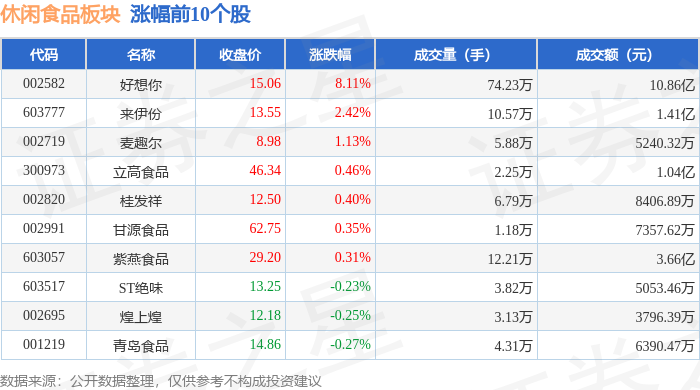
Market Overview - The leisure food sector experienced a decline of 0.89% on January 21, with Nanjiao Food leading the drop [1] - The Shanghai Composite Index closed at 4116.94, up 0.08%, while the Shenzhen Component Index closed at 14255.12, up 0.7% [1] Individual Stock Performance - The top-performing stock was "Good Idea" (好想你), closing at 15.06 with an increase of 8.11%, and a trading volume of 742,300 shares, amounting to 1.086 billion yuan [1] - Other notable gainers included "Lai Yifen" (来伊份) at 13.55, up 2.42%, and "Maiqu'er" (麦趣尔) at 8.98, up 1.13% [1] - Conversely, "Nanjiao Food" (南侨食品) saw a significant decline of 6.74%, closing at 18.53, with a trading volume of 63,400 shares and a turnover of 119 million yuan [2] Capital Flow Analysis - The leisure food sector experienced a net outflow of 56.8791 million yuan from institutional investors, while retail investors saw a net inflow of 40.5084 million yuan [2] - The data indicates that retail investors are showing interest in the sector despite the overall decline in stock prices [2] Detailed Stock Capital Flow - "Good Idea" (好想你) had a net inflow of 81.5449 million yuan from institutional investors, but a net outflow of 78.1028 million yuan from retail investors [3] - "Lai Yifen" (来伊份) had a net inflow of 8.1109 million yuan from institutional investors, with a net outflow of 1.32056 million yuan from retail investors [3] - "Nanjiao Food" (南侨食品) had a net outflow of 34.421 million yuan from retail investors, indicating a lack of confidence among smaller investors [3]

鸣鸣很忙今起招股;来伊份年度预亏1.7亿;君乐宝冲刺港股
Sou Hu Cai Jing· 2026-01-20 16:32
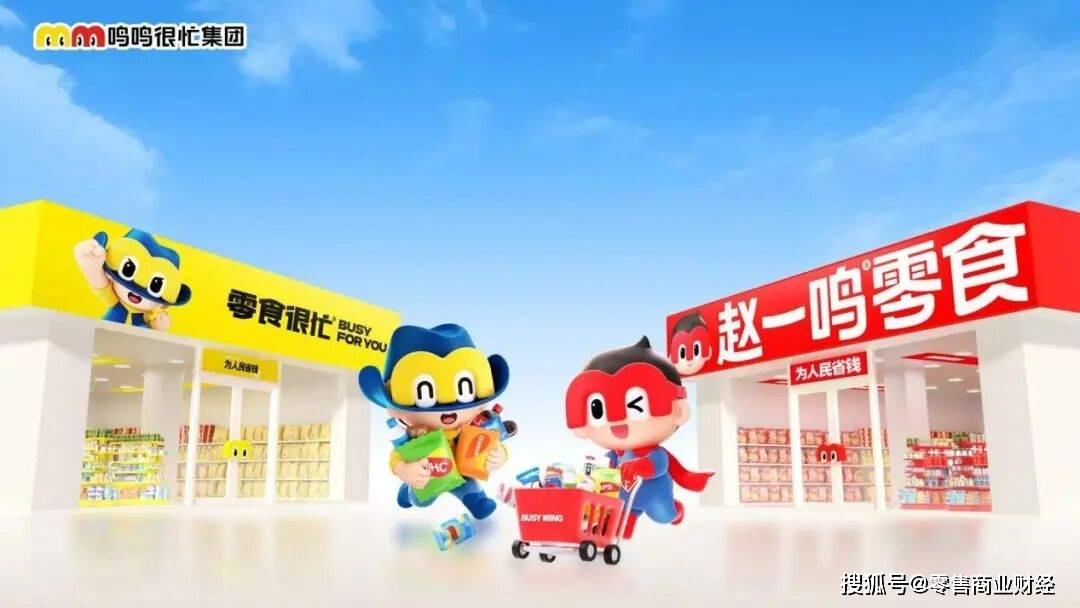
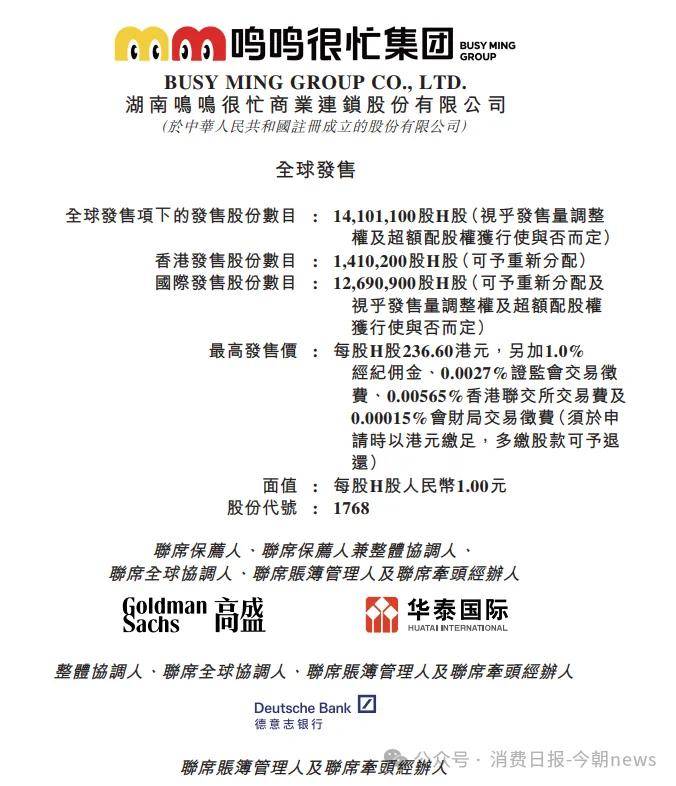
Group 1: Company Announcements - Hunan Mingming Hen Mang Commercial Chain Co., Ltd. (Mingming Hen Mang) has officially launched its global offering and plans to list on the Hong Kong Stock Exchange on January 28, 2024, with a total of 14.1011 million shares available for sale, expecting to raise approximately HKD 3.124 billion after expenses [1] - Good Products Co. has announced an expected net loss of RMB 120 million to RMB 160 million for the fiscal year 2025, primarily due to a decline in sales revenue and adjustments affecting gross margins [3] - Junlebao Dairy has submitted its prospectus to the Hong Kong Stock Exchange, reporting revenues of RMB 175.5 billion, RMB 198.3 billion, and RMB 151.3 billion for the years 2023 to 2025, with net profit increasing from RMB 558,000 to RMB 9 billion, a growth of over 700% [4] Group 2: Market Trends and Consumer Behavior - Taobao Flash Delivery has announced a subsidy of nearly RMB 2 billion for city couriers during the 2026 Spring Festival to enhance their income and reward their commitment [8] - Recent data indicates that trophy-related searches on Taobao have increased by over 50% year-on-year, with customized trophies for self-gifting seeing the highest demand [8] - The convenience food market in China shows that Kang Shifu has further increased its market share, with new products accounting for 2.51% of the market in Q4 2025, significantly ahead of competitors [17] Group 3: Financial Performance and Projections - Salia reported a net profit increase of 16% to 3 billion yen for the period from September to November 2025, with sales reaching 70.2 billion yen, a 15% increase [9] - Nanjing Xinbai expects a net loss of between RMB 839 million and RMB 1.026 billion for 2025, primarily due to goodwill and intangible asset impairments [18] - Laiyifen anticipates a net loss of approximately RMB 170 million for 2025, with adjustments to store numbers and gross margins impacting performance [18]


鸣鸣很忙IPO领跑,量贩零食争上市
Sou Hu Cai Jing· 2026-01-20 13:17
Core Insights - The article discusses the rapid rise of Hunan Mingming, a snack retail chain, which is set to launch its IPO on January 28, 2026, aiming to become the first publicly listed company in the bulk snack sector [2][5] - The company has experienced explosive growth, expanding from a regional player to a leader with over 20,000 stores in just two years, achieving a revenue increase from 4.286 billion yuan in 2022 to 39.344 billion yuan in 2024, representing an 860% growth [6][7] - Despite impressive growth figures, the company faces challenges such as low profit margins and intense competition, raising questions about the sustainability of its business model [6][21] Company Growth - Hunan Mingming's store count surged from 1,902 in 2022 to 19,517 by September 2025, with a significant presence in 28 provinces and 1,341 counties [7][10] - The company's GMV reached 66.1 billion yuan in the first three quarters of 2025, a 74.5% year-on-year increase, with net profit soaring by 218.9% [8] - The growth strategy includes a dual-brand approach, with "Snacks Busy" targeting younger consumers and "Zhao Yiming Snacks" focusing on family consumption, leveraging a shared supply chain and digital systems [9][12] Market Position and Strategy - Hunan Mingming capitalizes on the consumption upgrade in lower-tier markets, offering over 1,800 SKUs per store, which is double that of traditional supermarkets [12] - The company has positioned itself at the forefront of a channel transformation, with bulk snack sales surpassing supermarkets and e-commerce for the first time in 2024 [12] - The competitive landscape is evolving, with traditional brands struggling to adapt, as seen with Three Squirrels' failed acquisition of a bulk snack brand [18][19] Challenges and Risks - The industry is characterized by low profit margins, with Hunan Mingming's margin at 9.7%, while many smaller brands report margins below 5% due to aggressive pricing strategies [21] - The company faces pressure from rising costs for franchisees and a slowdown in same-store sales growth, indicating potential vulnerabilities in its business model [21] - Supply chain stability is critical as the company expands, with increased demands for efficiency and flexibility to respond to market changes [24][26] Future Outlook - The IPO is seen as a starting point for Hunan Mingming, providing capital to address challenges such as low margins and product differentiation [27] - The company plans to allocate funds for product development, store network upgrades, brand building, and enhancing digital capabilities [27] - The long-term success of Hunan Mingming will depend on its ability to increase its own brand offerings and optimize profitability while navigating a competitive landscape [27][28]
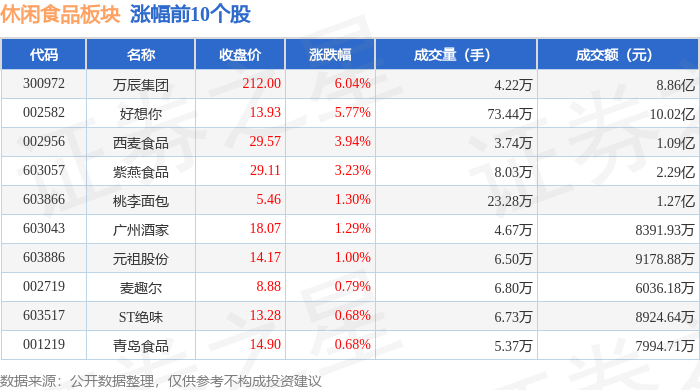
休闲食品板块1月20日涨1.54%,万辰集团领涨,主力资金净流出6030.19万元
Zheng Xing Xing Ye Ri Bao· 2026-01-20 08:51
Group 1 - The leisure food sector increased by 1.54% on January 20, with Wancheng Group leading the gains [1] - The Shanghai Composite Index closed at 4113.65, down 0.01%, while the Shenzhen Component Index closed at 14155.63, down 0.97% [1] - Key stocks in the leisure food sector showed significant price movements, with Wancheng Group rising by 6.04% to a closing price of 212.00 [1] Group 2 - The leisure food sector experienced a net outflow of 60.30 million yuan from institutional investors, while retail investors saw a net inflow of 75.82 million yuan [2] - Notable declines were observed in stocks such as Three Squirrels, which fell by 2.07% to a closing price of 24.58 [2] - The trading volume and turnover for various stocks in the sector varied, with significant activity noted in stocks like Haoxiangni and Ximai Food [2] Group 3 - Haoxiangni had a net inflow of 79.89 million yuan from institutional investors, while it faced a net outflow of 78.76 million yuan from retail investors [3] - Ximai Food also saw a net inflow of 10.14 million yuan from institutional investors, with retail investors experiencing a net outflow [3] - The data indicates varying levels of investor interest across different stocks within the leisure food sector, highlighting the dynamics of institutional versus retail investment [3]



临近春节三只松鼠部分产品再调价,零食“造流”同步趋向线下店打磨共振
Cai Jing Wang· 2026-01-19 14:57
Group 1 - Three squirrels have announced a price adjustment for offline distribution of nut gift products due to rising logistics and labor costs, effective January 19, 2026 [1] - This price adjustment is a routine practice for the company during the Spring Festival period, as confirmed by a company representative [1] - In October 2022, the company also raised prices on 35 products, with adjustments ranging from 0.2 to 10 yuan, primarily due to fluctuations in raw material costs [1] Group 2 - Three squirrels are expanding their offline presence by launching new community-oriented lifestyle stores, with 16 stores opened since June 2025 [2] - The newly opened mini lifestyle stores in Nanjing and Wuhu focus on high-density community areas and offer over 1,000 products, with a strong emphasis on fresh produce and self-owned brands [2] - The company plans to open an additional 9 mini lifestyle stores and 5 standard lifestyle stores in Nanjing and Anhui before the Lunar New Year [2] Group 3 - Other snack brands are also adapting to the market by enhancing their offline strategies, such as Laiyifen's financial support for franchisees to accelerate their "Ten Thousand Families" strategy [3] - Liangpinpuzi is focusing on regional development with its snack brand, while Qiaqia Foods is preparing for the Spring Festival by promoting new products through online and offline channels [3] - The snack industry is facing challenges in managing cost fluctuations while expanding their supply lines and enhancing their market presence [4]

饮料市场加速分化 接班潮涌能否讲出新故事?
Zhong Guo Jing Ying Bao· 2026-01-19 08:41
Core Insights - The beverage industry is shifting from merely quenching thirst to emphasizing health attributes, with this trend expected to be more pronounced by 2025 [1] - Reports indicate that low-sugar and no-sugar options will become standard in the beverage market by 2025, reflecting a clear trend towards health-conscious consumption [1] - The industry is experiencing a bifurcation, with some companies capitalizing on market trends for growth while others face declining performance [1] Industry Performance - In November 2025, China's beverage production reached 10.46 million tons, a year-on-year increase of 0.4%, with a cumulative production of 165.61 million tons from January to November, reflecting a 3.3% growth [2] - Eastroc Beverage reported impressive performance with a revenue of 16.844 billion yuan in the first three quarters of 2025, a 34.13% increase year-on-year, while Nongfu Spring achieved a revenue of 25.622 billion yuan, up 15.6% [2] - Conversely, traditional giants like Master Kong faced challenges, with a revenue decline of 2.7% in the first half of 2025 [2] Segment Analysis - Sales of tea beverages fell by 6.3% to 10.67 billion yuan, fruit juice sales dropped by 13.0% to 2.956 billion yuan, and packaged water sales decreased by 6.0% to 2.377 billion yuan [3] - Carbonated and other beverages saw a growth of 6.3%, reaching 10.256 billion yuan [3] - The plant-based protein drink segment struggled, with leading brands like Yangyuan and Chengde Lulux experiencing revenue declines of 7.64% and 9.42%, respectively [3] Competitive Landscape - Companies are adjusting to revenue declines, with some experiencing double-digit drops; for instance, China Resources Beverage's revenue fell by 18.5% to 6.206 billion yuan [4] - The competitive landscape is marked by price wars, particularly in the packaged water segment, leading to significant revenue drops for brands like "Yibao" [4] - Analysts suggest that the success of Nongfu Spring's tea segment indicates a shift from basic hydration to quality tea beverages, while traditional companies must innovate to escape the price war trap [4] Emerging Trends - The rise of functional beverages is evident, with products tailored for specific scenarios, such as sports and fitness, gaining traction [7] - Brands are focusing on packaging innovations and marketing strategies that align with health and fitness trends, such as electrolyte water and convenient single-use formats [7][8] - The health and wellness segment is seeing explosive growth, with numerous new brands entering the market, particularly in traditional Chinese health drinks [6] Leadership Transition - The beverage industry is witnessing a generational shift, with new leaders taking over established companies, such as Wei Hongcheng at Master Kong and Xu Yangyang at Dali Foods [9][10] - These new leaders bring fresh perspectives and experiences, which may help navigate the challenges of a saturated market [11] - However, not all transitions are smooth, as seen in the ongoing succession issues at Wahaha, highlighting the complexities of generational change in the industry [11]


来伊份升级加盟商支持力度
Zheng Quan Ri Bao Wang· 2026-01-19 01:44
Core Viewpoint - The company, Shanghai Laiyifen Co., Ltd., announced a special funding support plan for existing and new franchisees to enhance operational liquidity and accelerate its franchise business strategy [1] Group 1: Funding Support Plan - The funding will be used for franchisees to operate existing stores or open new franchise locations, with a maximum support period of 36 months [1] - The initiative aims to stimulate franchisee entrepreneurship and inject continuous momentum into the company's strategic development [1] Group 2: Franchise Business Growth - In the first half of 2025, the revenue from the franchise business reached 722 million yuan, representing a year-on-year growth of 78.65% [1] - Industry insiders believe that the increased support for franchisees is expected to accelerate market expansion and consolidate business growth [1] Group 3: Financial Structure Improvement - The shift from a heavy asset direct operation model to a franchise model is anticipated to significantly improve the company's financial structure and profitability [2] - The company has seen a reduction in management and sales expenses by 11.9% and 14.17% year-on-year in 2024, respectively, with further declines of 4.73% and 7.27% in the first three quarters of 2025 [2] Group 4: Market Competition and Future Outlook - The snack industry is entering a phase of refined channel competition, and the franchise model allows for rapid market penetration through local resources [2] - The company expects that as the franchise ecosystem matures and scale effects are realized, its performance will further improve, reshaping the growth curve [2]
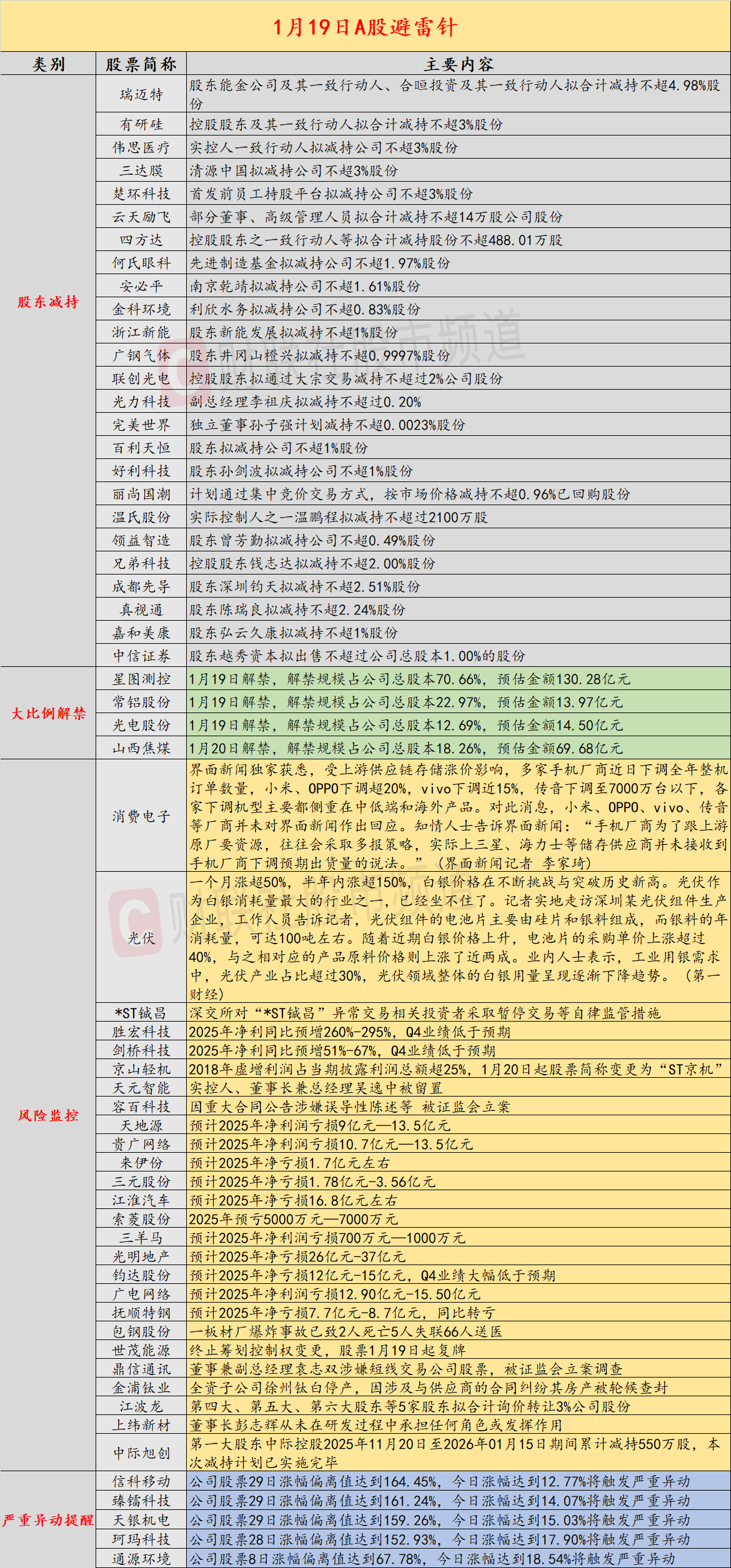
1月19日投资避雷针:2400亿PCB龙头四季度业绩低于预期


Xin Lang Cai Jing· 2026-01-19 00:33
Economic Information - Several smartphone manufacturers, including Xiaomi, OPPO, vivo, and Transsion, have lowered their annual shipment forecasts, with Xiaomi and OPPO reducing by over 20%, vivo by nearly 15%, and Transsion to below 70 million units [2] - Silver prices have surged over 50% in one month and over 150% in six months, impacting the photovoltaic industry, which consumes a significant amount of silver. The cost of raw materials for solar cells has increased by nearly 20% due to rising silver prices [2] - The company Xibei is expected to incur cumulative losses exceeding 600 million yuan from September 2025 to March 2026, leading to the closure of 102 stores, accounting for 30% of its total outlets [2] Company Alerts - Shenghong Technology anticipates a net profit increase of 260%-295% year-on-year for 2025, although Q4 performance fell short of expectations [4] - Cambridge Technology expects a net profit increase of 51%-67% year-on-year for 2025, with Q4 results also below expectations [4] - Multiple companies, including Weimait and Youyan Silicon, have announced plans to reduce their shareholdings by up to 4.98% and 3% respectively [4][11] Overseas Alerts - The three major U.S. stock indices collectively declined last Friday, with the Nasdaq China Golden Dragon Index dropping by 1.15%. Notable declines were seen in Chinese stocks such as Alibaba and JD.com [5] - The European Union is considering imposing tariffs on U.S. goods worth 93 billion euros in response to U.S. tariffs on eight European countries, which could take effect on February 6 if no agreement is reached [5]
2025年1-11月农副食品加工业企业有26875个,同比增长1.38%
Chan Ye Xin Xi Wang· 2026-01-17 04:00
2025年1-11月,农副食品加工业企业数(以下数据涉及的企业,均为规模以上工业企业,从2011年起, 规模以上工业企业起点标准由原来的年主营业务收入500万元提高到年主营业务收入2000万元)为26875 个,和上年同期相比,增加了367个,同比增长1.38%,占工业总企业的比重为5.11%。 上市公司:黑芝麻(000716),双汇发展(000895),千味央厨(001215),青岛食品(001219),三 全食品(002216),得利斯(002330),金字火腿(002515),洽洽食品(002557),五芳斋 (603237),安井食品(603345),绝味食品(603517),惠发食品(603536),有友食品 (603697),良品铺子(603719),来伊份(603777),桃李面包(603866) 相关报告:智研咨询发布的《2026-2032年中国营养食品加工行业市场经营管理及发展前景展望报告》 数据来源:国家统计局,智研咨询整理 知前沿,问智研。智研咨询是中国一流产业咨询机构,十数年持续深耕产业研究领域,提供深度产业研 究报告、商业计划书、可行性研究报告及定制服务等一站式产业咨询服务。专业的角 ...
