
贵州习酒

Search documents
电商博弈2.0,酒企再打渠道保卫战
Xin Lang Cai Jing· 2025-10-31 06:18
Core Viewpoint - The collective action of liquor companies against unauthorized sales on e-commerce platforms reflects a significant shift in the industry, aiming to protect pricing structures and stabilize channel ecosystems amid increasing competition from online sales [1][2][3] Group 1: Authorization Defense - This year's wave of notifications from liquor companies is unprecedented in both frequency and assertiveness, with major brands like Moutai and Wuliangye issuing warnings about unauthorized sales just before the "Double Eleven" shopping festival [2][3] - Moutai emphasized the importance of purchasing through authorized channels, while other brands like Xiaotuxian and Guotai also highlighted the risks associated with unauthorized sales, including counterfeit products [2][3] - The proactive stance of these companies marks a departure from previous years, where they typically reacted to counterfeit issues post-festival, now focusing on channel regulation and price stability [3][4] Group 2: Channel Power Struggle - The ongoing battle for channel authority between liquor companies and e-commerce platforms has intensified, with the rise of instant retail changing the dynamics of this competition [5][6] - Historical context shows that similar struggles occurred during the last downturn in the liquor market around 2012, but the current situation features more complex interactions and clearer objectives from liquor companies to control e-commerce ecosystems [6][7] - The shift in consumer purchasing behavior towards instant needs has accelerated the transfer of pricing power from producers to channels and consumers, prompting liquor companies to reclaim control through authorized sales channels [7][8] Group 3: Proactive Market Engagement - Liquor companies are actively seeking to break down barriers imposed by e-commerce and leverage online platforms for channel transformation, as seen with Moutai's entry into instant retail [8][9] - Collaborations between liquor brands and e-commerce platforms are emerging, with initiatives like the full-chain authenticity system launched by Meituan and various liquor brands to ensure product integrity [8][9] - The evolving relationship between liquor companies and e-commerce is shifting from confrontation to collaboration, aiming for a mutually beneficial ecosystem that enhances both parties' market positions [9][10]


酒企掀起“价盘保卫战”
Bei Jing Shang Bao· 2025-10-30 13:05
Core Viewpoint - The article discusses the ongoing price protection battle among major liquor companies in response to aggressive discounting on e-commerce platforms ahead of the "Double 11" shopping festival, highlighting the need for a new cooperative model between liquor companies and e-commerce platforms [1][6]. Group 1: Industry Actions - Major liquor companies, including Guizhou Moutai, Wuliangye, and Shui Jing Fang, have issued lists of authorized sales channels and identified unauthorized sellers in a bid to protect their pricing structures [1][2]. - Guizhou Moutai initiated the campaign by releasing a list of official online and offline sales channels, including its own app and major e-commerce platforms like Tmall and JD [2]. - Following Moutai, other companies like Guizhou Xijiu and Wuliangye have also published their authorized channel lists, with Xijiu listing 215 authorized stores [2][3]. Group 2: Market Dynamics - The aggressive pricing strategies employed by e-commerce platforms have led to lower transaction prices for liquor online compared to offline markets, creating pressure on traditional distributors [6]. - The price war initiated by e-commerce platforms has resulted in significant profit erosion for liquor companies, leading to concerns over product quality and service standards [6][4]. Group 3: Consumer Protection and Brand Integrity - The publication of authorized and unauthorized seller lists aims to protect consumers from counterfeit products while stabilizing price expectations among distributors [7]. - The actions taken by these leading liquor companies are seen as necessary to maintain brand reputation and ensure a fair competitive environment in the market [7]. Group 4: Future Strategies - The ultimate goal for liquor companies is to establish a balanced ecosystem that benefits brands, channels, and consumers, integrating supply chain resources effectively [8]. - The rise of instant retail is viewed as a key strategy for liquor companies to enhance consumer engagement and streamline inventory sales [9].


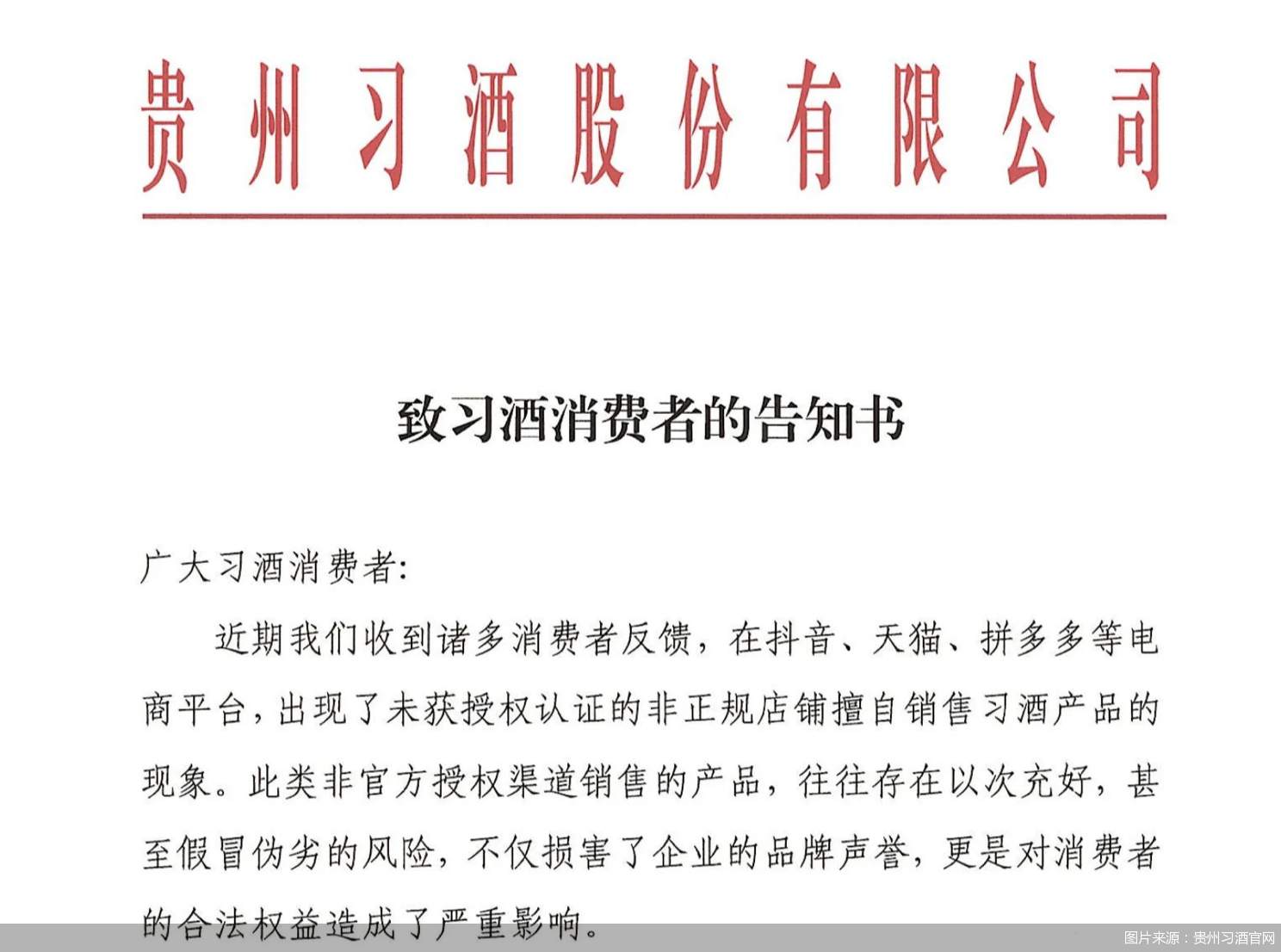
“不提供任何检验和售后服务”,让酒企“发飙”的开盖酒是什么
Sou Hu Cai Jing· 2025-10-26 14:39
Core Viewpoint - The rise of "opened bottle" and "opened cap" liquor products is linked to aggressive promotional strategies by e-commerce platforms during the "Double 11" shopping festival, leading to consumer confusion and potential risks associated with these products [1][10]. Group 1: Market Dynamics - E-commerce platforms are experiencing a surge in consumer activity due to promotional events, with various merchants employing creative strategies to attract buyers [1]. - The price difference between opened and unopened liquor products is significant, with some merchants selling opened cap liquor at prices much lower than official retail prices, creating a competitive edge [3][9]. Group 2: Regulatory and Safety Concerns - Guizhou Xijiu has announced it will no longer provide inspection or after-sales services for opened bottle and opened cap products, indicating a shift in responsibility for product quality [3][10]. - The proliferation of opened bottle and opened cap products poses risks to both consumers and brands, including potential quality issues and the undermining of brand integrity [10][11]. Group 3: Consumer Behavior and Risks - Consumers are often drawn to the lower prices of opened bottle products, but they may unknowingly purchase inferior or counterfeit products, leading to potential health risks [10][11]. - The lack of proper labeling and traceability for opened products complicates consumer rights and increases the difficulty of seeking redress in case of issues [10][11]. Group 4: Industry Practices - The emergence of opened bottle products is partly driven by liquor companies' promotional policies that incentivize the opening of bottles for rewards, which has inadvertently led to the rise of these non-compliant products [7][9]. - Some merchants are utilizing "no damage opening" techniques to sell opened products while maintaining the appearance of new items, further blurring the lines of compliance [6][8].
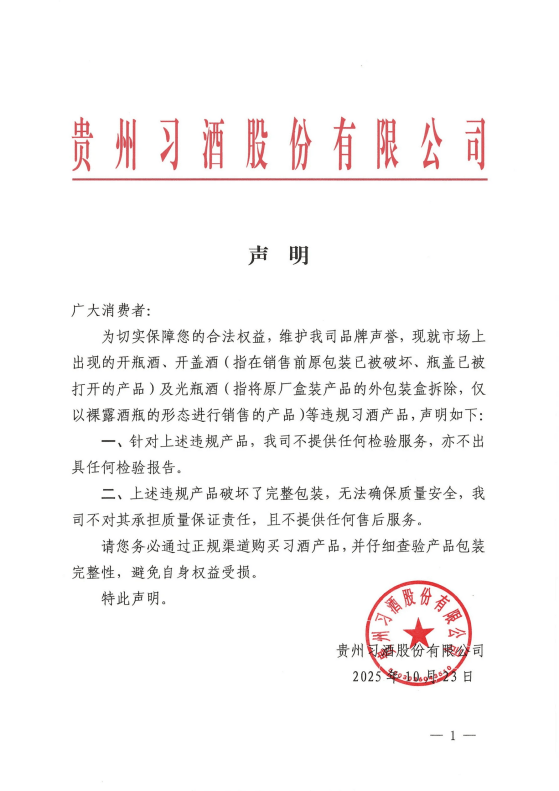
“违规”“不提供任何检验和售后服务”,让酒企“发飙”的开盖酒是啥
Xin Lang Cai Jing· 2025-10-26 07:13
Core Viewpoint - The rise of "open bottle" and "open cap" liquor products in the market is linked to promotional strategies by liquor companies, leading to consumer confusion and potential risks associated with these products [1][8][11]. Group 1: Market Dynamics - Major e-commerce platforms have initiated promotional activities for "Double Eleven," resulting in a surge in consumer spending, but also the emergence of consumption irregularities [1]. - Guizhou Xijiu has announced it will no longer provide inspection or after-sales services for open bottle and open cap products, distancing itself from quality assurance responsibilities [1][3]. Group 2: Consumer Behavior and Pricing - Consumers are puzzled by the existence of open bottle and open cap products, which are often sold at significantly lower prices compared to standard products [8]. - The price difference is attributed to liquor companies' "open bottle scan" red envelope policies, which incentivize sales but have inadvertently led to the proliferation of these irregular products [8][9]. Group 3: Risks and Regulatory Concerns - The sale of open bottle and open cap products poses risks to both liquor companies and consumers, including potential quality issues and the disruption of pricing systems [11]. - Regulatory bodies have raised concerns about the safety risks associated with these products, highlighting violations of multiple laws, including the Food Safety Law and Consumer Rights Protection Law [11][12].
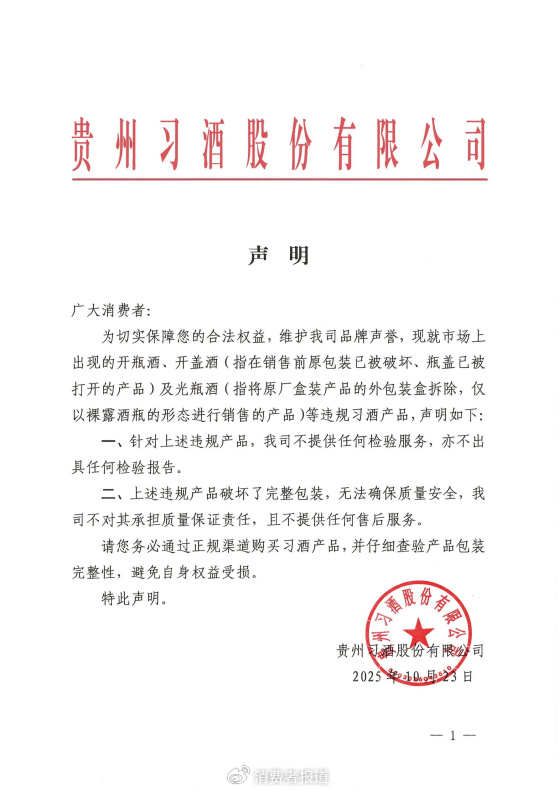
“违规”“不提供任何检验和售后服务”,让酒企“发飙”的开盖酒是什么?
Sou Hu Cai Jing· 2025-10-25 17:04
Core Viewpoint - The rise of "open bottle" and "open cap" liquor products during the "Double Eleven" shopping festival has led to various consumer issues, prompting Guizhou Xijiu to issue a statement denying responsibility for the quality of these products [1][16]. Group 1: Company Actions - Guizhou Xijiu announced it will no longer provide inspection and after-sales services for open bottle, open cap, and bare bottle products, thus not assuming quality guarantee responsibilities [1][3]. - The company defined open bottle and open cap products as those with damaged original packaging or opened caps, while bare bottles refer to products sold without their original packaging [3][16]. Group 2: Market Dynamics - Despite the company's statement, many merchants continue to sell low-priced open cap Xijiu products, with significant price discrepancies observed; for instance, a six-bottle pack of 53-degree 500ml Xijiu was priced at 379 yuan, while the official store listed it at 590 yuan, a difference of over 200 yuan [3][12]. - The proliferation of open bottle and open cap products is linked to liquor companies' "open bottle scan" red envelope policies, which incentivize consumers and distributors to increase sales through cash and points rewards [13][14]. Group 3: Consumer Risks - The existence of open bottle and open cap products raises concerns for both consumers and liquor companies, as these products can disrupt pricing systems, lead to price wars, and damage brand reputation due to potential quality issues [16][17]. - Consumers may mistakenly believe they are getting a bargain, but they risk purchasing inferior or counterfeit products, as the exposure to air can lead to spoilage, and the lack of traceability complicates accountability in case of issues [16][17].
芒果超媒再遇营收挫折:《再见爱人5》延播丨消费参考
2 1 Shi Ji Jing Ji Bao Dao· 2025-10-24 00:09
Core Viewpoint - Mango TV is experiencing a significant decline in revenue and profit, exacerbated by the postponement of its popular variety show "Goodbye Lover 5" and ongoing challenges in its advertising business [2][3][5]. Financial Performance - In the first half of the year, Mango TV's revenue decreased by 14.31% to 5.964 billion yuan, while net profit attributable to shareholders fell by 28.31% to 763 million yuan [3]. - Advertising revenue also declined by 7.79% to 1.587 billion yuan during the same period [3]. Impact of Variety Shows - The company had high hopes for "Goodbye Lover 5" to recover its financial performance, as the previous season was a significant hit [3]. - Despite the postponement of "Goodbye Lover 5," the impact on advertising may be less severe than anticipated due to the show's focus on divorce, which has historically attracted fewer sponsors compared to other programs [4][5]. Future Prospects - The upcoming variety show "Voice of the Future 2025" is expected to be a highlight for the company's performance in the second half of the year, featuring a rare multi-platform collaboration [4]. - The membership revenue for Mango TV grew by 19.3% year-on-year to 5.148 billion yuan by the end of 2024, driven by popular shows [3].

低价击穿底线、真假混卖,“双11”成白酒“打假主战场”| 行业风向标
Tai Mei Ti A P P· 2025-10-22 13:19
Core Viewpoint - The "Double 11" shopping festival has been extended to 36 days, coinciding with a significant crackdown on counterfeit products in the liquor industry, particularly targeting unauthorized sales channels [2][3][4]. Group 1: E-commerce Promotions - Major e-commerce platforms are adopting straightforward discount strategies, with JD.com offering discounts as low as 10% and Douyin providing at least 15% off, while Tmall is distributing 50 billion yuan in consumer vouchers [3]. - JD.com reported a significant increase in sales, with over 5.2 million brands seeing a year-on-year growth of over 300%, particularly in liquor categories, where aged liquor sales surged by 150% [3]. Group 2: Crackdown on Counterfeit Products - Leading liquor companies like Kweichow Moutai and Wuliangye have released official lists of authorized sales channels, while also naming unauthorized sellers, including major platforms like Douyin and Pinduoduo [4][5]. - The crackdown is a response to the aggressive price cuts and the proliferation of counterfeit products, with Moutai's price dropping below 1700 yuan and Wuliangye's below 800 yuan on some platforms [5][6]. Group 3: Industry Dynamics - The liquor industry's recent anti-counterfeit actions are not new, as major brands have previously targeted unauthorized sellers during major sales events [5]. - Industry analysts suggest that the crackdown aims to stabilize pricing, protect consumers from counterfeit products, and encourage e-commerce platforms to establish authorized sales mechanisms [5][9]. Group 4: Market Challenges - The ongoing low-price promotions threaten the survival of offline distributors and disrupt the established pricing structure of the liquor industry [7]. - There are concerns about counterfeit products, with a significant percentage of products tested being fake, highlighting the risks associated with low-price sales [7]. Group 5: Online Sales Growth - Despite challenges, online sales of liquor have seen substantial growth, with platforms like Meituan reporting an eightfold increase in sales and JD.com experiencing a 109% increase during the recent shopping festival [8][9]. - The liquor industry is navigating a complex landscape where online sales are becoming increasingly important, prompting companies to redefine their sales strategies [9].

美团、淘宝被五粮液点名!
Di Yi Cai Jing· 2025-10-20 14:13
Core Viewpoint - Major liquor companies, including Moutai and Wuliangye, have raised concerns about unauthorized sales of their products on e-commerce platforms, highlighting issues of product authenticity and complex supply chains [1][2] Group 1: Company Concerns - Several well-known liquor brands have issued statements accusing e-commerce platforms of selling products without authorization, leading to potential issues with counterfeit goods [1] - Wuliangye identified unauthorized online stores selling its products, which are not included in its official product control and traceability system, raising concerns about quality [1] - Guizhou Xijiu also criticized unauthorized online channels for selling products, indicating risks of counterfeit and substandard goods [1] Group 2: Pricing and Market Dynamics - As of October 20, the price of 53-degree Feitian Moutai was reported at 1,650 yuan per bottle, a decrease of 30 yuan from previous days, while Wuliangye's price remained stable at 769 yuan, both below market wholesale prices [1] - A comparison showed that Guizhou Xijiu's official flagship store prices were 30% higher than those on the e-commerce platforms' promotional channels [2] - E-commerce platforms are reportedly subsidizing prices through market purchases, complicating the supply chain and raising concerns about product authenticity [2] Group 3: E-commerce Platform Responses - Taobao's customer service claimed that its "Billion Subsidy Channel" guarantees product authenticity and has introduced third-party testing agencies, promising compensation for counterfeit products [2] - Industry experts noted that e-commerce liquor products primarily come from social channels, which have moved beyond manufacturer control, creating opportunities for counterfeit sales [2]

美团、淘宝被五粮液点名
Di Yi Cai Jing· 2025-10-20 10:39
Group 1 - Major liquor companies, including Moutai and Wuliangye, have expressed concerns over unauthorized sales on e-commerce platforms during the "Double Eleven" shopping festival [4][5] - Wuliangye's consumer notice highlighted the presence of unauthorized stores selling its products online, with prices significantly lower than market wholesale prices [4][5] - As of October 20, the price of Moutai was reported at 1650 yuan per bottle, down 30 yuan from previous days, while Wuliangye remained at 769 yuan per bottle, both below official retail prices [4] Group 2 - The online sales of liquor products are primarily sourced from market procurement by e-commerce platforms, leading to complex supply chains and potential quality issues [7] - Taobao's customer service claimed that its "Billion Subsidy Channel" guarantees product authenticity and has third-party testing, promising compensation for counterfeit products [7] - Industry experts noted that e-commerce platforms often pursue low-price strategies to attract traffic, which can create opportunities for counterfeit products [7]

美团、淘宝被五粮液点名
第一财经· 2025-10-20 10:08
Core Viewpoint - The article discusses the concerns raised by major liquor companies regarding unauthorized sales of their products on e-commerce platforms during the "Double Eleven" shopping festival, highlighting issues of authenticity and pricing discrepancies [3][5]. Group 1: Company Responses - Major liquor companies such as Moutai, Wuliangye, and Guizhou Xijiu have issued statements criticizing e-commerce platforms for selling products without authorization, leading to concerns about counterfeit goods [3][5]. - Wuliangye's notice to consumers highlighted that unauthorized stores may sell products outside of their official control and traceability systems, raising the risk of counterfeit and inferior products [3][5]. - Guizhou Xijiu also pointed out the risks associated with unauthorized online sales, although their authorized list mainly included their own stores and distributors on e-commerce platforms [5]. Group 2: Pricing and Market Dynamics - As of October 20, the price of 53-degree Feitian Moutai after subsidies was 1,650 yuan per bottle, a decrease of 30 yuan from the previous days, while Wuliangye's price remained stable at 769 yuan, both significantly lower than market wholesale prices [3]. - A comparison showed that Guizhou Xijiu's official flagship store prices were 30% higher than those on e-commerce platforms offering substantial discounts [5]. - An online liquor sales company representative noted that the current promotional prices are primarily due to e-commerce platforms purchasing from the market and subsidizing prices, which complicates the supply chain and raises concerns about product authenticity [5]. Group 3: E-commerce Platform Practices - E-commerce platforms are reportedly sourcing liquor products from social channels, which are outside the manufacturers' control, leading to potential issues with counterfeit products [5]. - Taobao's customer service claimed that their "Billion Subsidy Channel" is official and guarantees product authenticity, promising a "tenfold compensation" for counterfeit products [5]. - The article suggests that the aggressive low-price strategies employed by e-commerce platforms to attract traffic may create opportunities for counterfeit sales, indicating a shift away from the original sales intent of premium liquor brands [5].
