
通用汽车

Search documents
派杰投资:将通用汽车(GM.N)评级从中性上调至超配;将目标价从66美元上调至98美元。
Jin Rong Jie· 2026-01-08 08:54
派杰投资:将通用汽车(GM.N)评级从中性上调至超配;将目标价从66美元上调至98美元。 ...
中国车企深入巴西腹地
Cai Jing Wang· 2026-01-06 13:38
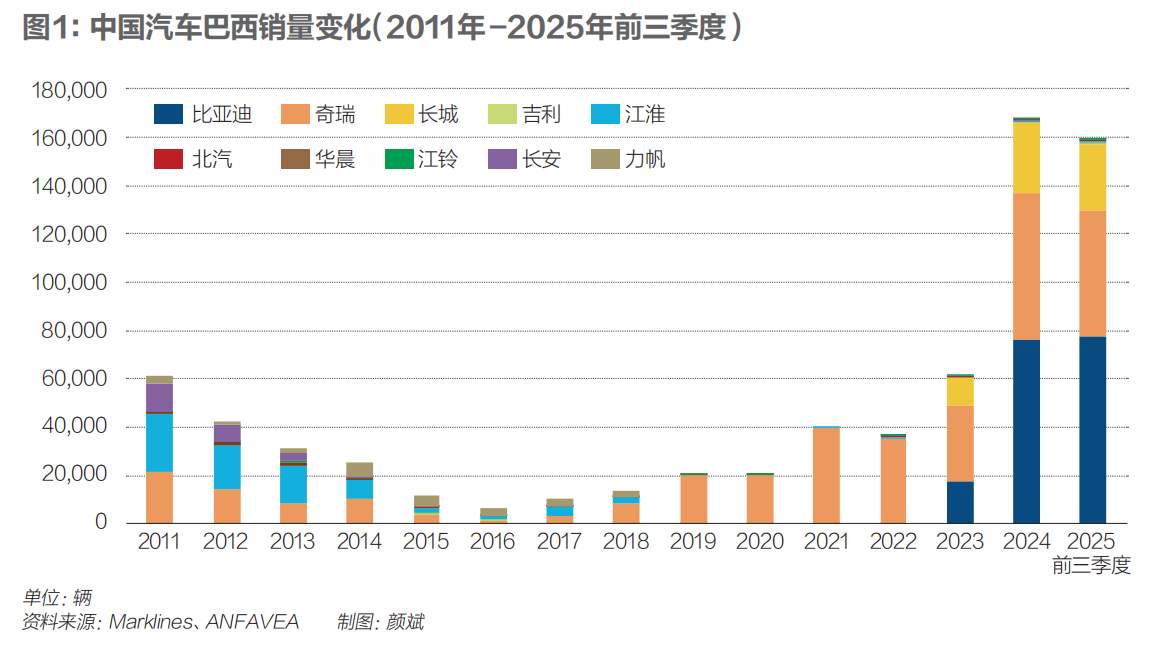
Core Insights - Chinese automotive brands are rapidly establishing a foothold in the Brazilian market, with nearly 40% representation at the São Paulo International Motor Show, showcasing a significant shift in market dynamics [1][3] - The success of Chinese companies in Brazil hinges on their ability to localize supply chains and enhance after-sales services, addressing past shortcomings [1][4] Group 1: Market Presence and Strategy - The São Paulo International Motor Show marked a collective appearance of Chinese brands, with notable participation from companies like BYD, Great Wall, and Chery, indicating a strong market presence [1][2] - Chinese brands are adopting high pricing strategies, with BYD's Tang L model priced at 399,900 reais (approximately 530,000 RMB), reflecting a shift towards the premium segment [1] - The overall market share of Chinese automotive companies in Brazil has surpassed 10%, establishing them as emerging players in the local automotive industry [3] Group 2: Historical Context and Evolution - The journey of Chinese automotive companies in Brazil can be divided into distinct phases: the initial wave from 2009 to 2014, a rebuilding phase from 2015 to 2020, and a resurgence starting in 2021 [7] - The first wave (2009-2014) was characterized by low-cost strategies and heavy marketing, but faced challenges due to a lack of localization and subsequent government policies that increased import taxes on non-localized vehicles [8][11] - The second phase saw companies like Chery pivoting to local partnerships, which helped improve brand perception and sales, with CAOA Chery achieving a 122% sales increase by 2018 [12] Group 3: Technological and Market Adaptation - The current wave (2021 onwards) is marked by significant capital investment and a focus on local production, with companies like Great Wall acquiring existing factories to establish a manufacturing base [13] - Chinese companies are leveraging advanced technologies in electric and hybrid vehicles, with BYD and Great Wall forming a duopoly in the Brazilian new energy vehicle market [14][20] - The adaptation to local market conditions includes developing vehicles that cater to Brazil's unique energy structure, particularly the prevalence of ethanol as a fuel source [27][28] Group 4: Challenges and Opportunities - The Brazilian automotive market presents challenges such as a highly unequal income distribution and specific consumer preferences for smaller vehicles due to parking constraints [23][24] - Chinese brands are addressing these challenges by offering compact, technologically advanced vehicles that appeal to middle-class consumers, moving away from the low-cost strategy of the past [25] - The Brazilian government's "MOVER" plan aims to stimulate local investment in high-efficiency vehicles, providing a framework for Chinese companies to align their strategies with national goals [29][32] Group 5: Future Outlook - The success of Chinese automotive companies in Brazil will depend on their ability to integrate technology transfer, deepen local market engagement, and enhance supply chain capabilities [33] - The potential for Chinese brands to act as a catalyst for innovation in the Brazilian automotive sector is recognized by the government, which seeks to leverage their presence for broader industrial upgrades [19][32]



EV退潮,自动驾驶接棒? CES 2026开幕,车企们把“下一轮浪潮”押在AI接管方向盘
Zhi Tong Cai Jing· 2026-01-06 11:58
Core Insights - The CES 2026 event in Las Vegas highlighted the dominance of AI-driven autonomous driving technology, with investors betting on AI revitalizing the traditional manufacturing sector, which has been hindered by slow technological progress and high costs [1][2] - Traditional automakers are pausing their electric vehicle (EV) transformation plans due to intense competition and reduced government subsidies, while suppliers and tech startups are showcasing their latest autonomous driving solutions [1][3] - Nvidia's CEO Jensen Huang announced the Alpamayo family of open-source AI models for autonomous driving, which aims to challenge Tesla's Full Self-Driving (FSD) system [4][5][6] Industry Trends - The automotive industry is increasingly focusing on physical AI and autonomous driving, with expectations that AI will be integrated into a wide range of everyday products beyond just vehicles [2] - The CES has evolved into a key platform for chip giants like Nvidia and AMD to unveil high-performance AI infrastructure for enterprise applications, alongside traditional consumer electronics [3] - Many traditional automakers are shifting their focus from launching new EVs to developing fully autonomous vehicles, reflecting a significant strategic change in the industry [3][4] Technological Developments - Nvidia's Alpamayo model, described as the "ChatGPT moment for physical AI," features 10 billion parameters and utilizes a novel "chain AI reasoning" approach to enhance decision-making in autonomous driving [5][6] - The introduction of the Alpamayo family aims to create a complete development ecosystem that includes models, simulation tools, and datasets to improve the safety and verifiability of autonomous driving technology [6][7] - Companies are also enhancing driver assistance systems, with some aiming for "hands-free" driving capabilities on highways and urban roads, similar to Tesla's FSD [7] Cost and Competitive Pressures - Traditional automakers, particularly Ford and General Motors, are becoming more strategic in their capital investments due to significant write-downs from changes in EV strategies and increased competition from Asian manufacturers [8] - The impact of higher tariffs imposed by the Trump administration on automotive imports is leading many U.S. manufacturers to absorb costs rather than pass them on to consumers, increasing pressure on profit margins [8] - Cost competitiveness is expected to be a central theme of discussion at CES, as automakers and investors focus on managing expenses amid rising competition [8]


汽车整车上市公司市值变化分析-12月
Sou Hu Cai Jing· 2026-01-06 09:40
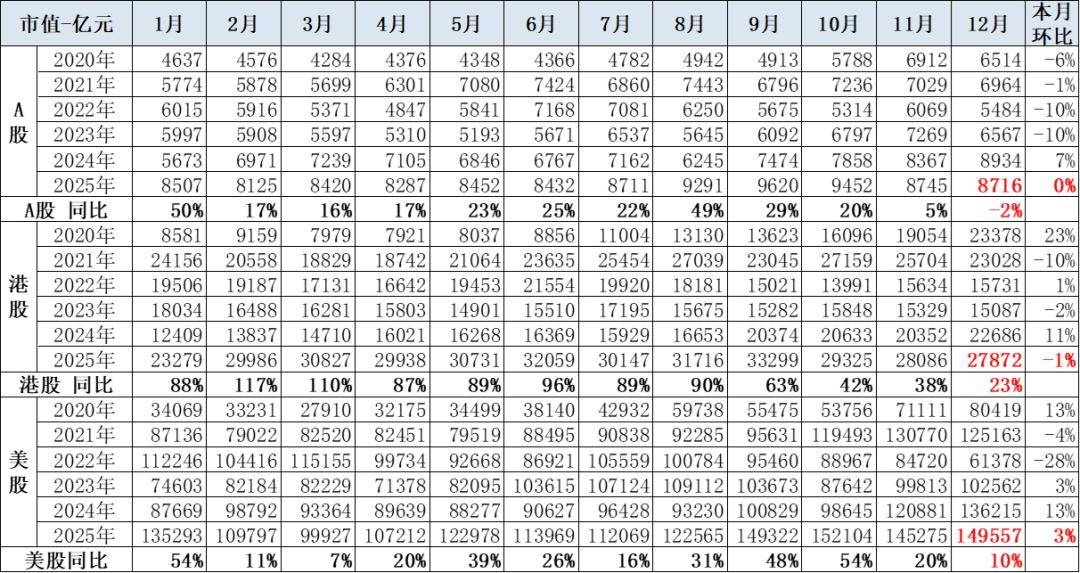
注:本分析文章仅代表崔东树个人观点,如有异议,请留言。 汽车整车上市公司市值不仅是资本市场对企业当前经营成果的定价,更是反映汽车行业趋势、技术变革与政策导向的"晴雨表"。很多整车企业都把市值管 理作为重要的工作,因此跟踪市值变化也是行业研究的重要领域。整车企业A股上市艰难,带来A股相对国际股市的竞争力较差。 世界汽车整车企业市值中,美股市场的规模最大,2025年12月份达到14.96万亿元的规模,环比11月增3%,同比增10%。而港股市场也达到了2.79万亿元 的规模,环比11月降1%,同比增23%。国内A股市场达到8716亿元的规模,环比11月降0.1%,同比降2%。在这里我们把A股港股中有些多地上市的公司市 值会按第一上市地做侧重,A股相对来说比较简单一点。 我们把中国车企和零部件企业的A股、港股、美股的三地市值汇总看,12月股票市值的汽车零部件占比47.5%(同期41%)表现较强,整车企业市值占比 48.4%(同期55.3%)的下降较快,虽然有奇瑞的加入,但市值占比仍是明显下降。 | 上市公司 | 12月市值 | 环比 | 同比 | 12个月位 | 5年位置 | | --- | --- | --- | ...
汽车行业周报-20251214
Huaxin Securities· 2025-12-14 14:01
Investment Rating - The report maintains a "Recommended" investment rating for the automotive industry and humanoid robotics sector [2][4][6]. Core Insights - The humanoid robotics sector is expected to reach a pivotal point in the next one to two years, with significant advancements anticipated in the field of embodied intelligence [3][4]. - The automotive industry has achieved record monthly production and sales figures, with a notable increase in the production of new energy vehicles [5][6]. Summary by Sections Humanoid Robotics Sector - The Huaxin humanoid robotics index decreased by 0.94% this week, but has a cumulative return of 94.3% year-to-date [16]. - The sensor segment within the humanoid robotics sector showed positive performance, increasing by 1.1%, while other segments like actuators and reducers experienced declines [19]. - Key companies in the robotics sector, such as Zhongjian Technology and Zhongding Shares, saw significant stock price increases [24]. Automotive Sector - The CITIC automotive index rose by 0.1%, outperforming the broader market by 0.2% [32]. - The motorcycle and other segments within the automotive sector performed well, with a 1.6% increase, while automotive sales and services dropped by 3.5% [35]. - The automotive industry's PE ratio is at 31.8, placing it in the 36.4% percentile over the past four years, indicating a relatively stable valuation [48]. Key Companies and Profit Forecasts - Recommended companies include: - New Spring Co., Ltd. (EPS: 0.68, PE: 16.22, Rating: Buy) [8] - Shuanglin Co., Ltd. (EPS: 1.24, PE: 30.45, Rating: Buy) [8] - Jianghuai Automobile (EPS: 0.12, PE: 412.83, Rating: Buy) [8] - Other notable mentions include KaiDi Co., Ltd. and Kete Co., Ltd. [7][10].



11月全球车企市值:同比普涨,环比普降(附榜单)
Xin Lang Cai Jing· 2025-12-13 09:51
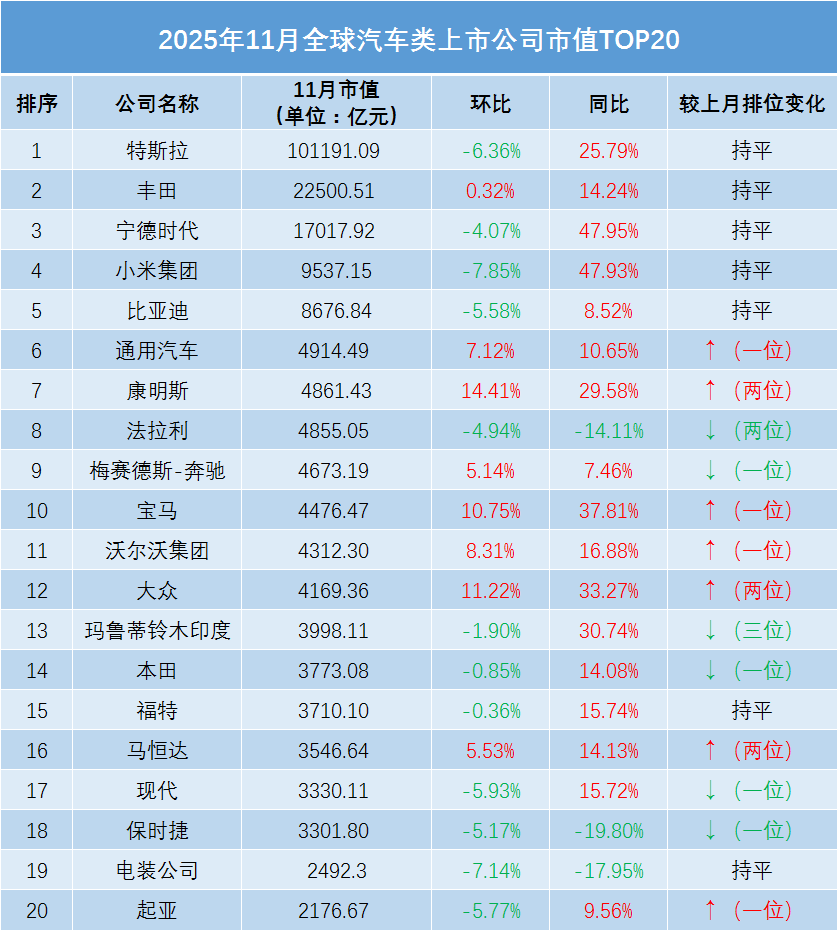
具体到各细分领域,2025年11月, A股迎来回落调整期,国内主要传统整车及经销商上市公司进入蛰伏;国内部分零部件企业市值环比普遍下调,整体呈 现"规模稳中有调、结构分化明显"的发展态势;国际主流汽车公司,通用市值实现攀升,德系巨头双涨;部分汽车新创公司市值继续展现出活力与波动 性。 国内主要传统整车及经销商上市公司市值: 同环比涨落现差异 | | | | 2025年11月全球汽车类上市公司市值TOP20 | | | | --- | --- | --- | --- | --- | --- | | 排序 | 公司名称 | 11月市值 (单位:亿元) | 环比 | 同比 | 较上月排位变化 | | 1 | 特斯拉 | 101191.09 | -6.36% | 25.79% | 持平 | | 2 | 幸田 | 22500.51 | 0.32% | 14.24% | 持平 | | 3 | 宁德时代 | 17017.92 | -4.07% | 47.95% | 持平 | | 4 | 小米集团 | 9537.15 | -7.85% | 47.93% | 持平 | | 5 | 比亚迪 | 8676.84 | -5.58% ...

汽车行业周报:自动驾驶发力,出行公司先行-20251208
Guoyuan Securities· 2025-12-08 07:50
Investment Rating - The report maintains a "Recommended" investment rating for the automotive industry [6] Core Insights - The automotive industry is experiencing a gradual recovery, with November wholesale sales remaining within a reasonable range. Retail sales of passenger vehicles in November reached 2.263 million units, a year-on-year decrease of 7%, but a month-on-month increase of 1%. Cumulatively, retail sales for the year reached 21.519 million units, a year-on-year increase of 6% [1][19] - The new energy vehicle market is showing strong growth, with November retail sales of 1.354 million units, a year-on-year increase of 7% and a cumulative increase of 20% for the year [1][19] - The report highlights the importance of autonomous driving and the strategic initiatives of ride-hailing companies, with significant advancements in technology and policy support driving the sector forward [4][26] Summary by Sections Weekly Market Review (2025.11.29-12.05) - The automotive sector saw a weekly increase of 1.38%, outperforming the Shanghai Composite Index by 0.10 percentage points. Most sub-sectors within the automotive industry also experienced gains [12][14] Weekly Data Tracking (2025.11.29-12.05) - Passenger vehicle retail and wholesale sales data for November indicate a mixed performance, with wholesale sales showing a year-on-year increase of 2% [19][1] Industry News (2025.11.29-12.05) - Significant developments include Shanghai's announcement of 330 kilometers of autonomous driving test roads, advancements in autonomous vehicle technology by companies like Xpeng and Geely, and the launch of new models featuring cutting-edge technology [26][27][32][30]


高盛闭门会-深度分析稀土市场前景,看好美股MP不看好稀土期货
Goldman Sachs· 2025-12-08 00:41
Investment Rating - The report holds a "Buy" rating for MP Materials and a "Sell" rating for Ramaco Resources [6]. Core Insights - The rare earth market, while small, is crucial for key industries, contributing approximately 3% to the US GDP, with China dominating the market by controlling 92% of refining and 98% of magnet manufacturing [1][2]. - The scarcity of heavy rare earth minerals, with 80% of reserves located in China and Myanmar, combined with complex extraction technologies, has led to a loss of technical advantage for Western countries [1][3]. - The demand for critical metals in clean technology is increasing, particularly for neodymium (Nd) and praseodymium (Pr) used in wind turbines and electric vehicle magnets [1][5]. - MP Materials has a strong operational foundation with high-quality assets and a solid customer base, including General Motors and Apple, supported by long-term contracts [1][6]. - The easing of US-China trade tensions is expected to benefit MP Materials, with fundamental factors likely to support stock price growth in the long term [1][6]. Summary by Sections Market Overview - The global rare earth market sales were approximately $7 billion in 2024, significantly smaller than the copper market [2]. - The geopolitical landscape is pushing for supply chain localization, making access to metals critical [5]. Company Analysis - MP Materials is positioned advantageously due to global supply tightness, having secured a minimum price guarantee of $110 per kilogram, which is significantly higher than global market prices [3][7]. - The company plans to expand its production capacity, with expectations to double its existing separation facility capacity by the end of 2026 [7]. Competitive Landscape - MP Materials employs a vertical integration strategy, which provides a competitive edge over Ramaco Resources, which is still in the development phase and requires substantial capital expenditure [6][7]. - The report highlights the significant differences in asset quality and business models between MP Materials and Ramaco Resources [6]. Future Outlook - The report anticipates that MP Materials will begin selling finished magnets to General Motors by late 2026, with a focus on heavy rare earths due to strong demand in defense applications [7]. - There is no indication of a surplus similar to LNG in the rare earth market, with predictions of continued deficits through 2027 due to strong demand growth [13].
特朗普宣布:将降低汽车燃油经济性标准
证券时报· 2025-12-04 10:01
Core Viewpoint - The Trump administration announced a reduction in fuel economy standards for vehicles produced in the U.S., aiming to lower consumer costs and protect jobs in the automotive industry [2]. Group 1: Fuel Economy Standards - The new average fuel economy standard for light vehicles is set to reach approximately 34.5 miles per gallon (about 6.9 liters per 100 kilometers) by the 2031 model year, significantly lower than the current requirement of 50.4 miles per gallon (about 4.7 liters per 100 kilometers) [2]. - The U.S. Department of Transportation estimates that the new standards will save car buyers $109 billion over the next five years, with an average reduction of $1,000 in the purchase cost of new vehicles [2]. Group 2: Industry Reaction - Executives from major automakers, including Ford, General Motors, and Stellantis, attended the announcement, with Stellantis shares rising over 3% and Toyota shares increasing nearly 2% in pre-market trading [3]. - Ford and General Motors also saw slight increases in their stock prices during the same period [3].

慧翰股份(301600) - 2025年12月3日投资者关系活动记录表
2025-12-03 09:26
Group 1: Regulatory Standards and Compliance - The EU's NG-eCall standard was updated to align with advancements in communication technology, transitioning from 2G/3G to 4G/5G to enhance emergency response efficiency and societal value [2][3] - The national standard AECS in China is on par with the EU's NG-eCall, with some requirements being even stricter, including support for 4G/5G technology and integration of the Beidou satellite navigation system [3] Group 2: Product Development and Market Position - The company has introduced a 5G-V2X TBOX product to meet the growing demand for smart driving and connectivity, significantly increasing the value per vehicle [4] - The TBOX market is dominated by three types of suppliers: international automotive component suppliers, suppliers with automotive backgrounds, and independent third-party suppliers like the company [4][5] Group 3: Competitive Advantages in eCall - The company was an early entrant in the eCall sector, obtaining the first EU eCall certification in China in 2019 and the new NG-eCall certification in January 2025, establishing a technological lead [7][8] - The company has participated in the development of national standards and was the first to pass the national AECS test, ensuring compatibility with all global emergency call systems [7] Group 4: International Expansion and Revenue Growth - The company's current export model primarily involves domestic manufacturers, with plans to enhance international presence by transitioning from "exporting vehicles" to "exporting technology" [9] - The company has achieved the German VDA6.3 certification, which enhances its credibility and capability to expand its international market share [9] Group 5: Future Development Strategies - The company aims to deepen its core business while exploring new growth areas, including digital energy management solutions and expanding applications of 5G-V2X technology [10] - The strategy includes leveraging existing technological foundations to support domestic and international automotive manufacturers in meeting safety standards [10]