
ARM

Search documents
Synopsys (NasdaqGS:SNPS) FY Conference Transcript
2026-01-15 20:17
Synopsys FY Conference Summary Company Overview - **Company**: Synopsys (NasdaqGS:SNPS) - **Event**: 28th Annual Elon Growth Conference - **Date**: January 15, 2026 Key Points Industry Context - **Geopolitical Challenges**: The company faced significant headwinds in fiscal Q3 due to geopolitical tensions, particularly in China, affecting customer decision-making and contract sizes [5][7][41]. - **Market Segmentation**: The semiconductor market is characterized by a "tale of two markets," with AI-driven sectors growing rapidly while traditional sectors like automotive and industrial lag behind [31][22]. Financial Performance and Outlook - **Fiscal Q3 Challenges**: The IP business experienced delays and downsizing of contracts due to uncertainty in the Chinese market and challenges with foundry customers [5][6][7]. - **2026 Forecast**: The company anticipates persistent headwinds in China and does not expect significant changes in the business environment compared to 2025 [7][41]. - **Ansys Acquisition**: The integration of Ansys is progressing well, with expectations for significant operating margin improvements and cost synergies [14][15]. Business Segments - **Ansys Performance**: Ansys is expected to continue strong growth in 2026, driven by its leading portfolio in simulation and analysis tools, which are underpenetrated in R&D budgets [11][12]. - **IP Business Strategy**: Synopsys remains the leader in interface and essential IP, focusing on evolving business models to meet customer needs, particularly in the data center AI segment [19][20][21]. - **EDA Growth**: The company aims to drive EDA growth through joint solutions with Ansys, leveraging AI and GPU technologies to enhance design processes [33][34][36]. Strategic Initiatives - **Resource Allocation**: The company has shifted resources to high-demand areas, particularly in HPC titles, to better align with market needs [6][7]. - **Monetization Models**: Synopsys is exploring royalty-based monetization for IP, particularly in the data center AI segment, while maintaining traditional NRE and usage fee models [25][26][27]. Customer Engagement - **China Market**: The company is committed to maintaining strong customer relationships in China despite uncertainties, focusing on clarity to aid customer decision-making [41][43]. - **Investor Communication**: Synopsys emphasizes its leading position in digital design and IP, highlighting the unmatched strength of its combined portfolio with Ansys [44]. Additional Insights - **Joint Product Development**: The integration of EDA and Ansys tools aims to solve complex design problems earlier in the cycle, potentially leading to better pricing and customer satisfaction [38][39][40]. - **Long-term Vision**: The company is focused on evolving its business model to adapt to the rapid changes in the semiconductor industry, particularly in AI and smart technologies [28][44]. This summary encapsulates the key insights and strategic directions discussed during the Synopsys FY Conference, highlighting the company's resilience and forward-looking strategies in a challenging market environment.

美股全线下挫,科技七巨头、芯片股普跌,携程跌超17%,白银狂飙突破93美元
2 1 Shi Ji Jing Ji Bao Dao· 2026-01-14 23:37
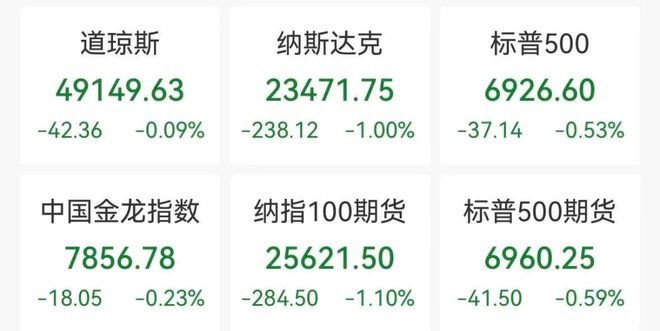
Market Overview - The three major U.S. stock indices closed lower on January 14, with the Dow Jones down 0.09%, S&P 500 down 0.53%, and Nasdaq down 1% [1] - Large tech stocks experienced declines, with Facebook, Amazon, and Microsoft each falling over 2%, while Tesla dropped nearly 2% and Nvidia fell over 1% [2] Technology Sector - The Philadelphia Semiconductor Index decreased by 0.6%, with Broadcom dropping over 4% and ARM and Marvell Technology each falling over 2% [3] - Intel saw an increase of over 3%, and AMD rose by over 1% [3] Chinese Stocks - The Nasdaq Golden Dragon China Index fell by 0.23%, with individual stocks showing mixed results; Bitdeer surged over 15%, while Ctrip Group dropped over 17% [4] Precious Metals - Silver reached a new high, with spot gold rising by 0.87% to $4626.1 per ounce, and COMEX gold futures increasing by 0.62% to $4627.7 per ounce [5] - UBS's Andrew Matthews indicated that silver prices could reach $100 per ounce by mid-2026, supported by supply shortages and increasing demand in industrial applications [5] Oil Market - International oil prices saw a significant drop, with WTI crude oil and Brent crude oil both falling by 3% at one point; however, WTI closed at $62.02 per barrel, up 1.42% [5] Cryptocurrency - Bitcoin continued to strengthen, rising nearly 2% to surpass $97,000 per coin, with over 120,000 liquidations occurring in the market within 24 hours [6] Economic Indicators - The Federal Reserve's Beige Book reported slight to moderate growth in consumer spending, with most regions experiencing stable employment conditions [7] - The probability of a 25 basis point rate cut in January is at 5%, while the likelihood of maintaining the current rate is at 95% [7] Federal Reserve Policy - Despite President Trump's pressure on the Federal Reserve for rate cuts, analysts suggest this may actually increase resistance to lowering rates [8] - Jamie Dimon, CEO of JPMorgan, emphasized the importance of the Fed's independence, warning that undermining it could lead to higher inflation expectations and interest rates over time [8]

美股全线下挫,科技七巨头、芯片股普跌,携程跌超17%,白银狂飙突破93美元
21世纪经济报道· 2026-01-14 23:27
记者丨金珊 张伟泽 吴斌 编辑丨黎雨桐 周三(1月14日),美国三大股指全线收跌,道指跌0.09%,标普500指数跌0.53%,纳指跌1%。 | 道琼斯 | 纳斯达克 | 标普500 | | --- | --- | --- | | 49149.63 | 23471.75 | 6926.60 | | -42.36 -0.09% | -238.12 -1.00% | -37.14 -0.53% | | 中国金龙指数 | 纳指100期货 | 标普500期货 | | 7856.78 | 25621.50 | 6960.25 | | -18.05 -0.23% | -284.50 -1.10% | -41.50 -0.59% | 大型科技股全线下跌,个股方面,脸书、亚马逊、微软跌超2%,特斯拉跌近2%,英伟达跌超1%。 | 名称 | 现价 涨跌幅 = | li | | --- | --- | --- | | 脸书(META PLATF | 615.520 -2.47% | | | META.O | | | | 亚马逊(AMAZON) | 236.710 -2.43% | | | AMZN.O | | | | 微软(MI ...

美股集体下跌,携程重挫18%,“妖镍”直线急升,加密货币反弹,超13万人爆仓
2 1 Shi Ji Jing Ji Bao Dao· 2026-01-14 15:45
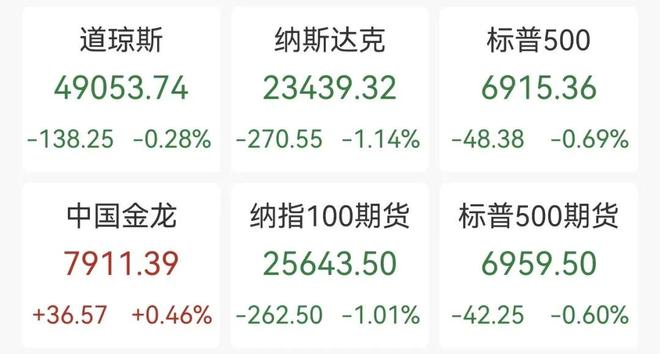
Market Overview - The US stock market experienced a collective decline, with the Nasdaq index dropping over 1% as of 23:00 [1] - The Dow Jones, Nasdaq, and S&P 500 indices closed at 49,053.74, 23,439.32, and 6,915.36 respectively, with declines of 0.28%, 1.14%, and 0.69% [2] Technology Sector - The technology sector saw significant losses, particularly in chip stocks, with ARM falling nearly 5% and other major companies like Nvidia and Marvell Technology declining around 2% [2][3] - The "big seven" tech companies in the US all experienced declines [2] Chinese Stocks - Several popular Chinese stocks faced downturns, with Ctrip initially plunging 18% due to an investigation by the market regulator for alleged monopolistic behavior [4] - Other Chinese companies like Dada Group and New Oriental also saw declines of over 3% [4] Precious Metals - Silver prices surged, breaking through $92 per ounce, marking a 28.6% increase year-to-date [5][6] - Gold prices also rose, reaching over $4,640 per ounce, with a 7.32% increase since the beginning of the year [6] Cryptocurrency Market - The cryptocurrency market rebounded significantly, with Bitcoin rising over 4% and Ethereum nearly 6% [8] - Over 130,000 traders faced liquidation in the past 24 hours, indicating high volatility [8][10] Economic Indicators - Despite lower-than-expected CPI data, the US stock market declined, reflecting concerns over political uncertainty, potential inflation rebound, and high valuation levels in the market [12][13] - The current valuation levels of US stocks, particularly in the tech sector, are perceived as high, leading investors to lock in profits and shift towards defensive strategies [13]
特朗普最新提议!金融股重挫!
证券时报· 2026-01-14 00:17
Market Overview - On January 13, US stock markets closed lower across the board, with the financial sector experiencing significant declines, impacting overall market performance [1][4][6] - The Dow Jones Industrial Average fell by 0.8% to close at 49,191.99 points, while the S&P 500 and Nasdaq indices dropped by 0.19% and 0.1%, closing at 6,963.74 and 23,709.87 points respectively [4][6] Financial Sector Performance - The financial sector saw a substantial drop, led by JPMorgan Chase, which fell over 4%. Other major financial stocks like Morgan Stanley, Goldman Sachs, Citigroup, Bank of America, and Wells Fargo also experienced declines of over 1% [6][7] - Visa's stock dropped more than 4%, with an intraday decline exceeding 5% [6] Technology Sector Performance - Major tech stocks showed mixed results, with Google rising over 1% while companies like Meta, Amazon, and Microsoft fell by more than 1%. Nvidia and Apple had gains of less than 1% [8] - The Philadelphia Semiconductor Index increased by 0.95%, reaching a new historical high, with notable gains from Intel (over 7%) and AMD (over 6%) [8] Energy Sector Performance - Energy stocks collectively rose, with ExxonMobil increasing by nearly 2% and other companies like Schlumberger and Occidental Petroleum rising over 1% [9] Precious Metals Market - The international silver price reached a new historical high, surpassing $89 per ounce, with an increase of over 2% on January 13. Since the beginning of 2026, the price has risen by more than 20% in less than 10 trading days [14][15] Chinese Concept Stocks - Chinese concept stocks generally declined, with the Nasdaq Golden Dragon China Index dropping by 1.86%. Notable declines included Brain Rebirth (over 26%) and WeRide (over 10%) [12][13] - However, some stocks like Canadian Solar and BeiGene saw gains of over 5% [13]

美股芯片股普跌,中概股集体大涨,知乎狂飙近22%,阿里涨超8%,黄金白银刷新高
21世纪经济报道· 2026-01-12 15:46
Market Overview - The U.S. stock market opened lower, with major indices showing a decline in pre-market trading [1] - Several semiconductor stocks experienced a drop, including Qualcomm, Lattice Semiconductor, and ON Semiconductor, which fell approximately 3% [1] Semiconductor Sector - Qualcomm's stock price is currently at $172.280, down 3.09% [2] - Lattice Semiconductor is priced at $82.190, down 3.08% [2] - ON Semiconductor is at $60.325, down 2.95% [2] - Intel and ARM also saw declines of nearly 2% [1] Banking Sector - The banking sector faced widespread declines, with Citigroup leading the drop at 3.40% [3] - Other banks like U.S. Bancorp and KB Financial Group also reported declines of 2.33% and 2.11%, respectively [3] Chinese Stocks - Chinese stocks showed a contrary trend, with the Nasdaq China Golden Dragon Index increasing by over 3% [3] - Notable gains included Zhihu and Kingsoft Cloud, which surged over 20% [4] Precious Metals - Gold prices reached $4,620 per ounce, marking an increase of over $300 in the first month of the year [5] - Silver prices also hit record highs, with COMEX silver rising over 8% in a single day [5] U.S. Treasury Bonds - The long-term U.S. Treasury bonds continued to decline, with the 30-year bond yield rising by 5 basis points to 4.86% [6] Dollar Index - The U.S. dollar index experienced a decline of over 0.3% during the day [6] Federal Reserve Investigation - A criminal investigation has been launched against Federal Reserve Chairman Jerome Powell, leading to a surge in gold and silver prices [9] - Analysts suggest that if the Fed loses its independence, it could lead to concerns about inflation and a weakening dollar, resulting in a "triple kill" scenario for stocks, currencies, and bonds [10]

美联储月末降息没戏?苹果加速CEO接班人计划
Shang Hai Zheng Quan Bao· 2026-01-10 01:11
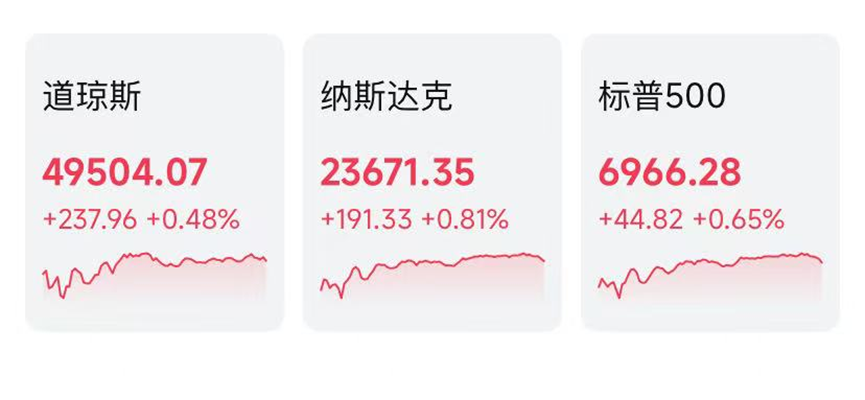
Group 1: Market Performance - The three major U.S. stock indices closed higher, with the Nasdaq rising nearly 1%, and both the Dow Jones and S&P 500 reaching all-time closing highs [1][2] - The Dow Jones increased by 0.48% to 49,504.07 points, while the S&P 500 rose by 0.65% to 6,966.28 points, and the Nasdaq gained 0.81% to 23,671.35 points [3] - For the week, the Dow Jones rose 2.32%, the S&P 500 increased by 1.57%, and the Nasdaq gained 1.88% [3] Group 2: Employment Data - The U.S. non-farm payrolls increased by 50,000 in December 2025, below the market expectation of 60,000, while the unemployment rate fell to 4.4%, better than the forecast of 4.5% [7][6] - Revisions showed that the non-farm payrolls for October were adjusted from -105,000 to -173,000, and for November from 64,000 to 56,000, indicating a total downward revision of 76,000 jobs for those two months [7] - The report alleviated severe concerns about labor market deterioration, which had prompted the Federal Reserve to lower interest rates in previous meetings [7] Group 3: Federal Reserve Outlook - The market currently estimates only a 5% probability of the Federal Reserve lowering interest rates at the next meeting [8] - The consensus is that the first rate cut by the Federal Reserve is expected in June 2026, with an anticipated total reduction of about 50 basis points throughout the year [8] Group 4: Apple Inc. Leadership Transition - Apple is accelerating the selection process for a successor to CEO Tim Cook, with John Ternus, the current Senior Vice President of Hardware Engineering, being the leading candidate [10][12] - Ternus, who joined Apple in 2001, has been instrumental in the development of several groundbreaking products and is recognized for his collaborative management style [12] - Other candidates being considered include Craig Federighi, Eddy Cue, and Greg Joswiak, with a potential announcement expected after the January earnings report [12]


软银投资(上)孙正义的“金蛋”大赚
3 6 Ke· 2026-01-06 04:13
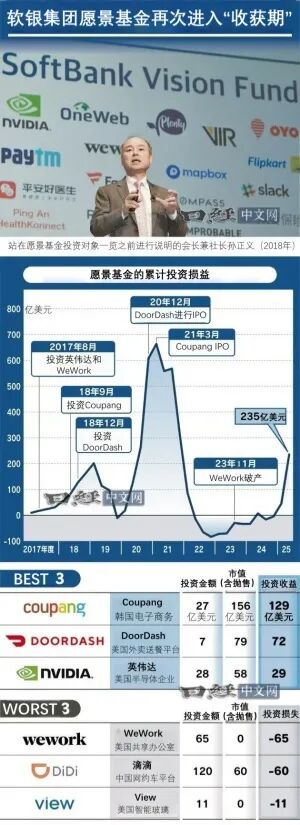
Core Insights - SoftBank Group's Vision Fund has shown strong performance, with total investments reaching $163.2 billion (approximately 25.3 trillion yen) and pre-tax investment returns of about 3.7 trillion yen as of September 30 [2][3] Group 1: Fund Performance - The Vision Fund was launched in 2017 with a scale of 10 trillion yen, and a second fund was established in 2019 [2][3] - The Vision Fund's investment returns recovered to nearly 3 trillion yen in the July-September quarter, marking a significant turnaround after challenges including the bankruptcy of WeWork [3] - The fund's largest successful investment is in Coupang, a South Korean e-commerce giant, which has seen its value increase to $15.6 billion, yielding a net profit of $12.9 billion [4] Group 2: Investment Strategy - SoftBank's investment strategy includes a focus on AI, with plans to invest an additional $22.5 billion in OpenAI, bringing total investments to $34.7 billion [9] - The second fund has faced challenges, with a current investment of $73.7 billion and a loss of $9.1 billion, primarily due to high entry prices for unlisted stocks [5] - The CFO expressed confidence in future IPOs, including potential listings for companies like Chime and Klarna, which could revitalize the second fund's performance [5] Group 3: ARM Investment - SoftBank's direct investment in ARM has generated a significant paper profit of 15 trillion yen, with ARM's value accounting for 18 trillion yen of the total 40 trillion yen in stocks held by SoftBank [6] Group 4: Market Sentiment - Despite the positive outlook for AI investments, SoftBank's stock has experienced volatility, dropping 40% within a month after reaching a historical high in October 2025 [9] - The market remains cautious about SoftBank's heavy investment in AI, indicating potential for continued stock price fluctuations [9]

软银投资(上)孙正义的“金蛋”大赚
日经中文网· 2026-01-06 02:50
Core Viewpoint - SoftBank Group's Vision Fund has shown strong performance, with total investments reaching $163.2 billion (approximately 25.3 trillion yen) and pre-tax investment returns of about 3.7 trillion yen as of September 30 [2][6]. Group 1: Fund Performance - The Vision Fund's investment returns have rebounded to nearly 3 trillion yen in the July-September quarter, marking a recovery after years of challenges, including the bankruptcy of WeWork [3][4]. - The first Vision Fund has generated a profit of $32.8 billion despite significant losses from WeWork, while the second fund, which started investing in 2019, has faced difficulties with a current loss of $9.1 billion on investments totaling $73.7 billion [7][8]. Group 2: Key Investments - Coupang, a South Korean e-commerce giant, has been the most profitable investment for SoftBank, with a return of 5.7 times the initial investment, reaching a value of $15.6 billion [6][7]. - DoorDash, a U.S. food delivery platform, generated $7.2 billion in profit, with an investment return of 11.7 times, and all shares have been sold [7]. - The second fund's most profitable investments include Beike, Symbotic, and Swiggy, with returns of $1.1 billion, $800 million, and $300 million respectively [7]. Group 3: Future Outlook - The second fund's underperformance is attributed to high entry prices for unlisted stocks, but upcoming IPOs, including Chime and Klarna, are expected to improve performance [8]. - SoftBank's CFO expressed confidence in future IPOs and the potential for recovery in the second fund's performance [8]. - The company plans to invest an additional $22.5 billion in OpenAI, bringing the total investment to $34.7 billion, aligning with the "ALL IN AI" strategy [12].

国产芯片设计的突围与机遇
2026-01-04 15:35
Summary of Semiconductor Industry Conference Call Industry Overview - The global semiconductor market is projected to exceed $700 billion by 2025, with AI chips and automotive electronics being the primary growth drivers [3][5] - China's semiconductor design industry is expected to surpass $118 billion in sales by 2025, reflecting a nearly 30% year-on-year growth [3][5] - By 2025, it is anticipated that there will be 831 Chinese semiconductor companies with sales exceeding $1 million, with the Yangtze River Delta region emerging as a core industrial cluster [3][5] Key Insights - The semiconductor design segment is crucial in the industry, akin to architects in construction, determining core functions and performance metrics of chips [3] - The global chip design market is dominated by U.S. companies, which account for 85% of total revenue, while Chinese firms have made strides in communication, image sensors, and some AI sectors but still lag in high-end CPUs [3][5] - Domestic chip design companies have shown significant vitality, with a compound annual growth rate of nearly 20% from 2006 to 2025 [5] Policy and Support - National policies are critical for the development of the semiconductor industry, with initiatives like the Big Fund addressing long investment cycles and high risks [6][7] - The "East Data West Calculation" project is providing significant market opportunities for domestic GPUs and AI [6][7] Challenges and Bottlenecks - The domestic EDA tools and IP market is experiencing structural bottlenecks, with only about 11.5% of EDA tools being domestically produced, particularly in advanced process designs [8] - High-end IP, such as CPU and GPU cores, still heavily relies on international suppliers like ARM and NVIDIA [8] Fabless Model Advantages - The Fabless model offers advantages such as asset-light operations and a focus on innovation, allowing companies to concentrate resources on chip design and algorithm optimization [9] - The boundaries between design and manufacturing are becoming blurred, necessitating a high degree of integration across the supply chain [9] IPO Trends in GPU Sector - The recent surge in IPOs among domestic GPU companies reflects a combination of explosive demand, technological maturity, and funding needs [10] - Despite many companies currently operating at a loss, achieving revenue scales of $1.5 to $2 billion will enhance profitability through economies of scale [13] Investment Considerations - The core investment logic in the chip design industry revolves around technological, ecological, and scenario barriers [14] - Key financial indicators to monitor include R&D investment, gross margin (ideally above 40%), and revenue growth rates [14] - Risks include potential underperformance in R&D, revenue shortfalls, and customer concentration risks [15] Future Trends and Growth Engines - Over the next 3-5 years, the industry is expected to see increased technological autonomy, diversification of application scenarios, and tighter ecological collaboration across the supply chain [16][17] - Potential growth areas include AI computing chips, automotive electronics, edge computing chips, and advanced packaging technologies [20] Investment Opportunities for Risk-Averse Investors - Risk-averse investors may consider index-based investments, such as the STAR Market chip design index, to diversify risk while capitalizing on industry growth [19] - ETFs that encompass leading companies in the semiconductor sector can provide a balanced approach to investment [19]