SK On

Search documents
美电动车补贴政策调整,欧美电动车需求走弱,韩国三大电池巨头去年第四季度均亏损
Huan Qiu Shi Bao· 2026-01-19 22:59
Group 1 - The core issue is that the three major South Korean battery manufacturers, LG Energy Solution, Samsung SDI, and SK On, reported operating losses in Q4 of last year due to changes in U.S. electric vehicle subsidy policies and weakening demand in Europe and the U.S. [1] - LG Energy Solution recorded an operating loss of approximately 1.22 trillion KRW (about 1.14 billion USD), which could increase to 4.55 trillion KRW if U.S. tax incentives are excluded [1] - Samsung SDI and SK On are also expected to incur significant losses, with estimates of 300.3 billion KRW and 2000 billion KRW respectively [1] Group 2 - The U.S. electric vehicle market has shown a significant decline, with new electric vehicle sales dropping by 48.9% month-on-month to 74,800 units in October last year [2] - Predictions for the U.S. electric vehicle market in 2023 are cautious, with a projected year-on-year decline of 29%, totaling around 1.1 million units [2] - The European market, where South Korean manufacturers are heavily invested, is also experiencing a slowdown, influenced by the EU's decision to withdraw plans to ban new gasoline vehicles by 2035 [2] Group 3 - The changes in market demand have affected the supply chain, leading LG Energy Solution to cancel contracts worth approximately 13.5 trillion KRW for electric vehicle batteries [2] - SK On has also terminated its joint battery factory project with Ford in the U.S. due to the changing market environment [2] - Earnings forecasts for the three major battery companies have been revised downwards, with LG Energy Solution's Q1 operating profit expected to drop from 502.4 billion KRW to 183 billion KRW [2]
30+固态电池企业新进展
DT新材料· 2026-01-19 22:33
Core Viewpoint - The article discusses the advancements and production timelines of solid-state batteries from various companies, highlighting the competitive landscape and technological progress leading up to 2026 and beyond [4]. Group 1: Company Developments - CATL launched the world's first sulfide solid-state battery pilot line in Hefei in May 2025, achieving an energy density of 450Wh/kg, with plans to expand production capacity to 50GWh by 2026 [6]. - Guoxuan High-Tech introduced its "Guan" quasi-solid-state square aluminum shell cell with an energy density greater than 300Wh/kg and initiated a pilot line with a 90% yield rate in May 2025 [8]. - EVE Energy's solid-state battery, "Longquan No. 2," achieved an energy density of 300Wh/kg and is aimed at high-end applications like humanoid robots and low-altitude aircraft [8]. - Aoxin Technology plans to launch its polymer solid-state battery with an energy density of 400Wh/kg by the end of 2025, targeting high-end new energy vehicles [8]. - Ganfeng Lithium announced the mass production of lithium sulfide, completing the last link in the solid-state battery ecosystem, with plans to launch solid-state batteries by the end of 2025 [9]. Group 2: Industry Trends - The solid-state battery industry is expected to enter a critical year in 2026, with many companies racing to achieve mass production [4]. - The article outlines the competitive landscape, with over 30 companies making significant strides in solid-state battery technology, indicating a robust growth trajectory in the sector [4]. - The anticipated commercialization of solid-state batteries is projected for around 2030, as supply chains mature and production processes are refined [6].




内地出口增长韧性进一步夯实:环球市场动态2026年1月16日
citic securities· 2026-01-15 03:07
Market Overview - A-shares opened high but closed lower, with the financing margin ratio adjustment cooling the market; Hong Kong stocks rose, driven by AI applications boosting tech stocks[3] - European markets slightly retreated, with energy and resource stocks performing well; US stocks weakened, particularly in tech, while healthcare and resource stocks supported the market[3] Economic Indicators - China's December exports increased by 6.6% year-on-year, significantly above the expected 2.2%, while imports rose by 5.7%, also exceeding expectations of a 0.3% decline[5] - The resilience in non-US exports, particularly in the semiconductor and automotive sectors, contributed to the stronger export performance[5] Commodity and Forex Markets - Safe-haven demand lifted metal prices, with gold, silver, tin, and copper reaching new highs; oil prices fell nearly 3% in early Asian trading due to geopolitical tensions easing[4] - The US Treasury yields declined by 2-5 basis points, with the yield curve flattening amid increased demand for safe assets[4] Stock Market Performance - The Dow Jones closed at 49,149.6, down 0.1%; S&P 500 fell 0.5% to 6,926.6; Nasdaq dropped 1.0% to 23,471.8[7] - In Latin America, the São Paulo Stock Exchange index rose by 2.0%, while the S&P Mexico IPC index increased by 1.6%[8] Sector Highlights - In the Hong Kong market, the Hang Seng Index rose by 0.56%, driven by tech stocks, particularly in AI applications, with Alibaba Health surging by 18.9%[10] - The energy sector in the US saw a notable increase of 2.26%, while the non-core consumer goods sector led declines with a drop of 1.75%[8] Fixed Income Market - The primary market saw $12.6 billion in investment-grade bonds issued, with strong demand reflected in an average oversubscription of 5.6 times[30] - Asian investment-grade bonds showed positive sentiment, with spreads generally narrowing due to strong buying interest[30]
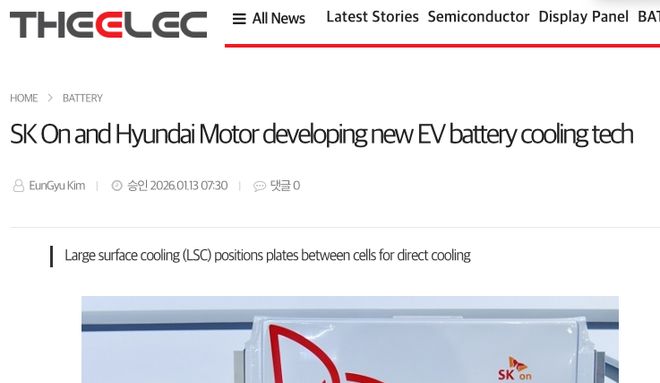
SK On与现代汽车联手开发新型电动汽车电池冷却技术
Huan Qiu Wang Zi Xun· 2026-01-13 08:57
Group 1 - SK On and Hyundai Motor are collaborating to develop a new electric vehicle battery cooling technology called Large Surface Cooling (LSC) technology [1][3] - LSC technology innovatively places cooling plates between battery cells for direct cooling, enhancing heat dissipation compared to traditional methods [3] - SK On's main product is soft-pack batteries, which typically use polyurethane or silicone materials to connect cells, but LSC technology replaces traditional mica insulation with metal heat sinks for improved cooling [3] Group 2 - The development of LSC technology began in the second half of last year, and it is currently undergoing validation for automotive application [3] - The commercialization of LSC technology will ultimately be decided by Hyundai Motor, which prefers surface cooling over liquid cooling, adding uncertainty to LSC's future [3] - SK On and its competitors, LG Energy Solution and Samsung SDI, have started using cooling plates in their energy storage systems, where coolant flows inside the plates to absorb and dissipate heat [3][4] Group 3 - Liquid cooling technology may only be applied to higher-priced models due to cost concerns, leading SK On and Hyundai to slow down its development [4]
35GWh!比亚迪等5企再拓储能产能
行家说储能· 2026-01-09 12:10
Core Viewpoint - The energy storage sector is experiencing significant capacity expansion, with multiple companies, including BYD, Guokai Energy, and Haopeng Technology, planning to increase their production capacity by a total of 35GWh in response to a surge in industry orders [1]. Group 1: BYD - BYD has initiated the construction of the third phase of its new energy power battery production base, planning a capacity of 15GWh for energy storage batteries, with a total investment of 5 billion yuan [2]. - The project timeline began in August 2021, with the agreement signed for investment in Shengzhou, and the total planned capacity is close to 100GW, with an investment amount reaching hundreds of billions [3]. - By the end of 2025, BYD's planned battery capacity is expected to reach 655GWh, with potential further increases to 810GWh in the next 1-2 years [3]. Group 2: Guokai Energy - Guokai Energy has launched the first phase of its 30GWh new energy battery production base in Gansu, focusing on a modern production base for 10GWh lithium iron phosphate energy storage cells, with an investment of 2.8 billion yuan [4]. - The company also has an intelligent manufacturing base in Anqing, Anhui, which is planned to achieve an annual output value exceeding 5 billion yuan [6]. Group 3: Haopeng Technology - Haopeng Technology plans to raise up to 800 million yuan for the construction of a 3GWh energy storage battery production line and a steel shell stacked lithium battery project [7]. - The total investment for the energy storage battery project is approximately 447.29 million yuan, with a focus on high-growth and high-value-added energy storage applications [8]. Group 4: Spring Sheng New Energy - Spring Sheng New Energy is set to establish a 4GWh energy storage battery production project in Shijiazhuang, with a total investment of 500 million yuan [11]. Group 5: SK On - SK On has officially launched a major capacity construction project in South Korea, aiming to establish a 3GWh battery production line specifically for energy storage systems, focusing on lithium iron phosphate (LFP) batteries [12]. - This project is the largest LFP battery production facility in South Korea and is part of the government's goal to expand energy storage system capacity to 138GWh by 2038 [13].

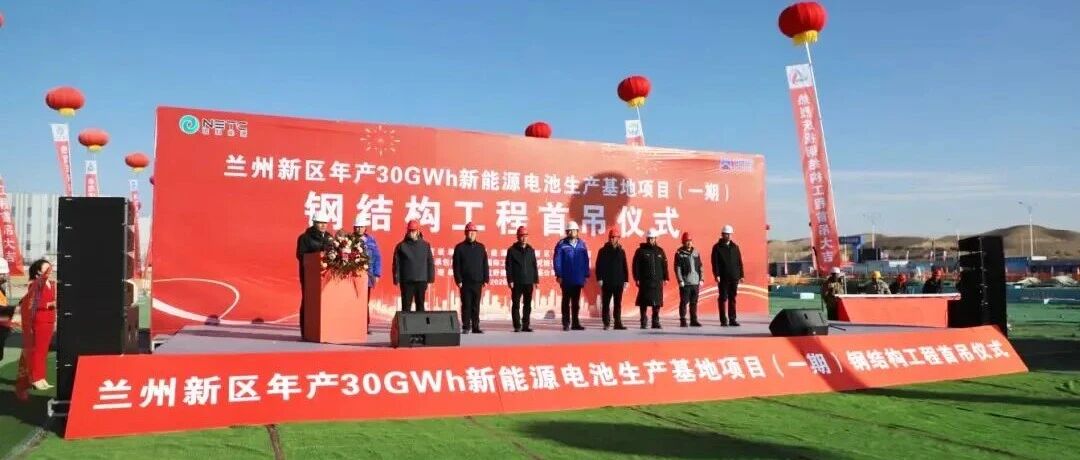
SK On首席执行官在CES会展上参观吉利展台并与公司高管会面
Xin Lang Cai Jing· 2026-01-07 05:18
他说:"现代汽车是 SK On 的核心合作伙伴兼可靠盟友。我们计划在乔治亚州建立一家电动汽车电池电 芯生产合资企业的工作正在推进中,预计今年将开始生产。" 李硕熙表示,SK On 正试图拓展其业务组合,以应对当前电动汽车需求的放缓局面,并且在与美国福特 汽车公司终止电池合资企业合作关系后,正在进行重组。 韩国电池制造商SK On的首席执行官李硕熙(Lee Seok-hee)当地时间周二在拉斯维加斯举行的 2026 年 国际消费电子展(CES)上探讨了与吉利汽车和现代汽车集团拓展业务合作的可能机会。 "我是应客户的要求前来参加CES的,"李硕熙在参观完拉斯维加斯会议中心吉利汽车的展台后说,"我 计划与客户会面,并研究结合人工智能和出行技术的最新趋势。" 在参观了吉利汽车的展台后,李硕熙与这家中国汽车制造商的高层管理人员进行了会面,其中包括副总 裁李传海。 李硕熙表示,SK On 正试图拓展其业务组合,以应对当前电动汽车需求的放缓局面,并且在与美国福特 汽车公司终止电池合资企业合作关系后,正在进行重组。 他说:"我将加快提升盈利能力的步伐,通过扩大基于磷酸铁锂的储能系统业务来实现这一目标。我预 计到今年年底将会看 ...

手握3200亿现金与5500亿债务压顶:“宁王”不停融资的A面B面
投中网· 2025-12-31 03:04
Core Viewpoint - CATL is actively seeking to raise funds through bond issuance despite having substantial cash reserves, indicating a strategic response to increasing competition and the need for aggressive expansion in the battery market [5][6][9]. Financial Position - CATL plans to issue bonds up to RMB 10 billion, with proceeds aimed at project construction, operational funding, and debt repayment [6]. - As of Q3, CATL holds cash reserves of RMB 324.24 billion, significantly higher than its peers [6]. - The company's financial assets increased by 202.9% year-on-year to RMB 43.26 billion, with investment income rising by 67.46% to RMB 5.24 billion [6]. Market Competition - CATL's market share in the power battery sector has declined to 41.7% in Q3 2025, down from 45.3% in the same period of 2024, marking the lowest level in five years [9]. - Competitors like Yiwei Lithium Energy have shown strong growth, with a 66.98% increase in battery shipments and a rise in market share from 3% to 4.6% [9][10]. Expansion Plans - CATL is aggressively expanding production capacity, with construction projects in various locations, leading to a 48.27% increase in ongoing projects year-on-year, totaling RMB 37.37 billion [11]. - The company is also investing heavily in overseas projects, with total investments in three major projects reaching RMB 136.7 billion [12][17]. Debt and Financing Strategy - CATL's total liabilities are projected to exceed RMB 600 billion this year, reflecting a significant increase in debt levels over recent years [18][22]. - The company's debt-to-asset ratio was 61.27% in Q3 2025, higher than the industry average of 48.67% [21]. - CATL has adopted a high-leverage financial strategy, which could pose risks if market conditions deteriorate [22].

Factorial Energy Plans IPO: What It Means for QS and SLDP
ZACKS· 2025-12-30 13:35
Core Insights - The solid-state battery sector is experiencing increased activity, with Factorial Energy planning to go public in mid-2026 to raise $100 million for its battery technology [1][3] - The public listing is expected to enhance investor interest in the solid-state battery market and raise questions about the positioning of established players like QuantumScape and Solid Power [2] Factorial's Public Debut - Factorial will go public through a SPAC merger with Cartesian Growth Corporation III, valuing the company at approximately $1.1 billion and allowing it to avoid traditional IPO hurdles [3] - The company aims to start trading on Nasdaq under the ticker FAC around mid-2026 [3] Partnerships and Technology - Factorial collaborates with major automakers such as Mercedes-Benz, Stellantis, and Hyundai, which facilitates real-world testing and commercialization of its batteries [4] - The company's solid-state batteries promise higher energy storage, lighter weight, faster charging, and longer driving ranges compared to conventional lithium-ion cells [4] Performance Potential - In tests, a Factorial battery cell enabled a prototype vehicle from Mercedes to travel nearly 750 miles on a single charge, indicating significant potential for electric vehicles [5] - Factorial's batteries are expected to first appear in high-performance or luxury vehicles, with plans to expand into more affordable models over time [5] Industry Context - Solid-state batteries represent the next evolution in EV energy storage, offering improved safety and energy density compared to lithium-ion cells [6] - Despite their promise, challenges remain in scaling production, with high costs and complex manufacturing processes posing significant hurdles [7] Competitive Landscape - Factorial enters a competitive space that includes QuantumScape and Solid Power, both of which are also focused on solid-state battery development [8] - QuantumScape has made strides in manufacturing and testing, with its Cobra process being 25 times faster and more compact than previous systems, showcasing tangible progress [9] - Solid Power emphasizes collaborations with automakers like BMW and Ford, advancing pilot-scale production and focusing on operational efficiency [10][11] Investor Considerations - Investors are evaluating the three companies based on risk versus visibility, with QuantumScape providing a clearer roadmap but facing execution risks, while Solid Power has strong OEM ties and measured progress [12] - Factorial, being newer and less proven, benefits from strong partnerships and a significant capital injection from its SPAC merger, potentially accelerating early adoption of its technology [12] Overall Implications - Factorial's upcoming IPO is a significant development in the solid-state battery sector, potentially accelerating industry momentum and pushing automakers towards faster adoption of solid-state technology [13]

三星SDI再获百亿元铁锂大单
起点锂电· 2025-12-29 10:32
Core Viewpoint - Samsung SDI is undergoing a significant strategic shift by signing a new contract worth over 2 trillion KRW (approximately 9.68 billion RMB) to supply square lithium iron phosphate (LFP) batteries for energy storage systems in the U.S. market, transitioning its electric vehicle battery production lines to energy storage battery production lines by 2027 [2]. Group 1 - Samsung SDI has signed an agreement to supply LFP batteries for energy storage systems to U.S. customers, with a contract value exceeding 2 trillion KRW, starting deliveries in 2027 over a three-year period [2]. - The production of energy storage system battery cells will commence at Samsung SDI's facility in Indiana, which is being repurposed from electric vehicle battery production to LFP energy storage battery production [2]. - The new battery products will be integrated into the second generation of Samsung Battery Box (SBB 2.0), offering high performance, enhanced safety, and competitive pricing to support stable power supply in the renewable energy and AI era [2]. Group 2 - Samsung SDI is currently the only non-Chinese manufacturer of square batteries in the U.S., utilizing hard aluminum shell packaging that provides better resistance to external impacts and lower heat generation compared to common soft-pack cells [3]. - In November, Samsung SDI was reported to be in discussions with Tesla regarding battery supply, with indications that an agreement may lead to the supply of approximately 10 GWh of energy storage system batteries annually for at least three years, potentially exceeding 3 trillion KRW (around 15 billion RMB) in total procurement value [6]. - Samsung SDI has at least two major factories in North America, one in partnership with Stellantis in Kokomo, Indiana, expected to start production in 2025 with an initial capacity of 23 GWh, and another in New Carlisle, Indiana, in partnership with General Motors, projected to begin large-scale production in 2027 with a capacity of 27 GWh [6].

锂电巨头丢掉近200亿元合同!
鑫椤锂电· 2025-12-29 07:05
Group 1 - LG Energy Solution has announced the termination of a supply contract with US-based Fraunhofer Battery Power Systems, valued at 3.9 trillion KRW (approximately 19 billion RMB) [1] - Just a week prior, LG Energy Solution lost a battery supply order worth 9.6 trillion KRW (approximately 45.7 billion RMB) due to Ford's significant adjustment of its electric vehicle strategy [2] - The recent announcements indicate that LG Energy Solution has lost a total of 13.5 trillion KRW (approximately 65.7 billion RMB) in potential revenue within a span of less than 10 days, which is equivalent to half of the company's total revenue of 25.62 trillion KRW last year [2] Group 2 - Ford has announced plans to transform its unfinished electric vehicle battery factory into a storage business, leveraging technology licensed from CATL to capitalize on AI power demand opportunities [2] - Another South Korean battery company, SK On, has also terminated its joint venture with Ford this month, highlighting the challenges faced by the automotive industry [2]