
巨子生物

Search documents
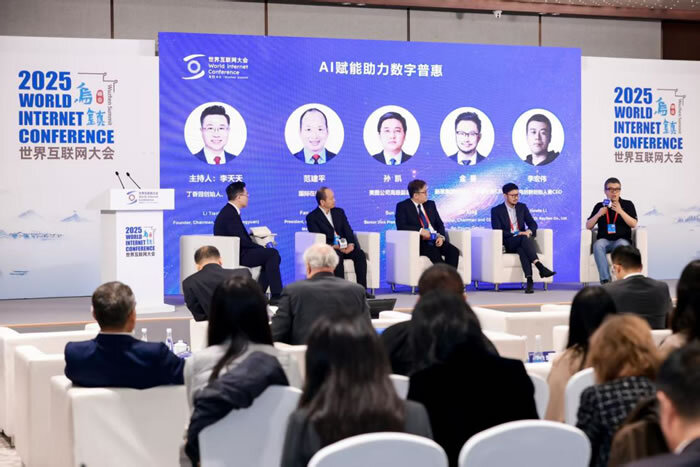
新氧创始人金星出席世界互联网大会:数智技术加速医美行业实现“营销驱动”向“交付驱动”转型
Zhong Guo Jing Ji Wang· 2025-11-09 01:50
Core Insights - The 2025 World Internet Conference held from November 6 to 9 focused on building a collaborative and inclusive digital future, with discussions on AI technology and the digital economy [1] - Jin Xing, founder and CEO of New Oxygen Group, highlighted the transformation of the medical beauty industry from a marketing-driven model to a user experience-centered delivery model, driven by AI and digitalization [1][3] Industry Overview - The Chinese medical beauty market is projected to reach 312 billion yuan in 2024, with a year-on-year growth of 14.8% [3] - The rise of diverse aesthetic values and the "self-appreciation economy" has made medical beauty a representative of new consumption [3] - However, uneven distribution of medical resources and high product prices have led to a trust crisis among consumers [3] Company Strategy - New Oxygen has implemented vertical integration and cost structure optimization since 2021, enhancing the safety, quality consistency, and inclusiveness of medical beauty services through digitalization and AI [3][4] - The company has established standardized fulfillment and dynamic quality control mechanisms to unify service quality across its stores [4][5] - New Oxygen has opened 41 stores in 10 major cities, becoming the largest chain in the light medical beauty sector in China [3] AI and Digitalization - New Oxygen has explored various AI applications in medical beauty, including intelligent skin detection and cross-regional store management, with five AI algorithms registered with the National Internet Information Office [7][8] - The company faces challenges in deep AI application due to high costs and the need for extensive multimodal data [8] - Jin Xing emphasized the importance of overcoming technical challenges to expand AI applications in the medical beauty sector [8] Pricing and Consumer Trust - The average customer price for light medical beauty in China is approximately 3,146 yuan, which is nearly equal to the average monthly disposable income [10] - High prices have contributed to the rise of "black medical beauty," creating potential medical risks [10] - New Oxygen aims to reduce marketing and supply chain costs from 60-80% to below 20% through vertical integration and digital operations, establishing a transparent pricing system [10] Regulatory Environment - Recent government policies are accelerating changes in the medical beauty pricing system, with efforts to streamline clinical trial approval processes [11] - The approval of various popular medical beauty products is expected to shift the market from a seller's market to a buyer's market, enhancing consumer trust [11] - New Oxygen is committed to maintaining transparency and quality in its services while expanding its store network [11]

直播惹祸?高位回撤近40%,三季度遭基金减持!潮玩巨头怎么了?
证券时报· 2025-11-08 11:07
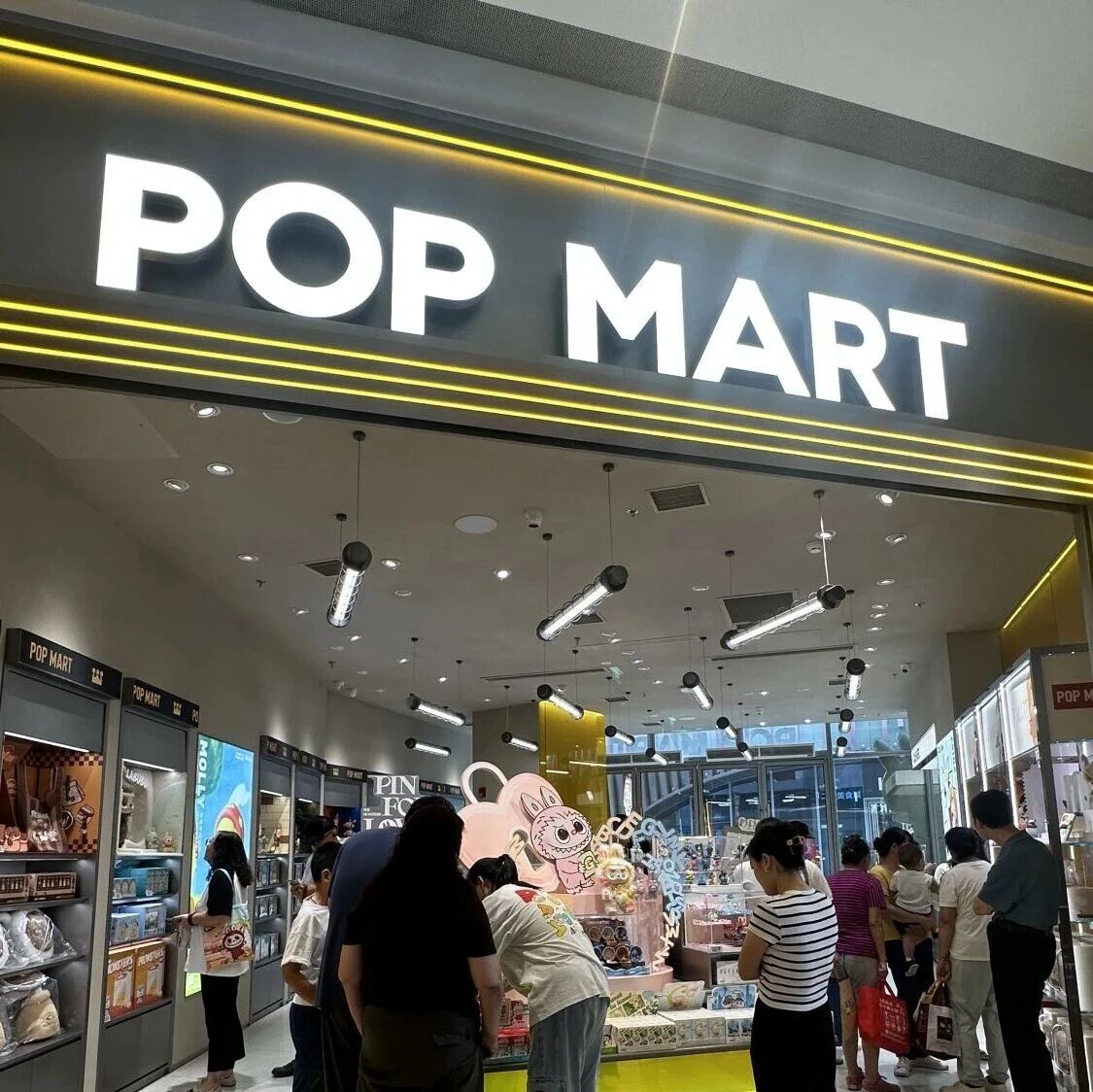
Core Viewpoint - The article discusses the significant decline in Pop Mart's stock price due to a "live streaming incident," which resulted in a market value loss of over 170 billion HKD in a single day. Despite impressive quarterly earnings, concerns about the sustainability of its popular IPs have led to a mixed response from public funds [1][3][6]. Stock Performance - Pop Mart's stock price fell by 5.88% on November 7, closing at 204.8 HKD per share, with a cumulative decline of nearly 40% over the past 50 trading days [3][4]. - The stock had previously reached a high of 339.8 HKD per share in August, with a market capitalization exceeding 450 billion HKD [3]. Financial Performance - In Q3, Pop Mart reported a revenue growth of 245%-250% year-on-year, with domestic revenue increasing by 185%-190% and overseas revenue by 365%-370% [3][4]. - Despite these strong financial results, the stock price continued to decline, attributed to falling second-hand market prices for its popular IP LABUBU and ongoing market concerns about future performance sustainability [3][4]. Fund Activity - Public funds showed a trend of reducing their holdings in Pop Mart during Q3, with the number of funds holding the stock decreasing from 286 to 180, and the number of shares held dropping by approximately 31% [6][7]. - Some funds, however, chose to increase their positions, citing the potential for a second wave of growth due to expanding fan bases and overseas market penetration [7][8]. Market Impact - The decline in Pop Mart's stock has negatively affected other consumer stocks, with notable declines in companies like Giant Bio and Anta Sports, among others [4]. - The Hang Seng Consumer Index has also seen a drop of over 6% in Q4, reflecting broader market challenges [9]. Future Outlook - Fund managers express optimism about the new consumption sector, anticipating opportunities during upcoming shopping festivals and the holiday season [9][10]. - The trend of "going overseas" is highlighted as a key growth factor for consumer brands, with increasing competitiveness of Chinese brands in international markets [10][11].
直播惹祸?高位回撤近40%,三季度遭基金减持!潮玩巨头怎么了?
券商中国· 2025-11-08 03:25
Core Viewpoint - The article discusses the recent decline in Pop Mart's stock price due to a "live streaming incident," which resulted in a significant market value loss, despite strong financial performance in Q3 [1][3]. Group 1: Stock Performance - On November 7, Pop Mart's stock dropped by 5.88%, leading to a market value loss of over 17 billion HKD [1]. - The stock has seen a nearly 40% decline over the past two months after reaching a high of 339.8 HKD per share in August [2][3]. - Despite a strong Q3 report showing a revenue increase of 245%-250%, the stock price continued to fall, attributed to concerns over the sustainability of its popular IP products [3][5]. Group 2: Fund Management and Market Sentiment - Public funds have shown a mixed response, with a reduction in the number of funds holding Pop Mart shares from 286 to 180 in Q3, and a decrease in heavy holdings by approximately 31% [5][6]. - Some funds have chosen to increase their positions, citing the potential for a second wave of growth due to expanding fan bases and overseas market penetration [2][6]. Group 3: Industry Context and Future Outlook - The decline in Pop Mart's stock has negatively impacted other consumer stocks, with significant drops observed across various companies in the sector [4]. - The overall consumer sector has faced challenges, but there is optimism for recovery during upcoming shopping festivals and the holiday season [7][8]. - The trend of "going overseas" is highlighted as a key growth factor for consumer brands, with increasing competitiveness in international markets [8][9].

美妆产业专题:大众赛道竞相追逐,百花齐放
2025-11-07 01:28
Summary of the Beauty Industry Conference Call Industry Overview - The beauty industry is experiencing intense competition, particularly during the 2025 Double Eleven shopping festival, where consumer voting power has increased to 60%, putting pressure on brands, especially domestic and unlisted ones [1][2][9] - A total of 88 brands participated in negotiations for 166 SKUs, with beauty products accounting for nearly 70% of the total [2][4] Key Insights and Arguments - Domestic brands performed exceptionally well during the 2025 Double Eleven, actively participating and offering significant discounts to enhance visibility [1][4] - International brands such as Estée Lauder and LVMH only had limited participation, with Make Up For Ever being the only brand from LVMH, while mid-to-high-end brands like L'Oréal Paris also participated [4] - The strategy for beauty brands included a combination of classic products and bestsellers, with deeper discounts offered. Some international brands adopted a "no price increase" strategy, with discounts going as low as 40% [1][5] - Domestic brands introduced new products with "no return" mechanisms to attract new users, while international brands launched IP collaboration products to appeal to younger consumers [1][5] Competitive Strategies - Beauty brands are enhancing competitiveness through product upgrades, maintaining stable prices, and innovation backed by evidence [6][7] - Notable examples include domestic brands like 彩棠, which upgraded its contour palette five times in six years, and 完美日记, which adapted to market demands by participating in major promotions [8] - Brands are also leveraging IP collaborations and unique packaging designs to attract younger demographics, such as 欧莱雅's collaboration with 熊猫花花 for a small eye cream [5][7] Market Trends - The beauty market is shifting towards a buyer's market, with increased consumer power and a greater presence of domestic brands [3][9] - New emerging brands are actively seeking exposure, with many participating in the "All Girls Offer" event, showcasing the overall operational capabilities of domestic brands [8] Risks and Challenges - The beauty market faces risks from macroeconomic fluctuations affecting consumer purchasing power and intense competition [10] - Brands must quickly respond to market changes, understand consumer preferences, and adapt to new consumption methods to remain competitive [10]

全面下滑,这家巨头恐跌出全球美妆十强
3 6 Ke· 2025-11-07 00:21
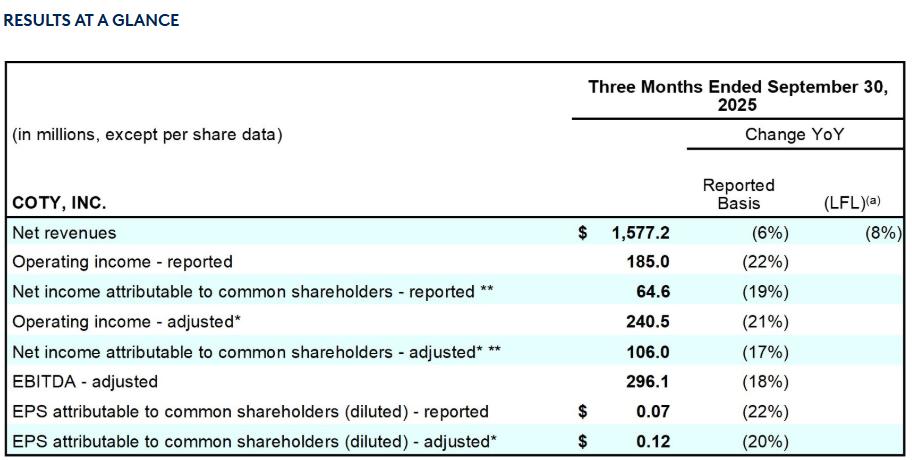
Core Viewpoint - Coty Inc., a century-old French perfume giant, is facing significant challenges, including declining performance across all business segments, plans to divest its mass cosmetics division, and the potential loss of the Gucci brand license, which could severely impact its revenue and profitability [1][28]. Financial Performance - For Q1 of fiscal year 2026, Coty's net revenue was $1.577 billion, a decrease of 6% year-over-year, and an 8% decline on a like-for-like basis [2][9]. - The reported net income was $64.6 million, down 19%, with a net profit margin of 4.1% [2][9]. - The mass beauty segment reported an operating loss of $7.7 million, with a loss rate of 1.5%, and an adjusted operating profit margin of 0.3%, down from 4.3% the previous year [9][28]. Business Segment Analysis - The high-end beauty segment generated $1.07 billion in net revenue, accounting for 68% of total sales, with a reported decline of 4% and a like-for-like decline of 6% [6][9]. - The mass beauty segment's net revenue was $508 million, representing 32% of total sales, with a reported decline of 9% and a like-for-like decline of 11% [6][9]. Regional Performance - All three major regions reported declines, with the Asia-Pacific region experiencing the largest drop of 9%, although there are signs of gradual improvement in the Chinese market [10][12]. - The European, Middle Eastern, and African markets, as the largest revenue source, saw a reported decline of 4% and a like-for-like decline of 9% [21][12]. Competitive Landscape - Coty is losing market share in the competitive global beauty landscape, particularly in the high-end fragrance segment, where it faces intense competition from companies like L'Oréal and Estée Lauder [24][28]. - The potential loss of the Gucci Beauty license, which contributes approximately 8% to Coty's sales and 11% to its profits, poses a significant risk to its future as an independent company [28][30]. Strategic Focus - Coty is focusing on optimizing its remaining high-end beauty operations and exploring new partnerships, while also emphasizing its core strength in the fragrance category [29][30]. - The company has appointed a new president for its mass beauty division, indicating a strategic shift aimed at addressing its current challenges [29].

被港股通资金 “越跌越买”,昊海生物科技能否找到估值回升的钥匙
Zhi Tong Cai Jing· 2025-11-06 14:16
Core Viewpoint - Haohai Biological Technology has been actively repurchasing its shares, indicating a strategy to support its stock price amid declining performance metrics in the medical aesthetics sector [1][4]. Share Buyback Activity - The company spent HKD 805,700 to repurchase 29,600 shares on November 5, marking the third consecutive trading day of buybacks in November [1]. - In total, Haohai has conducted 23 share buybacks this year, with 11 in the first half and 12 in the second half [1]. - The share buybacks in the second half were divided into two phases: the first from September 15 to September 24, and the second from October 27 to November 5 [1]. Financial Performance - For Q3 2025, the company reported revenue of CNY 594 million, a year-on-year decline of 11.29%, and a net profit of CNY 93.58 million, down 11.39% [4]. - Year-to-date revenue for the first three quarters was CNY 1.899 billion, down 8.47%, with a net profit of CNY 305 million, a decrease of 10.63% [4]. - The decline in revenue is attributed to insufficient domestic consumer demand, intensified industry price competition, and tax rate adjustments [4]. Business Segment Performance - The medical aesthetics segment generated CNY 575 million, accounting for 44.35% of total revenue, with hyaluronic acid products contributing CNY 347 million, down 16.80% [5]. - The epidermal growth factor products saw revenue of CNY 92.38 million, reflecting a growth of 13.73% [5]. Market Position and Valuation - Haohai's current PE (TTM) ratio is 14.82, below the industry average of 20, indicating potential undervaluation [3]. - Despite the stock price decline, the company maintains a net asset value of HKD 26.93 per share, providing an arbitrage opportunity for investors [7]. - Since August 20, 2023, the proportion of shares held by Hong Kong Stock Connect investors has increased from 30.35% to 35.78% [7]. Strategic Focus on Botulinum Toxin - The company has invested USD 31 million in Eirion to develop various botulinum toxin products, aiming to capture a share of the growing market [9]. - The medical aesthetics injection market is dominated by hyaluronic acid and botulinum toxin, which together account for 65% of the market [10]. - The domestic penetration rate for botulinum toxin is significantly lower than in mature markets, suggesting substantial growth potential [12]. Future Outlook - Despite current performance challenges, the company's ongoing development in the botulinum toxin sector may provide a pathway for recovery [14]. - The collaboration with Eirion is expected to yield new products that could enhance market presence and profitability in the future [14].

消费信贷回暖叠加旺季效应,港股消费ETF(513230)表现活跃
Mei Ri Jing Ji Xin Wen· 2025-11-06 06:46
Core Viewpoint - The Hong Kong consumption ETF (513230) is experiencing active performance, rising nearly 1.5% as the "Double Eleven" shopping season approaches, indicating a gradual release of consumer demand [1] Group 1: Market Performance - The ETF's holdings, including Alibaba, Tongcheng Travel, Nongfu Spring, Midea Group, and others, are showing significant gains [1] - The positive signals from recent bank disclosures regarding personal consumption loans indicate a notable year-on-year increase in personal consumption loans for multiple banks in the first three quarters [1] Group 2: Long-term Growth Drivers - Guohai Securities highlights that the long-term growth logic of the Hong Kong consumption sector is further solidified by the dual drivers of service consumption, which absorbs traditional employment and creates new jobs [1] - The recovery of labor-intensive service industries such as education, healthcare, and cultural tourism, along with the growth of the silver economy and digital services, showcases the resilience and growth potential of service consumption [1] Group 3: Investment Opportunities - The trends of domestic consumption recovery and the international expansion of domestic brands form the core momentum of the Hong Kong consumption market, providing clear long-term support for investors looking to allocate resources to core consumption assets in Hong Kong [1] - The Hong Kong consumption ETF tracks the CSI Hong Kong Stock Connect Consumption Theme Index, encompassing a wide range of sectors, including leading new consumption brands and major internet e-commerce players [1]
从盖楼到卖精华,珂谧能否捡到重组胶原蛋白的余热?
Tai Mei Ti A P P· 2025-11-06 01:46
Core Viewpoint - The emergence of the new skincare brand Key C (珂谧) by the company Furuida (福瑞达) marks a strategic shift from its traditional real estate and hyaluronic acid business to the collagen protein skincare market, aiming to differentiate itself through innovative technology and competitive pricing [1][2][4]. Company Transformation - Furuida, originally focused on real estate, has transitioned to the cosmetics sector, with its two existing brands, Yilian and Aier Doctor, contributing significantly to its revenue [4][5]. - In 2023, Furuida officially established a cosmetics-led business direction as its brands became the main revenue contributors [4][5]. Market Context - The beauty industry is experiencing a slowdown, and the competition in the collagen protein segment is intensifying, making Key C's entry particularly noteworthy [2][6]. - The overall revenue for Furuida's cosmetics segment in 2024 was 2.475 billion yuan, showing only a slight increase of 2.46% year-on-year, with Yilian's revenue at 963 million yuan (up 12.36%) and Aier Doctor's at 1.301 billion yuan (down 3.48%) [4][6]. Product Differentiation - Key C focuses on affordable medical beauty, utilizing transdermal penetration technology to compete against high-end anti-aging products priced in the thousands [2][6]. - The brand has achieved seven Class II medical device certifications and is developing additional Class III medical device projects, enhancing its credibility in the medical beauty space [7][8]. Pricing Strategy - Key C's pricing strategy is aimed at capturing market share through high cost-performance products, with its best-selling transdermal collagen essence priced at 600 yuan for 56 units, which can drop to 332 yuan during promotional events [8][10]. - This pricing approach disrupts the long-standing premium pricing of collagen products while maintaining a focus on effective ingredients [10][12]. Technological Innovation - Key C's transdermal penetration technology claims to improve skin absorption rates by 27.5 times compared to standard collagen products, addressing a significant industry challenge [11][12]. - The technology involves embedding transdermal peptide segments into the collagen sequence, allowing for effective penetration without compromising the integrity of the collagen [11][12]. Industry Challenges - The collagen protein market has faced scrutiny, with previous market leaders experiencing significant declines in market value, averaging over 40% from their peak [16][17]. - Consumer skepticism regarding the efficacy of collagen products has increased, leading to a more cautious approach from investors and the market [19][20]. Strategic Opportunities - Key C's entry into the collagen protein market represents a potential opportunity for differentiated competition amid industry challenges, contingent on its ability to innovate, educate consumers, and balance online and offline operations [19][20].


第一家市值500亿的本土美妆公司要出在上海?
3 6 Ke· 2025-11-06 00:26
Core Viewpoint - Shanghai is positioning itself as a leader in the cosmetics industry through the introduction of significant policies aimed at fostering high-quality development and innovation in the sector [1][5][14]. Group 1: Policy Measures - Shanghai released the "Measures for Further Promoting High-Quality Development of the Cosmetics Industry," which includes financial support of up to 30 million yuan for each project [1][5]. - The policy focuses on four key areas: technological innovation, service system innovation, ecological development, and industrial layout optimization, with 11 targeted initiatives to cultivate high-end and emerging brands [5][14]. - The measures include substantial financial support for innovative raw materials, with up to 2 million yuan for new registered raw materials and 500,000 yuan for new filed raw materials [5][14]. Group 2: Development Goals - Shanghai aims to cultivate one enterprise with a market value of 50 billion yuan, two enterprises with a market value of 10 billion yuan, and twelve enterprises with a production value exceeding 1 billion yuan within three years [7][8]. - The current highest market value for domestic beauty companies is held by Maogeping at approximately 38.27 billion yuan, followed by Juzhibio and Shangmei, both below 40 billion yuan [10][11]. Group 3: Competitive Landscape - The competition among major cities in China's cosmetics industry is intensifying, with Shanghai, Guangzhou, and Hangzhou being the primary contenders [2][11]. - Hangzhou has emerged as a strong competitor due to its e-commerce advantages and favorable business environment, housing top domestic brands like Proya and Maogeping [2][11]. - Shanghai's local beauty companies include Shangmei and Shanghai Jahwa, while brands like Lin Qingxuan and Natural Hall are targeting the Hong Kong stock market for IPOs [2][10]. Group 4: Industry Trends - The Chinese cosmetics market is experiencing a shift towards brand-driven and high-end products, with domestic brands capturing a growing market share [11][12]. - The market size for Chinese cosmetics is projected to be approximately 774.65 billion yuan in 2024, with domestic brands accounting for 55.74% of sales [11]. - Shanghai is actively developing live-streaming and cross-border e-commerce to enhance its competitive edge in the beauty sector [13][14]. Group 5: Regional Strategies - Different districts in Shanghai are focusing on specific segments of the cosmetics industry, such as functional skincare and AI integration in beauty health [14][15]. - The Jing'an district aims to create a billion-level beauty health industry cluster by 2028, attracting local beauty companies and establishing partnerships with major players [14][15].

中国品牌正通过IP运营、技术创新与供应链升级,捕捉全球Z世代"价值+体验"消费偏好
Mei Ri Jing Ji Xin Wen· 2025-11-05 05:44
Group 1 - Hong Kong stock market indices showed a slight decline, with the Hang Seng Index down 0.28%, the Hang Seng China Enterprises Index down 0.31%, and the Hang Seng Tech Index down 0.8% as of midday on November 5 [1] - The Hong Kong Consumption ETF (513230) experienced a minor drop, with constituent stocks showing mixed performance, including gains from Kang Shifu Holdings, Lao Pu Gold, and Li Ning, while Bilibili, Xpeng Motors, and Zhongsheng Holdings saw declines [1] - A recent report by Snapchat and Kantar highlighted the top 50 global brands favored by Generation Z in China, with Tencent, Xiaomi, and SHEIN taking the top three spots in gaming, 3C, and e-commerce categories respectively [1] Group 2 - The Hong Kong Consumption ETF (513230) tracks the CSI Hong Kong Stock Connect Consumption Theme Index, encompassing leading companies in internet e-commerce and new consumption sectors, including Pop Mart, Lao Pu Gold, and Miniso, as well as internet giants like Tencent, Kuaishou, Alibaba, and Xiaomi, showcasing a strong tech and consumption attribute [2]