
OPPO

Search documents
1月15日全球圈粉!广货何以行天下?
Sou Hu Cai Jing· 2026-01-13 15:29
Core Viewpoint - Guangdong products, known as "Guanghuo," have evolved from traditional goods to modern high-tech products like smartphones, drones, and electric vehicles, showcasing the region's manufacturing prowess and global reach [2][12]. Group 1: Market Expansion and Product Popularity - The cross-border e-commerce import and export scale has expanded 66 times over nine years, accounting for over one-third of the national total, making Guangdong the leader in this sector [6]. - Guangdong produces one out of every four express deliveries in China, indicating its significant role in the logistics and e-commerce landscape [6]. - Notable collaborations, such as Guangshi Pineapple Beer with trendy brands and LIGOMIN's youth-oriented clothing line, demonstrate how traditional brands are adapting to modern consumer preferences [6][8]. Group 2: Comprehensive Industrial Ecosystem - Guangdong's manufacturing ecosystem is characterized by a diverse range of products, from clothing to electronics, creating a robust industrial "full family bucket" that supports various consumer needs [12][13]. - The province boasts all 31 major manufacturing categories, with 15 of them ranking first nationally, and has established nine trillion-yuan industrial clusters in sectors like electronics, smart appliances, and new energy [12][13]. - The integration of upstream and downstream enterprises enhances efficiency, reduces costs, and accelerates response times, contributing to Guangdong's competitive edge [12][13]. Group 3: Intelligent Manufacturing and Innovation - Guangdong is transitioning from traditional manufacturing to intelligent manufacturing, with significant improvements in production efficiency, such as a 200% increase in automation at Gree's smart factory [15]. - The adoption of AI and biotechnology in food production has led to stable flavors, reduced energy consumption, and upgraded quality, showcasing the region's commitment to innovation [15]. - Government policies and market dynamics are aligned to support technological advancements, with initiatives aimed at fostering key technology breakthroughs and promoting local standards to international levels [15].





爆款“广东造”:“AI时代的新广货”全球进击
2 1 Shi Ji Jing Ji Bao Dao· 2026-01-13 13:22
Group 1 - Guangdong products, known as "广货," have been popular for over 40 years, with significant growth in cross-border e-commerce, expanding 66 times in 9 years and accounting for over one-third of the national total [1] - Guangdong produces 1 out of every 4 express deliveries in China and holds over 70% of the global consumer drone market share through companies like DJI [1][7] - The "广货行天下" spring campaign will kick off in Foshan on January 15, 2026, featuring nearly 30 key events and participation from around 6,000 enterprises [1] Group 2 - Guangdong established its manufacturing advantage through "三来一补" and has evolved to produce products that align with global trends, leading to the popular saying "远看是洋货,近看是广货" [2] - The region's rich labor resources and low operating costs were crucial for the success of local enterprises, such as the Taiping Handbag Factory [2] - Guangdong's local brands have gained national recognition, with products like "珠江水," "岭南衣," and "广东粮" becoming staples [2] Group 3 - Midea, a representative of Guangdong's industrial growth, has transformed from a small plastic production group to a Fortune Global 500 company, expanding its product range significantly [3] - Guangdong has become a global manufacturing hub, especially for consumer electronics, smart home appliances, and new energy vehicles, with companies like Huawei and OPPO contributing to significant global market shares [3][6] - The evolution of Guangdong's manufacturing is marked by a shift from "land and population dividends" to "engineer and innovation dividends," driving high-quality development [3] Group 4 - The rise of the AI era presents new opportunities for Guangdong's manufacturing sector, with a focus on technological innovation [4] - Guangdong leads the smart glasses manufacturing industry, accounting for 40% of the national market, with companies like 雷鸟创新技术 achieving significant sales growth [5][6] - The emergence of embodied intelligent robots, such as Atom, showcases Guangdong's advancements in automation and AI integration in various sectors [6] Group 5 - Guangdong produces 70% of the world's consumer drones, 40% of smartphones, and a significant share of industrial and service robots, highlighting its manufacturing dominance [7] - The region's industrial output includes 44 products with over 10% national market share and 23 products exceeding 20% [7]
从“经典广货”到“科技广货”,解码“广货行天下”新路径
Nan Fang Du Shi Bao· 2026-01-13 13:04
Core Viewpoint - Guangdong is transforming its traditional manufacturing into high-tech "Guangdong goods," leveraging technological innovation to enhance competitiveness and drive high-quality development in the global value chain [1][4]. Group 1: High-Tech Manufacturing - Guangdong accounts for 40% of the country's industrial robots, 80% of service robots, and 18% of integrated circuits, showcasing its significant role in high-tech manufacturing [2]. - The province is a major hub for smartphone production, with one in three smartphones sold globally being manufactured by Guangdong enterprises, highlighting its dominance in the industry [3]. - Key technological advancements in the smartphone sector include breakthroughs in chip technology by Huawei and innovations in fast charging and foldable screens by various local brands [3][4]. Group 2: Traditional Industry Transformation - Guangdong's textile and apparel industry is the largest in China, with 4,240 registered enterprises, representing 18.34% of the national total [5][6]. - The integration of digital technologies in traditional industries is enhancing productivity, with companies achieving significant efficiency gains through smart manufacturing processes [6][7]. - Companies like Yida Textile are innovating in functional fabrics, meeting market demands and expanding their reach to 137 countries, with notable sales growth in outdoor functional clothing [6][7]. Group 3: Export and Market Expansion - Guangdong's exports of high-tech products increased by 13.3% in the first half of 2025, reflecting the province's strong export capabilities in innovative manufacturing [8]. - The "Guangdong Goods Going Global" initiative aims to enhance market access and brand recognition for local products through coordinated promotional activities and partnerships with major e-commerce platforms [9]. - A series of promotional events will be held in early 2026 to showcase Guangdong's industrial products, emphasizing the transition from traditional to high-tech goods [9].
万马奔腾迎春来:上汽2025的体系破局与价值重估
Xin Lang Cai Jing· 2026-01-13 11:33
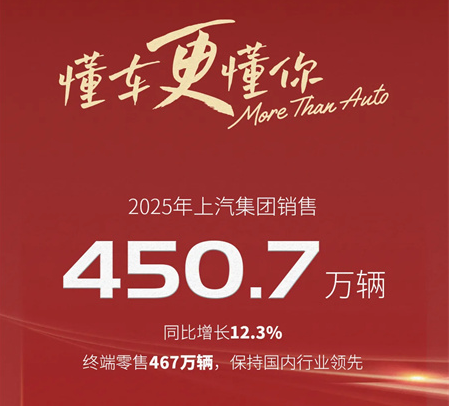
Core Insights - In 2025, SAIC Motor Corporation achieved significant growth, selling 4.507 million vehicles, a 12.3% increase year-on-year, and maintaining its position as the leading player in the domestic automotive industry [1][28] - A notable internal transformation occurred, with sales of self-owned brands reaching 2.928 million units, a substantial 21.6% increase, marking a historic high of 65% in total sales share [3][28] - The company's strategic focus on self-owned brand development and technological breakthroughs in smart electric vehicles is validated by market performance, indicating a successful transition from joint ventures to self-owned brands [5][30] Market Recognition - SAIC Motor's return to the SSE 50 Index in 2025 signifies a re-evaluation of its growth logic and intrinsic value by the capital market, reflecting a shift in focus from traditional manufacturing scale to sustainable high-quality development potential [6][30] - The return to the SSE 50 is seen as a "trust ticket" for future expectations, confirming that SAIC has successfully navigated its transformation [6][30] User Engagement and Product Innovation - The company is set to welcome its 100 millionth user in 2026, marking a significant milestone in its user-centric approach [7][31] - SAIC showcased a "cluster of blockbuster" products in 2025, demonstrating its capability to create star products across various market segments [7][31] Brand Highlights - The launch of the new generation of Zhiji LS6, featuring the "Star Super Range System" with a class-leading range of 1508 km, exemplifies SAIC's ability to establish a high-end intelligent electric brand [8][34] - The MG4, launched in August 2025, achieved over 10,000 deliveries for four consecutive months, driven by innovative technologies and a strong marketing strategy [11][35] - The Roewe M7 DMH, equipped with the latest DMH 6.0 hybrid system, addresses key consumer pain points with impressive range and fuel efficiency, solidifying its reputation as the "King of Family Cars" [14][38] - The launch of the SAIC Shangjie H5, developed in collaboration with Huawei, showcases a successful integration of smart travel solutions and manufacturing quality [17][41] Systematic Support for Innovation - SAIC's ability to produce multiple successful brands simultaneously is attributed to a robust systemic support structure that facilitates the "batch incubation of blockbusters" [20][44] - The company's comprehensive reform strategy aims to integrate management across passenger and commercial vehicle sectors, enhancing resource allocation and market responsiveness [21][45] - A focus on technology-driven and user-oriented product development has led to significant R&D investments, resulting in products with distinct technological features [23][47] Strategic Partnerships and Global Expansion - SAIC's strategic partnerships with leading tech companies like Huawei and OPPO enhance its technological capabilities and address gaps in smart vehicle features [24][48] - The company's global strategy has evolved to include localized R&D, production, and marketing, expanding its market reach and potential for blockbuster products [25][49] Future Outlook - SAIC's transformation serves as a model for upgrading traditional manufacturing in China, emphasizing strategic determination, technological resilience, ecological collaboration, and organizational vitality [26][50] - The company is positioned to lead the automotive industry towards a new phase of productivity, transitioning from scale leadership to quality leadership [26][50]

2025年全球智能手机出货量同比增长2%
Zheng Quan Shi Bao Wang· 2026-01-13 08:49
Group 1 - The global smartphone shipment is expected to grow for the second consecutive year in 2025, with a 2% year-on-year increase driven by high-end market trends and the rising adoption of 5G devices in emerging markets [1] - The smartphone market is gradually shifting towards higher price segments, with consumer demand for premium models being a major driver, while the demand for 5G phones is surging in developing regions [1] - The top five smartphone brands by market share in 2025 are Apple (20% market share, 10% year-on-year shipment growth), Samsung (19% market share), Xiaomi (13% market share), vivo, and OPPO [1] Group 2 - Apple's growth in 2025 is attributed to its expansion in emerging and mid-tier markets, improved product mix, and a significant upgrade cycle as millions of users seek to replace their devices [2] - Samsung's overall shipment growth in 2025 is supported by strong performance in Japan and continued growth in core markets, despite facing challenges in Latin America and Western Europe [2] - Xiaomi maintains stable performance due to its high-end strategy, strong demand in emerging markets, and effective channel management, particularly in Latin America and Southeast Asia [2] Group 3 - vivo's growth of 3% year-on-year is driven by its high-end strategy and strong offline channel execution in India, while OPPO's shipment volume decreased by 4% due to weak demand in China and intense competition [3] - OPPO's integration with realme aims to enhance resource synergy and create a differentiated strategy, with the combined shipment share expected to be 11%, ranking fourth in the global smartphone market [3] Group 4 - The global smartphone market is projected to weaken in 2026 due to DRAM/NAND storage shortages, rising component costs, and chip manufacturers prioritizing resources for AI data centers, leading to a 3% downward revision in shipment forecasts [4] - Despite supply constraints, Apple and Samsung are expected to remain resilient due to their strong supply chain capabilities and positioning in the high-end market, while Chinese brands focusing on lower price segments may face greater pressure [4]
苹果被曝买国产折叠屏拆解研究,仍难消除折痕
Guan Cha Zhe Wang· 2026-01-13 08:44
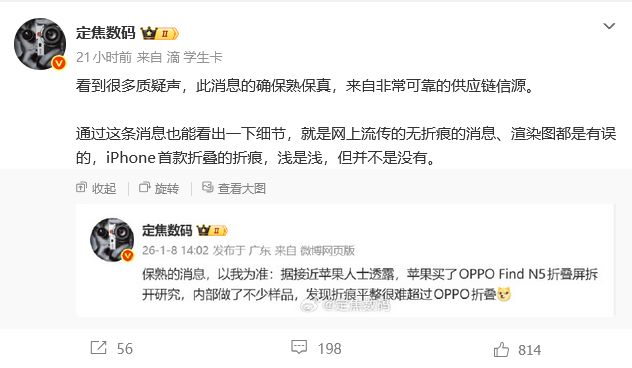
Group 1 - Apple is reportedly developing its first foldable iPhone, tentatively named "iPhone Fold," with a potential release in fall 2026 and a price exceeding $2000 (approximately 14,000 RMB) [3] - The iPhone Fold is expected to feature a book-style design similar to the Galaxy Z Fold 6, with a main screen size of 7.74 inches and an outer screen size of 5.49 inches [3] - Apple is exploring various hinge solutions to eliminate the "crease" issue commonly associated with foldable screens, indicating a strong focus on technological differentiation in the competitive foldable market [5][7] Group 2 - The OPPO Find N5, which Apple has reportedly disassembled for research, is set to be a direct competitor to the iPhone Fold, highlighting the need for Apple to surpass existing hardware standards [5][7] - Market research from Counterpoint Research indicates that global foldable smartphone shipments are expected to grow by 14% year-on-year in Q3 2025, reaching a historical high for the category [8] - Samsung leads the foldable smartphone market with a 64% share in Q3, showing a 32% increase in shipments compared to the previous year, while Huawei and Motorola follow with 15% and 7% market shares, respectively [8]

消费电子出海国别机会洞察
特易资讯· 2026-01-13 06:10
1. Report Industry Investment Rating No relevant content provided. 2. Core Viewpoints of the Report - The consumer electronics industry will undergo a comprehensive upgrade from products to ecosystems. Technological advancements will make devices smarter and more flexible, and environmental protection will become a key requirement. The global consumer electronics market is rapidly differentiating, with emerging markets presenting new opportunities [64]. - Chinese consumer electronics exports face new development opportunities in 2024, with emerging markets playing an increasingly important role. Green compliance and local production are crucial for companies to break through [4]. 3. Summary by Directory 3.1 China's Overall Consumer Electronics Export Situation - In 2024, China's consumer electronics exports had new opportunities. For example, the total export value of laptops was about $78.8 billion, a year - on - year increase of 4.1%. Chinese consumer electronics led globally with full - industrial - chain advantages and technological iteration capabilities [4]. - Emerging markets such as Southeast Asia, Latin America, and the Middle East had increasing contributions. Smartphones dominated in some emerging markets, while wireless headphones and power banks grew explosively in Africa and Southeast Asia through cross - border e - commerce. Green compliance and local production became key factors for companies [4]. 3.2 Export Statistics of Major Chinese Consumer Electronics from 2022 to June 2025 3.2.1 Smartphones - From 2022 to 2024, the total export value of smartphones decreased slightly from $137.31 billion to $133.08 billion. In the first half of 2025, the main export destinations were Hong Kong, China, the US, and Japan, accounting for 47.7% of the total export volume. Japan and the Netherlands had relatively large export increments [6]. 3.2.2 Tablets - From 2022 to 2024, the total export value of tablets decreased from $30.55 billion to $23.34 billion. In the first half of 2025, the main export destinations were Hong Kong, China, the US, and Japan, accounting for 58.5% of the total export volume. Singapore and Japan had relatively large export increments [9]. 3.2.3 Laptops - From 2022 to 2024, the total export value of laptops decreased and then remained stable, from $95.94 billion to $78.85 billion. In the first half of 2025, the main export destinations were the US, the Netherlands, and Japan, accounting for 43.2% of the total export volume. Japan and India had relatively large export increments [12][15]. 3.2.4 Wireless Headphones - From 2022 to 2024, the total export value of wireless headphones first decreased and then increased, from $10.1 billion to $9.85 billion. In the first half of the 2025, the main export destinations were the US, the Netherlands, and Hong Kong, China, accounting for 42.5% of the total export volume. Australia and Germany had relatively large export increments [18]. 3.2.5 Power Banks - From 2022 to 2024, the total export value of power banks decreased from $2.13 billion to $1.86 billion. In the first half of 2025, the main export destinations were the US, Germany, and the Netherlands, accounting for 22% of the total export volume. Mexico and Thailand had relatively large export increments [21][24]. 3.2.6 Multi - Speaker Speakers - From 2022 to 2024, the total export value of multi - speaker speakers remained stable, slowly decreasing from $4.36 billion to $4.04 billion. In the first half of 2025, the main export destinations were the US, the Netherlands, and Germany, accounting for 35.8% of the total export volume. The Netherlands and Poland had relatively large export increments [27]. 3.3 Analysis of Consumer Electronics Procurement and Supply in Emerging Markets from January to June 2025 3.3.1 Russia - From January to June 2025, there were 156 purchasers, 202 suppliers, 5,900 transactions, and the transaction amount was about $400 million. The average transaction amount per purchaser was $2,589,234, with an average of 37 transactions and an average transaction cycle of 142 days. The average transaction amount per of the top 800 suppliers was $1,971,085, with an average of 27 transactions and an average transaction cycle of 145 days [34]. 3.3.2 Mexico - From January to June 2025, there were 164 purchasers, 316 suppliers, 4,500 transactions, and the transaction amount was about $200 million. The average transaction amount per purchaser was $1,217,639, with an average of 28 transactions and an average transaction cycle of 121 days. The average transaction amount per supplier was $581,756, with an average of 12 transactions and an average transaction cycle of 142 days [37]. 3.3.3 Vietnam - From January to June 2025, there were 1,000 purchasers, 2,000 suppliers, 70,000 transactions, and the transaction amount was about $2.25 billion. The average transaction amount per purchaser was $2,244,470, with an average of 69 transactions and an average transaction cycle of 65 days. The average transaction amount per of the top 1000 suppliers was $2,244,746, with an average of 67 transactions and an average transaction cycle of 64 days [44]. 3.4 Briefing on Relevant Policies for Consumer Electronics Imports in Emerging Markets 3.4.1 Russia - It is the 11th largest economy globally, with a growing consumer electronics market but relying on imports. China is the main source of its consumer electronics imports. It has differential tariff policies, requires EAC certification, and restricts parallel imports. Importers are required to use rubles for settlement [52][58]. 3.4.2 Mexico - It is the second - largest consumer electronics market in Latin America. There is a significant "near - shore manufacturing" trend. It has zero - tariff policies for locally assembled products, and all products need NOM certification. There are also tax incentives for new - energy logistics and solar energy transformation in warehousing [55][56]. 3.4.3 Vietnam - It is the fastest - growing consumer electronics market in Southeast Asia. It has differential tariff policies, requires import model registration, and offers tax incentives for foreign technology companies [60]. 3.5 Future Development of the Global Consumer Electronics Industry - The industry will experience a comprehensive upgrade from products to ecosystems. Technology will make devices smarter, and environmental protection will be a hard requirement. The global market pattern is differentiating, and companies need to adopt different strategies in different markets [64]. 3.6 Appendices - Include the top 50 lists of consumer electronics purchasers in Russia, Mexico, and Vietnam [66][68][70].
12场促销+18场活动!闭眼囤广货的机会来了
2 1 Shi Ji Jing Ji Bao Dao· 2026-01-13 06:06
Core Viewpoint - The article highlights the evolution of "Guangdong goods" from traditional products to modern high-tech items, emphasizing the strength and global reach of Guangdong's manufacturing capabilities. Group 1: Promotion and Events - The "Guangdong Goods Going Global" spring action launch event will take place on January 15, featuring 12 promotional activities, including 10 offline and 2 online events in the first quarter of 2026 [1] - A total of 18 supporting activities will be organized as part of the spring action series [1] Group 2: Market Performance - Guangdong's cross-border e-commerce import and export scale has expanded 66 times over the past nine years, accounting for over one-third of the national total, maintaining the top position in the country [4] - For every four express deliveries generated nationwide, one originates from Guangdong [4] Group 3: Product Innovation - Guangdong's product offerings have evolved from basic necessities to a wide range of high-tech items, with one in three smartphones sold globally originating from the province [6] - DJI holds over 70% of the global consumer drone market share, while local automotive manufacturers are significantly increasing the export volume of new energy vehicles [6] Group 4: Industrial Ecosystem - Guangdong's manufacturing ecosystem is characterized by a comprehensive and efficient industrial structure, encompassing all aspects of daily life, from clothing to electronics [10] - The province boasts all 31 major manufacturing categories, with 15 of them ranking first in the country, and has developed nine trillion-yuan industrial clusters in sectors like electronics and new energy [10] Group 5: Intelligent Manufacturing - Guangdong is transitioning from traditional manufacturing to intelligent manufacturing, with significant improvements in production efficiency, such as a 200% increase in efficiency at Gree's smart factory [11] - The integration of AI and biotechnology in food production has led to enhanced quality and reduced energy consumption [13] Group 6: Future Outlook - The article emphasizes the need for Guangdong goods, highlighting their blend of practicality and creativity, and the resilience of the manufacturing sector in uncertain times [15]

全球最大的液冷展会来了|2026深圳国际液冷产业展会及论坛
Sou Hu Cai Jing· 2026-01-13 01:51
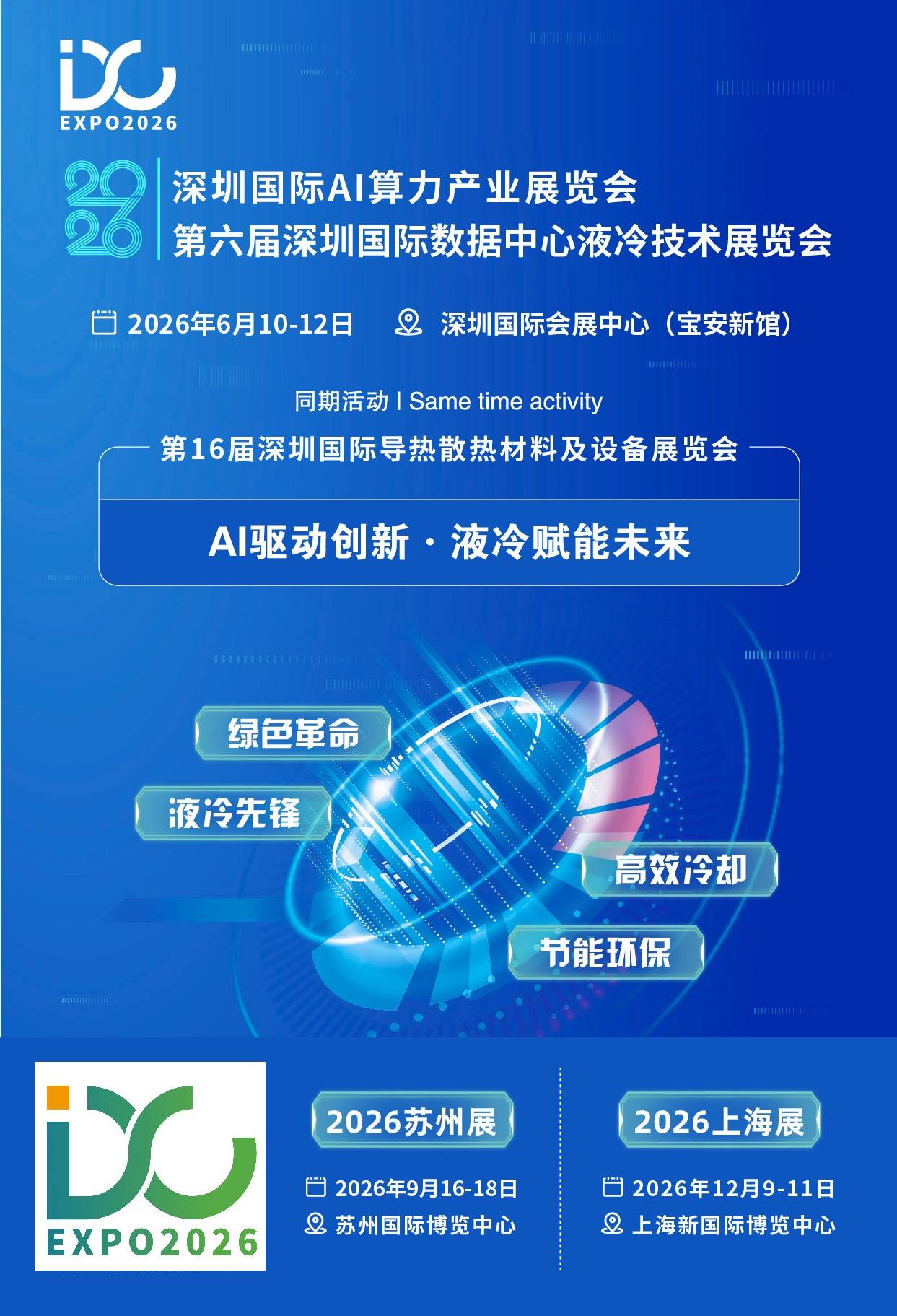
Group 1 - The 2026 Shanghai International Liquid Cooling Industry Exhibition will take place from December 9-11, 2026, at the Shanghai New International Expo Center [3] - The 2026 China (Shenzhen) International Liquid Cooling Industry Technology Exhibition is scheduled for June 10-12, 2026, at the Shenzhen International Convention and Exhibition Center [3] - The 2026 Suzhou Exhibition will occur from September 16-18, 2026, at the Suzhou International Expo Center [5] Group 2 - The rapid growth of big data has increased the demands on data center servers, necessitating higher power density in server cabinets [14] - Liquid cooling technology is becoming essential for data center efficiency, especially with the rise of 5G, edge computing, and AI applications [14][18] - The exhibitions aim to showcase the latest products and technologies in the liquid cooling industry, attracting professional audiences from data centers, power, electronics, edge computing, AI, and renewable energy sectors [14] Group 3 - The 2026 IDC exhibition is expected to cover an area of 15,000 square meters and will feature participation from major organizations such as the National Supercomputing Center in Shenzhen and Tencent [18] - Various technical exchange activities will be held during the IDC 2026 exhibition, focusing on industry hot topics and promoting diversified marketing strategies [19] - The exhibition will include a wide range of products covering cooling liquids, refrigerants, and various cooling devices, showcasing over a thousand new products across the entire industry chain [56] Group 4 - Shenzhen Angpai Technology Co., Ltd. is currently in the A-share IPO guidance stage, with plans to expand production capacity and R&D investment to capture market growth in liquid cooling [66] - The company has a registered capital of 90 million RMB and aims to leverage its professional R&D team and partnerships with universities to enhance its technological capabilities [66][68] - Angpai Technology's product offerings include liquid cooling module design, thermal management system integration, and innovative compressor technologies, with a focus on high reliability and efficiency [71][72]
万咖壹联20260112
2026-01-13 01:10
Summary of the Conference Call Company and Industry Overview - **Company**: 万咖壹联 (Wanka Yilian) - **Industry**: Mobile Advertising and AI Technology - **Market Position**: Holds over 50% market share in mobile advertising, collaborating with major smartphone manufacturers like Apple and Huawei, and covering over 1,300 gaming companies including Tencent and NetEase, reaching approximately 2 billion mobile users [2][4][3]. Core Insights and Arguments - **Strategic Partnerships**: The company has formed strategic alliances with top smartphone manufacturers, enhancing its ecosystem services and solidifying its market position [4][3]. - **AI Integration**: The introduction of generative AI, such as the AI assistant Doubao, is transforming information search and advertising effectiveness, leading to improved ROI for ad campaigns [2][5][9]. - **Advertising Evolution**: The shift from traditional click-based advertising to AI-driven demand fulfillment is expected to lower costs and enhance user experience, with a focus on structured and tagged content for better targeting [6][9]. - **Mobile Manufacturer Strategies**: Major manufacturers like Huawei and Xiaomi are developing their own AI search engines and collaborating with third-party models to enhance user experience [11][21]. Additional Important Points - **Content Quality**: New quality content must be innovative, practical, and data-supported, with a focus on quantitative analysis to provide value [8]. - **Business Model Progress**: The company has seen significant revenue from its browser-related business, with 25% of income derived from GO-related activities, and aims to further enhance this with AI technology [16][18]. - **GEO Impact**: Generative Search Engine Optimization (GEO) is in its early stages but already contributes 25% to 40% of total revenue in browser and search engine operations, indicating strong future growth potential [18]. - **User Experience Changes**: The application of GO technology is expected to streamline user interactions, making product searches and purchases more efficient, thus allowing users to focus on more important tasks [20]. - **Commercialization Opportunities**: Smartphone manufacturers are optimistic about the commercialization potential of AI and GEO integration, with companies like Xiaomi seeking to maintain control over their models while leveraging external AI capabilities [21][22].