
邮储银行

Search documents
突然激增!发生了什么?
中国基金报· 2026-01-26 07:20
【导读】环比大增420%,最短持有期理财产品受青睐 中国基金报记者 李树超 张玲 随着行情持续回暖,理财新发市场逐渐活跃,最短持有期产品尤其受到资金青睐,2025年12 月募集规模环比增逾4倍。 业内人士认为,多重因素推动最短持有期产品新发规模大增。普通投资者应根据自身需求匹 配不同期限理财产品,避免盲目追高。 最短持有期产品新发规模大增 中国理财网显示,1月以来,上银理财、信银理财、招银理财、青银理财等理财公司已累计发 布超20只最短持有期产品。同时,信银理财,浙江富阳农商银行、萧山农商银行旗下共9只最 短持有期产品处于待售状态。 Wind数据显示,2025年12月,理财新发规模达4631.76亿元,环比增长29.2%。其中,最 短持有期产品新发规模为近4个月最高,7天~1个月期限产品规模环比大增420.4%。 睿智新虹理财研究院表示,最短持有期理财产品能较好地平衡收益与流动性。对于投资者而 言,该类产品每日可以申购,享有"持有期后近似活期"的流动性体验,且其收益水平通常高 于日开放型产品。对于理财机构而言,设置固定持有期有助于缓解资金流动性管理的压力, 使其可以适当配置期限较长、收益较高的资产,进一步支撑 ...


信用卡分期贴息已到帐:实际利率最低近2%
Xin Lang Cai Jing· 2026-01-26 07:17
Core Viewpoint - The Ministry of Finance, the People's Bank of China, and the Financial Supervision Administration have announced the extension and expansion of the personal consumption loan interest subsidy policy, now including credit card installment services, which has led to significantly lower interest rates for consumers [2][4]. Group 1: Implementation of Interest Subsidy Policy - The new policy allows consumers to apply for interest subsidies on credit card installments, with banks providing detailed operational guidelines [2][3]. - Customers must sign a specific agreement to benefit from the subsidy, and banks have launched dedicated sections in their mobile apps for easy access to this service [3][4]. - The subsidy will automatically apply to eligible transactions made after January 1, 2026, without the need for customers to reapply [4]. Group 2: Interest Rates and Benefits - After applying the subsidy, the effective annual interest rate for credit card installments can drop to as low as 2.06%, which is significantly lower than traditional loan rates [5]. - Banks are offering varying interest rate discounts based on the installment period and customer credit status, with some rates as low as 3% after discounts [5][6]. - The subsidy directly reduces the interest burden on consumers, making it a financially attractive option for credit card users [5][6]. Group 3: Monitoring and Compliance - The authorities have emphasized the need for strict monitoring of loan purposes and fund flows, particularly to prevent misuse of funds in stock markets [8]. - Banks are required to take action against fraudulent activities, including the provision of false documentation or misrepresentation of loan purposes [8]. - Consumers are advised to use official channels for applying for loans and subsidies to avoid scams and protect their personal information [8].

央行连续 11 个月加量操作 MLF;资金面边际收敛,债市震荡调整
Dong Fang Jin Cheng· 2026-01-26 06:40
央行连续 11 个月加量操作 MLF;资金面边际收敛,债市震荡调整 【内容摘要】1 月 22 日,税期走款,资金面边际收敛;债市震荡调整;转债市场主要指数集 体跟涨,转债个券多数上涨;各期限美债收益率走势分化,主要欧洲经济体 10 年期国债收益 率走势分化。 一、债市要闻 (一)国内要闻 【央行行长潘功胜:继续维护好金融市场平稳运行,支持资本市场稳定发展】1 月 22 日,央 行行长潘功胜在接受采访时表示,2026 年,央行将继续实施好适度宽松的货币政策,把促进 经济稳定增长、物价合理回升作为货币政策的重要考量,发挥增量政策和存量政策集成效应, 为经济稳定增长、高质量发展和金融市场稳定运行营造良好的货币金融环境,为实现"十五五" 良好开局提供有力的金融支撑。潘功胜谈到,总量政策方面,灵活高效运用降准降息等多种货 币政策工具,保持流动性充裕,使社会融资规模、货币供应量增长同经济增长、价格总水平预 期目标相匹配。今年降准降息还有一定的空间。央行还将做好利率政策执行和监督,促进社会 综合融资成本低位运行。结构性政策方面,央行已在今年年初先行出台一批货币金融政策,对 结构性货币政策工具的政策要素作了优化完善。 【央行 ...
银行业周报:财政金融协同政策加码,被动资金流出扰动行情-20260126
Yin He Zheng Quan· 2026-01-26 06:39
Investment Rating - The report maintains a "Recommended" rating for the banking sector, highlighting its dividend value and low valuation as attractive for long-term investors [5][10]. Core Insights - A package of fiscal and financial policies has been introduced to support the banking sector, particularly in optimizing loan structures and stabilizing interest margins [7][8]. - The banking sector has experienced a decline of 7.44% year-to-date, underperforming the broader market, primarily due to passive fund outflows [9][10]. - The report emphasizes the potential for credit growth and structural optimization in the banking sector, driven by government policies aimed at supporting small and medium enterprises [8][9]. Summary by Sections Latest Research Insights - The report discusses the implementation of six fiscal and financial policies aimed at enhancing credit support for small and medium enterprises, including a 1.5% interest subsidy on loans [7][8]. - These policies are expected to lower overall financing costs and stimulate demand, thereby benefiting the banking sector [8]. Weekly Market Performance - The banking sector index fell by 2.70% during the week, while the broader Shanghai and Shenzhen 300 index decreased by 0.62% [18]. - State-owned banks, joint-stock banks, city commercial banks, and rural commercial banks saw declines of 4.36%, 3.08%, 0.43%, and 0.70%, respectively [18]. Valuation and Company Performance - As of January 23, 2026, the banking sector's price-to-book ratio stands at 0.64, indicating a 32.99% discount compared to the overall A-share market [35]. - The sector's dividend yield is reported at 4.92%, which is higher than the average for all A-shares, ranking second among industries [35]. - Eight listed banks have reported stable earnings recovery for 2025, with most showing growth in total assets compared to 2024 [15][16].






瞄准年终奖!银行新动作,力推“资产提升”
券商中国· 2026-01-26 06:22
券商中国记者梳理发现,临近新春,1月以来,多家银行推出"资产提升"活动,对于月日均金融资产较上月 提升达标的客户,银行送出多重优惠,还有银行打造了"年终奖专属理财"。 业内人士指出,银行此举旨在吸引年末的年终奖、尾款、到期存款等资金,优化资产负债结构,并提升财富管 理粘性,带动业务多元发展。 中国银行深圳分行活动页面显示,1月31日前,客户在该行日月均资产提升至20万元(含)至50万元(不 含),将获得100元到260元不等的微信立减金,月日均资产越高的客户,所获得的微信立减金也将增加。此 外,报名后,在该行资产保持不变的客户也可获得"资产保持礼"。 光大银行也发布开"薪"年终奖的专属活动,2月13日前,该行的薪资代发客户月日均资产较2025年12月提升1万 元或5千元以上的,可参与砸金蛋的活动,赢得消费立减金。 博通咨询金融业资深分析师王蓬博告诉券商中国记者,"争夺"年终奖,既能帮助银行充实存款储备,还能带动 理财、保险等中间业务增长,提升客户活跃度和留存率,降低获客成本。"银行瞄准的核心原因在于年终奖属 集中性、稳定性强的资金,契合当前银行优化负债结构、缓解息差承压的需求。同时,该时点客户资产配置意 愿较 ...

中国银行与房地产:2026 年 GCC 会议要点- 最糟糕的时期已过去?-China Banks and Property_ 2026 GCC takeaways_ Is the worst behind_
2026-01-26 02:49
Summary of Conference Call Notes Industry Overview - **Industry**: Chinese Banking and Property Sector - **Context**: Insights from the 2026 Greater China Conference (GCC) and subsequent macro, financial, and property tours Key Points on Economic Outlook - **2026 GDP Growth Target**: Expected to be set at 4.5-5.0%, with some experts optimistic about achieving close to 5% due to strong exports and easing deflationary pressures [2][8][10] - **Deflationary Pressure**: CPI expected to rise to 0.5%, while PPI may narrow its decline to a range of -1% to 0% [10] - **Consumption Growth**: Not seen as a key driver for 2026; trade-in subsidies are fading [2][19] Banking Sector Insights - **NIM Pressure**: Current stretched NIM levels are a constraint for rate cuts; a small rate cut of 10bps is anticipated [3][15] - **Loan Origination**: Decent loan origination observed in early January, primarily driven by corporate loans; retail loan recovery remains limited [5][48] - **Revenue Outlook**: Improved revenue outlook driven by less YoY NIM decline and ongoing fee income recovery; investment income may lag due to a less favorable bond market [5][50] Property Sector Outlook - **Bearish Sentiment**: Experts hold a bearish view on the property sector, expecting a 10% decline in property prices in 2026 and 5% in 2027 [4][27] - **Homebuyer Behavior**: Shift from buying to renting; potential 30-40% downside in property prices if rental yields align with mortgage rates [4][27] - **Policy Support**: Limited policy tools available to stabilize property prices; expectations for major new policies in 2026 are low [4][16][27] Specific Company Insights - **Chengdu MixC**: Strong sales growth with retail sales reaching approximately Rmb8.5 billion in 2025; proactive tenant changes attributed to outperformance [30] - **C&D Haiyao**: Luxury project demand remains, with a successful launch of a luxury residential project at an average price of over Rmb77,000 per sqm [31] Additional Considerations - **Geopolitical Risks**: Complicated geopolitical relations may impact export growth; however, solid external demand is expected [17] - **RMB Appreciation**: Potential for RMB to enter an appreciation cycle, with expectations of a 3-4% appreciation by the end of 2026 [18] - **Distressed Developers**: Many banks are allowing roll-over of existing project loans to distressed developers, delaying NPL recognition [22] Conclusion - The overall sentiment in the banking and property sectors is cautious, with expectations of limited growth and ongoing challenges. The focus remains on managing asset quality and navigating a complex macroeconomic environment.

流动性预期再升温,配置结构主导分化行情
Southwest Securities· 2026-01-26 02:33
1. Report Industry Investment Rating No relevant content provided. 2. Core Viewpoints of the Report - Last week, the bond market showed significant structural differentiation, influenced by macro - economic data and central bank liquidity operations. The "broad money" expectation may become the short - term trading focus, and the "stabilizer" effect of banks continues to work, with bonds within 10 years likely to be more stable. Liquidity abundance is expected to support the bond market to stabilize [2]. - In the context of the macro - economy still in the recovery stage and the need to boost the upward slope of prices, the central bank needs to maintain sufficient liquidity to support the real economy effectively [2]. 3. Summary According to the Table of Contents 3.1 Important Matters - In 2025, China's GDP grew by 5.0% in real terms, with the fourth - quarter real GDP growing by 4.5% and the nominal GDP growing by 3.85%, and the gap between nominal and real GDP growth rates narrowed [5]. - In January 2026, the central bank's MLF net injection was 70 billion yuan, and the medium - and long - term base money net injection in January reached 1 trillion yuan [2][8]. - Six major banks announced the optimization of personal consumption loan fiscal subsidy policies, including extending the implementation period, expanding the scope of support, and increasing subsidy standards [12][13]. - The central bank governor said that in 2026, the central bank will continue to implement a moderately loose monetary policy, and there is still room for reserve requirement ratio cuts and interest rate cuts [14]. 3.2 Money Market 3.2.1 Open Market Operations and Funds Rate Trends - From January 19 to 23, 2026, the central bank's 7 - day reverse repurchase operation had a net injection of 22.95 billion yuan. It is expected that 138.1 billion yuan of base money will be withdrawn from circulation from January 26 to 30 [16]. - Towards the end of January, the money market tightened marginally, and DR001 briefly exceeded the 1.3% - 1.4% operating range. As of January 23, R001, R007, DR001, and DR007 changed by 9.20BP, 2.23BP, 7.84BP, and 5.05BP respectively compared with January 16 [18]. 3.2.2 Certificate of Deposit (CD) Rate Trends and Repurchase Transaction Volume - In the primary market, last week, the CD issuance scale was 589.49 billion yuan, with a net financing of - 116.9 billion yuan. The CD issuance scale of city commercial banks was the largest, with a net financing of 72.72 billion yuan. The CD issuance interest rates of most institutions decreased compared with the previous week [24][28][30]. - In the secondary market, last week, CD interest rates generally declined under the background of loose liquidity. The 1Y - 3M spread of AAA - rated CDs was at the 47.07% quantile level [34]. 3.3 Bond Market 3.3.1 Primary Market - In early 2026, the issuance rhythm of national bonds accelerated compared with the same period in 2025, and the net financing scale of national bonds over 10 years was also higher than that from 2023 - 2025. The supply rhythm of central finance accelerated, mainly due to the issuance of discount national bonds and coupon - bearing national bonds in 2026 and the re - issuance of some coupon - bearing national bonds in 2025 [36]. - Last week, the supply scale of interest - rate bonds increased significantly. The net financing of national bonds, local bonds, and policy - bank bonds was 344.3 billion yuan, 222.37 billion yuan, and 187.5 billion yuan respectively. As of January 23, the issuance scale of special refinancing bonds in 2026 reached 250 billion yuan, mainly in long - term and ultra - long - term bonds [43][45]. 3.3.2 Secondary Market - Large - scale banks continued to prefer national bonds within 10 years, which supported medium - and short - term interest rates. The central bank's continuous large - scale MLF injection maintained abundant liquidity, and the term spread was compressed. The yields of national bonds and policy - bank bonds of various maturities changed to different degrees, and the implied tax rate of 10 - year policy - bank bonds decreased slightly [48]. - The average daily turnover rates of the 10 - year national bond active bond (250016) and the 10 - year policy - bank bond active bond (250215) decreased. The average spread between the 10 - year national bond active bond (250016) and the secondary - active bond (250022) increased by 0.03BP, indicating that the liquidity premium is tilting towards 250022 [50][52]. - The 10 - 1 - year and 30 - 1 - year national bond term spreads narrowed, and the long - term and ultra - long - term local - national bond spreads also narrowed [56][57]. 3.4 Institutional Behavior Tracking - In December 2025, the institutional leverage ratio increased seasonally. Banks and other institutions increased their leverage, while securities firms reduced their leverage. The 20 - day moving average of the single - day trading volume of inter - bank pledged repurchase was 7.87 trillion yuan last week, showing a "first rising, then falling" trend [63][65]. - In the cash - bond market, large - scale banks still preferred to increase their holdings of 5 - 10 - year national bonds, but the net purchase scale decreased significantly. Small - and medium - sized banks continued to reduce their holdings of 5 - 10 - year national bonds and policy - bank bonds. Insurance companies significantly increased their holdings of national bonds and local bonds over 10 years, and funds increased their holdings of 5 - 10 - year policy - bank bonds and national bonds over 10 years [63][72]. - The replenishment willingness of small - and medium - sized banks, securities firms, funds, and other institutions was relatively weak last week. The current replenishment costs of major trading desks vary significantly [75]. - Considering capital occupation and tax costs, commercial banks and insurance companies can obtain relatively higher returns by investing in local bonds due to the relatively high spread between local bonds and national bonds [84]. 3.5 High - Frequency Data Tracking - Last week, the settlement prices of rebar, wire rod, and cathode copper futures, the cement price index, and the South China Glass Index decreased compared with the previous week. The CCFI index decreased slightly, while the BDI index increased by 12.44%. The wholesale prices of pork and vegetables increased, and the settlement prices of Brent and WTI crude oil futures decreased slightly. The central parity rate of the US dollar against the RMB was 6.99 [88][89]. 3.6 Future Outlook - The "stabilizer" effect of banks continues to work, and bonds within 10 years are likely to be more stable. Although the ultra - long - term interest rate theoretically has more room, its stability is weaker than that of bonds within 10 years [90]. - Abundant liquidity is expected to support the bond market to stabilize. In the short term, the bond market is mainly in a recovery phase, with a low possibility of a trend - like decline. It is recommended to gradually take profits from band trading and choose national bonds within 10 years, especially the 10 - year national bond active bond (250016) [91].
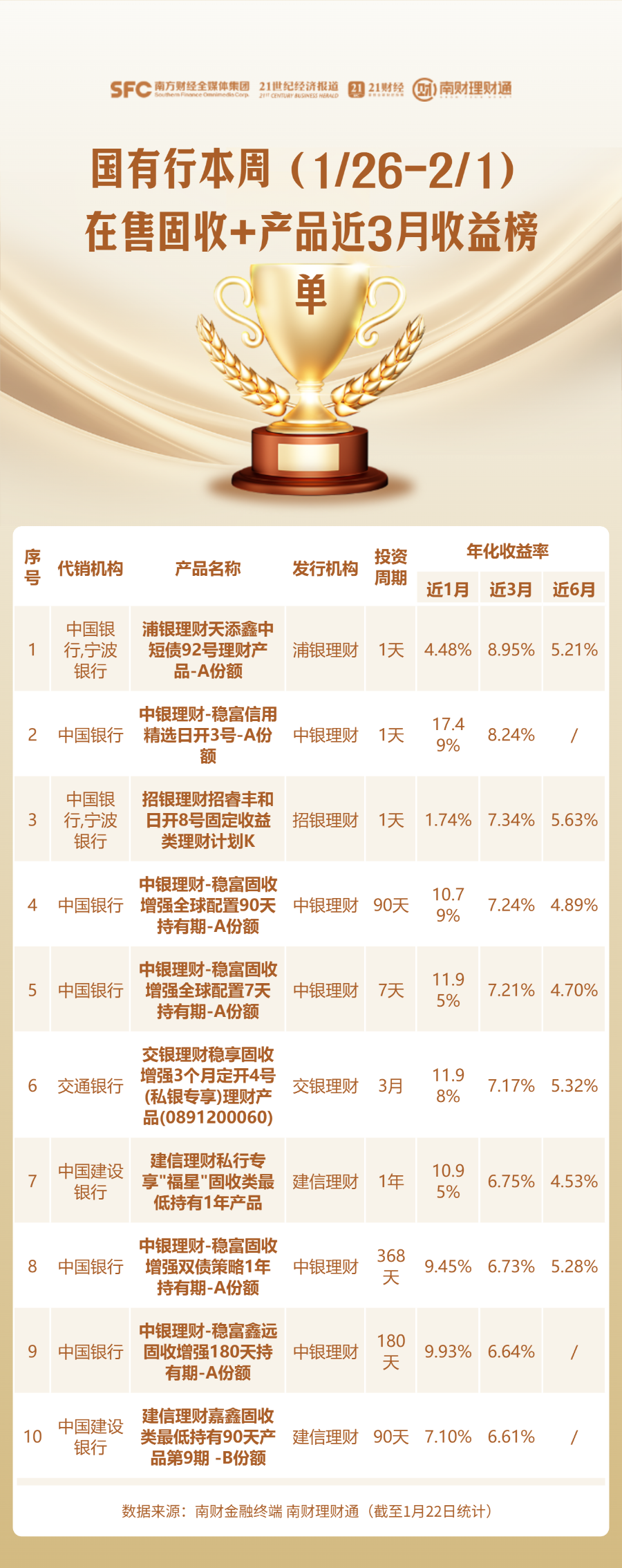
各银行本周在售“固收+”产品哪家强?
2 1 Shi Ji Jing Ji Bao Dao· 2026-01-26 01:21
本期,课题组重点关注理财公司发行的"固收+"产品,从代销渠道为投资者筛选出表现较优的在售产品。 | 2 | 中国银行 | FUBIBENT. INSTYMI.L. | 精选日开3号-A份 中银理财 1天 | | 17.4 9% | 8.24% | | --- | --- | --- | --- | --- | --- | --- | | | | 河 | | | | | | | 中国課 | 招银理财招睿丰和 | | | | | | 3 | 行,宁波 | 日开8号固定收益 | 招银理财 | 1天 | 1.74% | 7.34% 5.63% | | | 银行 | 类理财计划K | | | | | | ব | 中国银行 | 中银理财-稳富固收 增强全球配置90天 中银理财 90天 | | | 10.7 | 7.24% 4.89% | | | | | | | 9% | | | | | 持有期-A份额 | | | | | | 5 | 中国银行 | 中银理财-稳富固收 增强全球配置7尺 | 中银增财 | 7 天 | 11.9 5% | 7.21% 4.70% | | | | 持有期-A份额 | | | | | | 6 | ...
消金行业多措并举 促进消费者尽享贴息政策红利
Xin Lang Cai Jing· 2026-01-25 23:32
Core Viewpoint - The recent notification from the Ministry of Finance, the People's Bank of China, and the National Financial Regulatory Administration aims to optimize personal consumption loan subsidy policies, reducing credit costs and enhancing consumer willingness to spend [1][6]. Group 1: Policy Implementation - The notification supports innovation in consumer finance, extends policy duration, expands support scope, and increases the number of implementing institutions [1][6]. - Major platforms like Ant Group, JD.com, and Du Xiaoman have quickly launched measures to translate policy benefits into consumer services [1][6]. Group 2: Company Responses - Ant Group has extended the subsidy policy until the end of 2026, removed the 500 yuan cap on single transactions, and lifted previous restrictions on consumption areas [2][7]. - JD.com has fully adopted the new policy, ensuring rapid delivery of benefits to users, and has expanded the scope of its subsidy services [2][7]. - Du Xiaoman focuses on enhancing service experience and financial accessibility, introducing a "credit limit increase and interest reduction" service to support service consumption [2][7]. Group 3: Impact on Consumer Finance - Zhongyuan Consumer Finance has combined subsidy and rights protection strategies, benefiting over 3.46 million people and providing discounts exceeding 52.46 million yuan [3][8]. - Haier Consumer Finance has launched a "Smart Home Installment" service, covering 501 products, effectively stimulating demand in the home appliance sector [3][9]. Group 4: Market Trends and Insights - The implementation of the subsidy policy has led to a "precise drip irrigation" effect, boosting sales for merchants and providing discounts for consumers [4][10]. - Ant Group reported an 18% increase in average installment consumption during the 2025 Double 11 shopping festival compared to September 2025 [4][10]. - JD.com's subsidy service has covered over 100 million products, with a nearly 20% increase in average transaction amounts since the policy's implementation [4][10]. Group 5: Recommendations for Financial Institutions - Financial institutions are encouraged to deepen integration with high-frequency consumption scenarios and optimize product designs to meet diverse customer needs [5][10]. - Institutions should leverage technology to enhance risk management and automate approval processes, thereby reducing operational costs and improving coverage [5][10]. - Regional financial institutions not included in the national subsidy program are advised to pursue local consumption subsidy policies and enhance credit card marketing efforts [11].

从“漫灌”到“滴灌”:银行发力科技金融变革一线观察
Zhong Guo Zheng Quan Bao· 2026-01-25 21:05
Group 1 - The core viewpoint emphasizes the need for banks to transition from traditional lending practices to a more nuanced approach that supports technological innovation through precise financial support [1][6] - The shift in banking strategy involves moving from reliance on hard assets to understanding the potential of soft assets, requiring banks to assess future growth rather than just past performance [1][2] - Banks are increasingly adopting digital tools to identify potential technology companies, marking a consensus among many banks to upgrade their technology financial service models [1][2] Group 2 - The role of banks is evolving from being mere fund providers to becoming partners in the market, supporting technology companies throughout their growth journey [3][4] - Banks are implementing comprehensive financial service models that combine online and offline approaches to meet the financing needs of technology enterprises, particularly those with high development potential [2][3] - Collaborative ecosystems are being developed where banks not only provide loans but also connect technology companies with industry resources and investment opportunities [3][4] Group 3 - A systemic transformation within banks is necessary to create a long-term mechanism that encourages lending to technology companies, focusing on risk pricing, organizational structure, and incentive systems [5][6] - The current challenges in technology finance stem from mismatches between the needs of technology companies and traditional banking models, necessitating a shift in risk assessment and service collaboration [5][6] - The future of banking in the context of technology finance will involve creating a diverse ecosystem that includes government, investment institutions, and other stakeholders to enhance support for innovation [6]