中国国航

Search documents
中国国航(601111) - 中国国际航空股份有限公司2025年12月主要运营数据公告
2026-01-15 09:30
证券代码:601111 股票简称:中国国航 公告编号:2026-003 中国国际航空股份有限公司 2025年12月主要运营数据公告 本公司董事会及全体董事保证本公告内容不存在任何虚假记载、误导性陈述 或者重大遗漏,并对其内容的真实性、准确性和完整性承担法律责任。 2025 年 12 月,中国国际航空股份有限公司(以下简称"本公司")及所属 子公司(以下简称"本集团")合并旅客周转量(按收入客公里计)同比上升。 客运运力投入(按可用座位公里计)同比上升 4.0%,旅客周转量同比上升 10.0%。 其中,国内客运运力投入同比上升 4.2%,旅客周转量同比上升 10.6%;国际客 运运力投入同比上升 4.1%,旅客周转量同比上升 9.1%;地区客运运力投入同比 下降 0.7%,旅客周转量同比上升 4.1%。平均客座率 82.2%,同比上升 4.5 个百 分点。其中,国内航线同比上升 4.9 个百分点,国际航线同比上升 3.6 个百分点, 地区航线同比上升 3.4 个百分点。 货运方面,货运运力投入(按可用货运吨公里计)同比下降 1.9%,货邮周 转量(按收入货运吨公里计)同比上升 5.3%。货运载运率为 39.2% ...

中国国航(601111.SH):2025年12月客运运力投入同比上升4.0%
Ge Long Hui A P P· 2026-01-15 09:29
格隆汇1月15日丨中国国航(601111.SH)公布,2025年12月,中国国际航空股份有限公司(以下简称"本 公司")及所属子公司(以下简称"本集团")合并旅客周转量(按收入客公里计)同比上升。客运运力 投入(按可用座位公里计)同比上升4.0%,旅客周转量同比上升10.0%。其中,国内客运运力投入同比 上升4.2%,旅客周转量同比上升10.6%;国际客运运力投入同比上升4.1%,旅客周转量同比上升9.1%; 地区客运运力投入同比下降0.7%,旅客周转量同比上升4.1%。平均客座率82.2%,同比上升4.5个百分 点。其中,国内航线同比上升4.9个百分点,国际航线同比上升3.6个百分点,地区航线同比上升3.4个百 分点。 2025年12月30日起,公司新增成都天府-阿拉木图航线(每周两班)。2025年12月,本集团共引进6架 A320系列飞机和2架C919飞机。截至2025年12月底,本集团合计运营964架飞机,其中自有飞机418架, 融资租赁252架,经营租赁294架。 货运方面,货运运力投入(按可用货运吨公里计)同比下降1.9%,货邮周转量(按收入货运吨公里 计)同比上升5.3%。货运载运率为39.2%, ...
中国国航:2025年12月旅客周转量同比上升10%
Zheng Quan Shi Bao Wang· 2026-01-15 09:25
Core Viewpoint - China National Airlines (601111) announced an increase in passenger capacity and turnover for December 2025, indicating positive growth trends in the airline industry [1] Group 1: Capacity and Turnover - The group's passenger capacity is expected to increase by 4% year-on-year by December 2025 [1] - Passenger turnover is projected to rise by 10% year-on-year [1] Group 2: Average Load Factor - The average load factor is reported at 82.2%, which is an increase of 4.5 percentage points year-on-year [1]
中国国航:2025年12月旅客周转量同比上升10.6%
Xin Lang Cai Jing· 2026-01-15 09:21
Core Viewpoint - China National Airlines announced an increase in passenger turnover volume and capacity for the year ending December 2025, indicating a positive growth trend in the airline's operations [1] Group 1: Passenger Turnover and Capacity - The company's consolidated passenger turnover volume (measured in revenue passenger kilometers) is expected to increase by 10.0% year-on-year [1] - Passenger capacity input (measured in available seat kilometers) is projected to rise by 4.0% year-on-year [1] - Domestic passenger capacity input is expected to increase by 4.2%, with a corresponding passenger turnover volume increase of 10.6% [1] - International passenger capacity input is anticipated to rise by 4.1%, with a passenger turnover volume increase of 9.1% [1] - Regional passenger capacity input is projected to decrease by 0.7%, while passenger turnover volume is expected to increase by 4.1% [1] Group 2: Average Load Factor - The average passenger load factor is projected to be 82.2%, reflecting an increase of 4.5 percentage points year-on-year [1] - The domestic route load factor is expected to rise by 4.9 percentage points year-on-year [1] - The international route load factor is anticipated to increase by 3.6 percentage points year-on-year [1] - The regional route load factor is projected to increase by 3.4 percentage points year-on-year [1]
航空机场板块1月15日跌0.29%,厦门空港领跌,主力资金净流入357.22万元
Zheng Xing Xing Ye Ri Bao· 2026-01-15 08:59
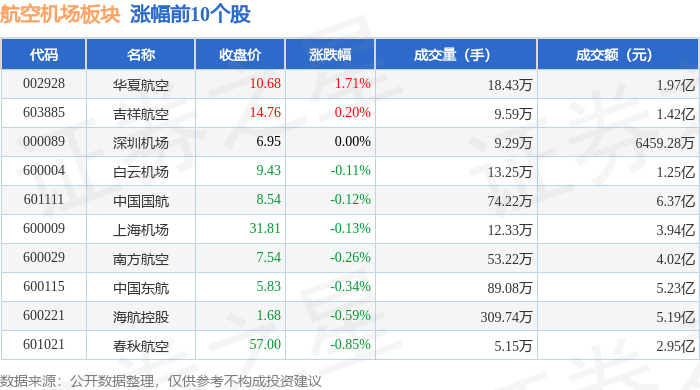
Core Viewpoint - The aviation and airport sector experienced a slight decline of 0.29% on January 15, with Xiamen Airport leading the drop. The Shanghai Composite Index closed at 4112.6, down 0.33%, while the Shenzhen Component Index rose by 0.41% to 14306.73 [1]. Group 1: Stock Performance - Xiamen Airport (600897) closed at 16.80, down 1.52% with a trading volume of 55,900 shares and a transaction value of 94.38 million [2]. - Huaxia Airlines (002928) saw a gain of 1.71%, closing at 10.68 with a trading volume of 184,300 shares and a transaction value of 197 million [1]. - China Eastern Airlines (600115) closed at 5.83, down 0.34% with a trading volume of 890,800 shares and a transaction value of 523 million [2]. Group 2: Capital Flow - The aviation and airport sector had a net inflow of 3.57 million from institutional investors, while retail investors saw a net outflow of 73.65 million [2]. - Spring Airlines (601021) had a net inflow of 27.87 million from institutional investors, representing 9.46% of its total trading [3]. - Xiamen Airport (600897) experienced a significant net outflow of 21.86 million from institutional investors, accounting for -23.17% of its total trading [3].




黑猫投诉12月数据说:考研元旦预订致OTA投诉量上涨 机酒相关投诉占比超八成
Xin Lang Cai Jing· 2026-01-15 02:32
Group 1 - The core point of the article highlights the significant increase in consumer complaints across various sectors, particularly in the OTA and food industries, driven by specific events and issues [1][12] - As of December 2025, the Black Cat Complaints platform has received nearly 31.95 million valid consumer complaints, with about 24.75 million responses from companies and approximately 20.99 million complaints resolved [1][12] - In December alone, there were nearly 790,000 valid complaints, indicating a notable rise in consumer dissatisfaction [1][12] Group 2 - The OTA sector saw a substantial increase in complaints, reaching nearly 14,000 in December, a month-on-month growth of 23.48%, largely due to hotel bookings for exams and New Year travel demands [2][13] - Complaints related to flight bookings accounted for over 6,300 cases, making up 45.54% of OTA complaints, with issues such as high cancellation fees and lack of compensation for flight changes being prominent [3][14] - Hotel booking complaints exceeded 5,100, representing 36.86% of OTA complaints, with consumers expressing concerns over unfulfilled cancellation policies and unsatisfactory hygiene conditions [3][14] Group 3 - In the airline sector, complaints reached nearly 4,500 in December, reflecting a 17.16% increase, with issues related to cancellation and change fees constituting nearly 60% of these complaints [4][16] - Specific complaints regarding flight cancellations or delays accounted for approximately 620 cases, representing 13.77%, while complaints about ticket price drops were around 580, making up 12.92% [4][16] - Among the top ten airlines, companies like China Southern Airlines and China Eastern Airlines had a 100% complaint response rate, while Shenzhen Airlines and Capital Airlines had response rates below 10%, indicating poor complaint handling [5][17] Group 4 - The food sector experienced a dramatic increase in complaints, with nearly 5,000 cases reported in December, a staggering 137.21% increase, largely due to issues surrounding MKAN products [6][18] - MKAN's complaints alone reached 3,200, accounting for nearly 65% of food-related complaints, highlighting significant consumer backlash [6][18] - The exposure of illegal additives in Han Shu products led to a rapid rise in complaints, with 980 cases reported within just five days following the news [7][19]
大摩闭门会-原材料-金融-交运行业更新-纪要
2026-01-15 01:06
Summary of Key Points from Conference Call Industry Overview - The conference call primarily discusses the financial, insurance, and transportation industries, with a focus on market trends and investment opportunities for 2026 [1][2][19]. Financial Industry Insights - **Loan Rates**: Loan rates are expected to gradually rebound due to regulatory changes, improved pricing awareness, and a balance in supply and demand. The central bank has shifted its focus from lowering financing costs to maintaining them at low levels, which will reduce pressure for rate cuts [3][4]. - **Market Activity**: An active capital market is beneficial for the financial sector, leading to increased household financial asset growth and significant contributions to fee income from new technologies and economic stabilization [6]. - **Investment Opportunities**: Preferred banks include Ningbo Bank and Minsheng Bank, with strong growth potential. In the insurance sector, China Life Insurance and regional insurers are highlighted as having significant growth potential [5][9]. Insurance Sector Projections - **Premium Growth**: The insurance industry is expected to see strong growth in new premiums and business value in 2026, driven by improved product attractiveness and the expansion of major companies in the bancassurance channel [9]. - **Investment Trends**: In 2025, insurance capital is projected to enter the market at approximately 1.8 trillion RMB, with about 1 trillion RMB flowing into the stock market. A shift from high-dividend stocks to growth stocks is anticipated [11]. Brokerage Industry Outlook - **Operating Environment**: The brokerage industry is expected to have a favorable operating environment in 2026, with active trading and a more friendly regulatory environment. Firms like Dongfang Caifu are expected to perform well due to high trading volumes [12]. - **IPO Activity**: The IPO market is anticipated to remain active, with a significant recovery in financing volumes expected in 2026, benefiting brokers with strong underwriting capabilities [13][14]. Transportation Industry Analysis - **Airline Sector**: The airline industry is in an upward cycle, with supply constraints due to delayed aircraft deliveries and increased demand for air travel in China. Policies promoting tourism and infrastructure investment are expected to support growth [19][20]. - **Shipping and Express Delivery**: The oil shipping sector is poised for growth due to increased demand for compliant vessels, while the express delivery market is expected to consolidate, with leading players gaining market share [19][21]. Market Risks and Challenges - **Risk Management**: The financial sector is effectively managing risks, particularly in manufacturing and small enterprises. Real estate risks are being closely monitored by authorities [7][8]. - **Economic Outlook**: The macroeconomic environment is stable, which is favorable for the financial sector's development. However, the shipping industry faces risks related to macroeconomic demand outlooks [20]. Additional Insights - **Commodity Markets**: The export of photovoltaic components and batteries is expected to increase significantly, impacting the electrolytic aluminum market. The lithium carbonate market is experiencing price increases due to environmental inspections and production delays [22][23]. - **Copper and Aluminum Supply**: The copper market is facing supply constraints, while aluminum prices are supported by strong demand from the photovoltaic sector [25][26]. This summary encapsulates the key insights and projections from the conference call, highlighting the financial, insurance, and transportation industries' dynamics and investment opportunities for 2026.
中信建投:“股债跷跷板”效应进一步支撑A股走势
Xin Lang Cai Jing· 2026-01-15 00:02
Group 1 - The global interest rate cut cycle is entering its second half in 2026, characterized by "internal and external easing resonance" and a shift from "extraordinary to normal" [3][4][5] - The macro liquidity environment remains favorable, with the People's Bank of China expected to maintain a moderately loose monetary policy, focusing on stabilizing economic growth and reasonable price recovery [7][59] - The depreciation of the US dollar is anticipated due to continued interest rate cuts by the Federal Reserve and worsening fiscal conditions, which will support the appreciation of the RMB and strengthen the A-share market [8][62][63] Group 2 - The long-term low interest rate environment is reshaping the stock-bond allocation logic, with a shift towards equity markets as the attractiveness of fixed income products continues to rise [13][16][44] - The "stock-bond seesaw" effect is expected to further support the A-share market, as funds flow into equities amid a low interest rate environment [14][17][44] - The demand for "deposit migration" from residents is projected to become the largest marginal increment for the market, as a significant amount of fixed-term deposits mature in 2026 [19][20][44] Group 3 - The capital market's status is significantly upgraded in the post-real estate era, becoming a core hub for economic development and resource allocation [22][47] - Policies are being implemented to enhance shareholder returns, with a focus on increasing dividend payouts and improving profit quality, which is becoming a trend in the market [32][33][56] - The overall funding ecology is improving, with a transition from a "financing-oriented" approach to a "balanced investment and financing" model, enhancing market attractiveness and stability [32][47][56]





中信建投:2026年A股资金面展望
Sou Hu Cai Jing· 2026-01-14 23:59
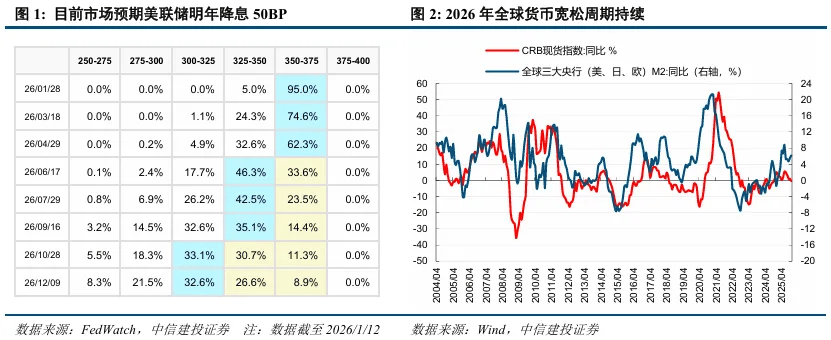
Group 1: Macro Liquidity and Economic Environment - The global interest rate cut cycle is entering its second half in 2026, characterized by "internal and external easing resonance" and a shift from "extraordinary to normal" conditions [2][5][61] - The Federal Reserve is expected to continue its rate cuts by 50 basis points, with a resumption of balance sheet expansion in December 2025 to alleviate dollar financing pressures [2][5][61] - Domestic monetary policy is transitioning from "extraordinary counter-cyclical adjustment" to "increased counter-cyclical and cross-cyclical adjustment efforts" [10][61] Group 2: Currency and Stock Market Dynamics - The weakening of the dollar due to continued Fed rate cuts and deteriorating U.S. fiscal conditions is expected to support the appreciation of the RMB, which may rise from 7.0 to 6.8 against the dollar [14][17][61] - The appreciation of the RMB is anticipated to enhance foreign investment in RMB-denominated assets, improve market risk appetite, and boost corporate profitability, thereby supporting the A-share market [17][61] Group 3: Investment Strategies and Asset Allocation - The long-term low interest rate environment is reshaping stock and bond allocation strategies, with a shift towards "fixed income plus" products and increased attractiveness of equity markets [20][21][62] - The "stock-bond seesaw" effect is expected to guide funds into equity markets, further supporting A-share performance despite potential long-term interest rate rebounds [25][62] Group 4: Capital Market Policy and Structural Changes - The capital market's status is significantly upgraded in the post-real estate era, becoming a core hub for economic development and resource allocation [4][32][63] - Policies are being implemented to enhance shareholder returns, with a focus on increasing dividend payouts and improving the quality of earnings, leading to a more balanced funding ecosystem [45][63] Group 5: Household Savings and Market Impact - The phenomenon of "deposit migration" is expected to become a significant marginal increment in the market as a large volume of fixed-term deposits matures in 2026 [3][29][62] - As of November 2025, household deposits in China exceeded 163 trillion yuan, with excess deposits potentially reaching 60 trillion yuan based on historical trends [28][29]
航油供应体系迎巨变 一体化整合能否稳定航司成本
Jin Rong Jie· 2026-01-14 10:48
Group 1 - The core point of the article is the restructuring of China Petroleum & Chemical Corporation and China Aviation Oil Group, which aims to create an integrated and centralized aviation fuel supply system in China, potentially consolidating the previously fragmented upstream refining, midstream trading, and downstream refueling structure into a closed industrial loop [1][3]. Group 2 - Aviation fuel is one of the main cost items for airlines, with its price fluctuations directly impacting airline profitability. According to China National Airlines' 2024 annual report, aviation fuel costs account for approximately one-third of total costs, and a 5% change in average aviation fuel prices could affect fuel cost fluctuations by about 2.686 billion yuan [3]. - Airlines express a preference for predictable fuel prices over simply low prices to stabilize cost management. The current pricing mechanism for aviation fuel purchases from China Aviation Oil is based on a weighted calculation centered around "comprehensive procurement costs," with international aviation fuel prices serving as a key reference benchmark [3]. - The initiation of this restructuring has raised market interest in the potential consolidation of other supportive state-owned enterprises in the civil aviation sector, with speculation that China Civil Aviation Information Network Co., Ltd. and China Aviation Supplies Holding Company may also be included in a higher-level industrial integration framework [3].