江淮汽车

Search documents
33股受融资客青睐,净买入超亿元
Zheng Quan Shi Bao Wang· 2026-01-20 02:01
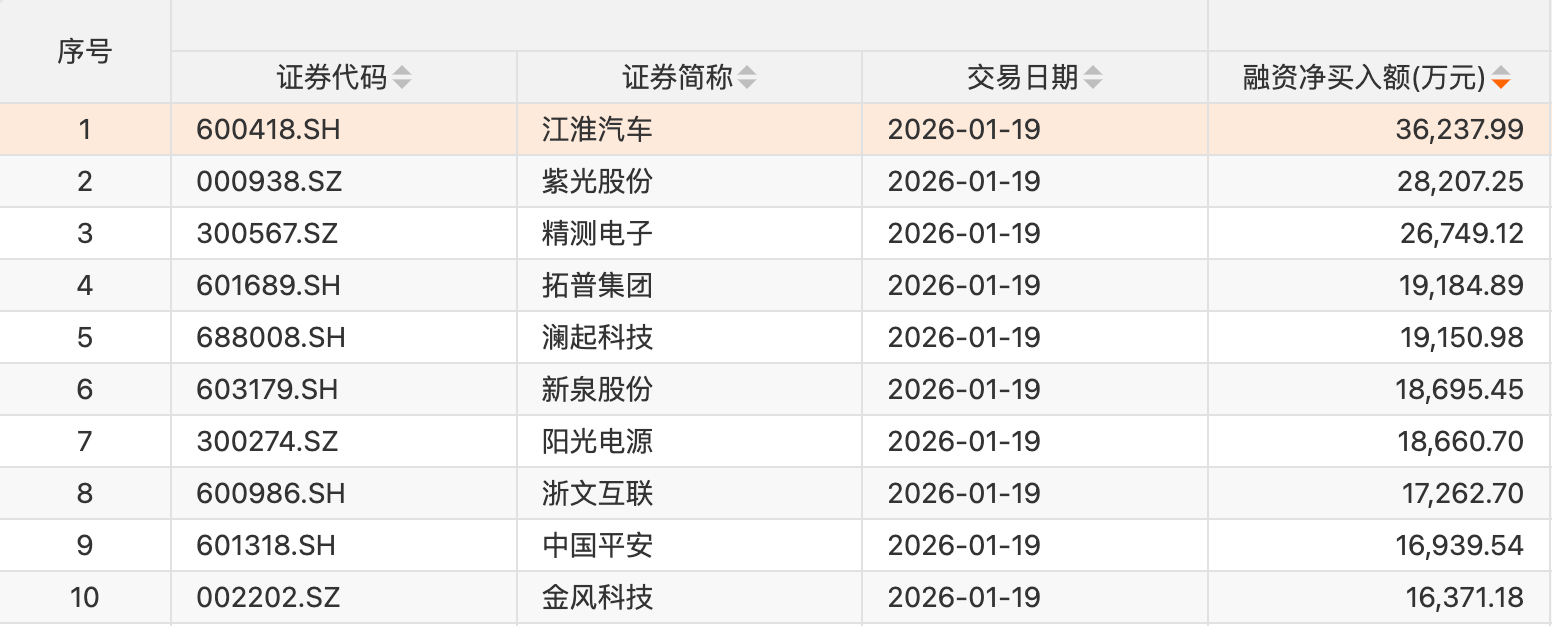
Summary of Key Points Core Viewpoint - As of January 19, the total market financing balance decreased to 2.71 trillion yuan, reflecting a reduction of 8.5 billion yuan from the previous trading day, indicating a cautious sentiment among investors [1]. Group 1: Market Financing Overview - The financing balance for the Shanghai Stock Exchange is 1.36 trillion yuan, down by 1.1 billion yuan, while the Shenzhen Stock Exchange's balance is 1.34 trillion yuan, decreasing by 7.5 billion yuan [1]. - The North Exchange saw an increase in financing balance to 9.11 billion yuan, up by 131 million yuan [1]. Group 2: Individual Stock Performance - On January 19, 1,619 stocks received net financing purchases, with 486 stocks having net purchases exceeding 10 million yuan, and 33 stocks surpassing 100 million yuan [1]. - Jianghuai Automobile led with a net purchase of 362 million yuan, followed by Unisplendour and Jingce Electronics with net purchases of 282 million yuan and 267 million yuan, respectively [1]. Group 3: Industry Analysis - The industries with the highest concentration of stocks receiving net financing purchases over 100 million yuan include electronics, power equipment, and non-ferrous metals, with 10, 6, and 3 stocks respectively [1]. - In terms of board distribution, 24 stocks on the main board, 4 on the ChiNext board, and 5 on the Sci-Tech Innovation board received significant net purchases [1]. Group 4: Financing Balance and Market Value - The average financing balance as a percentage of the circulating market value for stocks with significant net purchases is 4.76% [2]. - Zhejiang Wenhu's stock has the highest financing balance at 1.48 billion yuan, accounting for 10.95% of its circulating market value, followed by Jianghuai Automobile at 10.63% [2].


资金风向标 | 两融余额较上一日减少83.62亿元 汽车行业获融资净买入额居首
Sou Hu Cai Jing· 2026-01-20 01:52
Group 1 - As of January 19, the margin trading balance of A-shares is 27,231.75 billion yuan, a decrease of 83.62 billion yuan from the previous trading day, accounting for 2.63% of the A-share circulating market value [1] - The margin trading turnover on the same day is 2,683.76 billion yuan, down by 681.14 billion yuan from the previous trading day, representing 9.82% of the A-share transaction volume [1] - Among the 31 primary industries, 10 industries received net financing inflows, with the automotive industry leading at a net inflow of 758 million yuan [1] Group 2 - A total of 33 stocks received net financing inflows exceeding 100 million yuan, with Jianghuai Automobile leading at a net inflow of 362 million yuan [1] - Other notable stocks with significant net financing inflows include Unisplendour, Jingce Electronics, Top Group, Lanke Technology, New Spring Shares, Sungrow Power Supply, Zhejiang Wenhu Interconnect, China Ping An, and Goldwind Technology [1] - According to a report from Industrial Securities, in 2026, the automotive sector is expected to undergo a value reassessment due to advancements in high-level assisted driving and breakthroughs in robotics technology [2] - The robotics sector is gradually entering a large-scale production phase, with investment opportunities shifting from divergence to convergence [2] - The report suggests focusing on two main lines: technological changes in autonomous driving and robotics, and the industrial chain opportunities arising from large-scale implementation [2]


江淮汽车20260119
2026-01-20 01:50
Summary of JAC Motors Conference Call Company Overview - **Company**: JAC Motors - **Industry**: Automotive Key Financial Highlights - In Q4, JAC Motors reported a non-recurring net profit loss of 707 million yuan, showing a sequential improvement of 141 million yuan [2] - Volkswagen Anhui incurred a loss of approximately 1.1 billion yuan in the first half of the year, with 285 million yuan attributed to JAC Motors, and an expected total provision of 1.08 billion yuan for 2025 [2][5] - Excluding the impact from Volkswagen Anhui, JAC Motors is expected to achieve a net profit of 407 million yuan in Q4 [2][5] - For 2025, JAC Motors anticipates a total loss of 1.68 billion yuan, a reduction of 104 million yuan from the previous period, with a quarterly net profit loss of 246 million yuan in Q4 [4] Business Performance Insights - Traditional business performance was poor before 2023, but growth is expected in 2024 through overseas market expansion [2][6] - In 2025, traditional business is projected to face challenges due to the Russian scrappage tax and uncontrollable factors in the Middle East [2][6] - In Q3 2026, JAC Motors continued to report losses, but wholesale sales showed improvement, with the marginal profit per vehicle for the "Zun Jie" model exceeding 40,000 yuan [2][7] Production and Sales Outlook - The "Zun Jie" model had a wholesale volume of 9,633 units in Q4, with a capacity utilization rate of only 19%, indicating significant future profit potential as utilization improves [2][8] - The average net profit per vehicle is expected to reach over 50,000 yuan with increased capacity utilization [2][8] Market Strategy and Future Plans - JAC Motors plans to launch a high-end model in Q2 or Q3 of 2026, an MPV model in Q3 or Q4 of 2026, and an SUV model in the first half of 2027, which is expected to enhance market competitiveness [3] - Despite recent order fluctuations due to seasonal factors, the company maintains a stable margin profit outlook, bolstered by upcoming new models [9] Long-term Investment Perspective - The long-term investment value of JAC Motors is supported by a robust product cycle and market strategy, with a focus on improving governance and share structure [9] - Investors are advised to monitor the timing of equity operations and related disclosures, as these will positively impact the company's long-term development [9]
如何看2025年12月消费数据
2026-01-20 01:50
Summary of Key Points from Conference Call Records Industry Overview - **Consumer Sector Performance**: In December 2025, the overall retail sales growth was 0.9% year-on-year, with a full-year growth of 3.7%. Online retail grew by 5.2% for the year, while offline retail showed slower growth [2][3]. Key Insights and Arguments - **Retail Categories**: - Supermarket retail sales increased by 4.3% year-on-year, while department stores only saw a 0.1% increase [3]. - Essential goods performed well, with grain and oil food growth at 3.9%. In the discretionary category, cosmetics grew by 8.8%, and gold and jewelry increased by 5.9% due to a rise in gold prices [3][4]. - Communication equipment maintained a growth rate of over 20%, while home appliances declined by 19% due to tightening subsidies [3][4]. - **Automotive Sector**: - The total retail sales for automobiles reached 548.2 billion, down 5% year-on-year. Passenger car sales fell by 8.8%, but new energy vehicle wholesale sales grew by 3.3% [11]. - **Textile and Apparel**: - The textile and apparel sector saw a 0.6% year-on-year retail growth in December, but a decline in month-on-month performance due to weather and the delayed Spring Festival [13][14]. - **Alcohol Industry**: - The retail sales of the liquor industry decreased by 2.9% year-on-year in December, with a price index decline of 0.19%. The industry is currently in a phase of active inventory reduction [16][17]. - **Consumer Expectations**: - Due to the late Spring Festival and expectations of rising gold prices, consumer demand is anticipated to recover in January and February 2026 [5]. Additional Important Insights - **Investment Recommendations**: - In the beauty and personal care sector, companies like Shiseido and domestic brands such as Maogeping are recommended. For the gold and jewelry sector, brands with strong store expansion logic are highlighted [6][10]. - In the automotive sector, companies like JAC Motors and Geely are recommended, focusing on high-end and luxury markets [12]. - For the textile and apparel sector, brands like Li Ning and Fuanna are suggested, with a focus on companies that can support their market value through dividends [15]. - **Household Appliances**: - The household appliance sector is experiencing a downturn, with significant declines in sales across various categories. However, leading companies like Midea and Haier are expected to maintain slight growth due to low inventory levels [21][22][24]. - **Light Industry**: - The light industry saw a decline in furniture sales by 2.2% year-on-year, with exports down by 9.8%. However, some companies are expected to see revenue and profit recovery in 2026 [26][27]. Conclusion The consumer sector is facing mixed performance across various categories, with essential goods showing resilience while discretionary spending is under pressure. Investment opportunities exist in specific brands and sectors that are positioned to benefit from changing consumer behaviors and market dynamics.
33股获融资净买入额超1亿元 江淮汽车居首
Zheng Quan Shi Bao Wang· 2026-01-20 01:25
Industry Summary - On January 19, among the 31 primary industries tracked by Shenwan, 10 industries experienced net financing inflows, with the automotive industry leading at a net inflow of 758 million yuan [1] - Other industries with significant net financing inflows included banking, power equipment, non-bank financials, retail, and non-ferrous metals [1] Company Summary - A total of 1,619 stocks received net financing inflows on January 19, with 100 stocks having inflows exceeding 50 million yuan [1] - Notably, 33 stocks had net financing inflows exceeding 100 million yuan, with Jianghuai Automobile leading at a net inflow of 362 million yuan [1] - Other companies with significant net financing inflows included Unisoc, Jingce Electronics, Top Group, Lanke Technology, New Spring Shares, Sunshine Power, Zhejiang Wenhu Interconnection, and China Ping An [1]
592股获融资买入超亿元,特变电工获买入27.59亿元居首
Di Yi Cai Jing· 2026-01-20 01:15
Group 1 - On January 19, a total of 3,762 stocks in the A-share market received financing funds, with 592 stocks having a buying amount exceeding 100 million yuan [1] - The top three stocks by financing buying amount were Tebian Electric Apparatus, Zhongji Xuchuang, and Xinyi Sheng, with amounts of 2.759 billion yuan, 2.096 billion yuan, and 2.09 billion yuan respectively [1] - Two stocks had financing buying amounts accounting for over 30% of the total transaction amount, namely Kaile Co., Ltd. and Fuan Pharmaceutical, with ratios of 32.39% and 32.05% respectively [1] Group 2 - There were 33 stocks with a net financing buying amount exceeding 100 million yuan, with Jianghuai Automobile, Unisplendour, and Jingce Electronics leading at 362 million yuan, 282 million yuan, and 267 million yuan respectively [1]

深度 | 学习华为IPD运动,中国汽车业的一次大反思
汽车商业评论· 2026-01-19 23:07
Core Viewpoint - The year 2025 is marked as a significant learning year for Chinese automotive companies, which are increasingly adopting Huawei's methodologies, particularly the Integrated Product Development (IPD) process, to enhance their operations and product offerings [3][6]. Group 1: Learning from Huawei - Chinese automotive companies, whether state-owned or private, are engaging in a "learning from Huawei" movement, aiming to replicate its success in the automotive sector [3][6]. - The collaboration with Huawei has led to significant improvements in product development cycles and cost reductions for companies like GAC Group, which reported a reduction in product development time from 30 months to 18-24 months and a 10% decrease in development costs [11][6]. - The IPD process, which emphasizes market-driven product development, has become a sought-after model among automotive firms, with many companies adopting varying degrees of this approach [6][13]. Group 2: Implementation of IPD - The IPD framework encourages cross-departmental collaboration, allowing teams to share information transparently and make collective decisions throughout the product lifecycle [18][19]. - Companies implementing IPD have reported enhanced efficiency, with GAC Group noting a 70% improvement in data query efficiency and a significant reduction in fault tracing time [8][19]. - The structure of the PDT (Product Development Team) within the IPD framework allows for a more integrated approach to product development, ensuring that all relevant departments are involved from the outset [16][18]. Group 3: Challenges and Cultural Aspects - Despite the benefits, the transition to IPD is not without challenges, as companies often face cultural resistance and difficulties in aligning existing organizational structures with the new processes [38][46]. - The success of IPD implementation heavily relies on the leadership and cultural adaptability of the organization, as highlighted by the experiences of Huawei, which emphasizes a culture of accountability and collaboration [38][57]. - The ability to attract and retain talent is crucial for the successful adoption of IPD, as seen in Huawei's approach to hiring top talent and fostering a competitive environment [54][55].

华为乾崑智驾活跃用户数突破一百万 智能技术助推国产汽车工业“换道超车”
Ren Min Ri Bao· 2026-01-19 22:42
Core Insights - Huawei's partnership with various automotive manufacturers, including GAC Group and Dongfeng, marks a significant step in the development of smart connected vehicles, with over 1 million active users of Huawei's smart driving technology [1] - The penetration rate of smart vehicle technology in China has reached 50% in just five years, indicating rapid advancement in the industry [1] - The Chinese government emphasizes the importance of developing new energy vehicles as a pathway to becoming a strong automotive nation [1] Group 1: Technological Advancements - The Wuhu Zhijie Super Factory, a collaboration between Huawei and Chery, features 100% automation in welding and painting processes, showcasing the integration of AI in production [2] - Huawei's technology enhances driving experiences by optimizing features such as urban traffic congestion management and pedestrian recognition [2] - Huawei has established five major business segments in the smart automotive sector, focusing on core technologies like smart driving and vehicle control systems [3] Group 2: Successful Collaborations - The partnership between Huawei and Seres has led to the development of the "Wenjie" model, which has achieved significant market recognition and financial success, with projected revenues of 145.1 billion yuan in 2024, a 305.5% increase year-on-year [4] - Huawei's collaboration with Seres demonstrates the potential for traditional automakers to leverage Huawei's software and technology capabilities to enhance their manufacturing processes [4] - The "Hongmeng Zhixing" series of vehicles, including models across various price ranges, has achieved over 1 million units delivered, setting a record for new automotive brands [5] Group 3: Industry Impact - The launch of the first fuel vehicle equipped with Huawei's smart driving technology signifies a breakthrough in integrating advanced technology into traditional automotive designs [6] - Huawei's partnerships have led to the transformation of over 221 component manufacturers across multiple provinces, indicating a broad impact on the supply chain [6] - The collaboration with various automotive companies positions Huawei as a key player in driving the smart transformation of the Chinese automotive industry [7]

如何看2025年12月消费数据?
Changjiang Securities· 2026-01-19 14:31
Investment Rating - The report does not explicitly state an investment rating for the industry, but it provides insights into various sectors and companies with potential investment opportunities. Core Insights - In December, the total retail sales of consumer goods reached 45,136 billion yuan, a year-on-year increase of 0.9%. Excluding automobiles, retail sales amounted to 39,654 billion yuan, growing by 1.7%. For 2025, total retail sales are projected to reach 501,202 billion yuan, representing a 3.7% increase from the previous year, with non-automobile retail sales expected to grow by 4.4% to 451,413 billion yuan [4][7]. Retail Sector - The retail sector shows stable growth, with offline sales demonstrating resilience. In December, the retail sales of goods increased by 0.7% year-on-year, while dining revenue grew by 2.2%. Online retail sales of physical goods for the year increased by 5.2%, accounting for 26.1% of total retail sales [17][18]. Food and Beverage Sector - The food and beverage sector faced challenges in December, with dining revenue growing by only 2.2% year-on-year. The report suggests that the sector may see a rebound as previous restrictions on alcohol consumption ease [19][20]. Automotive Sector - The automotive sector experienced a decline in December, with total retail sales of automobiles at 548.2 billion yuan, down 5.0% year-on-year. However, the export of passenger vehicles saw significant growth, with a 50.4% increase in December [24][25]. Apparel and Textile Sector - The apparel and textile sector saw a slowdown in retail growth, with sales increasing by only 0.6% year-on-year in December. The report indicates that the sector is expected to recover in 2026 as inventory levels stabilize [28][29]. Home Appliances Sector - The home appliances sector faced a decline in December, with retail sales down 18.7% year-on-year. The report highlights that the sector's performance is affected by high base effects and the withdrawal of government subsidies [38][39]. Investment Recommendations - The report recommends focusing on companies with strong growth potential in various sectors, including beauty and personal care, gold and jewelry, and consumer electronics. Specific companies highlighted include 毛戈平, 上美股份, and 美的集团 [18][45].
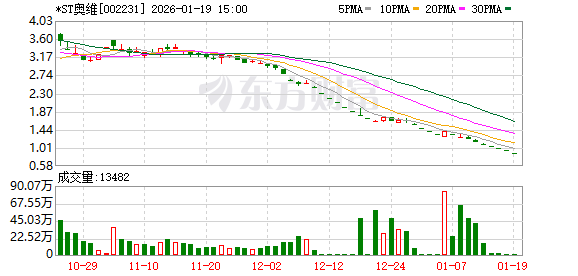
002231,锁定市值退市!2股获机构大幅抢筹
Zheng Quan Shi Bao Wang· 2026-01-19 13:57
Market Overview - The three major A-share indices showed mixed performance on January 19, with a total market turnover of approximately 2.73 trillion yuan, a decrease of over 320 billion yuan compared to the previous trading day [2] - More than 3,500 stocks closed higher, with 103 stocks hitting the daily limit [2] Sector Performance - The precious metals sector led the gains, with Sichuan Gold hitting the daily limit [2] - Other sectors that saw gains included electronic chemicals, photoresist, SMIC concepts, and agricultural chemicals [2] - Concepts such as Xiaohongshu, internet e-commerce, and Sora video saw significant declines [2] Institutional Ratings - A total of 16 buy ratings were issued by institutions today, covering 14 stocks [3] - The average increase for stocks rated as buy by institutions was 0.79%, outperforming the Shanghai Composite Index [3] - Notable performers included Jianghuai Automobile, Longxin General, and Southern Precision, with increases of 4.77%, 4.3%, and 2.07% respectively [3] Earnings Forecasts - Among the stocks rated as buy, seven provided earnings forecasts for 2025, with Shenghong Technology expecting a net profit growth of 277.68% year-on-year [3] - WuXi AppTec and Longxin General followed with expected net profit growths of 102.65% and 53.84% respectively [3] Industry Focus - The automotive sector was the most favored, with Jianghuai Automobile and BYD among the stocks receiving buy ratings from institutions [4] Institutional Trading - In the top stocks by institutional net buying, Jin Feng Technology saw a net purchase of 339 million yuan, leading the list [7] - Other notable net purchases included Nabichuan with 114 million yuan [7] - Conversely, Hongxiang Co. faced the highest net selling at 130 million yuan [7] Northbound Capital Flow - Northbound funds saw net purchases in 12 stocks, with China Western Electric leading at 314 million yuan [9] - Other significant net purchases included Xu Ji Electric and Giant Network, each exceeding 100 million yuan [9] Company Announcements - *ST Aowei announced a market cap lock for delisting, with a closing price of 0.89 yuan per share, totaling a market cap of 309 million yuan, below the 500 million yuan threshold for 12 consecutive trading days [10] - Pingzhi Information won a bid for a project worth approximately 489 million yuan [11] - Western Gold announced a share reduction plan by its controlling shareholder, with a maximum reduction of 911 million shares [11] - Liangpinpuzi projected a net loss of 120 to 160 million yuan for 2025 due to store optimization and declining sales revenue [11]