瑞幸咖啡

Search documents
瑞幸“9.9元”咖啡,越来越难喝到了
3 6 Ke· 2025-12-04 10:21
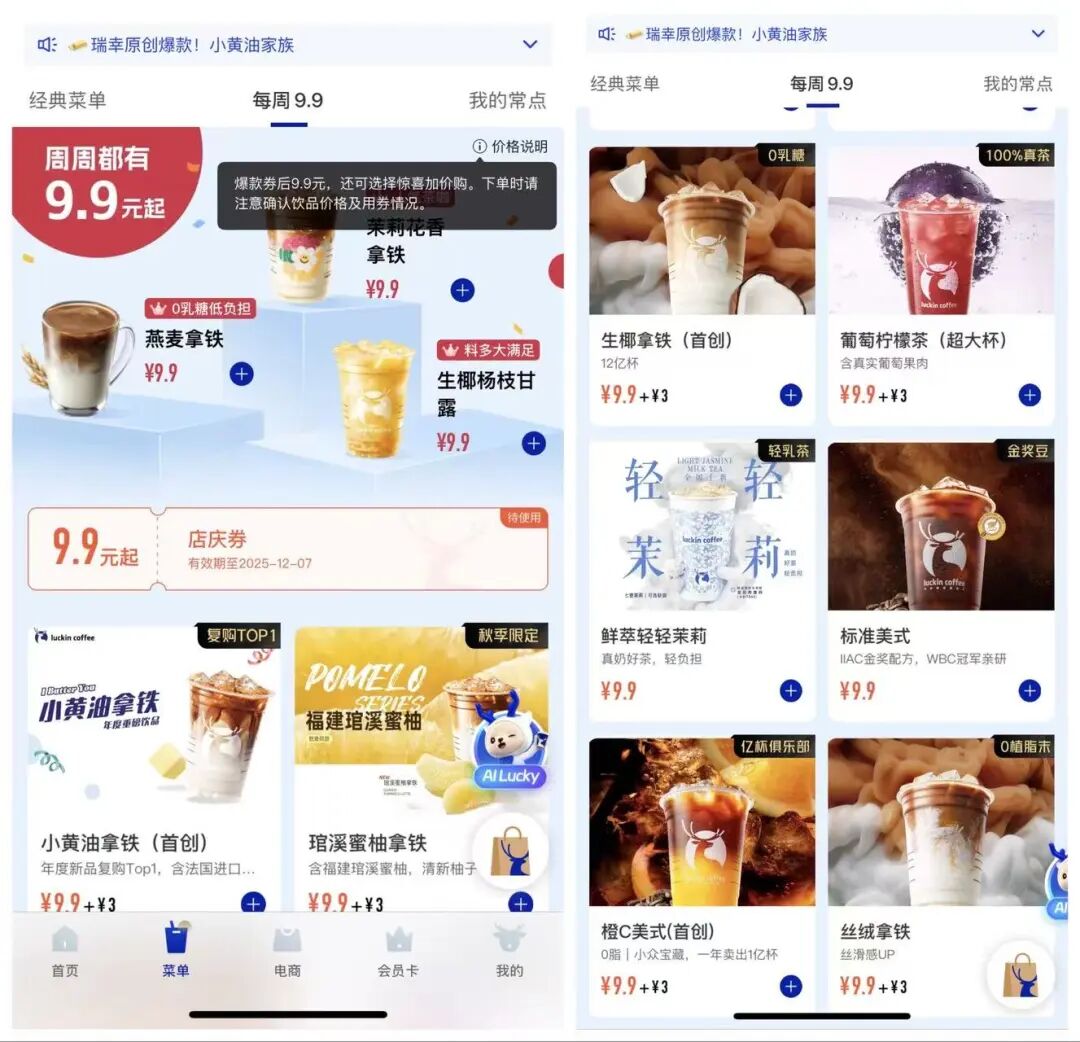
Core Viewpoint - Luckin Coffee's "weekly 9.9 yuan" promotion has become increasingly difficult to access, raising questions about its authenticity as the offer has been gradually reduced from a wide selection of drinks to only a few options, with additional costs now required for many items [1][2][4] Group 1: Promotion Changes - The "weekly 9.9 yuan" promotion started in the first half of 2023, initially allowing all drinks to be purchased at this price, but has since limited the offer to a few specific drinks, with many now requiring an additional 3 yuan [1][5] - Customers have expressed frustration over the promotion's diminishing value, feeling misled by the marketing tactics employed by Luckin Coffee [2][5] Group 2: Customer Experience and Legal Aspects - Legal experts indicate that while the small print disclosures may fulfill legal obligations, the marketing strategy may still be seen as misleading and could damage consumer trust [5] - The promotion's initial success was linked to a competitive pricing strategy aimed at increasing brand recognition and market share, but the recent changes may alienate some customers [9] Group 3: Financial Performance - In Q3 2023, Luckin Coffee reported a significant increase in monthly active customers, reaching 58.48 million, and a net revenue growth of 84.9% year-on-year, totaling 7.2 billion yuan [6] - However, the company's operating profit margin has decreased significantly, dropping from 18.9% to 3% in Q4 2023, and resulting in a loss of 65.11 million yuan in Q1 2024 [7] Group 4: Future Strategies - Luckin Coffee is expected to shift its promotional strategies towards more flexible methods, such as member-exclusive offers and limited-time discounts, as the low-price strategy becomes less sustainable [13] - The company is also exploring international expansion, having entered markets like Singapore and Malaysia, and is considering a return to the U.S. stock market [11][13]


瑞幸被曝克扣员工工时,每天白干3小时,官方暂未正面回应
Xin Lang Cai Jing· 2025-12-04 08:16
Core Viewpoint - Luckin Coffee is facing allegations of employee exploitation, particularly regarding unpaid overtime and excessive work hours, which has sparked significant public concern and discussion on social media [2][7][11]. Employee Exploitation Allegations - Employees claim they work 12 hours daily but are only compensated for 9 hours, resulting in 3 hours of unpaid labor [2][7]. - Reports indicate that scheduled "rest periods" require employees to remain on standby in-store without pay, leading to accusations of deceptive labor practices [2][7]. - High work intensity is reported, with strict performance metrics that pressure employees to complete tasks rapidly, often leaving no time for breaks [7]. Company Response - As of the article's publication, Luckin Coffee has not officially responded to the allegations of labor exploitation, and customer service representatives have avoided addressing the core issues [2][13]. Financial Performance - In Q3 2025, Luckin Coffee reported total net revenue of 15.287 billion RMB, a year-on-year increase of 50.2%, but net profit decreased by 1.9% to 1.28 billion RMB [13][14]. - The company added over 3,000 new stores, bringing the total to 29,214 globally [13]. - Despite revenue growth, the profit margin declined from 12.9% in the previous year to 8.4% in Q3 2025, indicating challenges in profitability [14][15]. Cost Structure - Total costs and expenses for Q3 2025 were 13.5106 billion RMB, a 57% increase from the previous year, with significant rises in material costs and operational expenses [14][15]. - Delivery costs surged by 211.4% to 2.8892 billion RMB, now accounting for 19% of total revenue, highlighting the financial impact of the competitive delivery market [15]. Market Position and Future Outlook - Luckin Coffee is planning to return to the U.S. capital market after overcoming past financial scandals, with the CEO expressing optimism about the company's growth and market position [16][17]. - The company has shown significant recovery from its previous financial crisis, achieving substantial revenue and profit growth, and is positioned as a leader in China's coffee market with a 32% market share [17].
瑞幸咖啡再上市:营收向左,利润向右
Sou Hu Cai Jing· 2025-12-04 07:04
Core Viewpoint - Luckin Coffee plans to restart its IPO in the U.S. after overcoming past financial scandals, aiming to leverage its current market position and growth potential [1][5]. Group 1: Company Overview - Luckin Coffee has transformed under new management, boasting nearly 30,000 stores and a market share exceeding 30%, with annual revenue approaching 50 billion RMB [3][7]. - The company reported a net income of 15.29 billion RMB in Q3, a year-on-year increase of 50.2%, and opened 3,008 new stores, marking an 11.5% increase [7]. Group 2: Financial Performance - Despite significant revenue growth, Luckin Coffee faces a decline in net profit, which fell by 2.7% year-on-year to 1.2783 billion RMB, indicating a situation of revenue growth without profit increase [8][9]. - The cost structure has shifted, with delivery fees rising to nearly 2.9 billion RMB, a staggering increase of 211.4%, now accounting for 19% of total revenue [8]. Group 3: Market Competition - The coffee market in China is projected to reach 313.3 billion RMB by 2024, growing at a rate of 18.1%, indicating a highly competitive environment with numerous players [10][11]. - Luckin Coffee now competes against established brands like Starbucks, as well as numerous new entrants, intensifying the pressure on profit margins [11][12]. Group 4: Strategic Challenges - The company’s high proportion of self-operated stores requires substantial capital expenditure, leading to unstable cash flow, which necessitates the IPO for additional funding [9]. - The competitive landscape is further complicated by Starbucks' recent partnership with Hillhouse Capital, which may enhance its market position and threaten Luckin's growth [15][17]. Group 5: Future Outlook - The management's motivation for the IPO is not only to secure funding but also to reward their efforts in revitalizing the company from its previous crisis [12]. - However, the current market sentiment towards Chinese companies in the U.S. and the potential for lower valuations due to cash flow concerns pose risks for the IPO [13].
【福利】36元优惠券获取攻略等您查收
中国建设银行· 2025-12-04 05:56
Group 1 - The article promotes a series of discounts and benefits through the "建行生活" app, including WeChat discount coupons starting from 0.99 yuan for purchases over 36 yuan [2][5] - The promotional activities are scheduled from August 1, 2025, to December 31, 2025, targeting winter dining experiences [2] - Various WeChat discount coupons are available for different spending thresholds, such as 3 yuan off for purchases over 2.01 yuan and 10 yuan off for purchases over 10.01 yuan [7][9] Group 2 - Users can participate in the WeChat discount activities through the "中国建设银行" app or the "建行生活" app, with specific instructions provided for accessing the discount sections [12] - Refund policies for the WeChat discount coupons are outlined, indicating that full refunds will return the discount amounts if the order is fully refunded, while partial refunds will return the discount proportionally [13][14] - The article includes customer service contact information for issues related to the discount cards, available daily from 9:00 to 23:00 [17]


库迪不能一直爆陆正耀的金币
3 6 Ke· 2025-12-04 04:18
"我不是想证明我有多了不起,只想告诉人家,失去的东西我一定要拿回来。"这句电影台词,恰似当年福建资本"雄狮"陆正耀再战咖啡赛道、创立库迪咖 啡时的心声。 2022年10月,瑞幸咖啡前董事长陆正耀携新品牌库迪重返咖啡赛道,也再次施展了熟悉的资本运营手法。从神州租车到神州优车,再到瑞幸咖啡,陆正耀 的商业打法始终围绕"资本驱动+规模扩张+流量营销"逻辑展开。 截至今年11月,库迪门店总数刚刚突破1.5万家——距离年初目标仅完成不到三分之一,与此同时,品牌已暴露出扩张的后遗症。从"10个月开4万家店"的 激昂誓言,到不得不面对增长失速、加盟商矛盾与营销转化的现实难题,库迪的故事,已成为陆系品牌寻求规模扩张与资本运作平衡性的再度拷问。 一、陆式打法2.0 库迪咖啡在年初定下了一个宏大目标,到2025年底全球门店规模达到5万家。 2025年接近尾声,这一目标与现实间的落差逐渐清晰:截至2025年11月,库迪门店总数仅突破1.5万家。曾立下"10个月开4万家店"誓言的库迪,不得不在现 实面前调整节奏。 2022年10月,瑞幸咖啡前董事长陆正耀携新品牌库迪重返咖啡赛道,再次施展了熟悉的资本运营手法:从神州租车到神州优车,再 ...

星巴克中国、蜜雪冰城……茶咖品牌们,都盯上了打工人的早餐
3 6 Ke· 2025-12-04 03:55
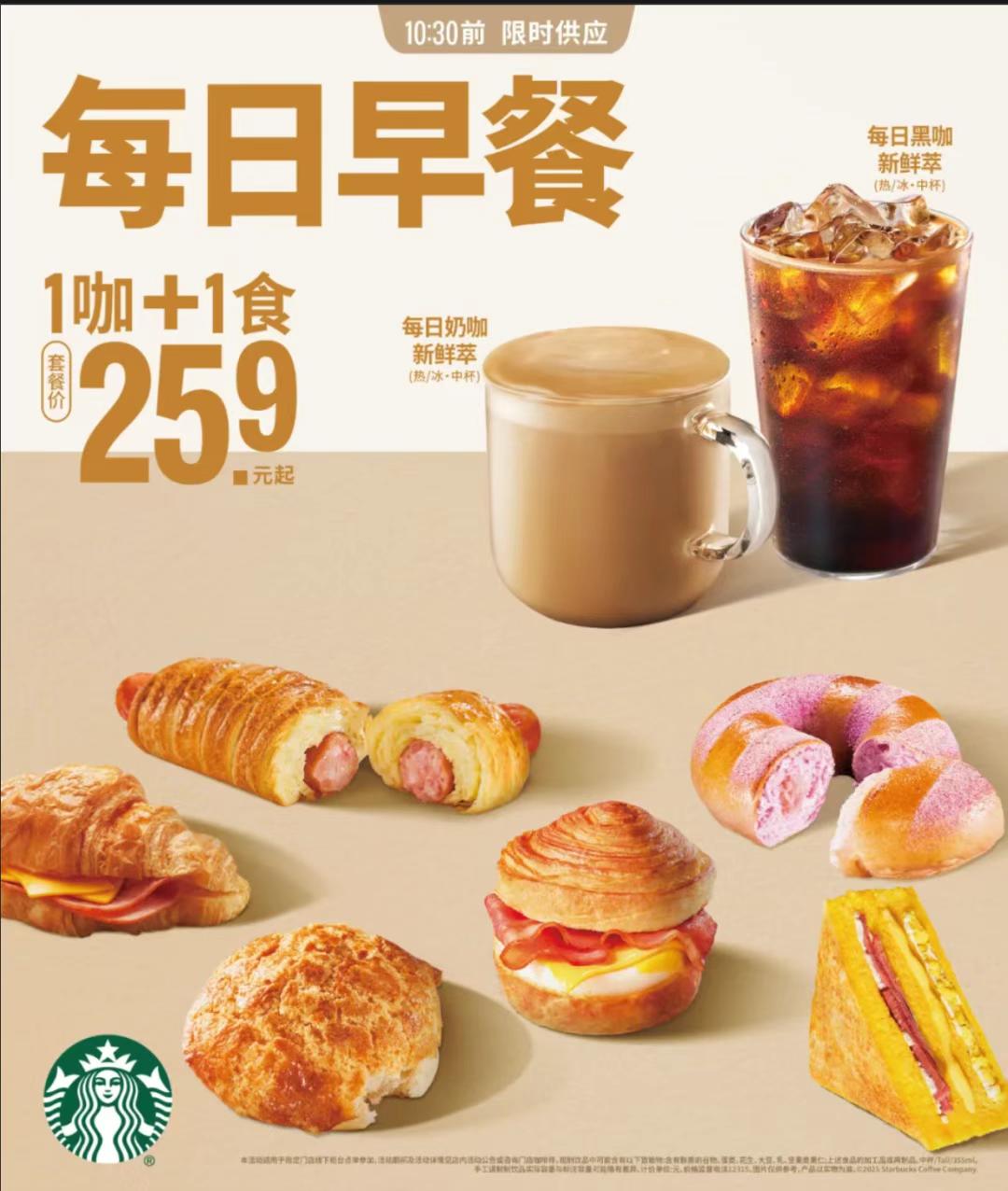
Core Insights - The article discusses the emerging trend of beverage brands, particularly coffee and tea chains, entering the breakfast market, indicating a shift in consumer behavior and market strategy [2][3][23] Group 1: Market Trends - Major beverage brands like Starbucks and Mixue Ice City are focusing on breakfast offerings, suggesting a strategic shift to capture consumer demand during this key meal period [2][4][22] - The trend of integrating food with beverages is becoming a standard practice rather than a differentiating factor, as seen with brands like Nayuki Tea and Tims Coffee [3][12][24] Group 2: Company Strategies - Starbucks launched a "Daily Breakfast" series in Shenzhen, offering value meal combinations at prices ranging from 25.9 to 31.9 yuan, which includes coffee and food items [6][8] - Tims Coffee has also entered the lunch market with a "Light Bagel Lunch Box" series, emphasizing health and freshness, indicating a broader strategy to attract consumers throughout the day [10][11] Group 3: Consumer Behavior - There is a growing consumer preference for convenient breakfast options, particularly among office workers and students, leading to increased demand for quick meal solutions [22][24] - The article highlights that breakfast consumption is becoming a necessity, with brands recognizing the importance of catering to this demand to enhance customer engagement and sales [22][26] Group 4: Competitive Landscape - The competitive landscape is shifting as beverage brands aim to capture a larger share of the breakfast market, which has traditionally been dominated by street vendors and local eateries [26][27] - The integration of food offerings is seen as a way to increase customer frequency and average transaction value, making it essential for brands to adapt to this evolving market [24][25]


2026消费年度策略新消费无惧质疑,逆流而上
2025-12-04 02:21
Summary of Conference Call Records Industry Overview - The new consumption sector shows higher growth elasticity compared to traditional consumption, particularly in high-end gold jewelry and IP retail segments, benefiting from structural track dividends and emerging categories [1][2] - Traditional consumption recovery relies on demand improvement and supply-side optimization, but current data indicates limited supply-side improvements [2] Key Companies and Their Performance Lao Pu Gold - Lao Pu Gold has increased prices three times in 2025, with a cumulative increase exceeding 40%, and expects further price elasticity in 2026 [1][6] - The company has improved user penetration among middle and high-net-worth individuals through local brand positioning and traditional cultural elements [1][4] - Membership growth has been significant, with a 74% increase in loyal members in the first half of the year, reaching 480,000, and expected to reach 600,000 by year-end [8] - The company faces cash flow pressure due to rapid expansion and rising gold prices, necessitating potential capital raising strategies [10] Luckin Coffee - Luckin Coffee has achieved same-store growth by increasing the proportion of private domain customer acquisition and core user repurchase frequency, although high delivery subsidies may negatively impact profit margins [3][15] - The company needs to assess the impact of delivery subsidies on profitability and same-store growth continuity for 2026 [3][15] Pop Mart - Pop Mart's North American market has shown a slowdown in growth but overall performance remains better than expected, aided by product channel adjustments and IP updates [11][12] - The company faces challenges in operational strategy adjustments and needs to optimize channel and product structures to improve market performance [12][14] - Future growth will depend on significant improvement signals from the North American market and the development of new independent product categories [14][13] Atour Hotel - Atour Hotel has integrated retail business operations, with retail accounting for 30%-40% of revenue, and expects revenue to approach 4 billion RMB by the end of 2025 [19][20] - The company focuses on member value experience and has successfully expanded its retail business through loyal user engagement rather than supply chain advantages [19][21] Market Trends and Future Outlook - The 2026 consumption market will focus on category dividends and the secondary utilization and monetization of user value, with growth continuity being crucial [3][22] - New consumption companies should demonstrate strong growth certainty to mitigate market uncertainties, with high-end gold jewelry and IP retail being key growth areas [5][22] - The overall consumer landscape is expected to show resilience, with potential growth rates of 20%-30% in certain sectors, particularly in low-frequency consumption industries [18][22]
票房刷新纪录、联名盲盒溢价翻倍!《疯狂动物城2》的“疯狂”不止票房
Yang Zi Wan Bao Wang· 2025-12-03 13:43
Group 1 - The core viewpoint of the article highlights the significant success of "Zootopia 2," which has surpassed a cumulative box office of 21 billion, setting multiple records in the Chinese film industry for imported animated films [1][3] - The film has not only achieved box office success but has also sparked a surge in IP collaboration, with Disney reporting a threefold increase in licensing business related to the Zootopia IP in the Greater China region since December 2023 [3] - By the end of 2025, over 2,000 licensed products related to Zootopia are expected to be launched in the Greater China region, showcasing the extensive market potential of the IP [3] Group 2 - The collaboration brands for Zootopia 2 span various popular sectors, including toys, gold, dining, card games, clothing, and automobiles, resulting in a diverse range of merchandise such as plush keychains, themed decorations, and limited blind boxes [5] - Notable brands like Pop Mart, Miniso, Luckin Coffee, and Chow Tai Fook have joined the collaboration, with products like Pop Mart's Zootopia-themed figurines priced at 69 yuan per blind box, which have seen a market price of around 200 yuan for rare items [5] - The dual success of box office performance and the collaboration market reflects the strong appeal of the content to audiences and the significant potential of classic IP in cross-industry commercial ventures [7]


“投资古茗账面盈利50亿元 最终可能赚到100亿元”
Zhong Guo Ji Jin Bao· 2025-12-03 12:17
Core Insights - The founder partner of Meituan Longzhu, Zhu Yonghua, predicts that the ready-to-drink beverage industry will see six new listed companies in the next five years, including Heytea and Chayan Yuese [1][4]. Industry Overview - The Chinese coffee and tea beverage market is expected to reach a trillion yuan scale in the next 5 to 10 years, with significant growth potential [4]. - The third quarter of this year saw the tea beverage market's overall revenue grow by 16.5% year-on-year, while the coffee market's revenue increased by 27.3% year-on-year [6]. Market Dynamics - The tea beverage market experienced a 4% year-on-year decline in the total number of stores, totaling 408,000, while the coffee market saw a 12.8% increase, reaching 193,000 stores [6]. - An "M-shaped" ecological structure is forming in the beverage industry, with leading brands expanding significantly while new brands emerge rapidly [7]. Competitive Landscape - The industry is transitioning from homogeneous expansion to value competition, focusing on differentiation, brand premium, and operational efficiency [7]. - The coffee market has produced three brands with over 10,000 stores: Luckin Coffee, Kudi Coffee, and Lucky Coffee, with the latter experiencing rapid growth under the support of the Mixue Group [7]. Regional Brand Strategy - Local brands are leveraging unique regional flavors and emotional connections to secure their market space amidst fierce competition [9]. - The example of Mo Mo Nan Lu, a local brand from Shandong with only 200 stores, illustrates the importance of focusing on local market cultivation and product differentiation through local ingredients [9][11].

瑞幸二次上市遭围剿,星巴克被资本拿下,29亿配送费 咖啡圈生死局
Sou Hu Cai Jing· 2025-12-03 11:48
Core Viewpoint - Luckin Coffee is facing significant challenges ahead of its potential re-listing, with a notable discrepancy between its impressive revenue growth and stagnant profits, raising concerns about its underlying business model and operational efficiency [1][9]. Financial Performance - Luckin Coffee's recent quarterly report shows a substantial increase in revenue and a rapid rise in store count, nearing competitors like Heytea. However, net profit remains unchanged, indicating deeper issues within its cost structure [3]. - The company spent nearly 2.9 billion on delivery services in just three months, more than doubling from the previous year, which highlights the financial strain from its delivery model [3][14]. Competitive Landscape - Intense price competition is evident, with competitors like Kudi Coffee drastically lowering prices, forcing Luckin to reduce its own prices from 9.9 yuan to 6.9 yuan, which has not resulted in a proportional increase in customer loyalty [5]. - The competitive pressure is compounded by Starbucks' aggressive expansion strategy in China and the emergence of Kudi Coffee, which closely mimics Luckin's business model [7]. Market Perception and Capital Concerns - Luckin's eagerness to re-list is driven by a desire to restore its image post-2019 financial scandal. However, the market remains skeptical, as the current financial performance does not convincingly demonstrate a sustainable profit model [9]. - The stock price increase in the pink sheet market appears speculative, with long-term investors scrutinizing the company's fundamentals for potential weaknesses [9]. Supply Chain and Operational Efficiency - The company recognizes that relying on subsidies is not a viable long-term strategy, as competitors are enhancing their supply chain capabilities to reduce costs and improve efficiency [11]. - Luckin must address its supply chain and store management issues to avoid superficial growth and ensure long-term viability in a competitive market [13][14].