中央汇金

Search documents
16年 vs 4个月:谁按下了ETF的万亿“快进键”?
Sou Hu Cai Jing· 2025-09-26 10:50
Group 1: Market Overview - The ETF market in China is rapidly approaching a scale of 5.5 trillion yuan, having crossed the 1 trillion yuan mark in just four months, compared to 16 years previously [2][3] - As of September 26, the total number of ETF funds reached 1,319, reflecting a growth rate of 32.4%, with total net asset value at 5.497 trillion yuan, an increase of 81.8% [3][8] - The growth of the ETF market is attributed to policy support, cost advantages, high transparency, and flexible trading mechanisms [2][3] Group 2: Supply and Demand Dynamics - The supply side of the ETF market has diversified, with products ranging from broad-based indices to sector themes, covering various asset classes [3] - On the demand side, the stabilization of the stock market and improved investor sentiment have led to increased inflows into ETFs, driven by both the wealth effect and risk aversion [5][8] - Individual investors are increasingly shifting from direct stock investments to ETFs, attracted by the ease of access and lower fees [8] Group 3: Role of Institutional Investors - The "national team," represented by entities like Central Huijin, has been actively investing in ETFs, contributing to market stability [6][7] - As of mid-2023, Central Huijin had invested over 210 billion yuan in 12 ETFs, holding a total market value of 1.28 trillion yuan in ETFs [6] Group 4: Market Challenges - The ETF market is experiencing a "Matthew effect," where larger ETFs attract more capital, leading to increased competition and product homogeneity [9] - The proliferation of similar ETFs may complicate investment choices for investors, potentially reducing investment efficiency [9] - As the ETF market expands, there are growing concerns about accumulated market risks, including liquidity issues during market volatility [10][11]

16年 vs 4个月:谁按下了ETF的万亿“快进键”?
和讯· 2025-09-26 10:11
Core Viewpoint - The rapid growth of China's ETF market, which is approaching a scale of 5.5 trillion yuan, is driven by policy support, cost advantages, transparency, and flexible trading mechanisms [2][3]. Group 1: ETF Expansion and Progress - The total scale of ETFs has surged from 4 trillion yuan to 5 trillion yuan in just four months [4]. - As of September 26, the total number of ETFs reached 1,319, with a net asset value of 5.497 trillion yuan, reflecting a 32.4% increase in the number of funds and an 81.8% increase in net asset value compared to the previous year [5][6]. Group 2: Supply and Demand Dynamics - The supply side has diversified ETF products, covering various asset classes, which enhances their attractiveness to investors [5]. - On the demand side, a recovering stock market and improved investor sentiment have led to increased inflows into ETFs, particularly during periods of market volatility [6][10]. Group 3: Role of Institutional and Retail Investors - The "national team," represented by entities like Central Huijin, has significantly increased its holdings in ETFs, spending over 210 billion yuan on 12 ETFs [7]. - Retail investors are increasingly shifting from direct stock investments to ETFs, driven by the convenience and lower costs associated with ETF investments [9][10]. Group 4: Market Competition and Risks - The ETF market is experiencing a "Matthew Effect," where larger funds attract more capital, leading to increased product homogeneity and potential challenges for investors in making choices [11]. - As the ETF market expands, risks such as liquidity issues during market volatility and valuation risks may accumulate, necessitating improved regulatory measures and investor education [12].

社保险资持仓超2万亿 A股“压舱石”效应凸显
Huan Qiu Wang· 2025-09-25 05:55
Group 1 - The core viewpoint of the article highlights a significant change in the funding structure of the A-share market, driven by "patient capital" such as social security funds and insurance funds, which has injected unprecedented stability and long-term confidence into the market [1][4] - As of the end of Q2 this year, the "national team" represented by Central Huijin and the China Securities Finance Corporation has a holding value in A-shares exceeding 3.7 trillion yuan, nearing historical peaks [1][3] - Long-term funds, including insurance and social security funds, have collectively surpassed 2 trillion yuan in holdings, marking a historical high, with insurance funds' equity allocation growth significantly outpacing their total asset growth, indicating strong confidence in the long-term value of the A-share market [1][3] Group 2 - The "national team" has actively entered the market through ETF channels, with an estimated cumulative investment of nearly 220 billion yuan in the first half of the year, including a substantial increase of 137.2 billion yuan in the CSI 300 Index ETF [3] - The market ecosystem is experiencing positive changes, with individual investors showing increased enthusiasm while maintaining a rational pace, and the margin trading balance rising from 1.39 trillion yuan before policy implementation to a historical high of 2.42 trillion yuan [3] - Foreign capital, another key component of "patient capital," has also been increasing its holdings in A-shares, with northbound capital reaching a holding value of 2.29 trillion yuan by the end of Q2, reflecting a long-term and value-oriented investment strategy [3][4] Group 3 - Industry analysts believe that the "patient capital" has become a core pillar for the stable and sustainable development of the A-share market, leading to a new era characterized by long-termism and value investment [4] - The continuous improvement of mechanisms for long-term capital entering the market is expected to facilitate a leap from scale expansion to quality enhancement in the A-share market [4]
东兴系人事调整 涉及多家子公司
Xin Lang Cai Jing· 2025-09-24 12:12
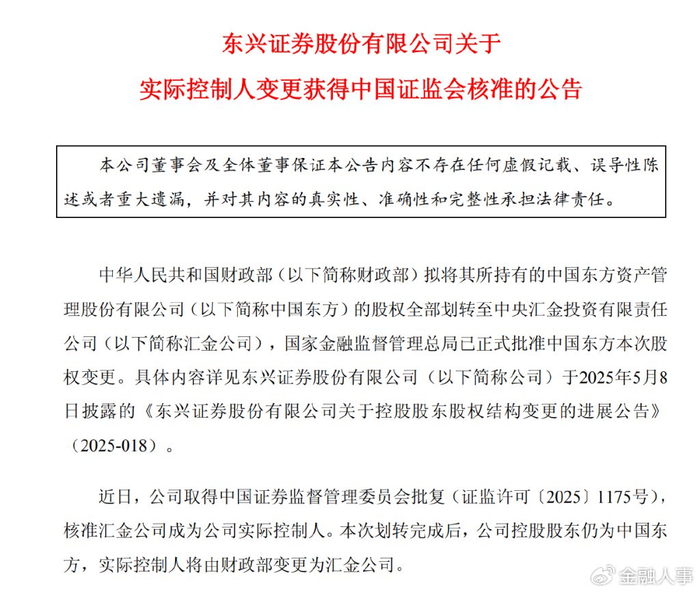
Core Insights - Dongxing Securities reported a revenue of 2.249 billion yuan for the first half of 2025, representing a year-on-year growth of 12.46%, and a net profit attributable to shareholders of 819 million yuan, up 42.12% [1] - The company underwent a series of personnel adjustments within its subsidiaries, including leadership changes at Dongxing Fund and the research institute [1][4] Company Performance - The actual controller of Dongxing Securities changed in 2025, with the Ministry of Finance transferring its 71.55% stake in China Orient Asset Management to Central Huijin, marking a significant shift in control [2] - Despite the positive performance, Dongxing Securities is involved in a fraud dispute related to the IPO of Zeda Yisheng, which has attracted market attention [4] Subsidiary Developments - Dongxing Fund maintained a total management scale of 38.912 billion yuan by the end of Q2 2025, ranking 92nd among 210 public funds, although it faced challenges in its equity business and rising costs [4][5] - The research institute of Dongxing Securities is experiencing pressure from declining commission rates and talent loss, with a focus on enhancing its competitive edge through restructuring and the recruitment of a new chief economist [5][6] Strategic Adjustments - The company is restructuring its research organization to improve the synergy of macro, mid, and micro research chains, aiming to address the competitive landscape and internal adjustments [5] - The recruitment of a chief economist, the first in six years, highlights the urgency for the company to strengthen its macro research capabilities [5][6]

“引长钱促长投”改革效果加快显现 各类中长期资金合计持有市值逾20万亿元
Jin Rong Shi Bao· 2025-09-24 03:32
Core Insights - The Chinese Securities Regulatory Commission (CSRC) is accelerating investment reforms to establish a "long money long investment" policy framework, with significant achievements in promoting long-term capital into the market as of August 2023 [1][4] Group 1: Investment Reforms - The CSRC has implemented a comprehensive fee reduction reform in the public fund industry, achieving a significant breakthrough with a three-phase fee reduction plan that has been fully rolled out [2] - The third phase of the fee reduction reform is expected to save investors approximately 30 billion yuan annually, with an overall reduction of about 34% in sales fees [2] - Cumulatively, the three phases of the public fund fee reform are projected to save investors around 51 billion yuan each year, exceeding the initial reduction targets [2] Group 2: Public Fund Industry Growth - The public fund industry in China has reached a record high, surpassing 35 trillion yuan by the end of August 2023, indicating its growing importance in the capital market [3] - The successful implementation of the fee reduction reform marks a new phase of high-quality development for the public fund industry [3] Group 3: Long-term Capital Investment - Long-term capital plays a crucial role in stabilizing the market and mitigating short-term volatility, with a reported increase of 6.4 trillion yuan in the A-share market's circulating value held by various long-term funds, representing a year-on-year growth of 42.7% [4] - As of August 2023, various long-term funds collectively held approximately 21.4 trillion yuan in A-share circulating market value [4] Group 4: ETF Development - The CSRC has proposed establishing a fast-track approval process for ETF index funds to enhance the scale and proportion of equity funds, with ETF assets exceeding 5 trillion yuan by August 2023 [5] - The development of innovative ETF products has catered to diverse investment needs, contributing to the high-quality growth of the industry [5] - Central Huijin has significantly increased its holdings in ETFs, with a total value of 1.28 trillion yuan by mid-2025, accounting for nearly 30% of the total ETF market [5]
“引长钱促长投”改革效果加快显现
Jin Rong Shi Bao· 2025-09-24 02:54
Core Viewpoint - The Chinese government is accelerating investment reforms to promote long-term capital investment in the capital market, with significant achievements reported in the entry of medium- and long-term funds into the market [1][4]. Group 1: Investment Reforms - The China Securities Regulatory Commission (CSRC) has issued guidelines to encourage medium- and long-term funds to enter the market, with a total of approximately 21.4 trillion yuan in A-share market value held by various medium- and long-term funds as of the end of August this year [1][4]. - The comprehensive fee reduction reform for public funds has been fully implemented, with a projected annual reduction of approximately 510 million yuan for investors, exceeding the initial targets [2][3]. Group 2: Public Fund Industry - The public fund industry in China has reached a record high, surpassing 35 trillion yuan in total assets by the end of August, marking a significant milestone in the industry's development [3]. - The fee reduction reform is seen as a critical step towards high-quality development in the public fund sector, with the third phase of the reform focusing on reducing sales fees and benefiting investors [2][3]. Group 3: Role of Medium- and Long-Term Funds - Medium- and long-term funds are crucial for stabilizing the capital market and mitigating short-term volatility, with a year-on-year increase of 42.7% in the market value held by these funds [4]. - The government has implemented measures to facilitate the entry of social security, insurance, and pension funds into the market, enhancing the overall investment landscape [4]. Group 4: ETF Development - The scale of Exchange-Traded Funds (ETFs) has surpassed 5 trillion yuan, with new innovative products launched to meet diverse investment needs [5]. - Central Huijin has played a significant role in boosting market confidence by increasing its holdings in ETFs, with a total value reaching 1.28 trillion yuan by mid-2025 [5].
起底救市旗手中央汇金
Hu Xiu· 2025-09-24 00:56
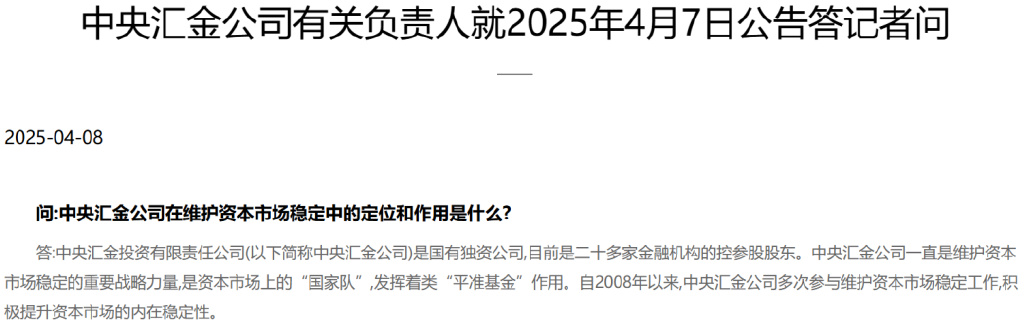
Core Viewpoint - The Central Huijin Investment Company has significantly increased its influence in the A-share market, acting as a stabilizing force during market fluctuations and adopting a more proactive approach in its investment strategies, particularly through the purchase of ETFs and shares in major banks [2][20][32]. Group 1: Central Huijin's Role and Influence - Central Huijin has clarified its role as a "national team" and "quasi-stabilization fund," committing to increase its holdings in various market styles of ETFs [2][3]. - The company has played a crucial role in stabilizing the market, especially following the easing of trade tensions and the recovery of the technology sector [3][4]. - Compared to other state-owned entities, Central Huijin's resources and mission align more closely with the functions of a "stabilization fund," allowing it to exert greater influence on the market [9][24]. Group 2: Historical Context and Evolution - Established in 2003, Central Huijin initially focused on the restructuring of major banks and has since evolved to manage a vast portfolio of state-owned financial assets [10][11]. - Over the years, Central Huijin has participated in market stabilization efforts during periods of significant downturns, notably in 2008-2009, 2011, 2012, and 2015 [14][15]. - The company has recently re-entered the market after a prolonged absence, actively buying shares in major banks and ETFs during market lows in 2023-2024 [21][22]. Group 3: Investment Strategy and ETF Focus - Central Huijin has shifted its investment strategy towards a more frequent and sustained presence in the market, particularly through the acquisition of ETFs, which have become its primary tool for market intervention [34][40]. - As of mid-2025, Central Huijin's ETF holdings reached approximately 1.28 trillion yuan, reflecting a tenfold increase from the previous year [48]. - The company has strategically focused on large-cap indices, such as the CSI 300 and SSE 50, to effectively stabilize the market and enhance investor confidence [45][46]. Group 4: Market Impact and Future Outlook - Central Huijin's actions have contributed to a higher proportion of institutional investors in the A-share market, promoting a more stable investment environment [53][54]. - The company's influence is expected to grow further as it continues to acquire significant stakes in major financial institutions and ETFs, thereby shaping the market landscape [27][29]. - While Central Huijin plays a vital role in market stabilization, the overall market recovery is contingent upon broader economic policies and fundamental improvements [56][58].
起底救市旗手中央汇金
虎嗅APP· 2025-09-23 23:56
Core Viewpoint - The article discusses the increasing influence of Central Huijin Investment Ltd. (Central Huijin) in the A-share market, highlighting its role as a stabilizing force and its strategic shift towards more frequent and sustained market interventions through ETF investments [2][3][6]. Group 1: Central Huijin's Role and Influence - Central Huijin has emerged as the most influential entity among the so-called "national teams" in the A-share market, surpassing other institutions like the Social Security Fund and the Securities Finance Corporation due to its larger resource pool and mission alignment with market stabilization [4][9][20]. - The company has been actively involved in the market since its establishment in 2003, initially focusing on restructuring major state-owned banks and later expanding its role to stabilize the financial system during market downturns [10][11][17]. - In recent years, particularly from 2023 onwards, Central Huijin has increased its market interventions, frequently buying shares of the four major banks and ETFs to bolster market confidence during periods of decline [17][18][20]. Group 2: Investment Strategy and ETF Focus - Central Huijin has shifted its investment strategy to focus primarily on ETFs, which allows for broader market impact while minimizing risks associated with individual stock trading [33][34]. - The company holds a significant amount of ETFs, with a total value reaching 1.28 trillion yuan by mid-2025, reflecting a tenfold increase from the previous year [42][43]. - The strategy of investing in large-cap indices like the CSI 300 and SSE 50 helps stabilize the market and provides liquidity, while also ensuring a relatively safer investment profile [38][39]. Group 3: Market Impact and Future Outlook - Central Huijin's actions have contributed to a notable increase in institutional investor participation in the A-share market, which has historically been dominated by retail investors [45]. - The company's interventions have been crucial in preventing excessive market declines, although the ultimate market recovery relies on broader economic and policy improvements [46][51]. - Looking ahead, Central Huijin is expected to continue playing a pivotal role in market stabilization, especially as it gains more resources and responsibilities from other state-owned financial institutions [26][27].
政策双周报(0905-0920):基金销售费率征求意见稿发布,14D逆回购招标方式调整-20250923
Huachuang Securities· 2025-09-23 03:41
1. Report Industry Investment Rating No information regarding the industry investment rating is provided in the report. 2. Core Viewpoints of the Report The report comprehensively analyzes various policies from September 5th to September 20th, 2025, including macro - economic, fiscal, monetary, financial regulatory, real estate, and tariff policies. It aims to provide an overview of the current economic policy environment and potential impacts on different sectors [1][2][3]. 3. Summary by Directory 3.1 Macro - economic Tone - The government is promoting the construction of a unified national market and expanding service consumption. Measures include rectifying disorderly competition, boosting consumer spending with about 420 billion yuan in fiscal support driving over 2.9 trillion yuan in sales, and promoting private investment [1][11][12] - The State Council has deployed measures to promote private investment, aiming to expand investment space, ensure fair competition, and support private capital in new areas [13][16] 3.2 Fiscal Policy - The fiscal policy is more active, with a focus on using special bonds to repay government arrears to enterprises. As of September 19th, 2025, 1.1506 trillion yuan of special bonds have been issued, exceeding the annual limit of 800 billion yuan [17] - Over 60% of financing platforms have exited, and 4 trillion yuan of the 6 - trillion - yuan special debt quota has been issued. The government debt risk is under control, and it plans to issue part of the 2026 local government debt quota in advance [18][19] 3.3 Monetary Policy - The central bank has optimized and simplified the evaluation indicators for primary dealers, which helps to improve the transmission of interest rates and strengthen the benchmark nature of the Treasury yield curve [21] - The 14 - day reverse repurchase operation has been adjusted to a fixed - quantity, interest - rate tender, and multiple - price winning bid method, further strengthening the policy interest rate status of the 7 - day reverse repurchase [22] - The global financial stability system faces challenges such as fragmented regulatory frameworks, insufficient regulation in digital finance, and weak regulation of non - bank intermediaries [23] 3.4 Financial Supervision - A draft for public comments on the management regulations of public fund sales fees has been released, and the second batch of science and technology innovation bond ETFs will be listed on September 24th [26] - New regulations for insurance, trust, and securities industries have been introduced, including the "Insurance Company Capital Guarantee Management Measures", the "Trust Company Management Measures", and the start of the self - evaluation of securities company classification [27][28] - The controlling rights of three AMC companies have been transferred to Central Huijin. There are concerns about the liquidity risk of funds concentrated in the technology sector, and the proportion of cash wealth management in August reached a new low for the year [29] 3.5 Real Estate Policy - Shenzhen has relaxed purchase restrictions in multiple districts, and Shanghai has exempted first - home buyers from property tax under certain conditions [32] - Shenzhen has released a draft for public comments on the housing provident fund management measures, and Beijing and Shanghai have adjusted the upper and lower limits of the monthly housing provident fund payment base [33] 3.6 Tariff Policy - Chinese and US leaders had a phone call, and the two sides reached a basic framework on issues such as TikTok. China opposes the politicization of technology and economic and trade issues [36][37]
存款疯狂 “逃离” 银行!万亿资金扎进股市,A股要迎来爆发期?
Sou Hu Cai Jing· 2025-09-19 07:56
Group 1 - The core viewpoint is that China's asset revaluation has long-term rationality and feasibility, supported by capital market dynamics and economic transformation [3][26][28] - Insurance funds have increased their stock investments by 640 billion yuan, indicating confidence in economic transformation and emerging industries [13][15] - The central Huijin has increased its stock ETF holdings by nearly 23% compared to the previous year, signaling market confidence in the transformation process [15][20] Group 2 - The report highlights that China's current securities ratio is low compared to developed countries, but this presents an opportunity for growth as the economy transitions [5][9] - Emerging industries such as technology and renewable energy are rapidly developing, necessitating capital market financing rather than relying solely on bank loans [7][11] - The low valuation of major Chinese indices provides a safety net for long-term foreign investment, despite potential fluctuations in external factors like U.S. interest rates [20][22][24] Group 3 - The current market fluctuations are normal as the investment cycle begins, and the increase in retail investment indicates a shift towards the stock market [24][28] - The long-term trend of asset revaluation is driven by multiple factors, including economic transformation, low valuations, capital support, and global attractiveness [26][30] - The focus should be on the broader economic transformation rather than short-term market volatility, as real investment opportunities lie in aligning with long-term trends [30]