青岛啤酒

Search documents
维京中国母港游轮黄渤海航线启航
Cai Jing Wang· 2025-08-18 04:05
近日,维京游轮推出2026年欧洲内河游轮航季及中国黄渤海航线。欧洲市场方面,2026年航季共设14条 航线,覆盖10国29个目的地,包括4条8-11日经典纯河轮航线及10条10日起"河轮+陆地游"航线。新增陆 地游目的地包括米兰、里昂、慕尼黑。 (维京游轮) 国内市场方面,首条黄渤海航线"7日中西文化之旅"于8月16日由"招商伊敦号"启航,新增天津作为母港 之一,串联青岛、大连两大海滨城市。岸上行程涵盖青岛啤酒(600600)博物馆、大连武术文化博物馆 等工业与文化地标。该航线仅设8月16日、22日两个限量出发日期。 维京中国持续推进"河轮+海轮"双轮驱动,通过欧洲内河的文化沉浸与国内沿海的在地探索,构建覆盖 高端客群的全场景服务体系。 ...
8元啤酒卖不动?重庆啤酒上半年业绩失速
凤凰网财经· 2025-08-17 12:44
Core Viewpoint - Chongqing Brewery's performance in the first half of 2025 was under pressure due to weak on-premise consumption channels, with revenue declining by 0.24% to 8.839 billion yuan and net profit down by 4.03% to 865 million yuan despite a slight increase in sales volume [2][3]. Group 1: Product Innovation and Market Strategy - The company has focused on launching new products and expanding its presence in the western market, responding to competition from both beer and liquor companies [5][6]. - New product launches include various beer flavors and non-alcoholic beverages, with the energy drink and fruit soda performing well in targeted markets [9]. - The strategy of cross-industry expansion aims to attract younger consumers and adapt to health trends, with a focus on diversifying product offerings [9]. Group 2: Sales Performance and Channel Analysis - In the second quarter, the company experienced a decline in revenue and net profit, with high-end product sales showing almost no growth [10][12]. - The revenue from high-end products (priced above 8 yuan) grew by only 0.04%, while mainstream products (priced between 4-8 yuan) saw a decline of 0.92% [11]. - The company is shifting focus to non-on-premise channels, which are expected to grow as consumer preferences change, with a nearly 29% increase in canning rates for certain products [12][13]. Group 3: Regional Market Challenges - The southern market, a key area for the company, saw a revenue decline of 1.47% to 2.479 billion yuan, highlighting competitive pressures from other major brands [15][17]. - To address these challenges, the company announced a 600 million yuan investment in its subsidiary in Foshan to enhance operational capabilities and market competitiveness [17].


食品饮料行业周报:茅台业绩符合预期,优质食品公司价值显现-20250816
Shenwan Hongyuan Securities· 2025-08-16 15:14
Investment Rating - The report maintains a positive outlook on traditional consumer head enterprises, indicating they have long-term investment value from a dividend and yield perspective [3][7]. Core Viewpoints - The report highlights that the liquor sector is under pressure due to slow macro demand recovery and limited consumption scenarios, with expectations of continued challenges in sales and financial statements this year [3][7]. - It emphasizes the importance of identifying companies with long-term competitiveness and improvement potential, particularly in the food and beverage sector [3][7]. - The report recommends key companies such as Kweichow Moutai, Shanxi Fenjiu, and Luzhou Laojiao in the liquor segment, while also focusing on companies in the dairy and beer sectors like Yili Group and Beijing Yanjing Brewery [3][7][9]. Summary by Sections 1. Weekly Insights on Food and Beverage - The food and beverage sector saw a 0.48% increase last week, with liquor up by 0.93%, but underperformed compared to the Shanghai Composite Index, which rose by 1.70% [6]. - The top gainers included Guifazhiyuan and Angel Yeast, while the biggest losers were Huangshanghuang and Yanjing Beer [6]. 2. Liquor Sector Analysis - Kweichow Moutai's bottle price is 1850 yuan, down 25 yuan week-on-week, while the box price is 1860 yuan, down 50 yuan [8]. - The report suggests a cautious approach, advising to wait for changes in the industry's fundamentals, particularly looking forward to the peak season in August and September [8]. 3. Consumer Goods Sector Analysis - The report is optimistic about the dairy sector due to declining costs and improving supply-demand dynamics, recommending companies like Yili and New Dairy [9]. - It notes that snacks, beverages, and low-alcohol products have structural growth opportunities, highlighting companies such as Uni-President China and Wei Long [9]. 4. Key Company Updates - Kweichow Moutai reported a revenue of 388 billion yuan for Q2 2025, with a net profit margin of 48.45%, down 1.04 percentage points year-on-year [8]. - Wei Long's H1 2025 revenue reached 3.483 billion yuan, up 18.52%, with a net profit of 733 million yuan, also up 18% [9]. - Shuanghui Development's H1 2025 revenue was 28.514 billion yuan, a 2.97% increase, with a net profit of 2.323 billion yuan, up 1.17% [10][17].






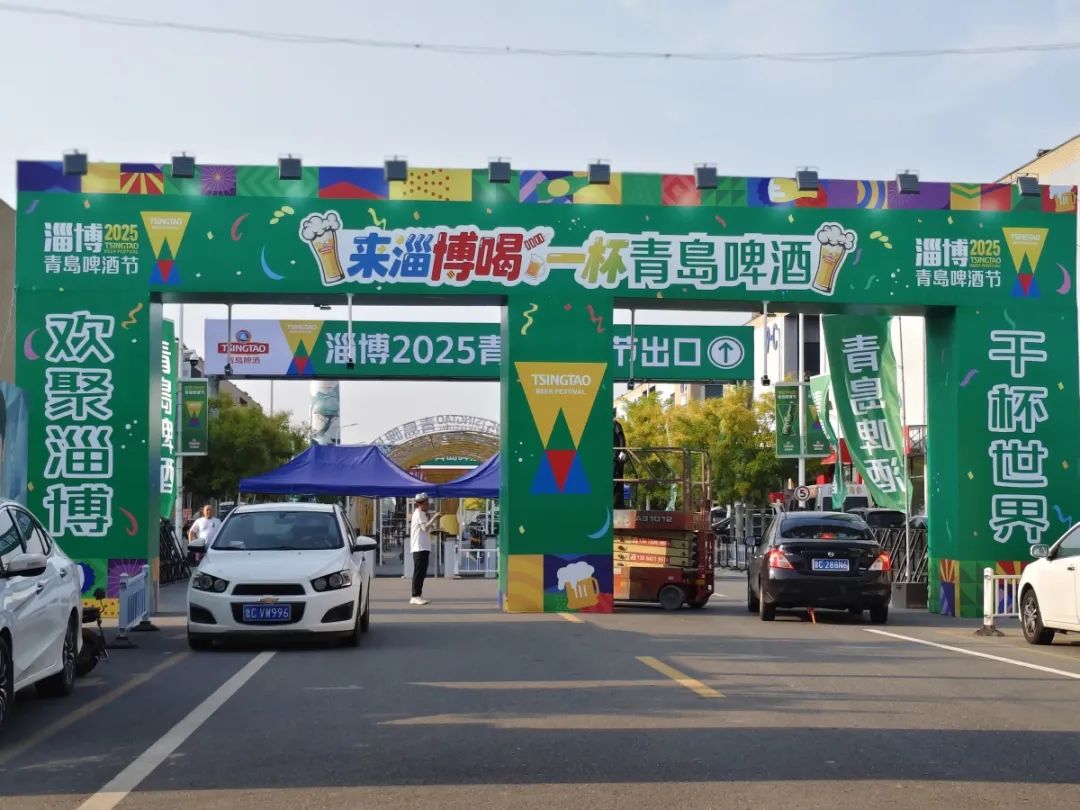
淄博青岛啤酒节启幕 烤串啤酒点燃“干杯”热情!
Qi Lu Wan Bao· 2025-08-16 09:25
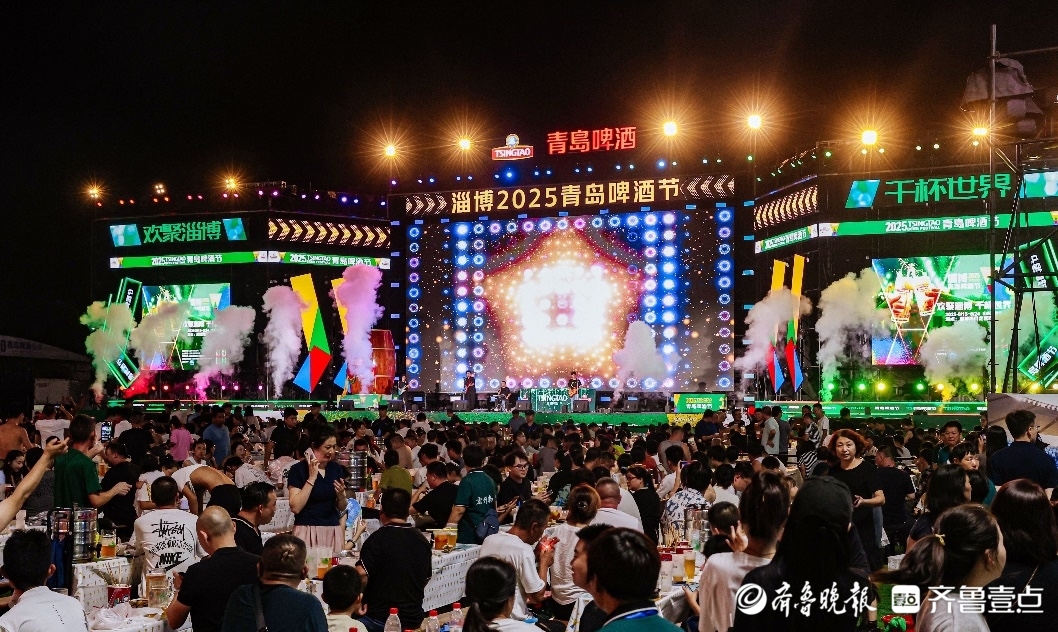
Core Viewpoint - The 2025 Zibo Qingdao Beer Festival creatively combines the renowned Zibo barbecue with the Qingdao Beer Festival, offering a unique experience that celebrates food, music, culture, and community spirit [1][3]. Group 1: Event Overview - The festival spans an area of 20,000 square meters, integrating Zibo's culinary reputation with the high-quality and joyful essence of Qingdao beer [3]. - The event features a variety of Qingdao beer products, including classic series, Qingdao Pure Draft, white beer, and local specialties like green Lansa beer, enhancing the culinary experience [5]. Group 2: Activities and Engagement - The festival includes themed nights focusing on different Qingdao beer products, incorporating performances, interactive games, and food pairings to create an immersive experience [7]. - A city-wide celebration allows the beer festival atmosphere to extend beyond a single venue, promoting a broader engagement with the community [8]. Group 3: Unique Features - Eye-catching installations and themed areas in popular locations throughout Zibo attract visitors, encouraging social media sharing and interaction [10]. - The introduction of a "backpack beer machine" allows for mobile beer distribution, enabling attendees to enjoy Qingdao beer anywhere in the city [12]. Group 4: Accessibility and Reach - A special shuttle bus service facilitates easy access to the main festival venue, enhancing participation for locals and visitors alike [14]. - The festival is part of a larger series of Qingdao beer events across various cities, ensuring a nationwide celebration of beer culture [14][15].
啤酒节有话题没热度 青岛啤酒们为何卖不动了?
Sou Hu Cai Jing· 2025-08-16 03:29
Core Viewpoint - Qingdao Beer is facing unprecedented pressure with a decline in revenue for 2024, marking the first drop in three years, and the lowest net profit growth in nearly eight years [2] Group 1: Financial Performance - In Q1 2025, Qingdao Beer achieved a slight revenue increase of 2.91% year-on-year, while net profit grew by 7.08%, still below historical growth rates [2] - The stock price of Qingdao Beer has been on a downward trend since 2023, closing at 67.76 yuan per share on August 8, down nearly 50% from its peak of 119.65 yuan [2] - The beer production in China for 2024 was 35.213 million tons, a decrease of 0.6% year-on-year, representing about 70% of the production in 2013 [2][3] Group 2: Market Trends and Competition - The high-end beer market has slowed down in 2024, with many companies experiencing a decline in sales of mid-to-high-end products [3] - Qingdao Beer has launched several high-end products since 2009, but by 2024, sales of high-end products decreased by 2.65% year-on-year [3][4] - Competitors like Yanjing Beer have successfully launched popular products, such as Yanjing U8, which saw over 30% revenue growth, contrasting with Qingdao Beer's declining main brand price [4] Group 3: Consumer Behavior and Challenges - Young consumers are increasingly favoring craft brands and value-for-money products, leading to a decline in demand for traditional industrial beers [5] - Qingdao Beer faces structural challenges, including a shrinking consumer base aged 18-49 and increased competition from low-alcohol and tea-flavored beverages [8] - The company struggles with brand recognition and market penetration in southern China, where revenue from key markets like South China and East China remains low [8] Group 4: Sales Channels and Strategies - Instant retail is emerging as a significant channel for Qingdao Beer, with sales on platforms like Meituan increasing by 24.8% in 2024 [6] - Despite rapid growth in instant retail, it still represents a small portion of total revenue, with Meituan's 10 billion yuan sales accounting for only about 3% of total revenue [7] - Qingdao Beer is enhancing its online and offline integration, launching new products through instant retail channels [6] Group 5: Brand Image and Quality Issues - Recent food safety incidents have negatively impacted consumer trust in Qingdao Beer, highlighting vulnerabilities in supply chain management [9] - The company has faced complaints regarding product quality, which further erodes brand reputation [9] Conclusion - Qingdao Beer is at a critical juncture, needing to develop a standout product to avoid falling into a dual crisis of failing high-end strategies and losing its core market [10]
白酒、食品品牌企业扎堆切入精酿啤酒赛道
Zheng Quan Ri Bao· 2025-08-15 17:07
Core Insights - The craft beer sector is witnessing an influx of brands from various industries, including major liquor companies like Wuliangye and food companies like Three Squirrels, aiming to explore new growth opportunities amid a competitive landscape in the high-end liquor market [1][4]. Group 1: Market Entry and Strategy - Wuliangye's subsidiary launched a craft beer named "Fenghuolun," targeting consumers aged 25 to 49, with a price point of 19.5 yuan per can, reflecting a strategy to attract younger demographics [2][1]. - Zhenjiu Liduo introduced its high-end craft beer "Niushi News" at a retail price of 88 yuan per bottle, aiming to redefine consumer perceptions of quality beer [2][3]. - The entry of food companies like Haoxiangni and Three Squirrels into the craft beer market indicates a broader trend of diversification among brands seeking new revenue streams [4][1]. Group 2: Industry Trends and Growth - The craft beer market in China is projected to grow from 428 billion yuan in 2022 to 680 billion yuan by 2024, with a compound annual growth rate of 26.7%, expected to exceed 1,040 billion yuan by 2025 [6]. - High-end beer has become a focal point for major breweries, with leading companies like China Resources Beer and Qingdao Beer experiencing significant profit increases, indicating a shift towards premium products [5][6]. - The craft beer segment is characterized by high profit margins, typically between 55% and 65%, which is 15% to 20% higher than industrial beer, attracting various brands to enter the market [6][4]. Group 3: Competitive Landscape - Major players in the beer market, including China Resources Beer, Qingdao Beer, and Budweiser APAC, dominate over 90% of the market share, while craft beer companies and regional brands compete for the remaining market [5][6]. - The high-end beer market is becoming increasingly competitive, with brands focusing on product innovation and premium positioning rather than just price competition [7][5]. - Experts suggest that the integration of liquor industries, such as the crossover between liquor and beer, will become a common practice, emphasizing the need for brands to develop management and operational capabilities to thrive in a diversified market [8][7].
2025淄博青岛啤酒节今日开幕
Xin Lang Cai Jing· 2025-08-15 12:04
Core Viewpoint - The 2025 Zibo Qingdao Beer Festival, themed "Gathering in Zibo, Cheers to the World," is set to provide a unique experience for citizens and tourists with a variety of activities and attractions [3][8]. Group 1: Event Overview - The beer festival spans 10 days, starting from August 15, and is held at the Haiyue Longgong West Square, covering an area of 20,000 square meters [3][5]. - The festival adopts an innovative model combining a main venue celebration with sub-venue interactions and city-wide popular check-in points [3][8]. Group 2: Venue and Attractions - The main venue is meticulously designed with various functional areas including a stage area, drinking zone, VIP tent, gathering camp, food area, and a time corridor [8]. - A high-standard seafood kitchen is featured in the food area, allowing visitors to select fresh seafood on-site [8]. Group 3: Entry and Attendance - The festival does not require tickets or reservations; attendees can enter by scanning their ID or QR code [8]. - There is a total capacity limit for the venue, and entry will be restricted once the maximum number of attendees is reached [8].
一文搞懂港股A股差异:从市场特征到风险模型
Minsheng Securities· 2025-08-15 10:53
Quantitative Models and Construction Methods 1. Model Name: Barra Risk Model - **Model Construction Idea**: The model identifies and quantifies common factors (industry and style factors) and idiosyncratic factors affecting stock returns, aiming to decompose return sources and provide risk constraints such as industry and style neutrality[119][121]. - **Model Construction Process**: - **Data Processing**: - Align reporting periods due to varying fiscal years among Hong Kong-listed companies[120]. - Standardize accounting standards using Wind GSD reports, converting to IFRS[120]. - Normalize financial reporting currencies using time-series exchange rates[120]. - Exclude dual-counter trading stocks and REITs for consistency[120]. - **Factor Construction**: - Constructed for three pools: Southbound Stock Connect, full Hong Kong market, and full market excluding penny stocks[121]. - Includes 10 major style factors (e.g., Beta, Momentum, Size, Earnings Yield) and industry factors[121]. - Factors are standardized using median-based outlier removal and normalized to standard normal distribution[122]. - Factor returns are calculated using Weighted Least Squares (WLS) with free-float market cap weights[122]. - Formula for WLS: ``` min Σ sqrt(w_i,t-1) * (r_i,t - Σ β_i,k,t-1 * f_k,t + Σ γ_i,m,t-1 * g_m,t)^2 ``` where weights are the fourth root of free-float market cap proportions[123]. - **Factor Definitions**: - Beta: Systematic risk derived from regression of stock returns against market returns[125]. - Momentum: Weighted log returns over a 500-day period[125]. - Size: Logarithm of total market capitalization[125]. - Earnings Yield: Inverse of P/E ratio[125]. - Volatility: Derived from residual standard deviation and monthly return ranges[125]. - Growth: Based on regression of past five years' revenue and earnings per share[125]. - Value: Inverse of P/B ratio[125]. - Leverage: Includes metrics like market leverage and debt-to-asset ratio[125]. - Liquidity: Based on trading volume relative to free-float shares over different time horizons[125]. - **Model Evaluation**: The model demonstrates good applicability in the Hong Kong market, with stable R² values across different pools[126][152]. --- Model Backtesting Results 1. Barra Risk Model - **R² Values**: - Southbound Stock Connect: Average R² = 36.7% since 2014[126][152]. - Full Hong Kong Market: Average R² = 17.4%[126][152]. - Full Market (Excluding Penny Stocks): Average R² = 21.9%[126][152]. - **Factor Cumulative Returns**: - Positive: Beta, Momentum, Liquidity, BP, Earnings Yield[130][149]. - Negative: Size, Growth, Non-Linear Size[130][149]. - Mixed: Volatility (positive for full market, negative for Southbound Stock Connect), Leverage (positive for full market, negative for Southbound Stock Connect)[130][149]. --- Quantitative Factors and Construction Methods 1. Factor Name: Penny Stock Screening - **Factor Construction Idea**: Screen stocks based on price, financial, and behavioral metrics to identify and exclude penny stocks[117][118]. - **Factor Construction Process**: - **Price Metrics**: - Rolling one-month average closing price < 1 HKD and market cap < 10 billion HKD[117]. - Rolling one-month average closing price < 1 HKD and average trading volume in the lowest 20% of the market[117]. - **Financial Metrics**: - ROE and debt-to-asset ratio thresholds[118]. - **Behavioral Metrics**: - History of stock splits or rights issues in the past year[118]. - **Exclusion of "Three Highs"**: High equity pledges, high debt ratios, and frequent fundraising activities[118]. - **Factor Evaluation**: Helps mitigate risks associated with high-volatility, low-liquidity stocks prevalent in the Hong Kong market[117][118]. --- Factor Backtesting Results 1. Penny Stock Screening - **Market Characteristics**: - As of June 2025, 56% of Hong Kong stocks are priced below 1 HKD, with 14.5% below 0.1 HKD[112][113]. - Penny stocks exhibit high volatility and low liquidity, making them risky for investment[112][117]. 2. Barra Risk Model Factors - **Cumulative Returns by Factor**: - Beta: Positive across all pools[130][149]. - Momentum: Positive across all pools[130][149]. - Size: Negative across all pools[130][149]. - Earnings Yield: Positive across all pools[130][149]. - Volatility: Positive for full market, negative for Southbound Stock Connect[130][149]. - Growth: Negative across all pools[130][149]. - Value: Positive across all pools[130][149]. - Leverage: Positive for full market, negative for Southbound Stock Connect[130][149]. - Liquidity: Positive across all pools[130][149].
永顺泰:公司持续推进与区域性中小客户及精酿啤酒客户的合作
Zheng Quan Ri Bao Wang· 2025-08-15 10:44
Core Viewpoint - The company aims to deepen its focus on the malt business, solidifying its leading position in the industry and striving to become a world-class malt supplier to meet the diverse needs of beer brewing customers [1] Group 1: Business Strategy - The company has a development strategy centered on the malt business, with a commitment to high-end development and organic growth that combines reasonable quantity increases with effective quality improvements [1] - The company has established over 20 years of cooperation with renowned beer manufacturers such as Budweiser, Carlsberg, Heineken, China Resources Snow Beer, Tsingtao Brewery, Yanjing Beer, and Zhujiang Beer [1] Group 2: Market Positioning - The company's malt production bases are strategically located in Guangdong, Zhejiang, Jiangsu, Shandong, and Hebei, aligning with the main markets for beer brewing and consumption across the country [1] - The company is also actively pursuing partnerships with regional small and medium-sized clients and craft beer customers, offering a wide range of reliable specialty and customized malt products along with attentive after-sales service [1]
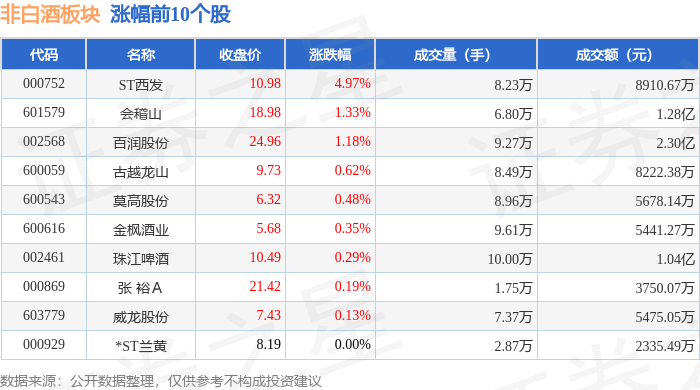
非白酒板块8月15日涨0.03%,ST西发领涨,主力资金净流出5307.59万元
Zheng Xing Xing Ye Ri Bao· 2025-08-15 08:37
Market Performance - On August 15, the non-liquor sector rose by 0.03% compared to the previous trading day, with ST Xifa leading the gains [1] - The Shanghai Composite Index closed at 3696.77, up 0.83%, while the Shenzhen Component Index closed at 11634.67, up 1.6% [1] Stock Performance - ST Xifa (000752) closed at 10.98, with a gain of 4.97% and a trading volume of 82,300 shares, amounting to a transaction value of 89.11 million yuan [1] - Other notable stocks included Huaiwei Mountain (601579) with a closing price of 18.98, up 1.33%, and Bai Run Co. (002568) at 24.96, up 1.18% [1] Capital Flow - The non-liquor sector experienced a net outflow of 53.08 million yuan from institutional investors, while retail investors saw a net outflow of 35.11 million yuan [2] - Conversely, speculative funds recorded a net inflow of 88.19 million yuan [2] Individual Stock Capital Flow - Aoqin Wen (600573) had a net inflow of 6.63 million yuan from institutional investors, representing 20.52% of its total capital flow [3] - ST Xifa (000752) saw a net inflow of 2.85 million yuan from institutional investors, but a net outflow of 6.10% from retail investors [3]