
国投电力

Search documents
电力行业财务总监CFO观察:东望时代陈艳32岁最年轻 2024年薪酬为60万元 公司归母净利润下滑424%
Xin Lang Zheng Quan· 2025-08-11 02:36
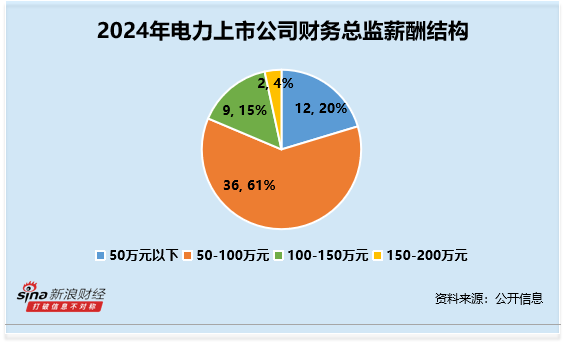
Core Insights - The total compensation for CFOs in A-share listed companies reached 4.27 billion yuan in 2024, with an average salary of 814,800 yuan [1] - The highest-paid CFO is Liu Xiaojun from JinkoSolar, earning 1.90 million yuan, while the lowest is Xie Jingyuan from *ST Lingda, earning 202,900 yuan [1] - The average age of CFOs is approximately 49.58 years, with the majority aged between 40-49 years [3] - There is a positive correlation between education level and salary, with PhD holders earning an average of 1.11 million yuan [5] - Some CFOs have seen salary increases despite their companies experiencing significant profit declines, indicating a disconnect between compensation and company performance [7] Compensation Overview - The total salary pool for CFOs in 2024 is 4.27 billion yuan, with an average salary of 814,800 yuan [1] - The highest average salary in the public utility-electricity sector is 743,800 yuan, with Liu Xiaojun earning 1.90 million yuan [1] - The majority of CFOs (61%) earn between 500,000 to 1 million yuan [1] Age Distribution - The average age of CFOs is 49.58 years, with 39% aged between 40-49 years [3] - The oldest CFOs are Zhou Hui from Linyang Energy and Zhu Yunshao from Shaoneng Co., both aged 57 [3] - The youngest CFO is Chen Yan from Dongwang Times, aged 32 [3] Education and Salary Correlation - The distribution of CFOs by education level shows 3 PhDs, 19 Master's degrees, 30 Bachelor's degrees, and 5 with associate degrees [5] - Average salaries by education level are 1.11 million yuan for PhDs, 860,200 yuan for Master's, 683,000 yuan for Bachelor's, and 532,700 yuan for associate degrees [5] - Companies with PhD CFOs have market capitalizations exceeding 100 billion yuan [5] Performance and Compensation Relationship - There are instances where CFOs received significant salary increases despite their companies reporting substantial profit declines [7] - For example, Liu Xijin from Jiawei New Energy saw a salary increase of 107% while the company's net profit dropped by 1,840.5% [7] - Five CFOs received warnings or public reprimands in 2024-2025, indicating compliance issues within the industry [7]


电力行业财务总监CFO观察:*ST聆达谢景远薪酬垫底 曾受到监管公开批评 2024年薪酬仅20万元
Xin Lang Zheng Quan· 2025-08-11 02:25
Summary of Key Points Core Viewpoint - The report highlights the salary trends of CFOs in A-share listed companies for 2024, indicating a total compensation of 4.27 billion yuan and an average salary of 814,800 yuan, with significant variations across industries and individual companies [1][3]. Salary Distribution - The total salary for CFOs in A-share listed companies reached 4.27 billion yuan, with an average salary of 814,800 yuan [1]. - In the public utility and power sector, the average salary for CFOs is approximately 743,800 yuan, with the highest being 1.90 million yuan for Liu Xiaojun of JinkoSolar and the lowest at 202,900 yuan for Xie Jingyuan of *ST Lingda [1]. - The majority of CFOs (61%) earn between 500,000 and 1 million yuan [1]. Age Structure - The average age of CFOs is approximately 49.58 years, with the most common age group being 40-49 years, comprising 39% of the total [3]. - The oldest CFOs are Zhou Hui of Linyang Energy and Zhu Yunshao of Shaoneng Co., both aged 57, while the youngest is Liu Zhenxin of Jiuzhou Group at 40 years old [3]. Educational Background - The educational distribution shows 3 PhDs, 19 Master's degrees, 30 Bachelor's degrees, and 5 Associate degrees, with corresponding average salaries of 1.11 million yuan, 860,200 yuan, 683,000 yuan, and 532,700 yuan respectively, indicating a positive correlation between education level and salary [5]. - Notable high-earning PhD CFOs include Zhou Changxin of Guotou Power and Zhan Pingyuan of Changjiang Power, with salaries exceeding 1 million yuan [5]. Performance and Compensation Relationship - There are instances of salary increases for CFOs despite declines in company performance, such as Liu Xijin of Jiawei New Energy, whose salary rose by 107% while the company's net profit fell by 1.84 billion yuan [7]. - The report notes that 5 CFOs received warnings or public notifications for violations in 2024-2025 [7]. Violations and Warnings - Specific cases of CFOs receiving warnings include Liu Dongmei of Meiyan Jixiang, who received 4 warnings related to improper financial disclosures, with a salary of 639,500 yuan [8]. - Other CFOs, such as Xia Xueling of Ningbo Energy and Gu Zhonglin of Jiangsu Guoxin, also faced warnings for various compliance issues, with salaries of 720,400 yuan and 691,200 yuan respectively [9][10].




上交所严查IPO与再融资违规,国投证券、中信证券遭警示
Sou Hu Cai Jing· 2025-08-11 00:19
Core Viewpoint - The Shanghai Stock Exchange (SSE) has strengthened its regulatory oversight by including refinancing violations in its review process, highlighting a zero-tolerance approach towards financial misconduct in the capital market [2][5]. Group 1: Regulatory Actions - The SSE's recent report includes a case involving Ankaite Technology Co., Ltd. (Ankaite), which faced issues such as related-party fund borrowing, inadequate internal controls over waste material sales, and inaccurate information disclosure [2][3]. - Ankaite's previous attempt to list on the Shenzhen Stock Exchange was thwarted due to insufficient disclosure of waste electrode disposal income, indicating a pattern of compliance issues [3]. - The SSE has taken regulatory warning measures against Ankaite and its sponsoring institutions, citing multiple financial accounting problems, including revenue recognition across periods and inaccuracies in research and development expense allocation [3][4]. Group 2: Market Trends - From May to June 2025, the SSE saw a significant increase in IPO applications, with 28 companies submitting requests, while only 3 IPOs passed the review process, indicating a shift towards refinancing projects [5]. - The SSE's decision to include refinancing in its regular reporting reflects a broader trend of tightening regulations, aiming to create a closed-loop supervision system that extends from IPOs to ongoing refinancing [5][6]. - The average R&D investment ratios for IPO companies on the Sci-Tech Innovation Board and the Growth Enterprise Market have increased, suggesting a growing emphasis on innovation and compliance among listed companies [6]. Group 3: Implications for Intermediaries - The SSE's actions signal a need for intermediaries to enhance their compliance and risk management systems, especially as they face scrutiny for inadequate due diligence and oversight [5][6]. - The involvement of leading securities firms in regulatory violations raises concerns about the quality of sponsorship and the potential for a trust crisis in the market [4][6]. - The SSE's regulatory measures emphasize the importance of transparent information disclosure and the accountability of both issuers and intermediaries in maintaining market integrity [6].

Nature对话黄和院士 | 借助合成生物学变革功能性脂质生产
合成生物学与绿色生物制造· 2025-08-10 12:50
Core Viewpoint - The article highlights the advancements in synthetic biology for the production of functional lipids, showcasing the innovative research led by Professor Huang He from Nanjing Normal University and the Jiangsu Provincial Synthetic Biology Research Center [2][10][14]. Group 1: Importance of Synthetic Biology - Synthetic biology is described as a field that reprograms life, utilizing engineering methods and gene editing to transform microorganisms into efficient production "factories" for useful compounds [11][12]. - The integration of synthetic biology with clean technology offers innovative solutions to global challenges, especially with the advent of CRISPR and other gene editing tools [12]. Group 2: Role of Artificial Intelligence - Artificial intelligence (AI) is crucial in the development of synthetic biology, enabling systematic programming of biological components and significantly reducing the development time of microbial "factories" from years to months [13]. - The combination of machine learning and CRISPR technology optimizes microbial metabolic pathways, revolutionizing industrial biotechnology [13]. Group 3: Focus on Functional Lipids - The shift in dietary patterns, with a decrease in carbohydrate consumption and an increase in fat intake, underscores the importance of lipid metabolism in health and disease, prompting a focus on functional lipids, particularly unsaturated fatty acids [11]. - Traditional extraction methods for functional lipids from fish are limited by high costs and lengthy supply chains, leading to research on engineered lipid production for cost reduction and sustainable practices [11]. Group 4: Achievements and Innovations - The research team has successfully constructed a cell factory using synthetic biology methods, achieving over a twofold increase in fatty acid yield and reducing research and development time significantly [11]. - A high-throughput screening platform was developed, increasing efficiency by over ten times, reducing extraction time from three days to three hours, and cutting costs by 80% [11]. Group 5: Future Plans - Future research will explore the synthesis of functional lipids from purified components, aiming to combine various beneficial ingredients for health management [11]. - The goal includes designing formulations that integrate functional components, such as carotenoids for vision enhancement and other ingredients for brain health [11]. Group 6: Unique Advantages of the Research Center - The Jiangsu Provincial Synthetic Biology Research Center, established in 2023, focuses on industrial biological manufacturing, bridging basic science and applied research [12][14]. - The center promotes interdisciplinary exploration and engineering solutions, providing early-career researchers with autonomy and reducing administrative barriers to collaboration [12]. Group 7: Collaboration and Impact - The center collaborates with major enterprises like the National Development Investment Corporation to connect market demands with scientific breakthroughs and result transformations [14]. - The recent feature in the prestigious journal Nature highlights Professor Huang He's international academic influence in the field [14].

山东首发竞价细则,机制电价步入正轨
Changjiang Securities· 2025-08-10 12:41
Investment Rating - The report maintains a "Positive" investment rating for the utility sector [7] Core Insights - The implementation of the market-oriented pricing mechanism for renewable energy in Shandong Province marks the beginning of a new development cycle for the sector. The total scale of mechanism electricity for 2025 is set at 9.467 billion kilowatt-hours, with wind power accounting for 8.173 billion kilowatt-hours and solar power for 1.294 billion kilowatt-hours. The bidding price range for wind power is between 0.094 and 0.35 yuan per kilowatt-hour, while for solar power it is between 0.123 and 0.35 yuan per kilowatt-hour, both below the benchmark price for coal-fired power [2][6] Summary by Sections Mechanism Pricing Implementation - Shandong Province has officially launched the market-oriented pricing mechanism for renewable energy, with the total mechanism electricity for 2025 set at 9.467 billion kilowatt-hours, including 8.173 billion kilowatt-hours from wind and 1.294 billion kilowatt-hours from solar [2][6] - The bidding limits for wind and solar projects are established at 0.35 yuan per kilowatt-hour, which is lower than the coal-fired benchmark price of 0.3949 yuan per kilowatt-hour [6] Project Capacity and Bidding Details - The mechanism electricity for individual projects is calculated based on installed capacity, annual utilization hours, and other factors. The annual utilization hours for land wind, offshore wind, and solar are set at 2417, 2860, and 1253 hours respectively [6] - The expected installed capacity for wind and solar projects eligible for the mechanism is approximately 5 GW and 1.3 GW respectively, reflecting a policy direction favoring wind power development over solar [6] Investment Recommendations - The report suggests that the "carbon neutrality" initiative and electricity market reforms will reshape the value of electricity operators throughout the 14th Five-Year Plan period. It recommends focusing on quality coal-fired operators and major hydropower companies, as well as leading renewable energy firms [6][12][13][14][15][17]






浙江电力现货市场转正,全国统一电力市场“1+6”规则初建
GOLDEN SUN SECURITIES· 2025-08-10 09:33
Investment Rating - The report maintains an "Overweight" rating for the electricity and public utilities sector [3]. Core Views - The Zhejiang electricity spot market has officially transitioned to operation, and the foundational rules for the national unified electricity market, referred to as "1+6," have been initially established [3][10]. - The energy transition is accelerating, with a recommendation to focus on flexible thermal power companies and undervalued green electricity operators [3][10]. Summary by Sections Industry Overview - The Zhejiang electricity spot market has officially commenced operations, with seven regions already in formal operation as of August 8. The market began trial operations in May 2024 and is part of a broader initiative to establish a national unified electricity market by 2029 [6][10]. - The foundational "1+6" rule system for the national unified electricity market has been preliminarily constructed, with significant growth in market transactions and participants [10][13]. Market Performance - During the week of August 4-8, the Shanghai Composite Index closed at 3635.13 points, up 2.11%, while the CSI 300 Index rose 1.23%. The CITIC Electricity and Public Utilities Index increased by 1.61%, outperforming the CSI 300 by 0.38 percentage points [3][54]. Investment Recommendations - The report suggests focusing on the following companies: Huaneng International, Huadian International, Baoneng New Energy, Sheneng Co., Jingtou Energy, and Zhejiang Energy for their resilient quarterly performance in the thermal power sector. It also highlights Qingda Environmental Protection as a leader in thermal power flexibility transformation [3][10]. - It recommends prioritizing undervalued green electricity operators, particularly in the Hong Kong market, and suggests companies like Xintian Green Energy (H), Zhongmin Energy, and Funiu Co. for investment [3][10]. Key Metrics - In 2024, the market-based electricity trading volume is projected to reach 6.18 trillion kilowatt-hours, accounting for approximately 63% of total electricity consumption. The trading volume of green certificates has surged by 364% year-on-year, with green electricity trading volume increasing by 235.2% [10][13].


89页|中国上市发电公司2024年回顾及未来展望报告
Sou Hu Cai Jing· 2025-08-09 23:34
Core Viewpoint - In 2024, China's power generation industry made significant progress in green low-carbon transformation, market mechanism deepening, and corporate value management, with a GDP growth of 5.0% and a social electricity consumption increase of 6.8%, outpacing GDP growth for five consecutive years [1][19]. Group 1: Industry Performance - The total installed power generation capacity reached 3.35 billion kilowatts, a year-on-year increase of 14.6% [1][19]. - Solar power generation capacity increased by approximately 89 million kilowatts, up 45.2%, while wind power capacity rose by about 52 million kilowatts, an 18.0% increase [1][19]. - Renewable energy generation capacity reached 1.9 billion kilowatts, accounting for 56.9% of the total installed capacity, with new energy (wind + solar) and nuclear power capacity surpassing thermal power for the first time [1][19]. Group 2: Financial Performance - Listed power generation companies experienced a slowdown in revenue growth, with total revenue reaching 1.4304 trillion yuan, a 0.8% year-on-year increase [59][62]. - Profitability efficiency slightly declined, but asset scale expanded steadily, with continuous capital expenditure increases [1][59]. - The overall electricity price declined, while the efficiency of electricity fee collection remained stable, and cost control capabilities improved, leading to a more reasonable asset-liability structure [1][59]. Group 3: Market Trends - Market trading volume accounted for 62.7% of total electricity consumption, reflecting a year-on-year increase of 1.3 percentage points [45][48]. - The trading activity in the industry increased, with mergers and acquisitions driving the integration process [2][6]. - The introduction of tax policy adjustments presents new challenges and opportunities, necessitating enhanced compliance management by enterprises [2][6]. Group 4: Future Outlook - The issuance of Document No. 136 marks the entry of renewable energy development into a high-quality phase, with new technologies like artificial intelligence accelerating the industry's smart and green transformation [2][6]. - The sustainable development disclosure standards are becoming increasingly refined, promoting deeper green low-carbon transitions [2][6].
浙江电力现货市场转入正式运行,7月份我国天然气进口量同比下降2.1%
Xinda Securities· 2025-08-09 15:39
Investment Rating - The investment rating for the public utility sector is "Positive" [2] Core Insights - The electricity sector is expected to see profit improvement and value reassessment following multiple rounds of supply-demand tensions. The continuous advancement of electricity market reforms is likely to lead to a stable but slight increase in electricity prices. The introduction of a capacity pricing mechanism will clarify the foundational role of coal power [4] - The natural gas sector is anticipated to benefit from the recovery in domestic consumption and the decline in upstream gas prices, with city gas businesses expected to achieve stable margins and high sales growth [4] Summary by Sections Market Performance - As of August 8, the public utility sector rose by 1.6%, underperforming the Shanghai Composite Index. The electricity sector increased by 1.41%, while the gas sector rose by 3.60% [3][10] - Key companies in the electricity sector saw significant stock performance variations, with Shanghai Electric rising by 11.35% and Guodian Power declining by 2.89% [11][13] Electricity Industry Data Tracking - The price of Qinhuangdao port thermal coal (Q5500) increased by 23 CNY/ton week-on-week, reaching 678 CNY/ton as of August 8 [3][19] - Coal inventory at Qinhuangdao port increased by 250,000 tons week-on-week, totaling 5.47 million tons [28] - Daily coal consumption in inland provinces rose by 6.42% week-on-week, reaching 4.09 million tons [28] Natural Gas Industry Data Tracking - As of August 8, the LNG ex-factory price index in Shanghai was 4,220 CNY/ton, down 14.38% year-on-year [52] - The EU's natural gas supply for week 29 of 2025 was 6.08 billion cubic meters, a year-on-year increase of 4.2% [60] - Domestic natural gas consumption in June 2025 was 35.05 billion cubic meters, a year-on-year increase of 1.9% [4] Key Industry News - The State Grid's electricity load reached a historical high of 1.233 billion kilowatts due to extreme weather conditions [4] - In July, China's natural gas imports totaled 10.632 million tons, a year-on-year decrease of 2.1% [4] Investment Recommendations - For the electricity sector, focus on leading coal power companies such as Guodian Power, Huaneng International, and Huadian International, as well as regional leaders in tight supply areas [4] - In the natural gas sector, companies with low-cost long-term gas sources and receiving station assets are recommended, such as Xin'ao Group and Guanghui Energy [4]
权益ETF系列:耐心持有,等待后排标的跟进
Soochow Securities· 2025-08-09 14:01
Investment Rating - The report maintains an "Increase" rating for the equity ETF series, suggesting a patient hold while waiting for follow-up on lower-tier targets [1][2]. Core Viewpoints - The report emphasizes a strategy of patience, indicating that investors should hold their positions and await developments in lower-tier assets [2][19]. Market Overview - A-share market performance from August 4 to August 8, 2025, shows the top three broad indices were: - Wind Micro-Pan Daily Equal Weight Index (4.49%) - CSI 2000 (3.54%) - CSI 1000 (2.51%) - The bottom three were: - ChiNext Index (0.49%) - STAR 50 (0.65%) - CSI 300 (1.23%) [11][14]. Style Index Performance - The top three style indices during the same period were: - Cyclical (CITIC Style) (3.49%) - Small Cap Growth (2.59%) - Giant Tide Small Cap (2.05%) - The bottom three were: - Consumer (CITIC Style) (0.77%) - Giant Tide Mid Cap (1.11%) - Large Cap Growth (1.17%) [14][15]. Industry Index Performance - The top three Shenwan first-level industry indices were: - National Defense and Military Industry (5.93%) - Nonferrous Metals (5.78%) - Machinery Equipment (5.37%) - The bottom three were: - Pharmaceutical Biology (-0.84%) - Computer (-0.41%) - Commercial Retail (-0.38%) [16][17]. Market Outlook - The macro model for August indicates a score of 0, with a 75% historical probability of an increase, suggesting a favorable outlook for the A-share market in August [19][25]. - The technical timing model indicates that the Wind All A Index is currently in an overbought state, with a risk level of 103.77, suggesting potential for increased volatility [19][22]. - The report notes that while there may be short-term fluctuations, the overall trend remains positive, and investors should maintain their positions [19][21]. Fund Allocation Recommendations - The report suggests a balanced ETF allocation strategy, indicating that lower-tier assets may present significant opportunities in the short term [19][21].
医保助力创新药① | 亲历创新药座谈会:“国字头”投资机构入场
Sou Hu Cai Jing· 2025-08-08 10:34
Group 1 - The National Healthcare Security Administration (NHSA) is providing unprecedented support for pharmaceutical innovation, as evidenced by a series of five symposiums focused on "Medicare Support for Innovative Drugs and Devices" [2][3] - The investment symposium featured prominent institutions such as the National Social Security Fund, China Investment Corporation, and various leading investment firms, indicating strong interest from the capital market in supporting innovative drugs [2][3] - NHSA's measures aim to enhance the quality of innovative drugs, addressing diverse medical needs and ensuring that innovation leads to tangible clinical benefits [3][4] Group 2 - NHSA emphasizes the importance of genuine innovation, rejecting superficial or redundant innovations, and aims to ensure that innovative drugs provide additional clinical benefits and societal value [4] - The NHSA has spent a total of 18.04 trillion yuan on healthcare since its establishment in 2018, with an annual growth rate of 11%, highlighting the increasing financial support for the healthcare sector [3][4] - The NHSA is committed to using health economics and technology assessments to negotiate Medicare payment standards that reflect the clinical value of drugs, ensuring alignment with China's market conditions [4] Group 3 - The integration of data, policy, and capital is crucial for the development of innovative drugs, with NHSA's symposiums serving as a platform for collaboration among these elements [5] - The establishment of a unified national Medicare information platform in March 2022 covers 1.33 billion insured individuals and facilitates approximately 3 trillion yuan in annual Medicare transactions, showcasing the scale and potential of Medicare data [5][6] - The NHSA's data is considered among the highest quality in various industries, and ongoing efforts to collect additional health data will enhance the comprehensiveness of the healthcare dataset [6] Group 4 - Investment institutions are particularly interested in Medicare data, as it reduces uncertainty in investing in innovative drugs, especially in biopharmaceuticals [7] - The shift from "experience-based" to "data-driven" approaches in drug development is facilitated by Medicare data, allowing for more precise evaluations and assessments in the pharmaceutical industry [7]
