
谷歌

Search documents
别再相信AI恋人了,它们连自己都养不活
Ge Long Hui· 2026-01-09 17:24
Core Viewpoint - Minimax's initial public offering (IPO) on January 9, 2026, saw its market capitalization exceed HKD 100 billion, driven by significant revenue growth, but underlying issues regarding growth quality, business model sustainability, and industry competition warrant scrutiny [1][7]. Revenue Performance - In the first three quarters of 2025, Minimax reported revenue of USD 53.437 million, a year-on-year increase of over 170%, with overseas market revenue accounting for 73.1% [1]. - The company's revenue growth is heavily influenced by marketing expenditures, which reached USD 86.695 million in 2024, representing 284.9% of its revenue [7]. Business Model Analysis - Minimax's revenue structure is characterized by a dominance of consumer (C-end) income, which constitutes over 71% of total revenue, primarily from two products: Talkie (35.1% of revenue) and Hai Luo AI (32.6% of revenue) [2]. - The C-end products face significant user retention challenges, with a reported drop in monthly active users by 60% in Q4 2025 [3]. Competitive Landscape - The AI video generation sector, where Hai Luo AI operates, is experiencing intense competition, with competitors like Runway and Pika Labs gaining market share [4]. - Minimax's B-end platform, while covering over 100 countries, lacks the scale and ecosystem influence of industry leaders, limiting its competitive edge [5]. Valuation Concerns - The market's enthusiasm for Minimax's IPO is seen as a reflection of an AI valuation bubble, with its growth driven more by marketing than by sustainable demand [7]. - The company has accumulated a net loss of USD 1.25 billion from 2022 to Q3 2025, with a research and development expense ratio of 337.4% [8]. Regulatory and Compliance Risks - Minimax's overseas revenue is concentrated in markets with stringent AI regulations, such as Singapore and the U.S., which could pose compliance risks [8]. - The company faces potential legal challenges related to copyright issues, with lawsuits from major studios claiming unauthorized use of copyrighted materials [15]. Strategic Recommendations - The analysis suggests that Minimax's approach may not be replicable for other Chinese AI companies, emphasizing the need for a shift towards sustainable business practices and localized operations [18][19]. - Companies are encouraged to focus on vertical B-end markets with strong demand and payment capabilities, rather than relying on consumer-driven growth [21].
?AI尽头是电力! 核电资产迎来狂飙时刻 Meta(META.US)锁定创纪录的6.6GW核电
Zhi Tong Cai Jing· 2026-01-09 14:03
Core Insights - Meta Platforms has announced a significant agreement to secure up to 6.6 gigawatts (GW) of nuclear power supply for its AI data centers by 2035, marking one of the most ambitious collaborations between a major tech company and nuclear power suppliers in the U.S. [1] Group 1: Agreements and Collaborations - Meta has reached a deal with Vistra to purchase power from three existing nuclear plants in Ohio and Pennsylvania, supporting the development of small modular reactors (SMR) with new nuclear developers Oklo and TerraPower [2][4] - The 20-year power purchase agreement with Vistra will provide over 2,600 megawatts (MW) of nuclear energy, including 2,176 MW from operational generation and an additional 433 MW from combined generation output enhancements [3] - Oklo's partnership with Meta will advance the construction of a 1.2 GW power park in Pike County, Ohio, with Meta providing prepayment to enhance project certainty [4] Group 2: Market Dynamics and Demand - The demand for electricity, particularly from nuclear sources, is surging due to the rapid expansion of AI data centers, with the phrase "the end of AI is electricity" gaining traction in investment discussions [6] - Goldman Sachs has revised its forecast for global data center electricity demand by 175% by 2030, indicating a significant increase in power consumption driven by AI models [7] - The International Energy Agency (IEA) predicts that global data center electricity demand will more than double by 2030, with AI applications being the primary driver of this growth [8] Group 3: Industry Trends and Government Support - The U.S. government is showing a renewed commitment to nuclear energy, with recent executive orders aimed at expanding the nuclear energy sector and streamlining project approvals [9] - Major tech companies, including Amazon, Google, and Microsoft, are increasingly favoring nuclear energy for their data centers due to its clean, stable, and efficient characteristics [8]

AI尽头是电力! 核电资产迎来狂飙时刻 Meta(META.US)锁定创纪录的6.6GW核电
智通财经网· 2026-01-09 13:46
智通财经APP获悉,Facebook与Instagram母公司Meta Platforms(META.US)当地时间周五公布三项重磅协 议,计划到2035年为其大型AI数据中心锁定高达6.6吉瓦(GW)的核电电力供应系统,这是迄今美国大型 科技巨头与核电供应商之间最为广泛且最具雄心壮志的合作之一。 谷歌、微软以及Facebook母公司Meta正在主导的全球AI数据中心新建与扩建进程可谓如火如荼,而这一 进程愈发凸显出电力资源供给的重要性,这也是为什么"AI的尽头是电力"这一投资主题愈发火热,而当 前激增的电力需求中又当属核电需求最为迅猛,兼具清洁、稳定与高效属性的核电系统已经成为科技巨 头们最青睐的电力资源。 Meta宣布与美国电力巨头Vistra(VST.US)达成交易,将从俄亥俄州与宾夕法尼亚州的三座现有核电站购 买电力资源,并且Meta还将支持美国新锐核电开发商Oklo(OKLO.US)与TerraPower计划在未来十年内大 规模建设的一种新型核电项目——即小型模块化核反应堆(SMR)项目;这些交易紧随2025年6月宣布的一 项重磅核电协议之后,当时Meta旨在从Constellation Energ ...
剑指“下一个CoreWeave”! AI算力租赁新势力Nscale大举吸金 时隔仅三个月掀20亿美元融资
Zhi Tong Cai Jing· 2026-01-09 08:08
Core Insights - Nscale, a UK-based cloud AI computing rental startup, is in talks to raise approximately $2 billion from Wall Street investors, highlighting the surging global demand for AI computing power [1][2] - The company has recently completed two successful funding rounds in September and October, raising a total of over $1.5 billion, including a record $1.1 billion Series B round, the largest in European history [1][2] - Nscale is collaborating with financial giants Goldman Sachs and JPMorgan Chase for this funding effort, indicating strong institutional interest [1][2] Company Overview - Nscale was spun off from a cryptocurrency mining business in 2024 and focuses on providing AI computing capacity through physical delivery or cloud-based rental services [3] - The company operates in the "new cloud" sector, similar to CoreWeave, a major player in AI computing rental, which has a market valuation of $38.5 billion [2][3] Revenue Model - Nscale's revenue primarily comes from two sources: long-term service contracts for guaranteed capacity and on-demand cloud AI computing rentals [4] - The company has disclosed a multi-year service agreement with Microsoft to deliver approximately 12,600 NVIDIA GB300 AI GPU units starting in Q1 2026, along with broader AI infrastructure services [4] Management and Strategic Moves - Nscale has made significant executive hires, including a COO from Palantir Technologies and a CFO from JPMorgan, which are seen as critical for its potential IPO [5] - The company has established a deep partnership with NVIDIA and is collaborating with OpenAI on large-scale AI infrastructure projects in Europe [5][7] Market Position and Competitors - Nscale aims to become the next CoreWeave, focusing on building a large-scale global cloud platform to meet the increasing demand for AI computing [7][8] - Competitors like CoreWeave and Nebius Group NV have seen significant stock price fluctuations, reflecting investor concerns about the sustainability of the AI infrastructure spending [6][8] Industry Trends - The demand for AI computing resources is experiencing explosive growth, driven by advancements in AI applications like Google's Gemini3, which has led to increased pressure on existing infrastructure [9] - The ongoing expansion of AI data centers is struggling to keep pace with the surging global demand for computing power, indicating a critical phase in the development of AI infrastructure [8][9]

太空算力中心具备颠覆性优势,HJT或为能源系统最优解
Zhong Guo Neng Yuan Wang· 2026-01-09 01:17
Group 1 - The emergence of "space computing" is driven by the increasing power demand in data centers due to global AI model advancements, leading to the deployment of high-performance satellites in low/mid orbits [1][2] - Space computing offers significant advantages over traditional ground data centers, including higher deployment efficiency, better energy efficiency, and lower cooling costs [1][2] - The "Zhijiang Laboratory + Guoxing Aerospace" collaboration has launched the "Trinity Computing Constellation" with 12 satellites in orbit, aiming for a future capacity of 1000 POPS [1][2] Group 2 - The energy system's weight significantly impacts the overall cost of satellites, with energy costs accounting for 22% of the total satellite economics [2] - Rollable solar arrays combined with flexible batteries are key to the development of space computing systems, with silicon-based HJT batteries being the most suitable for the new generation of rollable solar systems [2] - Companies like NexWafe and Solestial are accelerating their layouts in this area, and HJT batteries are also optimal for perovskite tandem applications, showing long-term evolution potential [2] Group 3 - The current mainstream orbits are LEO and SSO, with SSO providing stable sunlight year-round, making it the best choice for high-power data centers [3] - To address the shortage of orbital resources, space computing platforms are evolving towards large motherships and multi-satellite clusters, with Starcloud constructing a 4km x 4km solar mothership platform [3] - A 10 GW solar capacity can correspond to 448 Google Suncatcher satellites or 2 Starcloud motherships, indicating the scale of deployment needed [3] Group 4 - Investment recommendations focus on companies with overseas customer bases, such as HJT equipment leader Maiwei Co., Ltd. and Gaomei Co., Ltd., which has achieved mass production of 60μm ultra-thin silicon wafers [3]
美股震荡分化:科技股回调,能源与国防军工板块强势崛起,中概股韧性显现金龙指数收涨1.09%
Sou Hu Cai Jing· 2026-01-09 00:49
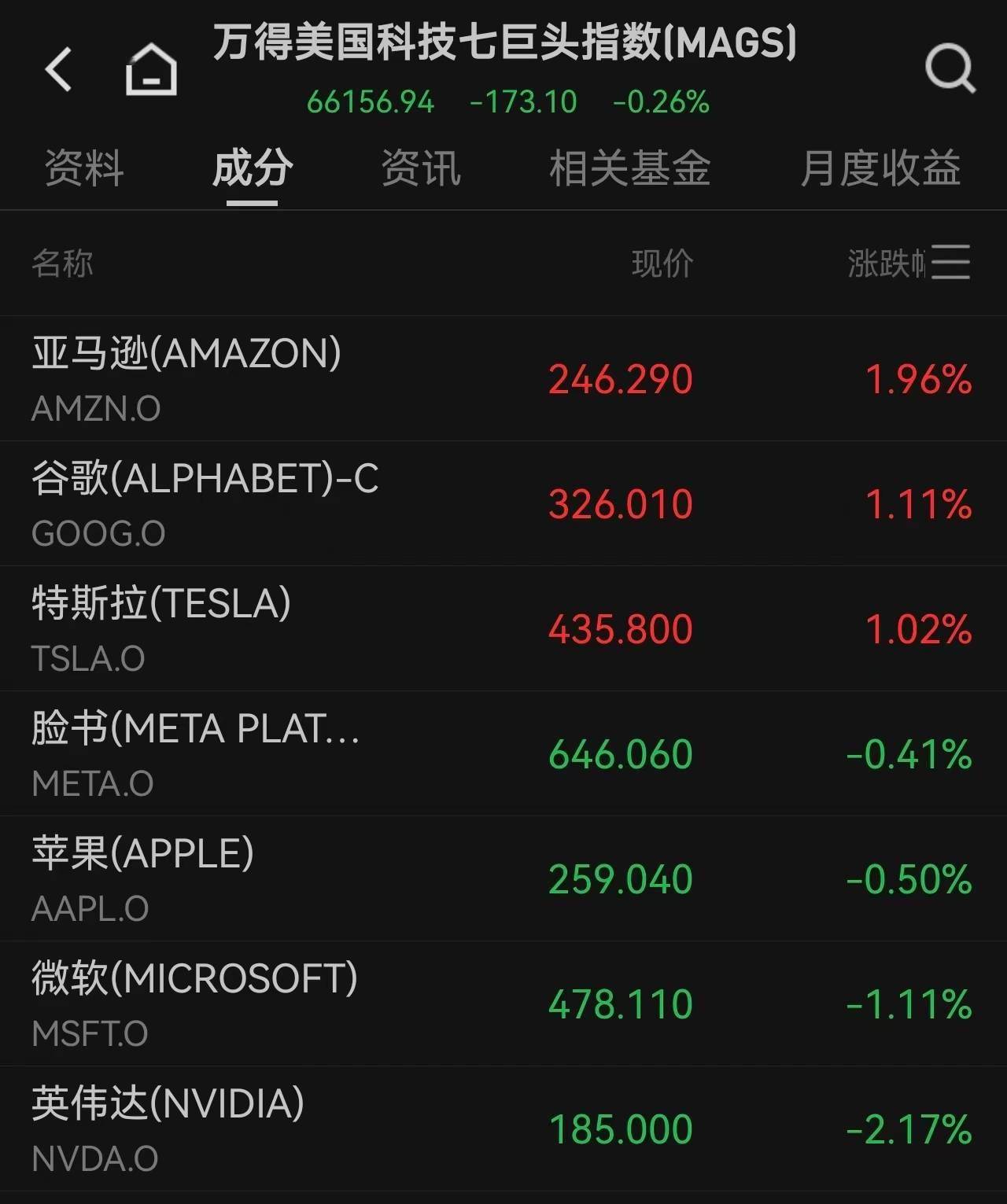
Market Overview - The US stock market showed a mixed performance, with the Dow Jones Industrial Average continuing its upward trend, approaching the psychological level of 50,000 points, while the tech-heavy Nasdaq index faced pressure from heavyweight stocks [1] - The Dow rose by 270.03 points, or 0.55%, closing at 49,266.11 points; the Nasdaq fell by 104.25 points, or 0.44%, closing at 23,480.02 points; the S&P 500 index was nearly flat, slightly up by 0.01%, closing at 6,921.46 points [1] Technology Sector - The technology sector experienced a pullback after several days of gains, with Nvidia down 2.15% and Apple declining for the seventh consecutive trading day, down 0.5% [2] - Other tech giants also saw declines, including Microsoft down 1.11% and Meta Platforms down 0.41%, contributing to the Nasdaq's overall decline [2] - Analysts noted that investors are becoming cautious about high valuations in AI concept stocks ahead of the earnings season, with a stricter market differentiation between winners and losers based on commercialization and capital expenditure returns [3] Chinese Stocks - Chinese stocks mostly rose, with the Nasdaq China Golden Dragon Index increasing by 1.09% [4] - Notable gainers included Century Internet up over 10%, and Global Data up over 8%, while companies like Bilibili, Tencent Music, and Alibaba saw gains exceeding 5% [4] Defense Sector - Defense stocks strengthened following Trump's proposal to increase military spending, suggesting a budget of $1.5 trillion for fiscal year 2027, a significant increase from the $901 billion approved for fiscal year 2026 [7] - This announcement positively impacted defense contractors, with Lockheed Martin rising by 4.3%, Northrop Grumman by 2.4%, and General Dynamics by 1.7% [7] Energy Sector - The energy sector was a market highlight, with stocks rising significantly due to a surge in international oil prices [8] - ConocoPhillips and Occidental Petroleum both rose over 5%, while ExxonMobil increased by over 3% and Chevron by more than 2% [8] - The S&P 500 energy index rose by 3.2%, marking the largest single-day increase since April 2025 [8] Economic Focus - Market attention is shifting towards the upcoming December non-farm payroll report, which is expected to provide valuable insights into the US labor market following the longest government shutdown in history [9] - Federal Reserve officials have differing views on interest rate cuts for the year, with some predicting only one cut while others anticipate two [9]

美联储,突发!特朗普发声
证券时报· 2026-01-09 00:17
Market Performance - The U.S. stock market showed mixed results with the Dow Jones Industrial Average rising by 0.55% to 49,266.11, while the Nasdaq Composite fell by 0.44% to 23,480.02, and the S&P 500 remained relatively flat with a 0.01% increase to 6,921.46 [1][2] Technology Sector - Major technology stocks experienced declines, with Intel down 3.57%, Nvidia down 2.15%, and Microsoft down 1.11%. However, Google, Amazon, and Tesla saw gains of over 1% [4] - Storage-related stocks faced a pullback, with Seagate Technology dropping over 7%, Western Digital down over 6%, and Micron Technology down over 3%. This decline followed a period of strong performance driven by increased demand for storage components due to AI infrastructure [4] Chinese Concept Stocks - Chinese concept stocks performed well, with the Nasdaq Golden Dragon China Index rising by 1.09%. Notable gainers included Bilibili up 6.51%, Tencent Music up 5.45%, and Alibaba up 5.26% [4] Federal Reserve Leadership - U.S. President Trump announced he has decided on a nominee for the next Federal Reserve Chair, although he did not disclose the name. The prediction platform Kalshi shows a 41% probability for Kevin Walsh and a 39% probability for Kevin Hassett as potential nominees [6] - The Congressional Budget Office forecasts that the Federal Reserve may implement a slight interest rate cut this year to address labor market risks, with current rates between 3.5% and 3.75% expected to drop to 3.4% by Q4 [7]

利好突袭!深夜,全线大涨!
券商中国· 2026-01-08 23:29
一则利好消息彻底引爆。 隔夜美股市场,美股军工股全线爆发,美国航天国防股指数ETF盘中一度大涨超4%,克瑞拓斯安全防卫 (Kratos)一度暴涨超20%,军用无人机厂商Aerovironment一度大涨超16%,洛克希德·马丁盘中最高涨超 9%。消息面上,美国总统特朗普表示2027财年美国军费应提升至1.5万亿美元,相当于较今年预算增逾50%。 华尔街分析师普遍认为,美国国防开支增长的方向明确。 另外,美联储货币政策走向也备受市场关注。美联储理事米兰表示,他希望2026年美联储累计降息150个基 点,以提振劳动力市场。美国财长贝森特明确指出,美联储不应推迟进一步降息,他还透露,下任美联储主席 人选将于1月公布。特朗普表示,他已敲定下一任美联储主席提名人选。 军工股全线爆发 美东时间1月8日,美股三大指数震荡分化,英伟达等科技巨头回落,截至收盘,道指涨0.55%,纳指跌 0.44%,标普500指数涨0.01%。 美股大型科技股涨跌不一,博通大跌超3%,英伟达跌超2%,微软跌超1%,苹果、Meta小幅收跌;亚马逊大 涨近2%,谷歌、特斯拉涨超1%。 存储芯片概念股集体下挫,希捷科技大跌超7%,西部数据跌超6%,S ...

当前时点如何看待PCB板块投资机遇
2026-01-08 16:02
Summary of PCB Industry Conference Call Industry Overview - The PCB market is expected to exceed 100 billion yuan, driven by increased shipments of Google's TPU and the 1.6T switch, leading to a rise in both volume and price. The orthogonal backplane is anticipated to start shipping by the end of 2026 or early 2027, contributing to new growth [1][2]. Key Demand Drivers - Demand growth in 2026 is primarily expected from Google, Nvidia, and the switch sector, with AI PCB demand projected to increase by over 200% due to the explosion of AIGC demand. The overall PCB market size is forecasted to surpass 100 billion yuan [2][3]. - Specific growth rates include: - Google: over 200% increase, mainly from increased shipment volumes - Amazon: approximately 90% growth - Nvidia: over 140% growth - Switch sector: 160% growth, significantly aided by new orthogonal backplane technology [3][4]. Major Suppliers and Capacity Expansion - Key players in the PCB industry include Shenghong, Gudian, and Taiwan Lianeng. New entrants in the GB300 sector include Fangzheng and Jingwang, increasing the number of potential suppliers from four or five to seven or eight [5]. - Current suppliers for Google and Amazon include ICU, Mirror Electric, and Hudean Shenlan, with potential new suppliers like Shenghong, Chaoyi, Pengling, and Dongshan Jinhwang, bringing the total number of suppliers for Google to around nine and for Amazon to about eight [5]. Foreign Manufacturers' Capacity Expansion - Foreign manufacturers such as Taiwan's Xinxing, Jinxiang Electric, Korea's ASU, and the US's TTM are expanding capacity at a relatively slow pace. For instance, ICU plans to increase capacity by only 10%, while Xinxing and TTM have insufficient capital expenditures. Mirror Electric's Suzhou factory shows some supply potential with a 25% increase in capital expenditure, but overall expansion remains slow [6]. Investment Logic and Focus Companies - The investment strategy remains focused on leading companies while also looking for emerging players that can achieve breakthroughs. Key areas of interest include shipments related to Google's TPU V7/V8 chips and Amazon's chips, as well as Nvidia's orthogonal solution testing phase [7][8]. - Notable companies to watch include Shenghong, Hudean, Dongshan, and Shengyi Technology, along with emerging firms like Pengding, Fangzheng, and Jingwang [7]. Supply and Demand Dynamics - The AI PCB market is expected to see significant growth by 2026, but supply will still be insufficient to meet demand. By 2027, as most capacity comes online, the supply-demand relationship may balance or even lead to oversupply. However, until the end of 2026, the market is expected to remain in a state of supply shortage [9].