
布鲁可

Search documents
日本IP吸金术:11个IP一年收入429亿,中国成“谷子经济”主战场?
3 6 Ke· 2025-06-18 01:30
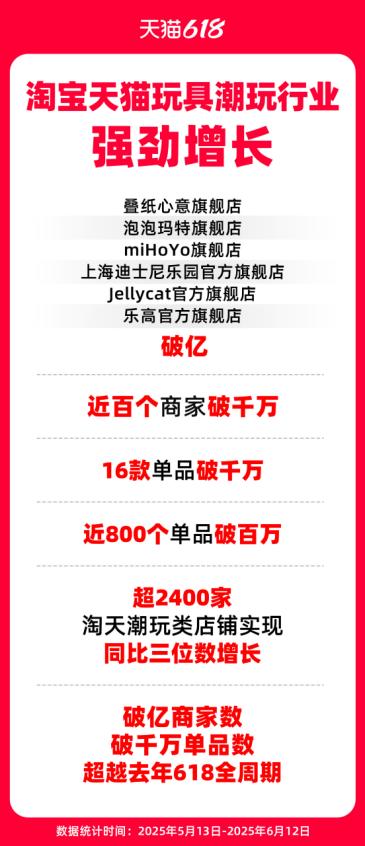
Group 1 - The toy and trendy play industry in China is experiencing explosive growth during the 618 shopping festival, with six merchants surpassing 100 million yuan in sales and nearly 100 merchants exceeding 10 million yuan [1][2] - The top IP products, including Sanrio and Ultraman cards, are performing exceptionally well, indicating a strong demand for Japanese IP in the Chinese market [2][3] - The overall market for trendy toys is expanding, with over 2,400 stores achieving triple-digit growth compared to the previous year [1][2] Group 2 - Major Japanese companies like Bandai, Sanrio, and Tsuburaya have reported significant revenue from their IPs, with Bandai's Dragon Ball generating approximately 9.44 billion yuan, a 35.6% increase year-on-year [4][5] - Sanrio's revenue in China has surged to 816 million yuan, with IP licensing contributing significantly to its growth [5][7] - Tsuburaya's Ultraman IP has generated 260 million yuan in licensing revenue in China, highlighting the strong performance of card sales [7][19] Group 3 - The competitive landscape of the trendy toy market is intensifying, with over 100 stores closing in the first half of 2025, indicating a significant shakeout in the industry [15][16] - The trend of localization is evident, as companies like Sanrio and Bandai are focusing on developing original IPs and collaborating with local partners to enhance their market presence [21][29] - The shift from content output to collaborative ecosystem building is becoming a key strategy for Japanese IP companies in China, aiming for sustainable growth in the competitive market [29][30]


IP产业链梳理及观点更新
2025-06-18 00:54
Summary of the IP Industry Conference Call Industry Overview - The IP derivative market is experiencing rapid growth, with revenue from derivatives surpassing that of the IP itself, indicating a significant potential for expansion in the market [1][2] - The IP industry chain consists of three segments: upstream content creators (movies, novels, games), midstream product developers (blind boxes, plush toys, cards), and downstream distribution channels (dealers, retail chains, secondary markets) [1][3] Key Insights - The demand for emotional value products varies by consumer demographics, with higher age groups favoring trendy toys and younger audiences gravitating towards card games [1][5] - Notable investment targets include companies in the trendy toy sector like Pop Mart, plush toy brands like Labubu and Jellycat, card game companies like Kayo, and entertainment consumer goods firms like Yadea Electric [1][6] Market Dynamics - Midstream product companies earn 50%-60% of consumer spending, with profit margins highly dependent on product categories; card products have a margin of about 70%, while trendy toys and plush toys range from 40%-70% [1][10] - The IP industry is recognized as a lucrative business, with the derivative products accounting for more than 50% of revenue in overseas markets [2] Future Prospects - The Chinese derivative market is expected to maintain high growth in the coming years, with companies like Pop Mart and Kayo leading the way [3][14] - Emerging companies are exploring new product categories such as food toys and card games, indicating a trend towards diversification in product offerings [14][24] Noteworthy Companies - **Pop Mart**: Demonstrates strong performance in IP incubation and operation, with significant revenue from major IPs like Labubu, and a successful global market presence [16] - **Aofei Entertainment**: Leverages a wide range of channels and has developed national-level IPs across various product categories [17][18] - **Ali Pictures**: Operates the largest IP licensing platform in China, showing rapid growth in sales and a strong portfolio of global IP resources [19] - **Shanghai Film**: Holds a diverse portfolio of classic IPs and is actively pursuing derivative product development [20] - **Kayo**: Plans to go public, with a focus on collectible card games and a projected revenue of 10 billion in 2024 [25] Additional Insights - The secondary market allows consumers to trade products with platforms taking a small commission, while self-operated channels can cover the entire industry chain [8] - The operational success of content stores is closely tied to location and product selection, affecting profitability [9] - Companies are increasingly diversifying their product lines, blurring the lines between different categories [24] Conclusion The IP industry is poised for significant growth, driven by increasing consumer demand for emotional value products and the successful strategies of key players in the market. The diversification of product offerings and the expansion into new categories will further enhance the industry's potential.
灵魂拷问!真假IP运营?52TOYS的AB面
Zhong Guo Ji Jin Bao· 2025-06-17 15:27
Core Viewpoint - 52TOYS is attempting to capitalize on the growing trend of collectible toys but faces significant challenges due to its reliance on non-exclusive licensed IPs and a weak direct sales channel compared to competitors like Pop Mart and Blokus [2][8]. Group 1: Company Positioning and Market Comparison - 52TOYS has submitted its IPO application to the Hong Kong Stock Exchange, aiming to leverage the current popularity of collectible toys [2]. - The company claims to be the "third largest IP toy company" by GMV, but its market share is only 1.2%, significantly lower than Pop Mart's 11.5% and Blokus's 7.5% [7][10]. - Despite its positioning as an IP operator, 52TOYS lacks a strong portfolio of proprietary IPs, relying heavily on licensed IPs, which are mostly non-exclusive [4][6]. Group 2: Financial Performance - 52TOYS's revenue from licensed IPs is projected to grow from 233 million RMB in 2022 to 406 million RMB in 2024, increasing its share of total revenue from 50.2% to 64.5% [4][5]. - The company's total revenue is expected to rise from 463 million RMB in 2022 to 630 million RMB in 2024, yet it has been operating at a loss, with losses increasing from 1.71 million RMB to 12.2 million RMB over the same period [8][9]. - The company has spent over 100 million RMB on IP licensing fees in the past three years, which has negatively impacted its gross margin [6]. Group 3: Sales and Distribution Channels - 52TOYS has reduced its number of direct retail stores from 19 in 2022 to only 5 currently, relying more on distributors for sales [10]. - Approximately 66.8% of the company's revenue comes from sales through distributors, while direct sales account for only 30.9% [10]. - The company's strategy of reducing direct retail presence indicates a weaker brand influence in the market [10].

灵魂拷问!真假IP运营?52TOYS的AB面
中国基金报· 2025-06-17 15:12
Core Viewpoint - 52TOYS aims to capitalize on the growing trend of collectible toys but faces significant challenges due to its reliance on non-exclusive licensed IPs and a weak distribution channel, which may hinder its profitability even if it successfully goes public [1][4][14]. Group 1: Company Positioning and Market Comparison - 52TOYS is positioning itself as a third-largest IP toy company by GMV, but its market share is only 1.2%, compared to 11.5% for Pop Mart and 7.5% for Blok [13]. - The company reported revenue growth from 463 million RMB in 2022 to 630 million RMB in 2024, yet it has been operating at a loss, with losses increasing from 1.71 million RMB to 12.2 million RMB over the same period [13]. - Despite its claims of being an IP operator, 52TOYS has few proprietary IPs and relies heavily on licensed IPs, which are mostly non-exclusive, including well-known brands like Crayon Shin-chan and Disney [5][10]. Group 2: Revenue and Cost Structure - Revenue from licensed IPs is projected to grow from 233 million RMB in 2022 to 406 million RMB in 2024, constituting 50.2%, 59.3%, and 64.5% of total revenue respectively [5][6]. - The company has spent over 100 million RMB on IP licensing fees in the past three years, with costs rising significantly, which has negatively impacted its gross margin [10]. - The reliance on distributors for 66.8% of revenue indicates a weak brand presence, as direct sales only account for 30.9% [14]. Group 3: Strategic Challenges - 52TOYS is reducing its direct retail presence, with only 5 stores remaining from 19 at the end of 2022, which limits its market reach [13]. - The company’s strategy of allocating 70% of resources to market-driven products, 20% to forward-looking designs, and 10% to creative designs raises concerns about its ability to innovate and develop proprietary IPs [10]. - Upcoming expirations of key IP contracts in the next two to three years pose a risk to sustaining revenue, as the current proprietary IPs are not yet profitable enough to support the business [10].

港股新消费熄火,“三姐妹”迎强降温,狂热行情暂歇?
Ge Long Hui· 2025-06-17 10:40
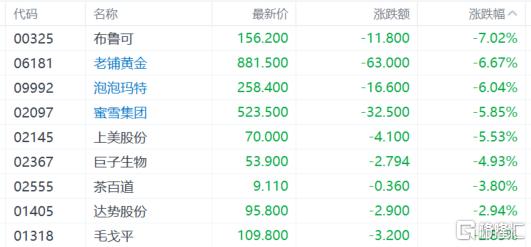
Core Viewpoint - The Hong Kong stock market's new consumption sector is experiencing a cooling period after a previous surge, with significant declines in the stock prices of key players in this sector. Group 1: Market Performance - The "new consumption trio" consisting of Lao Pu Gold, Pop Mart, and Mixue Group saw their stock prices drop significantly, with declines of 6.67%, 6.04%, and 5.85% respectively [2][3]. - Other companies in the sector, such as Bruker and Juzhibio, also faced declines, with Bruker dropping over 7% and Juzhibio nearly 5% [3][4]. - Year-to-date, Lao Pu Gold has increased by over 276%, Pop Mart by over 191%, and Mixue Group by over 158%, with a combined market capitalization exceeding 690 billion HKD [11][12]. Group 2: Market Dynamics - The new consumption sector experienced a strong rally earlier this year, with a reported increase of over 55% from April 7 to June 11, significantly outperforming internet giants during the same period [9]. - The influx of capital from southbound funds into the new consumption sector amounted to 18.325 billion HKD, marking it as a crucial source of incremental funding [9]. Group 3: Market Sentiment and Analysis - Analysts have raised concerns about the overheated nature of the new consumption market, suggesting that stock prices may be inflated beyond reasonable valuations [15][16]. - Factors contributing to the rise of new consumption include changing demographics, particularly the spending power of Generation Z, and a shift towards more frequent, smaller discretionary purchases due to slower income growth [15]. - Some analysts believe that the current market for innovative drugs and new consumption may have reached a peak, indicating potential volatility or adjustments ahead [17][18].

香港,正上演现象级IPO狂欢
Sou Hu Cai Jing· 2025-06-17 06:36
Group 1 - The core viewpoint of the articles highlights a significant IPO boom in Hong Kong in 2025, driven by a combination of market recovery, accelerated globalization strategies of Chinese companies, and the advantages of Hong Kong's stock market system [2][6]. - From January to May 2025, 26 mainland companies completed IPOs in Hong Kong, raising a total of 740 million HKD, surpassing the total number of A-share companies listed in the past three years [3][4]. - The current IPO wave includes over 150 companies in various core industries such as new energy, pharmaceuticals, and technology, with many planning to raise over 1 billion USD [3][4]. Group 2 - The appeal of the Hong Kong market is attributed to the stringent requirements of the A-share market, which compel companies to seek more favorable conditions in Hong Kong [6][7]. - The Hong Kong Stock Exchange has undergone significant reforms since 2025, improving efficiency and attracting international investors, which has led to a surge in successful IPOs [7][8]. - Notable companies like CATL and Midea are utilizing their Hong Kong listings to enhance their global presence and operational credibility [7][8]. Group 3 - Despite the current enthusiasm, there are concerns regarding the sustainability of the IPO boom, as the Hong Kong market's capacity and liquidity are relatively limited compared to the A-share market [8][9]. - Analysts suggest that while the market may experience upward trends, there could be short-term pressures on technology stocks and potential risks associated with companies blindly following the IPO trend without proper evaluation [8][9].





新消费概念港股跌幅扩大 泡泡玛特跌5%
news flash· 2025-06-17 05:36
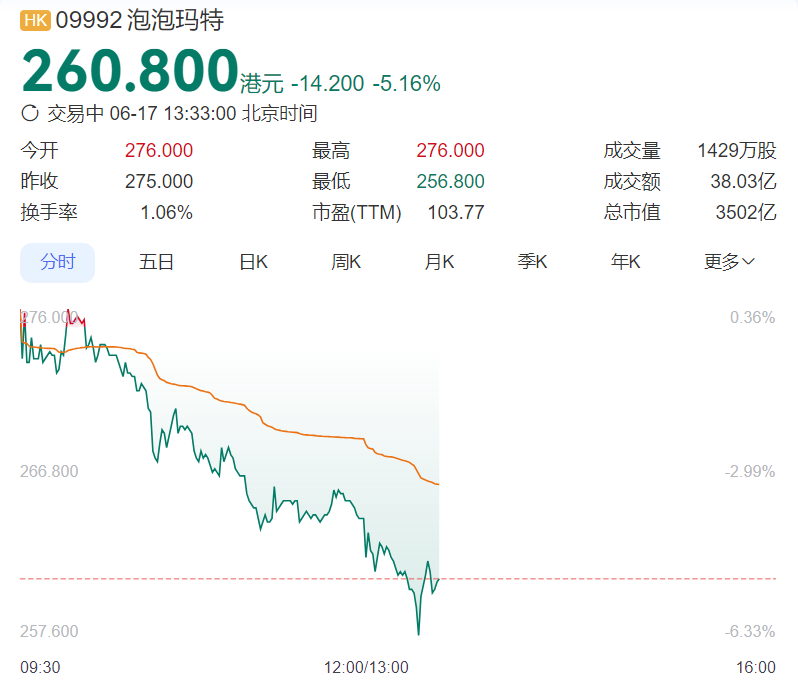
新消费概念港股跌幅扩大 泡泡玛特跌5% 智通财经6月17日电,新消费概念港股午后跌幅扩大。截至发稿,泡泡玛特跌5%,布鲁可跌5%,蜜雪集团跌 4%,茶百道跌3%。 | र्जन | 276.000 | | 最高 | 276.000 | | 成交量 | 1429万股 | | --- | --- | --- | --- | --- | --- | --- | --- | | 昨收 | 275.000 | | 最低 | 256.800 | | 成交额 | 38.03亿 | | 换手率 | 1.06% | | 市盈(TTM) 103.77 | | | 总市值 | 3502亿 | | 分时 | 田 | нк | 周K | 月K | 黎 | 年K | 更多v | ...
行业点评报告:看好电影衍生品市场,光线、果麦等相关营收或高增
ZHESHANG SECURITIES· 2025-06-17 03:57
Investment Rating - The industry investment rating is "Positive" (maintained) [5] Core Viewpoints - The future growth of the film market's non-ticket revenue is expected to accelerate, with film derivatives being a significant component of this revenue [1] - Leading companies like Light Media are projected to have optimistic sales outlooks for film and other entertainment derivatives, with the "Nezha" series expected to generate substantial sales [1][2] - The potential market capitalization increase from film derivative sales is estimated to be between 75 billion to 200 billion yuan, based on various assumptions regarding sales and profit-sharing [2][3] Summary by Sections Industry Overview - The report highlights the increasing importance of non-ticket revenue in the film market, particularly focusing on film derivatives as a key growth area [1] Company Analysis - Light Media's chairman revealed that the overseas box office for "Nezha" is expected to exceed 100 million USD, marking a significant achievement for Chinese films [1] - The "Nezha" series has already achieved hundreds of billions in sales from derivatives, with projections suggesting it could reach over a trillion yuan [1] Financial Projections - The report estimates that a sales figure of 100 billion yuan in film derivatives could correspond to a revenue of 50 billion yuan for related companies, with an assumed profit-sharing ratio of 5%-10% [2] - Valuation estimates for film derivative sales suggest a market capitalization increase of 75 billion to 200 billion yuan, with a neutral assumption placing it at approximately 131.3 billion yuan [3] Investment Recommendations - The report recommends focusing on leading film derivative companies such as Light Media, while also suggesting attention to other key players in the film and animation sectors, including Guomai Culture, Shanghai Film, and Wanda Film [3]
赚钱效应持续!四大特征解锁港股“打新”密码
证券时报· 2025-06-17 00:44
Core Viewpoint - The Hong Kong IPO market has been thriving since 2025, with a continued profit-making effect from "new share subscriptions" [1] Group 1: IPO Market Performance - Since 2025, 31 new stocks have been listed in Hong Kong, with only 9 experiencing a decline on their first day, resulting in a 29.03% failure rate. In the first half of 2024, 70 new stocks were listed, with 25 failing, leading to a 35.71% failure rate [1] - The performance of new stocks on their debut is characterized by four main features [3] Group 2: Characteristics of Successful IPOs - **Feature One: Popular Industries and Leading Companies** The IPOs in Hong Kong this year are driven by "technology + consumption," with significant participation from emerging consumption sectors and advanced technology fields. Notable companies include Ying'en Biotech, which saw a 116.70% increase, and Mixue Group, with a rise of 43.21% [3][4] - **Feature Two: A-Share Companies Listing in Hong Kong** A-share companies have played a significant role in the current IPO wave, with notable fundraising amounts. For instance, Ningde Times raised 41 billion HKD [4] - **Feature Three: Quality of Cornerstone Investors** The cornerstone investor system in Hong Kong is crucial, as these investors are typically large and reputable, providing a "backing" for the new stocks. The presence of high-profile cornerstone investors significantly influences the performance of new listings [5] - **Feature Four: High Subscription Multiples** The IPOs often see extremely high subscription multiples, indicating strong market interest. For example, Mixue Group's subscription exceeded 1.83 trillion HKD, with a subscription multiple over 5000 times [6]

内地企业抢滩港股 硬科技与新消费成热门
Zhong Guo Qing Nian Bao· 2025-06-17 00:03
Core Viewpoint - The trend of mainland companies listing in Hong Kong continues to grow, with significant increases in both the number of IPOs and the amount of capital raised in the first half of the year compared to the same period last year [1][2]. Group 1: IPO Market Overview - In the first half of the year, mainland companies accounted for 95% of the total number of IPOs and 96.7% of the total capital raised in the Hong Kong market [1]. - The number of companies listed in Hong Kong and the amount of capital raised increased by 33% and 711%, respectively, compared to the previous year [1]. - Over 50 A-share companies have announced plans to list in Hong Kong, indicating a strong interest in the market [2]. Group 2: Industry Trends - The "new consumption + hard technology" sectors are emerging as new engines for the Hong Kong stock market [2]. - The biotechnology and health, retail, and consumer sectors had the highest number of IPOs in the first half of the year, with significant interest in niche markets like trendy toys and new-style tea drinks [2]. - The report anticipates more large enterprises and industry leaders will enter the Hong Kong market, with an increasing proportion of IPOs from new consumption and hard technology companies [2]. Group 3: Investment Opportunities - The current growth lines in the Hong Kong market are technology and new consumption, with investment opportunities identified in AI, smart driving, robotics, and innovative pharmaceuticals [3]. - The launch of the "Tech Company Fast Track" by the Hong Kong Stock Exchange aims to facilitate the listing of specialized technology and biotech companies, enhancing the market's appeal [3][4]. - The "H+A" listing model is expected to connect the capital markets of the Guangdong-Hong Kong-Macao Greater Bay Area, providing new growth opportunities for both A-share and Hong Kong-listed companies [4][6]. Group 4: Challenges and Considerations - The "H+A" policy implementation faces challenges such as regulatory alignment, valuation differences, and information disclosure requirements [6]. - Companies listed in both markets must adapt to different regulatory standards, which may complicate their operations [6].