纳芯微

Search documents
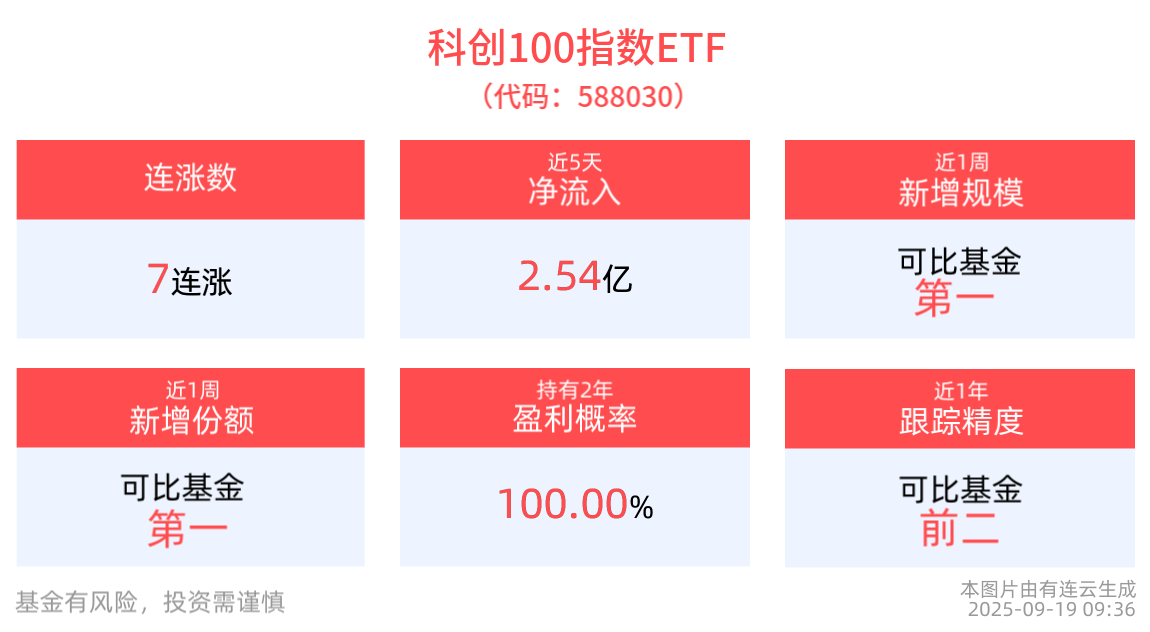
华为明确昇腾AI芯片迭代规划,科创100指数ETF(588030)盘初涨超1%
Sou Hu Cai Jing· 2025-09-19 02:11
Core Insights - The Shanghai Stock Exchange Sci-Tech Innovation Board 100 Index has shown a 0.99% increase, with notable gains from companies like SourceJet Technology and Yirui Technology [3] - Huawei has disclosed its Ascend AI chip iteration plan, with new models expected to launch in 2026 and 2027, indicating a potential boost for domestic computing chip market share [3][4] - Foreign institutions are increasingly researching Chinese chip companies, with significant interest in firms like Weijie Chuangxin and Naxin Micro [4] Market Performance - The Sci-Tech 100 Index ETF has seen a 3.49% increase over the past week, with a current price of 1.37 yuan [3] - The ETF's trading volume reached 24.93 million yuan, with an average daily trading volume of 440 million yuan over the past year, ranking first among comparable funds [3][4] - The ETF's scale has grown by 385 million yuan in the past week, with a significant increase in shares by 16.2 million [4] Investment Opportunities - Analysts suggest focusing on investment opportunities within the Huawei Ascend chain, as the trend towards self-sufficiency in computing power accelerates [4] - Major tech companies like Alibaba, Baidu, and Tencent are redefining the valuation benchmarks for Chinese tech assets, providing new directions for global capital allocation [4]

纳芯微涨2.07%,成交额2.73亿元,主力资金净流入1420.45万元
Xin Lang Cai Jing· 2025-09-18 02:36
Group 1 - The stock price of Naxin Micro increased by 2.07% on September 18, reaching 192.28 CNY per share, with a trading volume of 273 million CNY and a turnover rate of 1.01%, resulting in a total market capitalization of 27.405 billion CNY [1] - Year-to-date, Naxin Micro's stock price has risen by 47.57%, with a 6.45% increase over the last five trading days, 7.91% over the last 20 days, and 7.87% over the last 60 days [1] - Naxin Micro has appeared on the trading leaderboard twice this year, with the most recent occurrence on April 11, where the net buying on the leaderboard was -80.32 million CNY [1] Group 2 - Naxin Micro, established on May 17, 2013, and listed on April 22, 2022, focuses on the research and sales of high-performance, high-reliability analog integrated circuits [2] - The company's main business revenue composition includes signal chain products (38.45%), power management products (34.09%), sensor products (27.11%), and others (0.35%) [2] - As of June 30, the number of shareholders of Naxin Micro was 8,026, an increase of 5.25% from the previous period, with an average of 17,758 circulating shares per person, up by 45.09% [2] Group 3 - Naxin Micro has distributed a total of 162 million CNY in dividends since its A-share listing, with 80.85 million CNY distributed over the past three years [3] - As of June 30, 2025, among the top ten circulating shareholders, Xingshan He Run Mixed A (163406) held 3.5334 million shares, a decrease of 48,000 shares from the previous period [3] - Other notable changes in holdings include an increase of 127,980 shares for Galaxy Innovation Mixed A (519674) and a decrease of 65,950 shares for Xingshan Business Model Mixed (LOF) A (163415) [3]

中国汽车“带货”中国芯片
Di Yi Cai Jing· 2025-09-18 01:27
Core Insights - Chinese brands are demonstrating resilience in the face of a "weak peak season" threat in the fourth quarter of the year, with exports growing by 6.9% in the first eight months and 4.8% in August [2][5] - The shift towards non-American exports and the growth of private enterprises are key factors behind this performance [2][4] - The trend of "exporting" not just products but also brands, technology, and capital is becoming a new growth point for Chinese companies [4][8] Export Performance - In August, China's exports to the EU and Japan increased by 10.4% and 6.7% respectively, with ASEAN exports growing by 22.5% [5] - The Trade Desk's insights indicate that the upcoming holiday shopping season will see consumers making more rational purchasing decisions, with many planning to complete their shopping before Black Friday [3][6] Brand Strategy and Market Diversification - Chinese brands are increasingly diversifying their market strategies to mitigate risks associated with U.S. tariffs, focusing on Europe, Japan, and the Asia-Pacific region [6][7] - The trend of simultaneous market expansion is becoming more common, with companies leveraging successful experiences in one market to explore opportunities in others [7][8] Technological Innovation and Product Quality - Chinese brands are showcasing significant craftsmanship and technological innovation, particularly in AI and robotics, enhancing their competitiveness in the global market [4][8] - The shift from low-end manufacturing to high-end products is driving the internationalization of Chinese brands, although challenges remain in brand recognition compared to established international brands [9] Consumer Perception and Brand Value - There is a growing recognition of the importance of brand value and consumer trust in overseas markets, with Chinese brands moving towards establishing a local presence and identity [8][9] - The challenge lies in balancing the perception of value for money with the need to convey brand philosophy and values to international consumers [8][9]

中国汽车“带货”中国芯片
第一财经· 2025-09-18 01:16
Core Viewpoint - The resilience of Chinese brands is highlighted in the face of the "not-so-busy" fourth quarter in the European and American markets, with a notable increase in exports and a shift towards diversified market strategies [3][4][9]. Export Growth and Market Dynamics - In the first eight months of the year, China's goods exports grew by 6.9%, with August's export growth reaching 4.8%, driven by non-American exports and private enterprises [3][4]. - The Trade Desk's insights indicate that despite demand contraction, Chinese companies are increasing investments in marketing and brand building, showcasing strong craftsmanship and technological innovation [3][6]. - The U.S. holiday retail sales are projected to grow by only 1.2% in 2025, marking the lowest growth since 2009, with a significant decline compared to the previous year [5]. Competitive Edge of Chinese Electronics - At the 2025 Berlin International Consumer Electronics Show, around 764 Chinese companies participated, representing nearly 40% of exhibitors, indicating strong competitiveness in the electronics sector [6]. - Chinese brands are not only relying on manufacturing and logistics advantages but are also gaining premium capabilities in high-end markets, becoming significant choices for global consumers during the shopping season [6][12]. Diversification Strategies - Chinese brands have initiated diversification strategies in response to increased tariffs from the U.S., with exports to the EU and Japan growing by 10.4% and 6.7% respectively in August [9][10]. - The shift towards non-American markets is evident, with companies increasingly focusing on Europe and Asia-Pacific to mitigate trade war risks [10][11]. Brand Value and Consumer Trust - Chinese brands are transitioning from merely exporting products to establishing brand value and recognition in overseas markets, moving towards a model where they are seen as local international brands [12][13]. - The challenge remains for Chinese brands to balance value-for-money propositions with the need to convey brand values and ideologies to gain trust from overseas consumers [13][14].

外资机构密集调研中国芯片企业 硬科技产业迎黄金发展期?
Shang Hai Zheng Quan Bao· 2025-09-17 23:35
近段时间以来,A股市场芯片板块表现持续活跃,多只个股走出强势行情。数据显示,截至9月17日收市,芯原股份和寒武纪今年以来涨幅分别高达 229.6%、119.15%;瑞芯微、澜起科技、兆易创新等今年以来涨幅均超过70%。其中,中芯国际等龙头股近期创下股价历史新高。 与此同时,外资机构对中国芯片企业表现出浓厚兴趣,积极进行调研。数据显示,今年以来截至9月17日,唯捷创芯迎来41家外资机构调研,纳芯微、芯原 股份、国芯科技、东芯股份和瑞芯微均迎来20家外资机构调研。以纳芯微为例,在公司8月举办的业绩说明会中,参会名单中出现了富达、高盛、摩根士丹 利、美银证券、摩根大通等外资巨头的身影。 近期A股芯片板块表现强势,中芯国际等龙头股股价创下历史新高。在此背景下,外资机构密集调研中国芯片企业,国际资本亦持续加仓中国资产。多家外 资机构表示,中国"硬科技"产业正迎来黄金发展期,半导体、人工智能等领域蕴含丰富的投资机遇。 除了实地调研,外资机构也在上调对中国核心企业的估值与盈利预测。高盛近日发布研报,将中芯国际H股12个月目标价上调15%至73.1港元,在维持2025 年至2027年盈利预测基本不变的同时,上调2028年与2 ...

中国品牌不惧“旺季不旺” 中国汽车还能“带货”芯片
Di Yi Cai Jing· 2025-09-17 14:08
Group 1 - The core viewpoint is that despite the challenges in the US and European markets, Chinese brands are demonstrating resilience and adaptability in their export strategies [1][5] - China's goods exports increased by 6.9% in the first eight months of the year, with August's export growth reaching 4.8%, driven by non-US exports and private enterprise exports [1][4] - The Trade Desk's insights indicate that Chinese companies are increasing investments in marketing and brand building, showcasing strong craftsmanship and technological innovation in AI and robotics [1][3] Group 2 - The automotive sector is enhancing the global recognition of Chinese chips, with companies like Naxin Micro seeing over 10% of their revenue coming from overseas by 2024 [3][5] - Chinese brands are diversifying their export markets, with significant growth in exports to the EU and ASEAN, indicating a shift away from reliance on the US market [4][5] - The trend of early preparation for the holiday shopping season reflects a more rational consumer mindset, with half of US consumers planning to complete their purchases before Black Friday [2][5] Group 3 - Chinese brands are transitioning from merely exporting products to establishing themselves as international brands, focusing on brand value and consumer trust [7][8] - The global expansion of Chinese manufacturing is evolving from low-end to high-end products, enhancing brand internationalization [8] - There is a notable difference in consumer perceptions between Chinese fast-moving consumer goods and international brands, highlighting the need for greater cultural understanding and marketing efforts [8]
中国品牌不惧“旺季不旺”,中国汽车还能“带货”芯片
Di Yi Cai Jing· 2025-09-17 14:01
Group 1: Market Trends and Performance - China's exports grew by 6.9% in the first eight months of the year, with August's export growth reaching 4.8%, driven by non-U.S. exports and private enterprises [1] - The global economic pressure is expected to lead to a gradual decline in export growth in the fourth quarter, with a focus on the impact of external demand on production [2] - Despite challenges, Chinese electronic consumer goods maintain strong competitiveness, with approximately 764 Chinese companies participating in the 2025 IFA, accounting for nearly 40% of exhibitors [2][3] Group 2: Brand Strategy and Innovation - Chinese brands are increasingly integrating AI technology and showcasing craftsmanship and technological innovation, enhancing their competitiveness in high-end markets [3] - The shift from product export to brand export is evident, with companies leveraging long-term R&D and industry cluster advantages to expand globally [3] - Chinese brands are transitioning from relying solely on supply chain advantages to establishing brand value and recognition in overseas markets [7] Group 3: Diversification and Market Expansion - Chinese brands have initiated diversification strategies in response to increased tariffs from the U.S., with exports to the EU and Japan growing by 10.4% and 6.7% respectively in August [4] - The trade transfer effect is strengthening, allowing for continued growth in non-U.S. exports, which is crucial for mitigating external economic fluctuations [5] - Companies are now more confident in exploring multiple markets simultaneously, moving away from a single-market focus [6] Group 4: Consumer Behavior and Brand Perception - There is a noticeable shift in consumer behavior towards more rational purchasing decisions, with many planning to complete their holiday shopping earlier [2] - Chinese brands are increasingly recognized for their value and ideology, which is essential for gaining trust and acceptance in overseas markets [7][8] - The perception of Chinese fast-moving consumer goods and cultural brands still lags behind international brands, indicating a need for greater efforts in brand recognition and cultural understanding [8]
中美芯片战,中国大反击
虎嗅APP· 2025-09-16 14:05
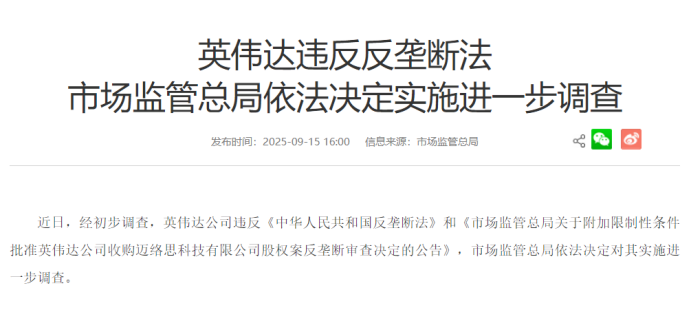
Core Viewpoint - The article discusses China's recent countermeasures in the ongoing chip war with the United States, highlighting three specific actions taken against American semiconductor companies, particularly Nvidia, in response to U.S. export controls and anti-competitive practices [4][5][6]. Group 1: China's Countermeasures - On September 13, China initiated an anti-dumping investigation into American-made analog chips [4]. - On the same day, China launched an anti-discrimination investigation against U.S. measures affecting the integrated circuit sector [4]. - On September 15, China determined that Nvidia violated antitrust laws, leading to further investigations [4][9]. Group 2: Nvidia's Antitrust Issues - Nvidia recently received U.S. government approval to sell H20 chips to China but faced scrutiny from the Chinese government for alleged antitrust violations [8][9]. - The investigation relates to Nvidia's 2019 acquisition of Mellanox Technologies, which was approved under specific conditions to prevent anti-competitive practices [11][14]. - Nvidia's supply of H20 chips to China has been criticized for not adhering to fair and non-discriminatory principles, as the performance of these chips is significantly lower than their counterparts available in other markets [16][17]. Group 3: Impact on the Semiconductor Industry - The anti-dumping investigation targets analog chips, with significant price discrepancies noted, such as a dumping margin of 340.10% for certain products [24][25][26]. - Major U.S. companies like Texas Instruments, ADI, Broadcom, and ON Semiconductor are implicated, with their combined revenue in China exceeding $10 billion, indicating potential significant financial repercussions [33]. - Following the announcement of these investigations, Chinese semiconductor stocks surged, while U.S. counterparts like Texas Instruments experienced declines [33]. Group 4: Broader Trade Implications - The article suggests that the ongoing trade tensions involve not only direct actions like anti-dumping and antitrust investigations but also broader issues of discrimination in trade practices [35][36]. - The ultimate goal for China is to enhance its self-sufficiency in semiconductor manufacturing, reducing reliance on foreign technology [37][38].



对美模拟芯片反倾销,业内怎么看?
3 6 Ke· 2025-09-16 04:26
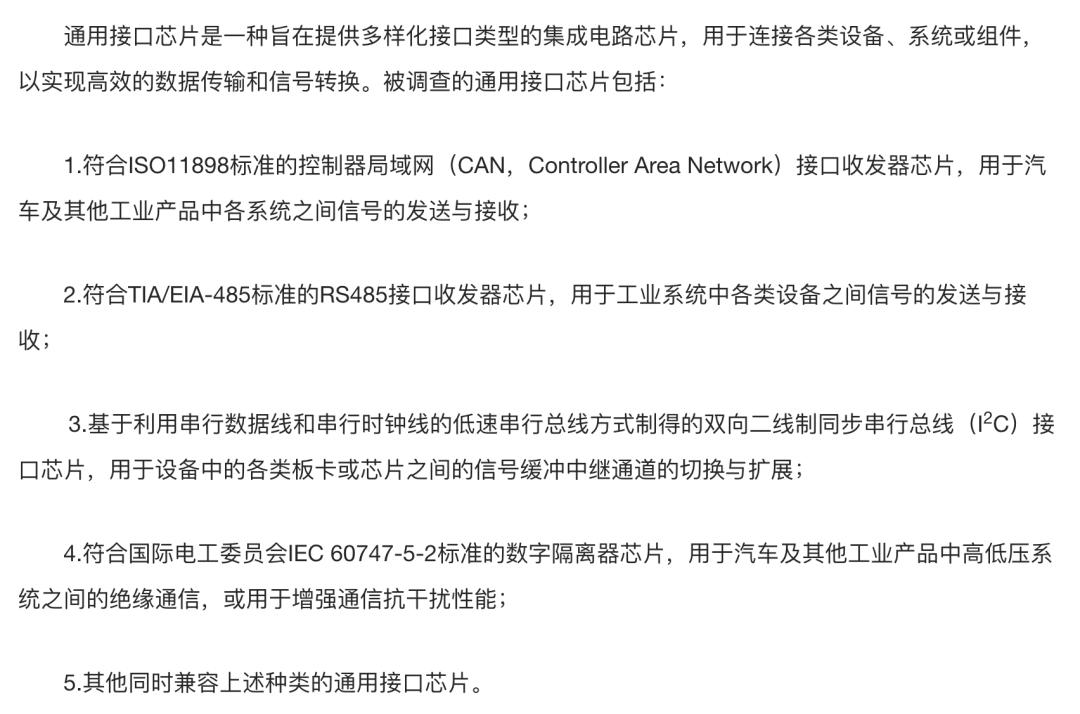
Group 1 - The Ministry of Commerce has initiated an anti-dumping investigation into imported analog chips from the United States, leading to a significant rise in the A-share analog chip sector [1][5] - Major companies such as Shengbang Co., Shanghai Beiling, and Naxinwei saw their stock prices hit the daily limit, while others like SIRUI and Aiwai Electronics also experienced notable gains [1][10] - The investigation was prompted by a formal request from the Jiangsu Semiconductor Industry Association, citing a significant price drop and a dumping margin exceeding 300% for the products in question [2][3] Group 2 - The investigation will cover products primarily used in automotive and industrial systems, specifically general-purpose interface chips and gate driver chips [8][9] - The products under investigation include both finished chips and raw materials like wafers and die, emphasizing the importance of product origin [10][12] - The investigation period is set from January 1, 2024, to December 31, 2024, with the industry damage assessment covering from January 1, 2022, to December 31, 2024 [12] Group 3 - The Chinese Semiconductor Industry Association and other industry groups have expressed support for the investigation, emphasizing the need for a fair market environment [5][6] - Despite improvements in domestic analog chip self-sufficiency, major players like Texas Instruments and Analog Devices still dominate the market [11] - The price competition from U.S. manufacturers has significantly impacted domestic small and medium-sized enterprises, highlighting the challenges faced by local firms in the high-end market [12][13]
反倾销反歧视反垄断:中国还击美国芯片战
Hu Xiu· 2025-09-16 04:05
Group 1 - China has initiated anti-dumping investigations against American-made analog chips and anti-discrimination investigations related to integrated circuits on the same day, marking a significant counteraction in the ongoing chip war with the U.S. [1][2] - The U.S. Department of Commerce recently added 32 entities to its export control "entity list," with 23 of them located in China and many involved in the chip business, which may have triggered China's response [2][3] - The ongoing trade talks between China and the U.S. in Spain may be influenced by these actions, suggesting a strategy of "fighting while negotiating" [3][4] Group 2 - Nvidia has been found in violation of antitrust laws by China's State Administration for Market Regulation (SAMR), which has decided to conduct further investigations [8][10] - The investigation relates to Nvidia's acquisition of Mellanox Technologies in 2019, which was approved under certain conditions to prevent anti-competitive practices [12][15] - Nvidia's current supply of H20 chips to China is significantly limited in performance compared to its H200 chips, raising concerns about compliance with fair trade practices [18][17] Group 3 - The anti-dumping investigation targets analog chips produced by U.S. companies, with the investigation period set from January 1, 2024, to December 31, 2024 [31][32] - The application for the investigation cites that U.S. companies have significantly increased their product imports to China while simultaneously lowering prices, adversely affecting domestic producers [36][39] - If the anti-dumping investigation is upheld, it could lead to substantial penalties for major U.S. chip companies, potentially impacting their revenues in China, which exceed $10 billion collectively [41] Group 4 - The Chinese government is also conducting an anti-discrimination investigation against U.S. measures that restrict high-end chips while allowing low-end chips to flood the market, which are seen as discriminatory trade practices [44][45] - The outcome of these investigations could lead to increased tariffs or restrictions on U.S. products if found to be unfair [45][46] - The ongoing investigations and trade tensions highlight the complex dynamics of the U.S.-China trade relationship, particularly in the semiconductor sector [46][47]