广发证券

Search documents
开源证券:衍生品监管透明化 规模限制有望放松利好头部券商
智通财经网· 2026-01-19 03:20
Core Viewpoint - The report from Kaiyuan Securities expresses optimism about the brokerage sector, highlighting the sustained growth of brokerage performance and the pressure on the funding side, indicating a significant lag in the brokerage sector [1] Group 1: Regulatory Developments - On January 16, the China Securities Regulatory Commission (CSRC) solicited opinions on the draft of the "Supervision and Management Measures for Derivative Transactions (Trial) (Draft for Comments)" [2] - The policy aims to strengthen the standardized management of the derivatives market, clarifying the CSRC's regulatory scope and emphasizing enhanced monitoring and cross-market regulation [3] - The policy supports the steady development of the derivatives market, encouraging risk management activities and limiting excessive speculation [3] Group 2: Impact on Brokerage Firms - The enhanced transparency in derivatives regulation is expected to benefit the long-term development of brokerage firms' derivatives business, providing a more stable operational framework for brokers and investors [4] - The derivatives business is highly concentrated, with top-tier brokers holding significant advantages; as of November 2023, the market share of the top five firms in swap and OTC options was 66% and 59%, respectively [4] - Top-tier brokers, such as CITIC Securities and Guotai Junan, can directly engage in stock hedging transactions, while secondary brokers are limited in their trading capabilities [4] Group 3: Market Stability and Investment Recommendations - Derivative tools are seen as beneficial for stabilizing market fluctuations, with the potential for relaxed scale restrictions favoring leading brokers [5] - The CSRC's commitment to a robust monitoring system for derivatives trading is expected to facilitate high-quality development in the derivatives business, contributing to market stability [5] - Investment recommendations include top brokers with strong international business and undervalued stocks, such as Huatai Securities and Guotai Junan, as well as firms with significant wealth management advantages like GF Securities [5]




华泰研究:结构性降息落地,融资逆周期调节
HTSC· 2026-01-19 03:10
Investment Rating - The report maintains an "Overweight" rating for the securities and banking sectors, while also suggesting a positive outlook for the insurance sector [10][40]. Core Insights - The report highlights a structural monetary policy shift with a focus on "increasing quantity and reducing price," indicating potential for further interest rate cuts and reserve requirement ratio reductions [12][41]. - The A-share market remains active, with an average daily trading volume of 3.47 trillion yuan and a financing balance exceeding 2.7 trillion yuan, marking a new high [12][28]. - The report emphasizes the importance of the recent increase in the minimum margin requirement for financing from 80% to 100%, which aims to stabilize market conditions and reduce leverage [14][18]. Securities Sector Summary - The securities sector is expected to benefit from improved market conditions, with a focus on high-quality brokerage firms such as CITIC Securities and Guotai Junan [3][27]. - The report notes that the recent increase in financing margin requirements is a regulatory measure to control leverage and stabilize market sentiment [14][15]. - CITIC Securities reported a 38% year-on-year increase in net profit for 2025, reflecting strong performance in brokerage and investment banking [27]. Insurance Sector Summary - The insurance sector is advised to focus on high-quality leading companies, as the market has recognized the strong performance of life insurance sales [39]. - The report indicates that the main drivers for insurance stock prices are currently on the asset side rather than the liability side, leading to some price corrections [12][39]. Banking Sector Summary - The banking sector is characterized by a stable performance, with major banks like Shanghai Bank and Nanjing Bank recommended for investment due to their solid fundamentals [3][40]. - The report highlights a decrease in social financing growth, primarily due to high government debt base effects, but notes an increase in corporate loans [42][43]. - The Central Bank's recent policies suggest room for further interest rate cuts, which could enhance the banking sector's profitability [41][40].



资管规模稳提升,把握优质金融
HTSC· 2026-01-19 03:10
Investment Rating - The report maintains an "Overweight" rating for the banking and securities sectors [9]. Core Insights - The overall AUM of China's asset management industry reached approximately 175.61 trillion yuan by the end of December 2025, with significant contributions from various sectors including banking wealth management, public funds, private equity, insurance, and trusts [15][16]. - The banking wealth management sector saw a year-on-year increase of 6.5%, reaching 31.63 trillion yuan, while public funds grew by 12% to 36.32 trillion yuan [15][16]. - The report highlights a positive trend in the issuance of financial products, with a notable increase in the number of new products launched in December 2025 compared to November [17][29]. Summary by Relevant Sections Banking Wealth Management - As of the end of 2025, the banking wealth management sector had a total AUM of 31.63 trillion yuan, reflecting a year-on-year growth of 6.5% [15][17]. - In December 2025, the market issued 3,039 wealth management products, a month-on-month increase of 15.5% [17][20]. - The average yield for wealth management products rose to 1.79% in December, an increase of 54 basis points from the previous month [43]. Public Funds - The total AUM of public funds reached 36.32 trillion yuan by the end of 2025, with a year-on-year increase of 12% [15][16]. - The issuance of new fund shares decreased by 0.7% year-on-year, but there was a notable increase in the proportion of equity and mixed funds [15][16]. Private Equity - By the end of November 2025, the private equity sector's AUM was 22.09 trillion yuan, with a month-on-month increase of 0.19% [15][16]. - In November, the sector saw a significant increase in new registrations, with a total of 713 billion yuan, marking a year-on-year growth of 97% [15][16]. Insurance Asset Management - The insurance sector's investment balance reached 37.46 trillion yuan by the end of Q3 2025, showing a year-on-year increase of 17% [15][16]. - The proportion of stock investments within the insurance asset management sector has increased, indicating a shift towards equity investments [15][16]. Securities Asset Management - As of Q3 2025, the securities asset management sector had an AUM of 6.37 trillion yuan, with a quarter-on-quarter increase of 4% [15][16]. - The number of new shares issued in December 2025 was 6.5 billion, reflecting a month-on-month increase of 45% [15][16]. Trusts - The trust sector's total asset scale was 32.43 trillion yuan by the end of June 2025, with a year-to-date increase of 10% [15][16]. - In December, the issuance of trust products decreased by 6% month-on-month, totaling 640 billion yuan [15][16].
机构称头部险企优势强化,证券保险ETF鹏华(515630)交投活跃
Xin Lang Cai Jing· 2026-01-19 02:53
消息面上,上周受监管降温信号影响,非银金融板块全周下跌2.63%,保险板块领跌(-3.59%)。 证券保险ETF鹏华紧密跟踪中证800证券保险指数,中证800证券保险指数是在中证800指数的基础上, 选择证券保险行业内对应的证券作为指数样本,为投资者提供更多样化的投资标的。 数据显示,截至2025年12月31日,中证800证券保险指数(399966)前十大权重股分别为中国平安、东方 财富、中信证券、国泰海通、中国太保、华泰证券、中国人寿、广发证券、招商证券、新华保险,前十 大权重股合计占比64.71%。 机构指出,本次板块回调核心系市场情绪传导带来的短期扰动,而非行业基本面恶化:一方面,年 初"开门红"大涨,存在获利盘兑现需求;另一方面,杠杆资金收缩引发市场对权益资产波动担忧,险资 投资收益预期短期受压制。从行业银保渠道维度看,头部险企期交保费规模与市场份额实现双重提升, 中长期分红险已成为渠道核心供给品类,有效缓解Margin下行压力。短期来看,市场监管降温引发的情 绪波动对保险板块形成一定压制,但中长期来看,行业基本面向上逻辑清晰:资产规模AUM扩容与利 差率修复形成双轮驱动,推动投资收益确定性提升,叠加 ...
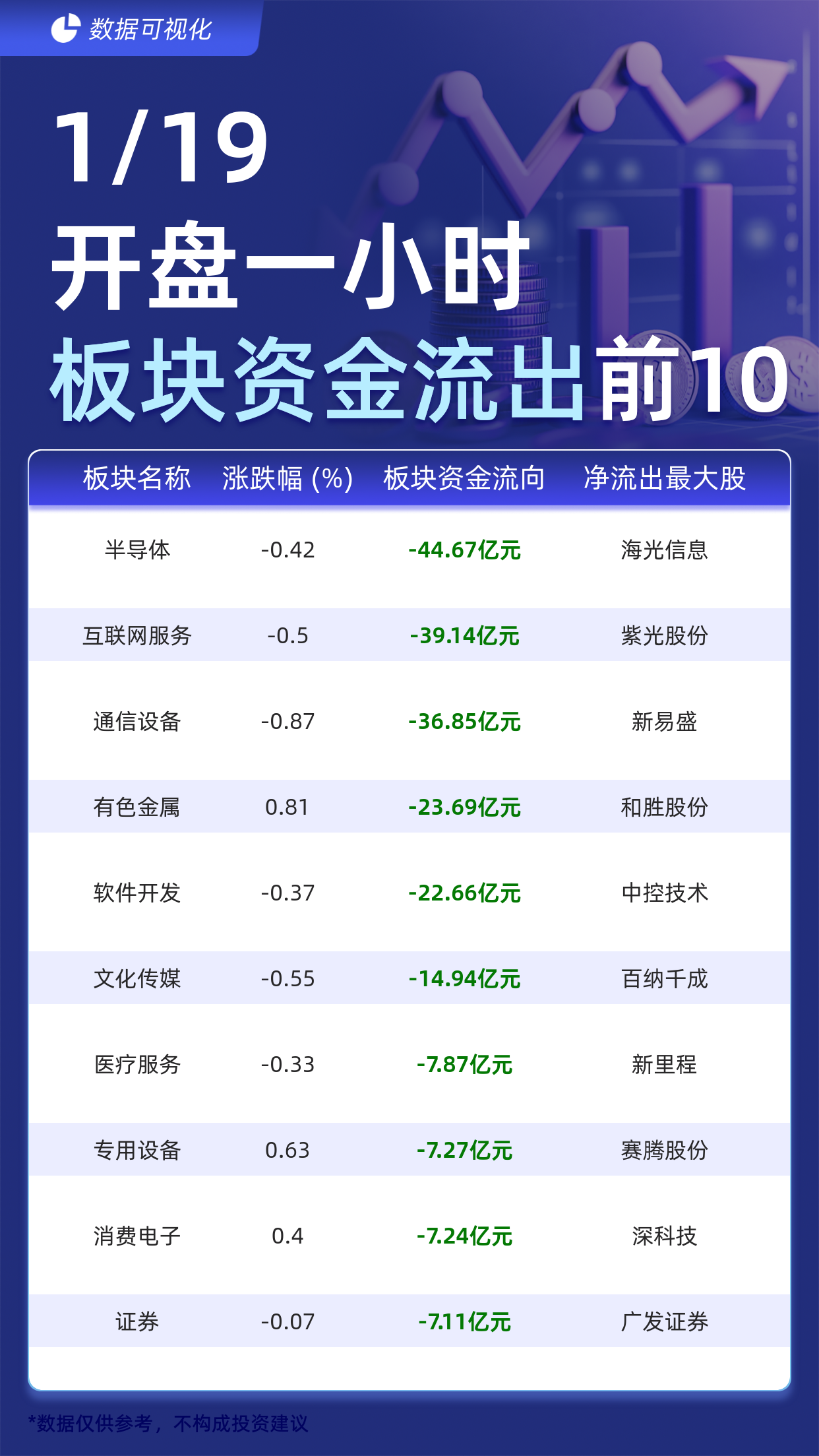
主力板块资金流出前10:半导体流出44.67亿元、互联网服务流出39.14亿元
Jin Rong Jie· 2026-01-19 02:38
Group 1 - The main market experienced a net outflow of 17.805 billion yuan in principal funds as of January 19, with significant withdrawals from various sectors [1] - The top ten sectors with the largest fund outflows included: Semiconductor (-4.467 billion yuan), Internet Services (-3.914 billion yuan), Communication Equipment (-3.685 billion yuan), Non-ferrous Metals (-2.369 billion yuan), Software Development (-2.266 billion yuan), Cultural Media (-1.494 billion yuan), Medical Services (-0.787 billion yuan), Specialized Equipment (-0.727 billion yuan), Consumer Electronics (-0.724 billion yuan), and Securities (-0.711 billion yuan) [1][3] Group 2 - The Medical Services sector saw a fund outflow of 0.787 billion yuan, indicating a negative change of -0.33% [3] - The Specialized Equipment sector experienced a fund outflow of 0.727 billion yuan, with a positive change of 0.63% [3] - The Consumer Electronics sector had a fund outflow of 0.724 billion yuan, reflecting a positive change of 0.4% [3] - The Securities sector recorded a fund outflow of 0.711 billion yuan, with a slight negative change of -0.07% [3]

格隆汇港股通5日资金流入流出排行榜 | 1月18日
Ge Long Hui· 2026-01-19 00:59
Key Points - Significant inflow of funds into stocks such as JunDa Co., Ltd. (02865), Shandong Molong (00568), and Lion Holdings (02562) over the past five days, with changes in holding ratios of 12.76%, 4.30%, and 4.09% respectively [1] - Conversely, notable outflows were observed in stocks like Huaxia Hengsheng Technology (03088) and GF Securities (01776), with holding ratio changes of -14.20% and -6.92% respectively [1] Inflow Summary - **JunDa Co., Ltd. (02865)**: - Holding ratio change: 12.76% - Cumulative holding ratio: 49.2974% - Net inflow amount: 233.608 million - Net shares bought: 809.38 thousand [2] - **Shandong Molong (00568)**: - Holding ratio change: 4.30% - Cumulative holding ratio: 58.6827% - Net inflow amount: 36.768 million - Net shares bought: 1101.52 thousand [2] - **Lion Holdings (02562)**: - Holding ratio change: 4.09% - Cumulative holding ratio: 51.9135% - Net inflow amount: -35.712 million (indicating outflow) - Net shares bought: 1875.35 thousand [2] - **Weimob Group (02013)**: - Holding ratio change: 2.65% - Cumulative holding ratio: 29.6699% - Net inflow amount: 346.284 million - Net shares bought: 10505.30 thousand [2] - **Zhongqing Co., Ltd. (01855)**: - Holding ratio change: 2.56% - Cumulative holding ratio: 10.3564% - Net inflow amount: 28.986 million - Net shares bought: 2115.60 thousand [2] Outflow Summary - **Huaxia Hengsheng Technology (03088)**: - Holding ratio change: -14.20% - Cumulative holding ratio: 6.07% - Net inflow amount: -0.873 million - Net shares bought: -17.60 thousand [2] - **GF Securities (01776)**: - Holding ratio change: -6.92% - Cumulative holding ratio: 53.4549% - Net inflow amount: 13.941 million - Net shares bought: -66.32 thousand [2] - **Nanjing Panda Electronics (00553)**: - Holding ratio change: -3.35% - Cumulative holding ratio: 46.719% - Net inflow amount: -47.038 million - Net shares bought: -811.60 thousand [2] - **CIFI Holdings Group (00884)**: - Holding ratio change: -3.23% - Cumulative holding ratio: 11.8448% - Net inflow amount: -2.942 million - Net shares bought: -1438.94 thousand [2] - **Hongye Futures (03678)**: - Holding ratio change: -2.34% - Cumulative holding ratio: 58.3444% - Net inflow amount: -31.207 million - Net shares bought: -584.10 thousand [2]
港股再融资迎开门红 近30家公司集中“补血”
Shang Hai Zheng Quan Bao· 2026-01-18 18:15
Group 1 - Guangfa Securities plans to raise approximately HKD 6.1 billion through a combination of H-share placement and convertible bond issuance, with net proceeds aimed at increasing capital for its overseas subsidiaries to support international business development [1] - The placement was completed on January 14, with 219 million shares sold at HKD 18.15 per share, and HKD 2.15 billion in bonds issued, which can be converted into H-shares under certain conditions [1] - SF Express announced a strategic shareholding arrangement with Jitu Express, involving a placement of approximately 226 million H-shares at HKD 36.74 per share, raising about HKD 8.3 billion to fund the acquisition of Jitu Express shares [1][2] Group 2 - The flexible refinancing rules in Hong Kong have led to a market environment characterized by "on-demand financing," with 2025 seeing a total refinancing scale of approximately HKD 325 billion, surpassing the HKD 285 billion raised through IPOs [3] - Hong Kong's capital market offers diverse refinancing tools, including placements and issuances, with a relatively simple approval process, allowing companies to choose financing methods based on their needs [3] - The ongoing trend of A+H listings is expected to continue in 2026, driven by favorable market conditions, including the return of international capital to the Hong Kong market as the Federal Reserve enters a rate-cutting cycle [4]
非银金融周报:融资保证金比例上调,金监总局部署2026年监管工作-20260118
HUAXI Securities· 2026-01-18 14:52
Investment Rating - The industry rating is "Recommended" [5] Core Insights - The adjustment of the financing margin ratio from 80% to 100% aims to cool down excessive leverage and maintain market stability. This change will take effect on January 19, 2026, and applies only to new financing contracts [3][4][15][7] - As of January 14, 2026, the total market financing balance reached a historical high of 2.68 trillion yuan, with the margin balance accounting for 2.59% of the A-share market capitalization, indicating an increase from the average level of 2.40% in 2025 [4][15] - The non-bank financial sector index fell by 2.63%, underperforming the CSI 300 index by 2.06 percentage points, ranking 26th among all primary industries. The securities sector decreased by 2.21%, while the financial technology sector increased by 1.34% [2][13] Summary by Sections Market and Sector Performance - The average daily trading volume of A-shares for the week of January 11-17, 2026, was 34.651 billion yuan, a 21.5% increase week-on-week and a 189.4% increase year-on-year. The average trading volume for the first quarter of 2026 is 31.585 billion yuan, up 107.7% from the same period in 2025 [19] - In the same week, three new stocks were issued, raising 2.025 billion yuan, while two new stocks were listed, raising 1.484 billion yuan. Year-to-date, three A-share IPOs have raised 3.039 billion yuan [19] Financing Margin Ratio Adjustment - The financing margin ratio adjustment is a regulatory measure to prevent systemic risks and protect investors' rights. The increase in the minimum margin requirement is intended to curb market overheating and ensure a smooth market transition [4][7][15] Regulatory Developments - The National Financial Supervision Administration held a regulatory work meeting on January 15, 2026, outlining five key tasks for the year, including risk resolution for small and medium-sized financial institutions and enhancing regulatory quality. The focus for 2026 is on preventing systemic risks and ensuring high-quality industry development [8][16][17]





湘财证券晨会纪要-20260118
Xiangcai Securities· 2026-01-18 14:46
Macro Commentary and Market Analysis - Recent macro data shows a rebound in exports with a year-on-year growth rate of 6.6% in December, up from 5.90% in November, leading to an annual cumulative growth rate of 5.50% [2][3] - M2 growth in December was 8.50%, expected to remain around 8% in 2025, indicating a "moderately loose" monetary policy that supports economic recovery [3] - M1 growth was only 3.80% in December, reflecting weak investment and consumption willingness among enterprises and residents [3] - M0 saw a significant increase of 10.2% in December, indicating strong cash demand and active payment activities [3] Industry and Company Analysis - The securities industry experienced a slight decline, with the brokerage index down 2.2%, underperforming the CSI 300 index by 1.6 percentage points [12] - The average daily stock trading volume reached 34,283 billion yuan, a 21.2% increase week-on-week, marking a historical high [13] - The financing scale for equity financing reached 1,113 billion yuan, with significant contributions from large-scale placements [14] - The current PB valuation of the brokerage index is 1.38x, which is at the 35th percentile of the last decade, indicating a low valuation relative to expected earnings growth [12][15] Investment Recommendations - The report suggests maintaining an "overweight" rating on the securities industry, highlighting the potential for valuation recovery due to favorable regulatory policies and increasing trading activity [15] - Focus is recommended on internet brokerages with strong beta attributes and firms with solid earnings certainty in an active market environment [15]
金融行业周报(2026、01、18):央行宣布结构性降息,衍生品交易监管更规范-20260118
Western Securities· 2026-01-18 11:43
Investment Rating - The report does not explicitly state an overall investment rating for the financial industry, but it provides specific recommendations for various sectors and companies within the industry [3][21]. Core Insights - The financial industry experienced a decline this week, with the non-bank financial index down by 2.63%, underperforming the CSI 300 index by 2.06 percentage points. The banking sector saw a decline of 3.03%, also underperforming the CSI 300 index by 2.46 percentage points [1][9]. - The report highlights a structural interest rate cut by the central bank, which is expected to impact various financial sectors, particularly banks and insurance companies. The insurance sector is viewed as being in a critical window for performance and valuation recovery [3][21]. - Regulatory measures have been introduced to stabilize the derivatives market, which is expected to benefit well-capitalized and compliant brokerage firms [2][17]. Summary by Sections 1. Weekly Performance and Sector Insights - The non-bank financial index decreased by 2.63%, with the securities, insurance, and diversified financial indices down by 2.21%, 3.59%, and 1.83% respectively [1][9]. - The banking sector's performance was notably poor, with state-owned banks, joint-stock banks, city commercial banks, and rural commercial banks experiencing declines of 2.20%, 4.08%, 2.40%, and 2.20% respectively [1][9]. 2. Insurance Sector Insights - The insurance sector's index fell by 3.59%, underperforming the CSI 300 index by 3.02 percentage points. The report indicates that regulatory cooling measures have created short-term pressure on the insurance sector, but the long-term outlook remains positive due to asset growth and interest margin recovery [1][13][15]. - Key companies such as China Pacific Insurance, China Life, and New China Life are recommended for investment due to their strong fundamentals and recovery potential [3][16]. 3. Brokerage Sector Insights - The brokerage sector saw a decline of 2.21%, with the report emphasizing the potential benefits of new regulatory measures aimed at enhancing the derivatives market. The focus is on larger, well-capitalized firms that can navigate the evolving regulatory landscape [2][17]. - Recommendations include major brokerages like Guotai Junan and Huatai Securities, which are expected to benefit from the anticipated recovery in profitability and valuation [2][18]. 4. Banking Sector Insights - The banking sector's index fell by 3.03%, with the central bank's recent interest rate cut expected to support the sector's performance in the long run. The report suggests that banks may see a gradual recovery in net interest income and profitability [3][21][22]. - Specific banks such as Hangzhou Bank and Ningbo Bank are highlighted as potential investment opportunities, particularly those with previously undervalued positions [3][22].