三星

Search documents
这个世界怎么又开始为缺芯买单了?
Xin Lang Cai Jing· 2026-01-29 08:24
春节前夕,黄仁勋如期开始他的一轮中国行。 炒股就看金麒麟分析师研报,权威,专业,及时,全面,助您挖掘潜力主题机会! 从上海小笼包到北京云南菜再到深圳牛肉火锅,老黄一边与民同乐搞起美食之旅,一边对员工们盛赞 DeepSeek 等中国开源大模型,最后成功喜提"首批40万颗H200芯片进口获批"的头条,开启了自己的下 一段行程。 要知道,此时此刻距离DeepSeek上一次震撼发布已经过去了一年,而大模型的魔法,也在过去一年 SOTA模型35天一换的迭代中,似乎失去了万众瞩目的光环。 Scaling law 的魔法与 FOMO 情绪的催涨不会消失,只是从模型参数,转移到了硬件与资本市场。 继英伟达GPU与存储的一路暴涨,2026年开年,反复在神狗二象性蹦极的国产半导体,也用一场史诗级 上涨宣告了自己的回归。 不仅台积电、三星赚的盆满钵满,中芯国际、华虹一众国产晶圆厂机台稼动率久违的重回100%,转到 冒烟,也赚到手软。 资本开支随之水涨船高,半导体设备与材料企业自然率先吃到红利。 高景气度的地方,投资者都怕落人之后。截至1月26日,中证半导体材料设备指数开年涨幅达23%,而 跟踪这个指数的半导体设备ETF易方达(15 ...

公司问答丨联赢激光:公司产能可以满足下游市场需求 不存在产能瓶颈
Ge Long Hui· 2026-01-29 08:24
Core Viewpoint - The company, Lianying Laser, is experiencing significant demand for small steel shell batteries driven by major brands like Apple and Samsung, with orders reaching 400-500 million yuan for 2025 and expectations to exceed 1 billion yuan in 2026 [1] Group 1: Production Capacity and Management - The company asserts that its production capacity can meet downstream market demand and does not face any capacity bottlenecks [1] - The company is closely monitoring developments in artificial intelligence and plans to integrate AI and other new technologies into its production and management processes to enhance operational efficiency [1] Group 2: Market Demand and Future Planning - There is a growing demand for steel shell batteries in wearable devices, such as foldable smartphones and AR glasses, which is expected to be included in the company's capacity planning for 2026 [1]

这个世界怎么又开始为缺芯买单了?
远川投资评论· 2026-01-29 08:17
Core Viewpoint - The semiconductor industry is experiencing a significant cycle of growth driven by AI demand, leading to a resurgence in semiconductor equipment and materials, with a focus on capital expenditure and production capacity expansion [6][19][20]. Group 1: Semiconductor Market Dynamics - The semiconductor market faced a major crisis starting in 2021 due to pandemic-related disruptions, leading to a global chip shortage that affected various sectors, particularly automotive [6][7]. - The panic buying of chips created a closed-loop of high demand and low supply, resulting in extreme price inflation for certain components, such as automotive chips [8][11]. - In 2023, the global semiconductor market is projected to decline by 11% to $533 billion, with memory markets experiencing a nearly 40% contraction [11][12]. Group 2: Capital Expenditure Trends - Semiconductor capital expenditure surged by 35% in 2021 and an additional 15% in 2022, driven by capacity expansion plans from major players like TSMC and Samsung [11][12]. - In 2023, global semiconductor capital expenditure is expected to total $169 billion, reflecting a 7% decline, with memory sectors facing a 21% drop [12][13]. Group 3: AI and Semiconductor Demand - The demand for AI servers is significantly higher than traditional servers, with AI servers requiring 8 times the DRAM and 3 times the NAND capacity [13][14]. - The anticipated growth in AI applications is expected to lead to another chip shortage by the end of 2024, as supply struggles to keep pace with surging demand [14][15]. Group 4: Semiconductor Equipment Market - The semiconductor equipment market is projected to grow significantly, with Morgan Stanley raising its forecast for the global semiconductor capital equipment market growth rate to 16% by 2026, reaching $136 billion [19][20]. - The demand for semiconductor equipment is driven by the need for expanded production capacity in response to the AI-driven demand surge [16][19]. Group 5: Investment Strategies - Investing in semiconductor equipment and materials is crucial for capturing industry growth, with ETFs providing a practical approach for investors to gain exposure to leading companies in the sector [24][25]. - The semiconductor equipment ETF, E Fund (159558), has shown strong performance, reflecting the high demand and growth potential in the semiconductor equipment market [21][25].



20cm速递|关注科创芯片ETF国泰(589100)投资机会,市场关注行业景气
Mei Ri Jing Ji Xin Wen· 2026-01-29 07:55
Group 1 - The core viewpoint of the news highlights the recent decline of the Kexin Chip ETF Guotai (589100) by over 1.1%, with market attention focused on industry conditions and opportunities for investment during the pullback [1] - According to Debon Securities, the supply of storage and logic chips remains tight, leading to widespread price increases in the industry. The demand for AI servers is driving up prices, particularly for server DRAM, which is expected to push up prices for HBM, PCDRAM, and LPDDR [1] - The global supply of 8-inch wafers is constrained due to production cuts by TSMC and Samsung, reflecting a trend where the rapid growth in AI server demand is squeezing capacity for other applications [1] Group 2 - The Kexin Chip ETF Guotai (589100) tracks the Kexin Chip Index (000685), which has a daily price fluctuation limit of 20%. This index selects listed companies from the Sci-Tech Innovation Board that are involved in the entire semiconductor industry chain, including materials, design, manufacturing, and packaging/testing [2] - The index focuses on high growth potential and technological innovation, reflecting China's progress in achieving self-sufficiency and breakthroughs in the semiconductor field [2]
模拟芯片需求复苏再添力证!意法半导体(STM.US)Q4营收及Q1指引均超预期
Zhi Tong Cai Jing· 2026-01-29 07:52
Core Viewpoint - The demand for analog chips is showing signs of recovery, as evidenced by STMicroelectronics (STM.US) reporting better-than-expected Q4 revenue and Q1 guidance for 2026 [1] Financial Performance - STMicroelectronics reported Q4 revenue of $3.329 billion, a year-on-year increase of 0.2%, surpassing analyst expectations of $3.29 billion [1] - Gross profit decreased by 6.5% year-on-year to $1.172 billion, with a gross margin of 35.2% [1] - Operating profit fell by 66.0% year-on-year to $125 million; excluding a $141 million impairment charge from business restructuring, the operating profit would be $266 million [1] - Non-GAAP earnings per share were $0.11, down 70.3% year-on-year [1] - For Q1 2026, STMicroelectronics expects revenue of $3.04 billion, exceeding analyst expectations of $2.99 billion, with a projected gross margin of 33.7% [1] Market Context - STMicroelectronics is a joint venture between France and Italy, providing a wide range of chips, including high-performance power chips for Tesla (TSLA.US) and core chips for Apple (AAPL.US) [2] - The company heavily relies on U.S. customers, with about 20% of its revenue coming from Apple and Tesla, but lacks manufacturing facilities in the U.S., potentially leading to additional costs for customers [2] Industry Trends - Competitors like Texas Instruments (TXN.US) and Analog Devices (ADI.US) have also reported strong performance, indicating a potential recovery in the analog chip market [3] - Texas Instruments forecasts Q1 2026 revenue between $4.32 billion and $4.68 billion, with an expected earnings per share of $1.22 to $1.48 [3] - The global semiconductor market is gradually recovering, driven by AI demand, with analog chips experiencing tightening supply and longer lead times [4] - Analog chips play a crucial role in various applications, including communication, automotive electronics, and AI data centers, where they are essential for power management and signal processing [4] Supply Chain Dynamics - There is a notable shortage of certain analog chip models in automotive, industrial, and AI server sectors, primarily due to the reduction in 8-inch wafer production capacity by major manufacturers like Samsung and TSMC [5] - The global 8-inch wafer capacity is expected to decrease by 2.4% by 2026, contributing to the supply constraints in the analog chip market [5] - The World Semiconductor Trade Statistics (WSTS) anticipates continued strong demand for chips, including analog and MCU chips, entering a robust recovery phase in 2026 [5]

关注芯片ETF(512760)投资机会,存储/逻辑芯片供给持续紧张,行业普遍价格上涨
Mei Ri Jing Ji Xin Wen· 2026-01-29 07:26
1月29日,芯片ETF(512760)回调超4%,存储/逻辑芯片供给持续紧张,行业普遍价格上涨,把握回调 布局机会。 (文章来源:每日经济新闻) 德邦证券指出,硬科技方面,存储/逻辑芯片供给持续紧张,行业普遍价格上涨。受AI服务器需求持续 提升以及相关芯片利润较高的影响,AI服务器正在挤压其他应用的半导体供给。从存储芯片来看,服 务器Dram的涨价有望推动HBM、PCDram和LPDDR的价格;企业级SSD价格继续上涨,MLC NandFlash 供需失衡加剧。从逻辑芯片来看,受台积电、三星减产影响,全球8寸晶圆供给格局紧张。这反映了由 于AI服务器需求快速增长导致其他应用产能受到挤压的趋势。在此趋势以及国产替代的影响下,国内 晶圆代工、存储厂商、半导体设备/材料及IC设计厂商等半导体中上游都有望充分受益。另一方面,芯 片成本的提高对于消费级产品冲击较大,可能会导致终端产品价格上调、需求转弱等连锁反应。这轮半 导体周期的节奏还需进一步观察,核心在于AI服务器资本开支及AI技术对于宏观经济的提振作用。 芯片ETF(512760)跟踪的是中华半导体芯片指数(990001),该指数聚焦中国A股市场中的半导体行 业, ...
CounterPoint:苹果 iPhone 16 登顶 2025 全球最畅销智能手机
Huan Qiu Wang Zi Xun· 2026-01-29 07:02
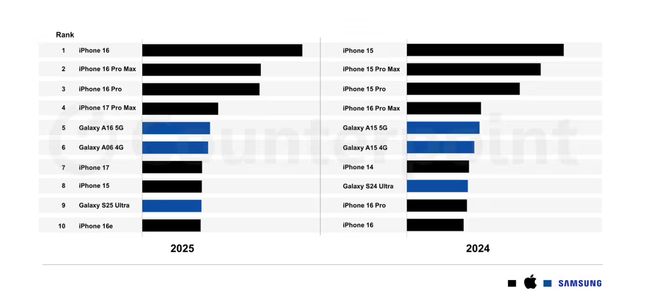
Group 1 - The core point of the article is that Apple's iPhone 16 is projected to be the best-selling smartphone globally in 2025, with Apple and Samsung continuing to dominate the top ten smartphone sales for the fourth consecutive year [1][3]. - In the top ten global smartphone sales for 2025, Apple occupies 7 positions while Samsung holds 3, collectively contributing to 19% of the total global smartphone sales for the year [3]. - The strong performance of the iPhone series is attributed to robust demand in key markets such as the US, China, and Western Europe, with the iPhone 17 series seeing an 11% increase in sales compared to its predecessor [3]. Group 2 - The iPhone 17 standard model has gained attention for significantly narrowing the configuration gap with the Pro series by offering a high refresh rate screen and increased base storage, making it one of the standout models of the year [3]. - The newly launched iPhone 16e has achieved stable sales in Japan and the US, supporting Apple's efforts to expand its market share due to its accessible price point [3]. - Samsung's Galaxy A16 5G has emerged as the best-selling Android smartphone in 2025, showcasing a balanced hardware and software configuration, while its flagship S series has maintained a position in the global top ten for the second consecutive year [3]. Group 3 - The report predicts that a global shortage of storage chips will lead to price increases for related products, significantly impacting the price-sensitive mid-to-low-end smartphone market, particularly in emerging markets like the Middle East, Africa, and Latin America [4]. - As a result of these market dynamics, flagship models with technological advantages and brand premium capabilities are expected to see an increase in their sales share globally [4].

HBM市场霸主尽享AI红利!SK海力士年度利润首超三星
智通财经网· 2026-01-29 06:47
不过,竞争正在加剧。尽管SK海力士在HBM领域成功取得早期领先地位,并在去年获得了英伟达HBM 合同的最大份额,但三星和美光科技等竞争对手一直在取得一些突破。三星已扩大了其HBM销售,并 表示仍将在今年开始交付搭载最新第六代HBM技术的HBM4产品。 专注于存储行业和AI供应链的SemiAnalysis分析师Ray Wang表示:"我们预计三星将在HBM4方面迎来重 大转折,并将克服去年的质量问题,为英伟达的新产品供货。" 尽管如此,分析师预计SK海力士将在HBM4领域保持较高的市场份额和主导地位。Ray Wang表示表 示:"HBM4的竞争实际上是SK海力士与三星之间的竞争,我们认为这两家公司比美光科技更具竞争 力。""我们预计SK海力士将保持其在HBM4领域的领先地位,而三星将取得实质性进展,并在HBM4领 域变得比(前几代)更具竞争力。" 市场目前预测,2026年SK海力士将占据全球HBM4市场54%的份额,三星与美光科技(MU.US)则分别以 28%和18%的占比紧随其后。Counterpoint Research的研究主管MS Hwang表示:"SK海力士显然是亚洲 杰出的'AI赢家'。"他补充称, ...
电子元器件,涨声一片!
是说芯语· 2026-01-29 06:47
Price Increases in Semiconductor and Electronic Components Industry - Resonac announced a price increase of 30% for copper-clad laminates and adhesive films starting March 1, 2026, due to tight supply and rising costs of raw materials and labor [3] - Nanya Plastics will raise prices for all CCL products and PP by 8% starting November 20, 2025, citing increases in international copper prices and raw material costs [7] - TrendForce predicts that the average capacity utilization rate of global 8-inch wafer foundries will rise to 85%-90% in 2026, leading to price increases of 5%-20% for wafer foundry services across the board [8] - TSMC plans to increase prices for advanced technology nodes (5nm, 4nm, 3nm, 2nm) by 8%-10%, with a 50% increase for 2nm wafers starting in 2026 [10] - SMIC has implemented a price increase of approximately 10% for certain capacities [11] - Several packaging and testing companies have begun raising prices, with increases nearing 30% due to high demand and full capacity utilization [13] Memory Chip Price Increases - Samsung has raised NAND flash prices by over 100% and plans to increase server DRAM prices by 60%-70% in Q1 2026 [15] - SK Hynix is also raising server DRAM prices by 60%-70% and has negotiated significant price increases for LPDDR memory used in iPhones, approaching 100% [16] - Micron has announced a general price increase of approximately 20% across its product lines [17] - NAND flash wafer prices increased by over 10% in December 2025, with SSD prices rising by 15%-20% [24] Passive Components Price Adjustments - Various passive component manufacturers, including Yageo and Panasonic, have announced price increases for capacitors and resistors ranging from 8% to 30% [26][31] - ROHM Semiconductor has raised prices for thick film resistors by 8%-20% [38] - Multiple manufacturers are adjusting prices due to rising raw material costs and supply chain pressures [47] Power Devices and Other Electronics - Huazhong Microelectronics confirmed price increases for certain IGBT products due to rising copper and raw material costs [48] - Several semiconductor companies, including Jiangxi Tianyi and Wuxi Zongxiang Technology, have raised prices for specific products by 10%-20% [82][83] CPU and GPU Price Trends - AMD and Intel are planning to increase server CPU prices by up to 15% due to high demand from large enterprises [62] - NVIDIA and AMD are expected to raise GPU prices in early 2026, with multiple price adjustments anticipated throughout the year [79]

台积电的最大客户,变了
芯世相· 2026-01-29 06:38
Core Viewpoint - The semiconductor industry is undergoing a historic transition as Nvidia has officially surpassed Apple to become TSMC's largest customer, driven by the surging demand for AI computing capabilities, indicating a fundamental restructuring of the global chip market [3][4]. Group 1: Nvidia's Rise and Market Dynamics - Nvidia's dominance as TSMC's top customer reflects a steep growth curve in AI-centric chip production, with Nvidia occupying more advanced process capacity than any other client [3][4]. - Nvidia's H100 and H200 data center GPUs, manufactured using TSMC's 4nm and 5nm processes, are priced over $30,000 each, significantly higher than smartphone processors, altering the semiconductor value chain's incentive structure [5][6]. - Over the past 18 months, Nvidia's wafer orders have grown exponentially, leading TSMC to expand its advanced packaging capacity to meet Nvidia's CoWoS requirements, which are critical for modern AI accelerators [6]. Group 2: Apple's Semiconductor Strategy - Apple's replacement by Nvidia does not indicate weakness but rather reflects a maturation of its product lineup and a more restrained hardware update strategy [7]. - Apple completed its transition to self-developed chips for its Mac product line in 2022, leading to a temporary spike in chip demand, which has since normalized [7]. - Despite a relative decline in its share of TSMC's revenue, Apple remains a key customer and is expected to continue using advanced processes for its upcoming A19 and M5 chips [7][8]. Group 3: TSMC's Capacity Allocation Challenges - TSMC faces increasing complexity in balancing the demands of major clients like Nvidia and Apple while also servicing other companies such as AMD and Qualcomm [9][10]. - TSMC's capital expenditure for 2024 exceeds $40 billion, aimed at expanding capacity in Taiwan, Arizona, Japan, and potentially Europe [10]. - The shift towards AI chip demand is influencing TSMC's technology development focus, necessitating a fundamental change in process optimization strategies to cater to high-performance computing [10]. Group 4: Competitive Landscape and Market Implications - Nvidia's strengthened relationship with TSMC occurs amid other foundries struggling to catch up in advanced processes, giving TSMC significant bargaining power [11]. - Geopolitical uncertainties complicate long-term capacity planning for Nvidia and TSMC, as prioritizing high-margin AI chip production may extend lead times and increase costs for other clients [11]. - Major tech companies like Amazon, Google, and Microsoft are accelerating their custom chip initiatives to reduce reliance on Nvidia and secure manufacturing resources amid tightening capacity [11]. Group 5: Future Trends in Semiconductor Manufacturing - The relationship between Nvidia, Apple, and TSMC is expected to continue evolving, with TSMC planning to enter mass production of 2nm processes by 2025 [12][13]. - The long-term trajectory of AI chip demand remains uncertain, with potential shifts in relative positions between Nvidia and Apple depending on market conditions and product innovations [12]. - TSMC's global expansion adds new dimensions to the relationship, as the willingness of Nvidia and Apple to shift core production to higher-cost, lower-risk U.S. facilities remains uncertain [13].