
HTSC

Search documents
券商晨会精华 | 配置上围绕中期主线 重视安全边际
智通财经网· 2025-11-24 00:31
Market Overview - The market experienced fluctuations last Friday, with the Shanghai Composite Index falling over 2% and the ChiNext Index dropping over 4% [1] - The total trading volume in the Shanghai and Shenzhen markets reached 1.97 trillion, an increase of 257.5 billion compared to the previous trading day [1] - By the end of last Friday, the Shanghai Composite Index fell by 2.45%, the Shenzhen Component Index by 3.41%, and the ChiNext Index by 4.02% [1] Investment Strategies - Huatai Securities emphasized the importance of focusing on mid-term themes and maintaining a safety margin in current market conditions, suggesting that the market adjustment has begun to show potential for recovery [2] - The firm noted that the current market valuation is close to a "reasonable" central point, and if there is an overshoot, investors could consider increasing their positions [2] - Recommended sectors include low-level domestic consumption, domestic computing power, and innovative pharmaceuticals, while continuing to hold large financial stocks to reduce volatility [2] Monetary Policy Insights - CITIC Securities highlighted that the recent issuance of offshore central bank bills in Hong Kong aims to stabilize the offshore RMB exchange rate and curb speculative trading [3] - The issuance is intended to tighten offshore RMB liquidity, thereby increasing the cost of short-selling and preventing a consensus on unilateral depreciation [3] - The central bank's strategy is based on three considerations: managing liquidity to avoid excessive market fluctuations, enhancing the competitiveness of the offshore RMB bond market, and preventing abnormal cross-border capital flows to maintain financial stability [3] Policy Focus - Zhongtai Securities indicated that the current "anti-involution" policies are likely to focus more on key sectors with global "rare earth-like" characteristics, particularly in industries like photovoltaics, batteries, and automobiles, where low-price competition has intensified [4] - The characteristics of these key sectors include holding dominant capacity and technology in the global market, facing challenges from disorderly expansion and low-price competition, and having potential for long-term growth driven by external demand [4] - The policies aim to ensure healthy industry development and leverage these sectors as strategic tools or bargaining chips between nations [4]



券商晨会精华:配置上围绕中期主线,重视安全边际
Xin Lang Cai Jing· 2025-11-24 00:25
Group 1: Market Overview - The market experienced fluctuations with the Shanghai Composite Index falling over 2% and the ChiNext Index dropping over 4% last Friday [1] - The total trading volume in the Shanghai and Shenzhen markets reached 1.97 trillion, an increase of 257.5 billion compared to the previous trading day [1] - Key sectors showing gains included the shipbuilding sector and AI applications, while battery, silicon energy, and lithium mining sectors faced declines [1] Group 2: Securities Insights - Huatai Securities emphasized the importance of focusing on mid-term themes and maintaining a safety margin in current market conditions [1] - CITIC Securities noted that the central bank's issuance of offshore central bank bills in Hong Kong could help stabilize the offshore RMB exchange rate [2] - Zhongtai Securities indicated that the current "anti-involution" policies may increasingly focus on key areas with global "rare earth-like" characteristics, particularly in industries facing low-price competition [3] Group 3: Policy Implications - The issuance of offshore central bank bills is aimed at tightening offshore RMB liquidity, increasing short-selling costs, and stabilizing exchange rate expectations [2] - The "anti-involution" policy is expected to address industries that dominate global capacity and technology, face chaotic expansion, and have long-term growth potential driven by external demand [3]
交银施罗德中证智选沪深港科技50交易型 开放式指数证券投资基金基金份额发售公告
Zhong Guo Zheng Quan Bao - Zhong Zheng Wang· 2025-11-23 22:24
Core Points - The fund is named "CITIC Schroder CSI Smart Selection Hong Kong-Shenzhen Technology 50 ETF" and is a stock-type open-ended index fund [17] - The fund is registered with the China Securities Regulatory Commission (CSRC) under document number 2287, but this registration does not imply any judgment on the fund's investment value or market prospects [1] - The fund's management company is CITIC Schroder Fund Management Co., Ltd., and the custodian is Guotai Junan Securities Co., Ltd. [2][19] Fund Offering Details - The fund will be available for subscription from December 1, 2025, to December 5, 2025, with both online and offline cash subscription options [3][23] - The minimum subscription amount for online cash subscription is 1,000 shares, and the maximum is 99,999,000 shares [4][29] - For offline cash subscription, the minimum is 1,000 shares through sales agents and 1,000,000 shares directly through the fund management company [5][31] Subscription Process - Investors must have a Shanghai Securities Account to subscribe to the fund, which can be either an A-share account or a fund account [4][37] - Subscription fees will be borne by investors and are not included in the fund's assets, with specific fee rates applicable [27] - The fund's subscription funds will be held in a dedicated account until the end of the fundraising period, and any interest generated will be allocated to the fund's assets [25][55] Fund Management and Operations - The fund is designed to track the CSI Smart Selection Hong Kong-Shenzhen Technology 50 Index using a full replication method [11] - The fund has an indefinite duration and is classified as a stock-type fund, which typically has higher risk and return expectations compared to mixed or bond funds [17][11] - The fund will be subject to various risks, including market risk, management risk, and specific risks associated with the underlying index [10][12] Regulatory and Compliance - The fund's contract and prospectus will be published on the management company's website and the CSRC's fund disclosure website [13] - The fund must meet specific conditions, including a minimum of 200 investors and a total subscription amount of at least 200 million RMB, to become effective [56] - If the fundraising conditions are not met by the end of the subscription period, the management company will return the subscription funds to investors with interest [24][57]
刚宣布,又一家AIC来了
Zhong Guo Ji Jin Bao· 2025-11-23 12:40
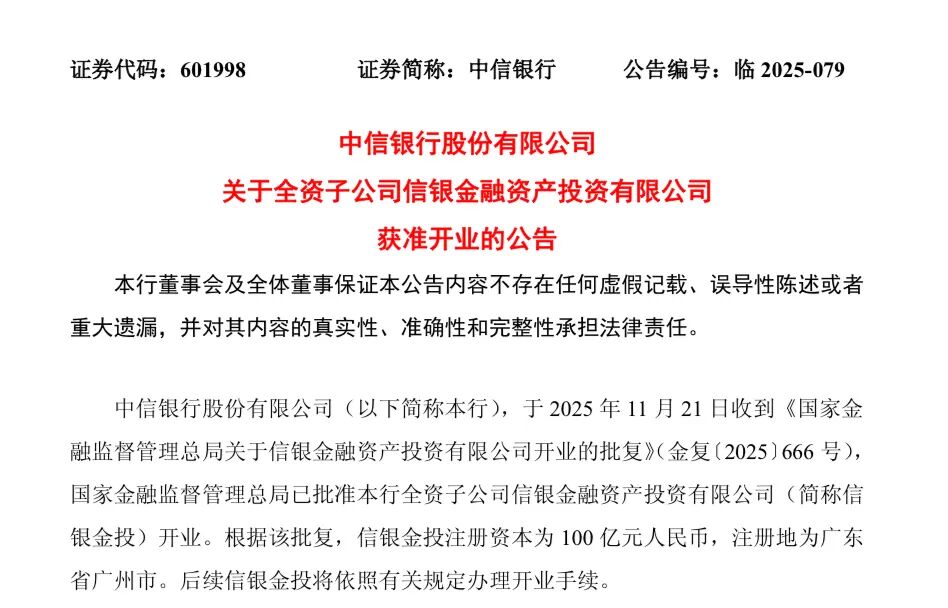
Core Points - CITIC Bank's wholly-owned subsidiary, Xinyin Financial Investment Co., has been approved to commence operations with a registered capital of 10 billion RMB [1][4] - The establishment of Xinyin Financial Investment is part of CITIC Bank's strategy to support the development of "technology finance" and strategic emerging industries [3][5] - The approval process for Xinyin Financial Investment took only six months, indicating a smooth establishment process [3] Company Overview - Xinyin Financial Investment will focus on market-oriented debt-to-equity swaps and equity investment in strategic emerging industries and "specialized, refined, unique, and innovative" sectors [5][6] - The company aims to support technology enterprises and the private economy, helping to reduce leverage and promote sustainable development [3][5] - CITIC Bank has a strong advantage in corporate finance, with a well-established credit and risk management capability, which is expected to enhance its contributions to high-quality economic development [6] Industry Context - The approval of Xinyin Financial Investment aligns with the recent expansion of financial asset investment companies (AIC) in China, which aims to bolster support for technology innovation and private enterprises [7][10] - Other banks, including Industrial Bank, China Merchants Bank, and Postal Savings Bank, have also received approvals to establish AICs, indicating a growing trend in the industry [7][8][9] - The establishment of AICs is expected to open new growth opportunities through equity investment, while also presenting challenges in liquidity management and risk control [10]


非银金融行业周报:开门红展望乐观,人身险产品费用分摊指引发布-20251123
KAIYUAN SECURITIES· 2025-11-23 09:15
Investment Rating - The industry investment rating is "Overweight" (maintained) [1] Core Views - The non-bank financial sector is under pressure due to overall market adjustments, with the insurance sector outperforming the CSI 300 index [5] - Insurers are preparing for a positive outlook for the 2026 opening, with improvements in new policies and value rates, supported by stable long-term interest rates [6] - The brokerage sector continues to show high performance, with a focus on undervalued leading brokerages [5] Summary by Sections Insurance - The release of the "Guidelines for Expense Allocation of Life Insurance Products" aims to enhance expense management and improve shareholder value [6] - Insurers are expected to see growth in bank insurance channels and a shift towards dividend insurance, with new health insurance regulations likely increasing product ratios [6] - Long-term interest rates are stabilizing, and the cost of liabilities is expected to decrease, improving the overall profitability of insurers [6] Brokerage - CICC plans to merge with Dongxing Securities and Xinda Securities, aiming for economies of scale and improved shareholder returns [7] - The average daily trading volume of stock funds is reported at 23.3 trillion, reflecting a decrease of 6.6% [7] - The brokerage sector is expected to see significant ROE expansion, with continued low valuations presenting strategic investment opportunities [7] Recommended and Beneficiary Stocks - Recommended stocks include China Life H, Ping An, Huatai Securities, Guotai Junan, and others [8] - Beneficiary stocks include Tonghuashun and Jiufang Zhitu Holdings [8]
资金逆势买入,中证500ETF、创业板ETF、沪深300ETF、科创50ETF备受资金青睐
Sou Hu Cai Jing· 2025-11-23 06:59
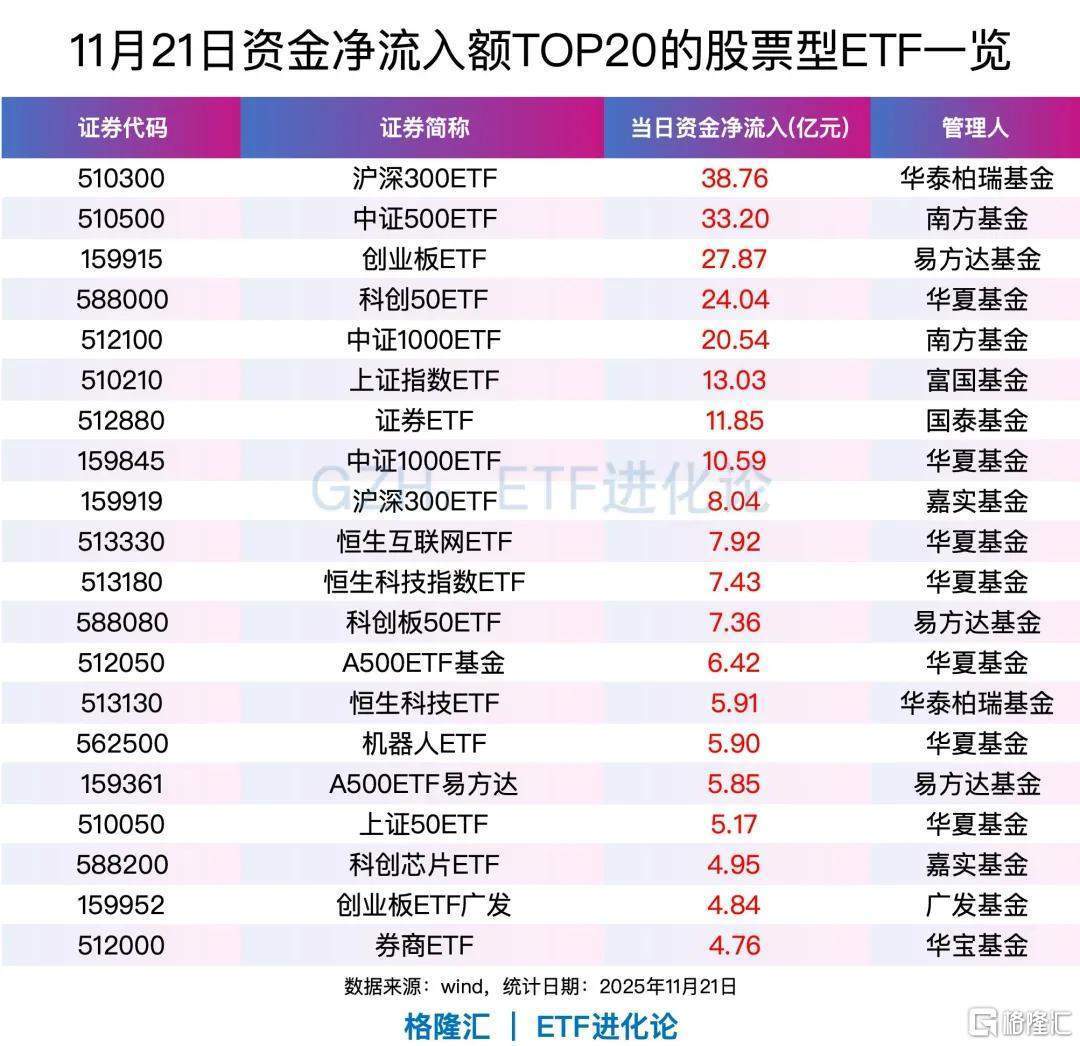
Core Insights - Despite the overall weak performance of the A-share market, there is a notable trend of capital inflow into stock ETFs, indicating a "buy the dip" mentality among investors [1][6]. Market Performance - On November 21, the A-share market experienced significant declines, with the Shanghai Composite Index falling by 2.45% to close at 3834.89 points, the Shenzhen Component Index down by 3.41%, and the ChiNext Index dropping by 4.02%. The total market turnover reached 1.98 trillion yuan [1]. - For the week, the Shanghai Composite Index decreased by 3.90%, while the Shenzhen Component Index fell by 5.13% [2]. ETF Capital Inflows - On November 21, the net inflow into stock ETFs reached 40.755 billion yuan, with significant contributions from the CSI 300 ETF and the CSI 500 ETF, each exceeding 3 billion yuan in net inflow [1]. - The cumulative net inflow into ETFs for the week amounted to 70.121 billion yuan, with the CSI 500 ETF, ChiNext ETF, and CSI 300 ETF leading the inflows [3][4]. Fund Manager Insights - Fund managers noted a pronounced trend of "high cutting and low buying," where funds are flowing out of previously high-performing sectors and into undervalued sectors with strong earnings support [6]. - The report highlighted that various ETFs, including the non-bank Hong Kong Stock Connect ETF and the securities ETF, received over 1.5 billion yuan in net inflows this month [6]. Future Outlook - According to research from China International Capital Corporation, the Chinese stock market is expected to benefit from the AI technology wave and ample liquidity, with reasonable valuations. However, increased volatility may be anticipated towards year-end [8]. - Huatai Securities forecasts that overall liquidity will remain abundant next year, with significant incremental capital expected in the equity market, although the scale of inflows may not match this year [8].

政策与创新是关键支撑 券商2026年度A股策略会集体锚定“新”机遇
Zheng Quan Ri Bao· 2025-11-22 01:41
Core Viewpoint - The market is focused on the expected development trends for 2026, with a consensus emerging that A-shares present structural opportunities and that the macroeconomic environment will continue to show signs of recovery [1][2]. Group 1: Economic Outlook - Major securities firms predict China's economic growth for 2026 will be in the range of 4.9% to 5.0%, with a "front low, back high" growth pattern expected [3]. - The overall judgment from economists is that the macroeconomic environment will be "stable and improving, with structural optimization" [2][3]. - Export resilience and ongoing industrial upgrades are viewed as key supports for the macroeconomy, with expectations of strong export performance in 2026 [2]. Group 2: Policy and Structural Changes - The core direction for policy in 2026 will focus on structural optimization and a balanced approach to supply and demand [3]. - There is an expectation of moderate expansion in fiscal policy, which will support the conclusion of the deleveraging cycle [2][3]. - The need to address weak domestic demand remains a critical issue for 2026, with price stability being essential for growth [4]. Group 3: Investment Themes - The investment focus for A-shares in 2026 is expected to shift from being driven by sentiment, funds, and valuation to being driven by performance verification [5]. - Key areas of interest include technology growth, external demand breakthroughs, and cyclical recovery [5][6]. - The AI revolution is entering a critical application phase, which is anticipated to support the performance of Chinese assets [6]. Group 4: Sectoral Insights - Three main structural themes for 2026 include recovery trades in cyclical sectors, technology industry trends particularly in AI, and the enhancement of manufacturing influence [6][7]. - The potential for Chinese companies to improve their position in the global value chain is highlighted, with a focus on upgrading traditional manufacturing and expanding global presence [7].


中国银河年内发债规模位居行业TOP1 三季度信用减值损失仅0.25亿是否充分考虑风险?
Xin Lang Cai Jing· 2025-11-21 10:34
Core Viewpoint - The A-share market has been strong since July 2025, leading to a significant increase in bond issuance by securities firms, with a year-to-date issuance exceeding 1.6 trillion yuan, a growth of over 50% year-on-year [1] Group 1: Bond Issuance - As of November 21, 2025, 73 securities firms have issued bonds totaling over 1.6 trillion yuan, marking a year-on-year increase of more than 50% [1] - China Galaxy, Guotai Junan, and Huatai Securities are the top three firms in terms of bond issuance, with amounts of 134.9 billion yuan, 124.3 billion yuan, and 121.9 billion yuan respectively [1] - China Galaxy began its aggressive bond issuance in May 2025, with a monthly issuance exceeding 10 billion yuan, peaking at 21 billion yuan in August [1] Group 2: Financial Performance - China Galaxy's assets have shown a positive trend, with significant increases in customer deposits and lending activities, reflecting a robust market environment [2] - The company's lending amounts were 101 billion yuan and 132.5 billion yuan at the end of Q2 and Q3 respectively, with a quarter-on-quarter growth of 31% in Q3 [2] - Revenue for Q3 2025 reached 9.004 billion yuan, representing a year-on-year growth of 55.94%, driven by significant increases in brokerage, proprietary trading, and net interest income [2] Group 3: Risk Management and Credit Business - The annualized return on investment for China Galaxy in Q3 was 4.49%, an increase of 0.64 percentage points year-on-year, ranking 17th among 43 listed securities firms [3] - The company has maintained a balanced approach to risk management, with no significant shift towards equity assets despite the expansion of proprietary trading [3] - Credit impairment losses for the first three quarters of 2025 were negative, indicating a decrease in expected credit risk, contrasting with a significant impairment loss recorded in Q4 2024 [3][4] Group 4: Overall Assessment - China Galaxy's proactive bond issuance strategy and focus on proprietary business have led to strong performance in Q3 2025 [5] - There are concerns regarding the potential lag in credit impairment loss recognition, suggesting that current performance may not fully reflect operational risks [5]

国泰海通|AI应用· 合集
国泰海通证券研究· 2025-11-21 08:46
Core Insights - The release of Google's Gemini 3 marks a new leap in large model technology, showcasing significant advancements in reasoning, multi-modal understanding, and code generation capabilities [8][9][10] - Alibaba has launched the "Qianwen App," an AI assistant based on the Qwen model, aiming to compete directly with ChatGPT [5][28] - The Chinese government has issued guidelines to accelerate the cultivation and application of high-value AI scenarios, indicating strong support for AI development [5][24] Group 1: AI Applications and Market Trends - The AI application theme is gaining traction, with a focus on domestic consumption, infrastructure in Xinjiang, and AI applications in various sectors [5][8] - The Chinese government aims for over 70% penetration of new-generation intelligent terminals and agents by 2027, and over 90% by 2030, highlighting the urgency of AI integration [5][8] - The financial sector is identified as a prime testing ground for AI applications, with significant potential for transformation through AI technologies [13][14] Group 2: Technological Advancements - Gemini 3 has achieved a significant leap in reasoning capabilities, scoring 37.5% in the Humanity's Last Exam, a notable increase from its predecessor [8] - The model's multi-modal understanding has set new benchmarks in complex scientific chart analysis and dynamic video comprehension [9] - Innovations in code generation and front-end design have positioned Gemini 3 as a leader in programming competitions, enhancing its commercial viability [9][10] Group 3: Competitive Landscape - Alibaba's "Qianwen App" is positioned to leverage its strong model performance to create a high user engagement platform, potentially accelerating the profitability of large model vendors [28][29] - The competition in the AI space is intensifying, with major players like Google and Alibaba making significant strides in consumer-facing AI applications [34][35] - The AI ecosystem is evolving rapidly, with companies like OpenAI and Nvidia pushing the boundaries of AI capabilities and applications [51][56] Group 4: Policy and Regulatory Environment - The Chinese government's recent policies are designed to foster AI development, emphasizing the importance of high-quality data governance and infrastructure [24][25] - The issuance of guidelines for AI deployment in government sectors indicates a structured approach to integrating AI into public services [24][25] - The focus on AI in governance is expected to create substantial market opportunities, with projections estimating the AI+ government service market to reach 2.54 billion RMB by 2024 [25]

HTSC(06886) - 海外监管公告
2025-11-21 08:33
香港交易及結算所有限公司及香港聯合交易所有限公司對本公告的內容概不負責,對其準確性 或完整性亦不發表任何聲明,並明確表示概不對因本公告全部或任何部分內容而產生或因倚賴 該等內容而引致的任何損失承擔任何責任。 於本公告日期,董事會成員包括執行董事張偉先生、周易先生及王瑩女士;非執 行董事丁鋒先生、陳仲揚先生、柯翔先生、晉永甫先生及張金鑫先生;以及獨立 非執行董事王建文先生、王全勝先生、彭冰先生、王兵先生及老建榮先生。 (於中華人民共和國註冊成立之股份有限公司, 中文公司名稱為華泰證券股份有限公司,在香港以HTSC名義開展業務) (股份代號:6886) 海外監管公告 本公告乃根據上市規則第13.10B條規則作出。 茲載列本公司在上海證券交易所網站刊登之《華泰證券股份有限公司2025年面向 專業投資者公開發行公司債券(第十期)票面利率公告》,僅供參閱。 釋義 於本公告,除文義另有所指外,下列詞彙具有以下涵義。 「本公司」 指 於中華人民共和國以華泰證券股份有限公司的公司名 稱註冊成立的股份有限公司,於2007年12月7日由前身 華泰證券有限責任公司改制而成,在香港以「HTSC」 名義開展業務,根據公司條例第16部以 ...