
长安汽车

Search documents
重庆长安汽车股份有限公司 关于部分限制性股票回购注销完成的公告
Zhong Guo Zheng Quan Bao - Zhong Zheng Wang· 2026-01-15 23:46
登录新浪财经APP 搜索【信披】查看更多考评等级 1.重庆长安汽车股份有限公司(以下简称"公司")本次回购注销原32名激励对象已获授但尚未解除限 售的A股限制性股票共1,161,948股,占回购注销前公司总股本的0.01%。 2.中国证券登记结算有限责任公司深圳分公司确认已于2026年1月15日办理完成公司本次部分限制性股 票回购注销事宜。本次注销符合法律、行政法规、部门规章、规范性文件、公司章程、股权激励计划等 的相关规定。 本公司及董事会全体成员保证信息披露的内容真实、准确、完整,没有虚假记载、误导性陈述或重大遗 漏。 特别提示: 3.本次回购注销完成后,公司总股本由9,914,086,060股减少至9,912,924,112股。 公司于2025年9月26日召开第九届董事会第四十五次会议,并于2025年10月24日召开2025年第一次临时 股东大会,审议通过了《关于调整A股限制性股票激励计划回购价格及回购注销部分限制性股票的议 案》。详细内容见2025年9月27日披露在巨潮资讯网(www.cninfo.com.cn)及《中国证券报》《证券时 报》《证券日报》《上海证券报》的《关于调整A股限制性股票激励计划 ...

2026年销量目标现分化:传统车企稳健推进 新势力冲刺高增长
Zhong Guo Zheng Quan Bao· 2026-01-15 22:47
Core Insights - The automotive market in 2026 is characterized by significant differentiation among major car manufacturers, with a total sales target exceeding 21.55 million units, approximately 63% of the 2025 domestic sales volume [1] - Traditional automakers are targeting a steady growth rate of 10% to 30%, focusing on new energy vehicles and international expansion, while new entrants and cross-industry brands are setting aggressive targets of 34% to 67.5% to capture market share [1] Summary by Category Traditional Automakers - Major traditional automakers have set sales targets concentrated around 3 million units, with Geely aiming for 3.45 million units in 2026, a 14% increase from 2025, and a new energy vehicle target of 2.22 million units, achieving a penetration rate of 64.3% [2] - Chery Group has set a target of 3.2 million units, also a 14.03% increase, with plans to launch 17 key models focusing on electrification and intelligence [2] - Dongfeng Group is more aggressive, raising its target from 2.5 million to 3.25 million units, a 30% increase, with a focus on 1.7 million new energy vehicles and 600,000 exports [2] - Great Wall Motors has set a more cautious target of 1.8 million units, reflecting a 36% increase from 2025 [2] New Entrants and Cross-Industry Brands - New entrants like Leap Motor are setting high growth targets, with a goal of 1 million units in 2026, representing a 67.5% increase from 2025's 596,600 units [3] - Xiaomi aims for 550,000 units, a 34% increase, with plans to launch multiple new models to enhance its product matrix [3] - NIO has set a target range of 456,000 to 489,000 units, maintaining a stable growth rate of 40% to 50% [3] Joint Venture Brands - Joint venture brands are generally more conservative, with GAC Toyota setting a target of 800,000 units, a mere 3.6% increase from 2025 [4] - SAIC Volkswagen aims for 1 million units, maintaining its 2025 target, while overall, SAIC Volkswagen targets 1.2 million units through the introduction of seven new energy vehicles [4] Factors Supporting Target Achievement - The differentiation in growth targets reflects a shift from incremental expansion to competition within existing market shares, with the difficulty of achieving these targets closely tied to company fundamentals, product strategies, and operational capabilities [5] - New energy vehicle sales growth targets are significantly higher than overall targets, indicating a consensus that new energy vehicles are becoming the main growth driver in the market [5] - The ability to meet sales targets is influenced by three key dimensions: the rollout of new energy products, success in overseas markets, and the overall capability of the organization [6][7]
2025中国汽车驶出增长新动能
Xin Lang Cai Jing· 2026-01-15 22:40
Core Insights - The Chinese automotive industry has achieved significant milestones in 2025, with total vehicle production and sales exceeding 34 million units, and new energy vehicles (NEVs) surpassing 16 million units, marking a structural upgrade in the industry [5][6] - NEVs now account for over 50% of new car sales in China, indicating their dominance in the market [6][7] - The industry is experiencing rapid technological advancements, particularly in smart driving and battery technology, which are enhancing the competitiveness of electric vehicles [9][10] Industry Performance - In 2025, China's NEV production reached 16.62 million units, with sales at 16.49 million units, reflecting year-on-year growth of 29% and 28.2% respectively, maintaining the global leadership for 11 consecutive years [6][7] - BYD has surpassed Tesla in annual pure electric vehicle sales, marking a significant achievement for the company [7] - The introduction of L3-level autonomous driving vehicles by Changan and BAIC marks a transition from technology validation to mass production applications [8] Technological Advancements - The automotive industry is witnessing breakthroughs in battery technology, with advancements in energy density and charging efficiency, contributing to the reduction of "range anxiety" for electric vehicle users [9] - The integration of AI and robotics into the automotive sector is creating new opportunities for innovation and efficiency [10] - The collaboration between companies like JD, GAC Group, and CATL is enhancing the entire automotive value chain from R&D to sales [9][10] Regulatory and Market Dynamics - The industry is facing challenges related to "involution" competition, prompting regulatory measures to ensure fair market practices and promote high-quality development [12][13] - New guidelines and safety standards are being implemented to enhance the safety and reliability of electric vehicles [13][14] - The focus on building a modern industrial system and promoting green consumption is expected to drive the future growth of the automotive sector [14][15]

时代长安动力电池项目落地川渝高竹新区
Si Chuan Ri Bao· 2026-01-15 22:24
●项目总投资约55亿元,新建年产25GWh动力电池生产基地,建成后可为长安汽车旗下品牌提供 新能源汽车动力电池配套 ●预计今年一季度正式开工,2027年下半年正式投产。投产后预计可实现年产值约100亿元 该项目由时代长安动力电池有限公司主导投资建设,总投资约55亿元,计划用地约1000亩,新建 年产25GWh动力电池生产基地。项目立足"技术领先的新能源动力电池配套基地"定位,将导入宁 德时代最新一代电池制造工艺,推出系列前沿产品。建成后可为长安汽车旗下品牌提供新能源汽 车动力电池配套,实现核心零部件本地化供应。目前,项目已完成选址地块平场工作,预计今年 一季度正式开工,2027年下半年正式投产。投产后预计可实现年产值约100亿元,带动约2500人就 业。 "该项目是'川渝合作、双向赋能、成果共享'的示范性项目,具有链主效应和示范带动作用。"川 渝高竹新区管委会常务副主任赵冬表示,项目将吸引动力电池及上下游企业集聚,加快形成引进 一个、带动一串、辐射一片的产业集群格局, ●将吸引动力电池及上下游企业集聚,推动新区承接东部新能源汽车产业转移 本报讯(甘文颖 四川日报全媒体记者 伍力)1月14日,时代长安动力电池项 ...
自动驾驶出行图景 加速“驶来”
Zhong Guo Zheng Quan Bao· 2026-01-15 21:12
Core Insights - The launch of the first L3-level conditional autonomous driving vehicles in China marks a significant milestone in the industry, indicating the transition to a new era of operational autonomous vehicles [1][4][8] Group 1: Industry Developments - The Ministry of Industry and Information Technology has granted approval for the first L3-level autonomous vehicles, allowing them to operate in designated areas of Beijing and Chongqing [1] - The L3-level vehicles are expected to achieve a penetration rate breakthrough by 2026, paving the way for higher-level autonomous driving technologies (L4) to enter large-scale commercial deployment [1][7] - The trial operation of L3 vehicles signifies a shift from "assisted driving" to "system-led" driving experiences in specific scenarios [2] Group 2: Technical and Operational Insights - The trial of L3 vehicles has already accumulated over 70,000 kilometers of autonomous driving mileage in complex urban environments, showcasing their capability in handling various driving scenarios [2][3] - The vehicles are currently being tested with enterprise users who possess professional skills, providing valuable feedback for system optimization [3] - The introduction of L3 vehicles establishes a legal framework for liability and safety standards, enhancing industry confidence and encouraging hardware deployment and data collection for future advancements [3][4] Group 3: Future Projections - By 2026, L2 technology is projected to become standard in mainstream vehicles, with a penetration rate exceeding 70%, while L3 technology is expected to accelerate in development and testing across major cities [6][7] - The Robotaxi sector is expanding, with a significant increase in fleet size anticipated, indicating a shift in user acceptance from novelty to regular use [7] - The ongoing advancements in AI and autonomous driving technologies present a strategic opportunity for the industry, with expectations for a more integrated and innovative future in transportation [8]

2026年销量目标现分化: 传统车企稳健推进 新势力冲刺高增长
Zhong Guo Zheng Quan Bao· 2026-01-15 21:12
Core Insights - The automotive market in 2026 is characterized by significant differentiation in sales targets among major car manufacturers, with a total target exceeding 21.55 million units, approximately 63% of the 2025 domestic sales volume [1] - Traditional automakers are focusing on stable growth rates of 10% to 30%, while new entrants and cross-industry brands are setting aggressive targets of 34% to 67.5%, indicating a strong push for market share [1] Summary by Company - **Geely**: Set a sales target of 3.45 million units for 2026, a 14% increase from 2025, with a focus on 2.22 million units of new energy vehicles (NEVs), achieving a penetration rate of 64.3% [1] - **Chery**: Aims for 3.2 million units, a 14.03% increase from 2025's 2.81 million units, with plans to launch 17 key models [2] - **Dongfeng Group**: Targets 3.25 million units, a 30% increase from 2025, with 1.7 million NEVs and 600,000 units for export [2] - **Great Wall Motors**: Sets a more conservative target of 1.8 million units, a 36% increase from 2025's 1.32 million units [2] - **Leap Motor**: Aims for 1 million units, a 67.5% increase from 2025's 596,600 units, leveraging core technology and a competitive parts system [2] - **Xiaomi**: Targets 550,000 units, a 34% increase from 2025's 410,000 units, emphasizing a stable expansion strategy [3] - **NIO**: Plans for a sales range of 456,000 to 489,000 units, maintaining a growth rate of 40% to 50% [3] - **GAC Toyota**: Sets a conservative target of 800,000 units, a 3.6% increase from 2025 [3] - **SAIC Volkswagen**: Aims for 1 million units, maintaining 2025 levels, with plans for 7 new NEV models [3] Market Dynamics - The automotive industry is shifting from incremental expansion to competition within existing market shares, with varying growth rates reflecting companies' strategies and market conditions [4] - Traditional automakers are generally targeting growth rates between 13% and 30%, with NEV sales growth rates significantly higher, indicating a consensus on NEVs as the main growth driver [4] - New energy vehicle sales targets are notably higher than overall sales targets, with Geely and Changan targeting 32% and 26.2% growth rates respectively [4] Strategic Considerations - The high growth targets set by new entrants are driven by the need for scale to improve cash flow and profitability, but achieving these targets will require strong organizational capabilities [5] - Key factors influencing the achievement of sales targets include the rollout of new energy products, success in overseas markets, and the overall capability of the companies [6] - The industry is expected to see a 4.3% growth in exports, with companies like BYD targeting 1.5 to 1.6 million units for overseas sales [6]





传统车企稳健推进 新势力冲刺高增长
Zhong Guo Zheng Quan Bao· 2026-01-15 20:48
Core Insights - The automotive market in 2026 is characterized by significant differentiation in sales targets among major car manufacturers, with a total target exceeding 21.55 million units, approximately 63% of the 2025 domestic sales volume [1] - Traditional automakers are focusing on stable growth rates of 10% to 30%, while new entrants and cross-industry brands are setting aggressive targets ranging from 34% to 67.5%, indicating a strong push for market share [1] Summary by Company - Geely aims for a sales target of 3.45 million units in 2026, a 14% increase from 2025, with a focus on 2.22 million units of new energy vehicles, achieving a penetration rate of 64.3% [1] - Chery targets 3.2 million units, a 14.03% increase from 2025, with plans to launch 17 key models focusing on electrification and intelligence [2] - Dongfeng Group sets an ambitious target of 3.25 million units, a 30% increase from 2025, with a focus on 1.7 million new energy vehicles and 600,000 exports [2] - Great Wall Motors adopts a more cautious approach with a target of 1.8 million units, reflecting a 36% increase from 2025 [2] - Leap Motor aims for 1 million units, a 67.5% increase, building on a strong 2025 performance of 596,600 units [2] - Xiaomi targets 550,000 units, a 34% increase, emphasizing a production strategy driven by orders [3] - NIO sets a sales target range of 456,000 to 489,000 units, maintaining a growth rate of 40% to 50% [3] - GAC Toyota's target is 800,000 units, a modest 3.6% increase, while SAIC Volkswagen aims for 1 million units, maintaining its 2025 target [3] Market Dynamics - The differentiation in sales targets reflects a shift from incremental expansion to competition within existing market shares, with the difficulty of achieving these targets closely tied to each company's base, product layout, and systemic capabilities [4] - Traditional automakers are generally targeting growth rates between 13% and 30%, with a notable emphasis on new energy vehicle sales growth, which is significantly higher than overall growth targets [4] - New energy vehicles are recognized as the main growth engine, with companies like Geely and Changan setting ambitious growth targets for their new energy vehicle sales [4] - The aggressive targets set by new entrants are seen as a response to the need for scale, cash flow improvement, and valuation support, although they face challenges in converting scale into systemic strength [5] Key Factors for Target Achievement - The success of sales targets hinges on three main dimensions: the rollout of new energy products, effectiveness in overseas market expansion, and the overall systemic support capabilities of the companies [5] - Companies like Geely and Changan are expected to achieve their targets due to stable completion rates and robust channel layouts, while some joint venture brands may face risks of market share erosion despite conservative targets [5]

2026重马周日开跑 这些路段将交通管制
Xin Lang Cai Jing· 2026-01-15 17:23
(一)封控区 1.南岸区:南滨路(复兴街路口至二塘路下穿道路段)、烟雨路(柏子桥加油站至烟雨公园路段)。 2.巴南区:巴滨路(二塘广场下穿道至汇吉路口)。 (二)管控区 1.南岸区:腾龙大道、涂山路、海新街、南坪东路、江南大道、凤临路、丹龙路、丹回路、汇龙路等连 接封控区的道路。 2.巴南区:渝南分流道、马王坪正街等连接封控区的道路。 2026重庆马拉松将于1月18日8:30~15:15在南岸区南滨路和巴南区巴滨路举行。记者从知情人士处获 悉,张水华已确认获得本周末重庆马拉松的参赛资格,其报名成绩在女子精英选手中排名第6位。 为确保活动期间道路交通安全、有序,根据《中华人民共和国道路交通安全法》及相关法律规定,公安 机关交通管理部门决定对赛道及与赛道关联的部分区域分时段实施交通管制。现将有关事宜通告如下: 交通管制区域 (二)管控区交通管制措施 1.管控时间:1月18日7:00~1月18日15:30。 2.管控措施:在管控区内,对进入封控区方向行驶的车辆采取分流减量、绕行措施;管控区域内禁止车 辆占道停放。 公交运行调整 1月17日22:00~1月18日15:30交通管制时段内,公交119路、375路、338 ...
重夺“汽车第一城” 西部大佬杀回来了
Mei Ri Jing Ji Xin Wen· 2026-01-15 15:14
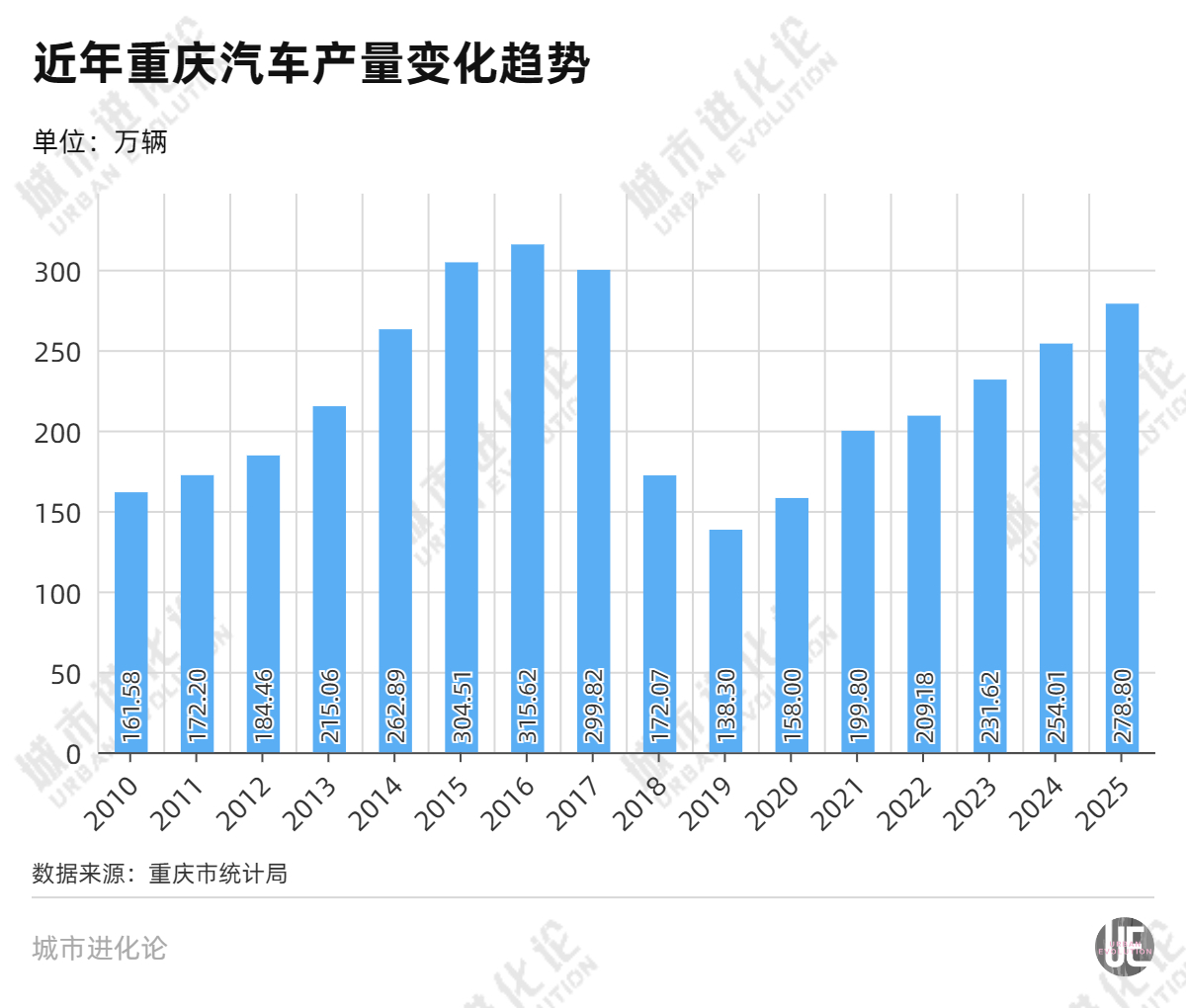
Core Insights - The competition for the title of "Automobile Capital" in China is intensifying, with Chongqing projected to produce 2.788 million vehicles in 2025, marking a 9.7% increase and solidifying its position as the top city in vehicle production [1] - Chongqing's automotive industry is experiencing a resurgence after a decade, particularly in the production of new energy vehicles (NEVs), which are expected to reach 1.296 million units, a 36% increase [1] - The issuance of China's first L3-level autonomous driving license to Changan Automobile signifies a historic milestone for smart driving in China, positioning Chongqing as a leader in this domain [1] Industry Overview - Chongqing aimed to become "China's Detroit" in 2013, achieving the highest vehicle production in the country by 2014, with production peaking at 3.156 million units in 2016 [4] - However, from 2017, Chongqing's vehicle production began to decline, dropping to 1.383 million units by 2019, attributed to a shift in consumer preferences towards mid-to-high-end vehicles and insufficient production capacity [5] - The rise of NEVs has disrupted the traditional automotive landscape, with national NEV sales surpassing 1 million units within three years after first exceeding 100,000 units in 2015 [6] Company Developments - Changan Automobile launched the "Shangri-La" plan in 2017, aiming for full electrification by 2025, but initially faced challenges as NEV production in Chongqing grew slowly from 40,400 units to 51,100 units by 2020 [7] - A turning point occurred in 2021 when Changan partnered with Huawei and CATL to introduce new high-end NEV brands, leading to a significant increase in sales, with total vehicle sales reaching 2.913 million units and NEV sales at 1.11 million units, a 51.1% increase year-on-year [7] - Seres, another key player, transitioned from traditional automotive manufacturing to NEVs, achieving profitability in 2024 and selling 472,300 NEVs in the previous year, a 10.63% increase [7] Competitive Landscape - The collaboration with Huawei has been pivotal for Chongqing's NEV transformation, with Seres being the first to adopt Huawei's smart selection model [8] - The automotive industry is entering a new competitive phase characterized by smart electric vehicles, with Chongqing positioned to lead due to its early adoption of L3-level autonomous driving technologies [12] - The competition is heating up, with cities like Guangzhou and Shenzhen also vying for leadership in the NEV sector, each setting ambitious goals for future growth [17] Challenges and Future Outlook - Despite its recent successes, Chongqing faces challenges in AI and core technology competitiveness, ranking 14th nationally in AI industry competitiveness, indicating a need for improvement in talent attraction and retention [20] - The city aims to address these shortcomings by enhancing its automotive industry through innovation and integration with advanced technologies, targeting high-quality development by 2024 [14][21]

重夺“汽车第一城”,西部大佬杀回来了
Mei Ri Jing Ji Xin Wen· 2026-01-15 15:12
Group 1 - The core viewpoint of the article highlights the intense competition among cities for the title of "Automobile Capital," with Chongqing regaining its position as the leader in automobile production after a decade of decline [1][2][3] - Chongqing's automobile production is projected to reach 2.788 million units in 2025, marking a 9.7% increase, with new energy vehicles (NEVs) expected to account for 1.296 million units, a growth of 36% [1][2] - The issuance of the first L3-level autonomous driving license in China to Changan Automobile signifies a historic milestone for smart driving in the country, positioning Chongqing as a frontrunner in this field [2][11] Group 2 - The article discusses the historical context of Chongqing's automotive industry, noting its peak production of 3.156 million units in 2016, followed by a significant decline starting in 2017, where production fell to 1.383 million units by 2019 [5][6] - The resurgence of Chongqing's automotive sector is attributed to its focus on new energy vehicles, with Changan and Seres leading the charge through strategic partnerships, including collaborations with Huawei [7][10] - The competitive landscape is evolving, with predictions that the penetration rate of L3 and above autonomous vehicles will exceed 10% by 2030, indicating a shift towards smart electric vehicles as a new competitive arena [13][21] Group 3 - Chongqing aims to become a "smart connected new energy vehicle capital" by 2024, leveraging its unique geographical features as a testing ground for intelligent vehicles [14][17] - The article notes that while Chongqing is making strides, it faces challenges in AI competitiveness, ranking 14th nationally in AI industry strength, which could hinder its automotive ambitions [19][20] - The need for Chongqing to address its weaknesses in core technologies and talent retention is emphasized, as it seeks to maintain its leading position in the next round of industry competition [21]