追觅科技

Search documents
白电三巨头PK:美的狂奔 海尔稳健 格力再垫底
Xin Lang Ke Ji· 2025-09-02 01:00
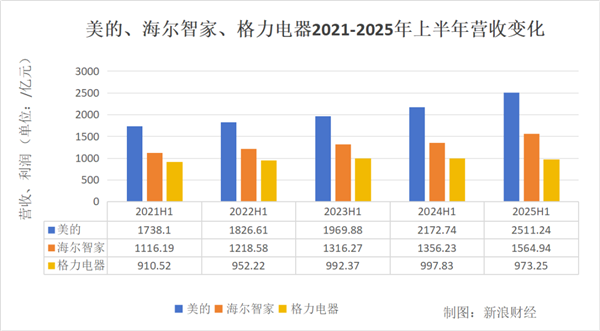
Core Insights - The article discusses the performance of major home appliance companies in China, specifically Midea Group, Haier Smart Home, and Gree Electric, as they release their half-year reports for 2025 [2][3][4]. Group 1: Financial Performance - Midea Group reported a revenue of 251.12 billion yuan, a year-on-year increase of 15.58%, and a net profit of 26.01 billion yuan, up 25.04% [2][7]. - Haier Smart Home achieved a revenue of 156.49 billion yuan, with a growth of 10.22%, and a net profit of 12.03 billion yuan, increasing by 15.59% [2][10]. - Gree Electric's revenue was 97.32 billion yuan, showing a decline of 2.46%, while its net profit was 14.43 billion yuan, up by 1.95% [2][13]. Group 2: Market Trends - The domestic home appliance market (excluding 3C products) reached a retail value of 453.7 billion yuan, growing by 9.2% year-on-year [6]. - The air conditioning sector saw a retail volume of 38.45 million units, a growth of 15.6%, with a retail scale of 126.3 billion yuan, up 12.4% [6][21]. - The washing machine market's retail value was 47.6 billion yuan, increasing by 11.5%, while the refrigerator market reached 67.28 billion yuan, growing by 3.5% [6]. Group 3: Competitive Landscape - Midea Group is positioned to "compete against two" with its revenue nearly matching the combined revenue of Haier and Gree [7][8]. - Gree Electric has shown a noticeable decline in growth, with its revenue growth turning negative for the first time since 2021 [12][15]. - The competitive dynamics are shifting, with companies like Xiaomi gaining market share, prompting major players to adjust their strategies [22][23]. Group 4: Business Adjustments - Midea Group has made operational adjustments to enhance efficiency and streamline its business [22]. - Gree Electric is focusing on diversifying its product lines beyond air conditioning to improve its market presence [22]. - Haier Smart Home is actively expanding through investments and acquisitions to broaden its business scope [22].




白电“三巨头”PK:美的狂奔,海尔稳健,格力再垫底丨BUG
Xin Lang Cai Jing· 2025-09-02 00:53
Core Insights - The article discusses the performance of major home appliance companies in China, specifically Midea Group, Haier Smart Home, and Gree Electric, based on their half-year reports for 2025, highlighting their revenue and profit growth rates [2][5][7]. Group 1: Company Performance - Midea Group leads in both revenue and profit growth, achieving a revenue of 251.12 billion yuan, a year-on-year increase of 15.58%, and a net profit of 26.01 billion yuan, up 25.04% [5][7]. - Haier Smart Home reported a revenue of 156.49 billion yuan, a 10.22% increase, and a net profit of 12.03 billion yuan, growing by 15.59% [7][9]. - Gree Electric experienced a revenue decline of 2.46%, totaling 97.32 billion yuan, while its net profit grew by 1.95% to 14.43 billion yuan [9][11]. Group 2: Market Trends - The domestic home appliance market (excluding 3C products) saw a retail sales increase of 9.2% in the first half of 2025, reaching 453.7 billion yuan [5]. - The air conditioning sector experienced a retail volume growth of 15.6%, with sales reaching 38.45 million units, and a retail scale of 126.3 billion yuan, up 12.4% [5][15]. - The washing machine market grew by 11.5%, while the refrigerator market saw a 3.5% increase in retail sales [5]. Group 3: Competitive Landscape - Midea Group is positioned to "compete against two" with its revenue nearly matching the combined total of Haier and Gree [5][7]. - Gree Electric's core air conditioning business, which traditionally contributed over 70% of its revenue, is facing challenges with a 5.09% decline in the consumer electronics segment [12][14]. - The competitive landscape is intensifying, with companies like Xiaomi gaining market share, prompting major players to adjust their strategies [16][17].
勇敢还是盲目?追觅高调跨界 要造“世界上最快的车”
2 1 Shi Ji Jing Ji Bao Dao· 2025-09-01 23:19
Core Viewpoint - The automotive market in China is highly competitive, and companies must excel in operational efficiency, supply chain control, technology reserves, and brand strength to survive [1][2][11] Group 1: Company Strategy and Development - Pursue Technology Integration: The company aims to leverage its existing technology in clean energy to support its automotive ambitions, with a focus on achieving "technological compounding" [2][3] - Dual Business Model: The company is adopting a "left hand and right hand model," where the left hand represents contract manufacturing (ODM) and the right hand focuses on self-developed vehicle projects [4][5] - Talent Acquisition: The company has built a team of over 1,000 professionals from leading automotive firms, indicating a strong commitment to developing its automotive capabilities [2][3] Group 2: Product Lines and Market Positioning - Diverse Product Lines: The company has planned five product lines, targeting various segments from high-end supercars to more affordable electric vehicles, aiming to cover a wide market spectrum [1][2] - Initial Product Development: The first mass-produced vehicle is currently in the design review stage, with plans to showcase prototypes in the near term [1][4] Group 3: Challenges and Market Environment - Underestimated Complexity: The company faces significant challenges in technology integration and market positioning, particularly in matching the performance of established brands like Bugatti [6][7][11] - Regulatory Hurdles: The company is constrained by the current regulatory environment, which has halted the issuance of new automotive manufacturing licenses, complicating its path to market entry [10][11] - Market Decline: The company's core business in the cleaning sector is experiencing a decline, which may drive its urgency to diversify into automotive manufacturing [11][12]
想造“世界上最快的车”,追觅是“无畏”还是“无知”
2 1 Shi Ji Jing Ji Bao Dao· 2025-09-01 16:09
Core Viewpoint - The automotive market in China is highly competitive, and companies must excel in operational efficiency, supply chain management, technology reserves, and brand strength to survive [2][14] Group 1: Company Overview - Pursue Technology has announced plans to launch its first ultra-luxury electric vehicle by 2027, aiming to compete with renowned supercar brands like Bugatti [2] - The company has established a dedicated automotive team of over 1,000 members, recruiting talent from leading firms such as Geely, Huawei, Xiaomi, and BYD [4] - Pursue's automotive project, named "Starry Sky Plan," is positioned as the core of its vehicle manufacturing efforts [4] Group 2: Product Lines and Strategy - Pursue has outlined five product lines (S/A/B/C/D) targeting various market segments, from high-end brands like McLaren and Lamborghini to domestic competitors like Tesla and NIO [2] - The company is also exploring innovative categories, such as the integration of cleaning robots with vehicles [2] - Pursue's strategy includes a "left-hand" model focusing on contract manufacturing and a "right-hand" model for self-developed vehicles [5][7] Group 3: Technological Development - As of May 2025, Pursue has filed 6,379 patents related to automotive technology, with 3,155 granted, focusing on key areas like sensor fusion and motor control [5] - The company aims to leverage its existing technology in home appliances to enhance its automotive capabilities, although it faces challenges in adapting these technologies for automotive applications [11][12] Group 4: Market Challenges - Despite its ambitions, Pursue faces significant hurdles, including a lack of experience in automotive development and the complexities of vehicle manufacturing [9][12] - The company must navigate stringent regulations regarding automotive manufacturing qualifications, as new licenses are no longer being issued [13] - Pursue's core business in the cleaning sector is experiencing a decline, which may drive its urgency to diversify into automotive manufacturing [14]

想造“世界上最快的车”,追觅是“无畏”还是“无知”
21世纪经济报道· 2025-09-01 15:57
Core Viewpoint - The article discusses the ambitious plans of Chase Technology to enter the automotive industry, aiming to produce a luxury electric vehicle by 2027, while highlighting the challenges and complexities of this endeavor in a highly competitive market [1][2]. Group 1: Company Strategy and Plans - Chase Technology has announced the incubation of a new automotive project, planning to launch its first ultra-luxury electric vehicle by 2027, directly competing with renowned brands like Bugatti [1]. - The company has outlined five product lines, targeting various segments of the automotive market, including high-end brands like McLaren and Lamborghini, as well as competing with domestic players like Tesla and NIO [1][3]. - The "Starry Sky Plan" has been established as the core of its automotive business, with a team of over 1,000 employees, many of whom come from leading companies in the industry [4]. Group 2: Technological and Operational Challenges - Despite its ambitions, Chase Technology faces significant challenges in technology and industry qualifications, particularly in matching the performance of established brands like Bugatti [9][12]. - The company has a history of technological development, with 6,379 patent applications related to automotive technology, but it still lacks the necessary experience in automotive R&D and production processes [4][10]. - The "left-hand" business model focuses on modifying existing domestic models for export, while the "right-hand" model aims for self-developed vehicles, which is currently stalled at the design review stage [5][6][7]. Group 3: Market Context and Competitive Landscape - The Chinese automotive market is highly competitive, with existing players struggling to maintain profitability, making it difficult for new entrants like Chase Technology to establish a foothold [1][13]. - The domestic robot vacuum market, where Chase Technology primarily operates, has seen declining sales, prompting the company to diversify into automotive manufacturing [13]. - Other companies in the home appliance sector have attempted similar transitions into automotive but have faced challenges due to their smaller scale and resources compared to giants like Xiaomi and Huawei [13].

想造“世界上最快的车”,追觅是“无畏”还是“无知”?
2 1 Shi Ji Jing Ji Bao Dao· 2025-09-01 11:08
Core Viewpoint - The automotive market in China is highly competitive, with companies needing to focus on operational efficiency, supply chain control, technological reserves, and brand strength to survive [1][2]. Group 1: Company Strategy and Development - Chasing Technology has announced plans to launch its first ultra-luxury electric vehicle by 2027, aiming to compete with renowned supercar brands like Bugatti [1][2]. - The company has established five product lines, targeting various segments from high-end brands like McLaren and Lamborghini to domestic competitors like Tesla and NIO [1][2]. - Chasing Technology has built a team of over 1,000 professionals from leading automotive companies, indicating a strong commitment to its automotive ambitions [3][4]. Group 2: Technological and Operational Challenges - The company has applied for 6,379 patents related to automotive technology, with 3,155 granted, focusing on key areas such as sensor fusion and motor control [4]. - Despite its technological aspirations, Chasing Technology faces significant challenges in adapting its existing technology to meet automotive standards, particularly in terms of torque output and environmental durability [9][10]. - The company is pursuing a dual strategy: leveraging original design manufacturing (ODM) for immediate revenue while developing its own vehicles [5][7]. Group 3: Market Position and Competition - The domestic market for robotic vacuum cleaners, Chasing Technology's core business, has been declining, leading to concerns about the company's growth prospects [13]. - The company is aware of the difficulties in obtaining automotive manufacturing qualifications, which have become increasingly stringent in China [12]. - Chasing Technology's ambition to produce the "world's fastest car" remains largely aspirational, with significant hurdles to overcome before achieving this goal [14].
追觅科技创始人俞浩发起“xxx”全球公益项目 首批教室于尼泊尔及江西启用
Xin Lang Ke Ji· 2025-09-01 07:03
责任编辑:杨赐 新浪科技讯 9月1日下午消息,由追觅科技创始人俞浩发起的"xxx"全球公益项目正式启动,首批教室分 别落地中国江西吉安及尼泊尔加德满都,覆盖学生数量超万名。该项目未来将持续拓展,致力于推动教 育公平与科技创新启蒙。据了解,截至2023年8月31日,追觅公益已与全球超过26家公益组织达成合 作,累计投入资金1776万元。目前,项目覆盖9个国家,执行超过20个公益项目,支持62所学校,惠及 32200名儿童。 ...
百度欲从瑞士开启欧洲无人驾驶业务;比亚迪宣布马来西亚建厂并加大印尼投资;京东拟在新加坡设立REIT|一周大公司出海动态
Tai Mei Ti A P P· 2025-09-01 06:03
Group 1: Autonomous Driving Initiatives - Baidu is launching its autonomous driving business in Europe, starting with an office in Zurich and plans to operate in Switzerland and Europe by next year, initially with safety drivers in vehicles [1] - Pony.ai is planning to deploy a fleet of autonomous taxis in Hong Kong after overcoming regulatory hurdles, while downplaying competition from Tesla [2] Group 2: Automotive Industry Developments - ZhiMi Technology has officially announced its entry into the automotive sector, aiming to produce a luxury electric vehicle comparable to Bugatti, with a team of nearly 1,000 people and a patent portfolio of 6,379 applications [4] - BYD's vehicle registrations in the EU doubled in July, surpassing Tesla's registrations, with 13,503 units sold across the EU and additional countries [9] - BYD has launched the Atto 1 in Indonesia, with two models priced at 2.09 billion and 2.49 billion Indonesian Rupiah [10] - BYD announced plans to build an assembly plant in Malaysia, expected to start production in 2026 [12] - BYD's Thailand factory has produced and exported over 900 Dolphin electric vehicles to Europe, marking a significant milestone for the company [14] Group 3: Consumer Brands Expansion - Mixue Group reported a revenue of 14.87 billion yuan in the first half of 2025, with a net profit of 2.72 billion yuan and a global store count of 53,014 [5] - Lucky Coffee has opened its first overseas store in Malaysia, offering a localized menu alongside classic products [7] - Xiaomi has established around 200 stores overseas, with a target of over 100 stores in Southeast Asia by 2025 [8] Group 4: Investment and Financing Activities - JD.com is planning to establish a real estate investment trust (REIT) in Singapore, with assets potentially exceeding $1 billion [18] - Chery Automobile has made significant progress towards its IPO in Hong Kong, with plans to issue up to 699 million shares [19]



湾财周报 新“股王”位置能坐多久;追觅要造超跑
Nan Fang Du Shi Bao· 2025-08-31 14:06
Key Points - The AI chip stock Cambricon (688256) experienced a high-level correction, closing at 1492.49 CNY per share with a decline of 6.01% on August 29, 2023, indicating significant market volatility and a potential challenge to maintain its position as the "new stock king" [2][3] - Cambricon's trading volume reached 26.51 billion CNY with a turnover rate of 4.27%, and there was a net outflow of over 3 billion CNY, reflecting a clear division among major investors [3] - The company’s founder saw his wealth increase by over 100 billion CNY in two years, while major investors gained 5.8 billion CNY in profits [2] Industry Developments - Pursuit Technology announced plans to enter the automotive market, aiming to produce a luxury electric vehicle that competes with Bugatti Veyron, with a team of nearly 1,000 people already established for this project [2][4] - The Chengdu Auto Show highlighted a stark contrast in the automotive market, with over 20 brands, primarily luxury ones, absent from the event, while leading domestic brands like BYD and Changan showcased their presence [4] Financial Reports - BYD reported a revenue of 371.28 billion CNY for the first half of 2025, marking a 23.3% year-on-year increase, surpassing Tesla for the first time in revenue during this period [6][7] - The net profit attributable to shareholders for BYD was 15.51 billion CNY, reflecting a 13.79% increase, with automotive and related products contributing 302.51 billion CNY, accounting for 81.48% of total revenue [7] - Seres posted a net profit of 2.941 billion CNY for the first half of 2025, up 81.03% year-on-year, with a revenue of 62.40 billion CNY and a significant increase in R&D investment [7] - Country Garden Services reported a revenue of 23.19 billion CNY for the first half of 2025, a 10.2% increase, with a focus on achieving reasonable profitability in the next three to five years [8]


字节跳动营收超过Meta;追觅科技单月发近4000万元激励金,多名员工获6位数奖励丨Going Global
创业邦· 2025-08-31 10:13
Core Viewpoint - The article highlights significant events and trends in the global market, focusing on companies' performance, product launches, and investment activities in the overseas expansion sector [2]. Group 1: Major Events - TikTok Shop in Thailand has been accused of monopolistic practices, but the company denies these claims, emphasizing its commitment to fair competition [5]. - Temu has resumed direct shipping to the U.S. and increased its advertising spend after a temporary halt due to tariff changes, significantly boosting its presence in the market [6]. - Pool cleaning robots have become a top-selling category on AliExpress this summer, with a significant portion of sales coming from Europe [7]. Group 2: Company Performance - ByteDance reported a revenue of $48 billion for Q2, surpassing Meta's $47.5 billion, and is planning a new employee stock buyback program [10]. - Cambrian's stock price has surged over 100% this month, making it the new "stock king" in the A-share market, with a year-to-date increase of over 2500% [11]. - Bubble Mart's mini LABUBU sold out in 60 seconds during its online launch, indicating strong consumer demand [13]. Group 3: Investment and Financing - Nvidia, in partnership with Google, led an $863 million funding round for nuclear fusion startup CFS, which aims to accelerate the development of commercial fusion power plants [51]. - Lantu Motors is set to list on the Hong Kong Stock Exchange, marking a significant milestone in its development as a high-end new energy brand [49]. - Physical AI company Jiji Vision completed two rounds of financing within six months, indicating strong investor interest in its technology [53][54]. Group 4: Market Trends - BYD's revenue for the first half of 2025 exceeded 371.28 billion yuan, marking its first time surpassing Tesla's revenue [23]. - The U.S. has announced new tariffs on small packages, leading to uncertainty in cross-border e-commerce and affecting small businesses reliant on international shipping [42]. - Chanel is reportedly planning to cut 20% of its workforce in China amid a downturn in the luxury goods market [43].