小米汽车

Search documents
科学评估体系构筑行业公信力 2025年一季度汽车品牌影响力指数正式发布
Zheng Quan Ri Bao Wang· 2025-06-15 12:44
Core Insights - The report highlights a significant shift in the automotive brand influence landscape in China, particularly in the passenger vehicle sector, where domestic brands have made historic breakthroughs, with six out of the top ten positions occupied by Chinese brands [1][3][5] Passenger Vehicle Market - BYD leads the passenger vehicle market with verified sales of 623,400 units, surpassing Volkswagen by 180,000 units, indicating a strong market dominance driven by its advancements in new energy technology [3] - Aito (问界) has established a new benchmark in brand reputation with an impressive 89.67% netizen voice share and only 29 complaints, showcasing its quality management as a model for high-end market strategies [3] - New entrants like Li Auto and Xpeng maintain a strong presence in the mid-market segment, while Xiaomi's vehicle has not yet matched its high media presence with corresponding sales figures [3] Commercial Vehicle Market - Jiangling Motors stands out in the light commercial vehicle sector, ranking first with a score of 684.22, despite having only 44% of the second-place competitor's media voice, demonstrating effective conversion of positive sentiment into sales [4] - The pickup truck market continues to see a concentration of market share, with Great Wall Motors dominating 47% of the total sales in the top ten, while Jiangling maintains a strong second position [4] - In the light truck segment, Foton leads with 91,900 units sold, capturing 34% of the market share, while the new energy player, Dongfeng, leads in electric vehicle discussions with a 72.18% netizen voice share [5] Industry Trends - The report indicates a core trend of transformation within the automotive industry, with domestic brands reshaping competitive dynamics in the passenger vehicle sector and local companies establishing dominance in the commercial vehicle market [5] - The upcoming data collection for the second quarter will continue to provide authoritative references for policy-making, corporate strategy, and investment decisions, reflecting the ongoing evolution of the Chinese automotive industry [5]





多车企承诺“60天账期”产业链迎协同发展
Huafu Securities· 2025-06-15 08:21
Investment Rating - The industry rating is "Outperform the Market" [7] Core Viewpoints - Multiple automotive companies have committed to a "60-day payment term" to enhance the efficiency of capital turnover in the supply chain and promote high-quality development in the automotive industry [2][3][12] - The supply chain payment term issue has been a persistent challenge for the Chinese automotive industry, with automakers extending payment terms to pressure suppliers, which distorts normal business relationships and affects fair competition [3][13] - Shortening payment terms will impact automakers' cash flow and limit their ability to engage in price wars, which have already compressed profit margins [3][13] Market Performance - From June 9 to June 13, the automotive sector declined by 0.8%, underperforming the CSI 300 index, which fell by 0.3%, resulting in a 0.5 percentage point lag [4][14] - Year-to-date, the automotive sector has increased by 7.8%, ranking 6th among 31 sectors [4][14] - Within sub-sectors, commercial trucks and motorcycles saw increases of 10.7% and 2%, respectively, while passenger vehicles and auto parts declined by 2% and 1.6% [21] Key Industry Data - Retail sales of passenger vehicles from June 1 to June 8 reached 343,000 units, a year-on-year increase of 19%, but a month-on-month decrease of 12% [5][31] - New energy passenger vehicle retail sales were 202,000 units, up 40% year-on-year and 4% month-on-month [5][36] - In May, total automotive sales were 2.686 million units, with a year-on-year growth of 11.2% [39] Valuation Metrics - The overall PE-TTM for the automotive industry is 25.81 times, with a historical percentile of 60.48% [23][27] - The overall PB for the automotive industry is 2.42 times, with a historical percentile of 67.87% [23][27] Industry News - Xiaopeng G7 was officially launched with a pre-sale price of 235,800 yuan, featuring advanced AI capabilities [69] - GAC's first mass-produced flying car, AirCab, has begun pre-orders with a price not exceeding 1.68 million yuan [69] - Geely announced the release of its Raytheon AI hybrid system, which boasts high thermal efficiency and low fuel consumption [70]
BBA正在排队降价
投资界· 2025-06-15 08:02
Core Viewpoint - The article discusses the current challenges faced by luxury car brands, particularly BMW, in the context of aggressive price competition and declining sales in the Chinese market, highlighting the shift in consumer perception and market dynamics [4][7][16]. Group 1: Price Competition and Sales Decline - BMW has experienced significant price cuts, with the latest 5 Series model dropping from an initial price of 439,900 yuan to as low as 260,000 yuan, reflecting a broader trend of price reductions among luxury car brands [4][12]. - In the first quarter of 2025, BMW's total revenue was 33.758 billion euros, down 7.8% year-on-year, and net profit fell by 26.4% [7]. - The Chinese market, which is BMW's largest single market, saw a 17.2% decline in sales, contributing to a global sales drop for the brand [7][17]. Group 2: Market Dynamics and Brand Perception - The luxury car market is undergoing a transformation, with traditional brands struggling to maintain their status as new energy vehicles and domestic brands gain traction [18][26]. - The perception of luxury brands is at risk as aggressive pricing strategies may lead consumers to view these brands as lower-end [15][16]. - The competitive landscape is intensifying, with domestic brands like BYD and Geely launching over 70 models with price cuts, forcing traditional luxury brands to respond [26][27]. Group 3: Future Strategies and Collaborations - In response to market pressures, luxury brands are seeking partnerships with Chinese companies, such as BMW and Audi collaborating with Huawei, to enhance their competitiveness in the smart vehicle sector [28][29]. - Despite current challenges, luxury brands still possess significant financial resources, with BBA (BMW, Benz, Audi) investing over 35 billion euros globally in 2024 [29]. - The ongoing price war and market dynamics suggest that the competition among luxury car manufacturers is far from over, indicating a potential shift in the industry landscape [30].


汇川技术子公司联合动力创业板IPO过会 A股分拆上市现新信号
Shang Hai Zheng Quan Bao· 2025-06-13 18:54
Core Viewpoint - Huichuan Technology's spin-off subsidiary, United Power, has received approval for its IPO on the ChiNext board, marking a significant development in the A-share spin-off listing landscape after a period of regulatory tightening [1][4]. Summary by Sections Spin-off Listing Progress - United Power's IPO application was approved by the Shenzhen Stock Exchange, representing the first spin-off IPO approval in 2025, signaling a potential revival in A-share spin-off listings [1]. - The new "National Nine Articles" issued in April 2024 has led to stricter regulations on spin-off listings, causing many companies to halt their plans, yet United Power's approval indicates that the process is not entirely stagnant [1][4]. Company Performance and Financials - United Power, established in 2016, focuses on electric drive systems and power systems, with plans to raise 4.857 billion yuan for various projects including production and R&D [1][2]. - The company reported revenues of 5.027 billion yuan in 2022, 9.365 billion yuan in 2023, and projected 16.178 billion yuan in 2024, with net profits turning from a loss of 179 million yuan in 2022 to a profit of 936 million yuan in 2024 [2]. Regulatory Scrutiny and Market Conditions - The Shenzhen Stock Exchange's listing committee emphasized the importance of sustainable revenue growth and the potential risks of being replaced as a third-party supplier during the IPO review [2][3]. - The committee also requested United Power to address the sustainability of its growth in light of industry trends, customer supply chain developments, and price fluctuations [3]. Independence and Strategic Considerations - The new regulations stress the need for the independence of spin-off companies, with a focus on their business independence, technological advancement, and reasonable valuation [4][5]. - Huichuan Technology asserts that United Power maintains a high level of operational independence from its parent company, aiming to enhance clarity in its business structure and reduce risks associated with diversification [5].

车企是如何靠“打白条”,把供应商压榨到需要借钱运转的?
3 6 Ke· 2025-06-13 12:24
Core Viewpoint - The discussion around BYD's "Di Chain" has intensified, particularly in light of concerns regarding the company's high debt levels and payment terms, which have drawn comparisons to the troubled Evergrande Group [2][22]. Group 1: Debt and Payment Terms - BYD's debt ratio is reported to be 70% with total liabilities reaching 584.66 billion [2]. - BYD's average turnover days are 127, comparable to Geely, and lower than other competitors like SAIC and Great Wall [2]. - Following public scrutiny, multiple car manufacturers, including BYD, committed to a payment term of no more than 60 days, highlighting regulatory concerns about extended payment periods harming the automotive industry [2][26]. Group 2: Di Chain Overview - "Di Chain" is an electronic debt certificate provided by BYD to its suppliers, functioning similarly to a promissory note but lacking the legal protections of traditional commercial bills [3][5]. - Suppliers can hold Di Chain until maturity for cash or use it as a debt instrument for financing [3][5]. Group 3: Financial Implications - Di Chain serves as a supply chain financial tool that can help alleviate cash flow issues for small and medium-sized enterprises (SMEs) while generating revenue for banks [5][6]. - Some banks offer financing against Di Chain, providing a 50% discount rate and charging a 3% annual interest rate for loans secured by Di Chain [6]. Group 4: Supplier Challenges - Suppliers face pressure to accept Di Chain, especially smaller ones with less negotiating power, leading to extended payment timelines [7][9]. - The payment cycle can exceed 6 months, significantly impacting suppliers' cash flow and operational capabilities [9][11]. - Di Chain can create a cascading effect where risks are transferred down the supply chain, further entrenching smaller suppliers in a cycle of dependency [11][12]. Group 5: Regulatory and Market Context - The scale of Di Chain issuance is substantial, with reports indicating over 400 billion in cumulative issuance, raising concerns about liquidity and potential risks if suppliers demand cash simultaneously [22][24]. - Compared to other automotive companies, BYD's issuance volume is significantly higher, which could pose systemic risks [22][23]. - The automotive industry is facing a common challenge regarding supply chain financing, necessitating regulatory oversight to ensure sustainable growth [25][26].
鑫椤锂电一周观察 | 国务院严令锂电客户承诺“60天付款”
鑫椤锂电· 2025-06-13 08:04
-广告- 关注公众号,点击公众号主页右上角" ··· ",设置星标 "⭐" ,关注 鑫椤锂电 资讯~ 本文来源: #鑫椤锂电 行业热点 I C C S I N O 国务院严令锂电客户承诺"60天付款" 在国家部委就保障产业链供应链稳定、促进汽车产业高质量发展作出一系列部署的背景下,广汽集团、中 国一汽、东风汽车、赛力斯集团、比亚迪、长城汽车、小米汽车、小鹏汽车等车企宣布,自6月10日起, 将供应商的支付账期控 制在60天以内,以保障供应链资金高效周转,助力产业链协同发展。 锂电巨头将于6月底停产! 瑞典电池制造商 Northvolt 将于 2025 年 6 月底停止其谢莱夫特奥工厂的电池单元生产。 据破产管理人 称,这一决定是在瑞典正在进行的破产程序的背景下做出的。寻找电池生产买家的尝试迄今为止尚未成 功。这意味着这家瑞典公司在其本土的电池生产将彻底结束。Northvolt自3月12日宣布破产以来,尽管生 产大幅削减,但仍依靠斯堪尼亚的订单维持部分运营。如今,斯堪尼亚将转向中国电池巨头宁德时代,彻 底中断与Northvolt的合作。一旦斯堪尼亚退出,Northvolt在瑞典将无任何订单来源。 津巴布韦将从20 ...
鑫椤锂电一周观察 | 国务院严令锂电客户承诺“60天付款”
鑫椤锂电· 2025-06-13 08:03
-广告- 关注公众号,点击公众号主页右上角" ··· ",设置星标 "⭐" ,关注 鑫椤锂电 资讯~ 锂电材料端市场情况 锂电巨头将于6月底停产! 瑞典电池制造商 Northvolt 将于 2025 年 6 月底停止其谢莱夫特奥工厂的电池单元生产。 据破产管理人 称,这一决定是在瑞典正在进行的破产程序的背景下做出的。寻找电池生产买家的尝试迄今为止尚未成 功。这意味着这家瑞典公司在其本土的电池生产将彻底结束。Northvolt自3月12日宣布破产以来,尽管生 产大幅削减,但仍依靠斯堪尼亚的订单维持部分运营。如今,斯堪尼亚将转向中国电池巨头宁德时代,彻 底中断与Northvolt的合作。一旦斯堪尼亚退出,Northvolt在瑞典将无任何订单来源。 津巴布韦将从2027年起禁止锂精矿出口 津巴布韦一位内阁部长表示,为鼓励外国矿业公司在该国开展精炼业务,津巴布韦将于2027年禁止锂精矿 出口。信息部长詹凡·穆斯韦雷在首都哈拉雷表示:" 自2027年1月起,将不再允许锂精矿出口。 "2025年稍 早,津巴布韦锂出口商寻求将税收延迟至2027年。一些非洲国家一直在努力推动外国矿业公司为其经济创 造更多价值。据CRU集团称 ...


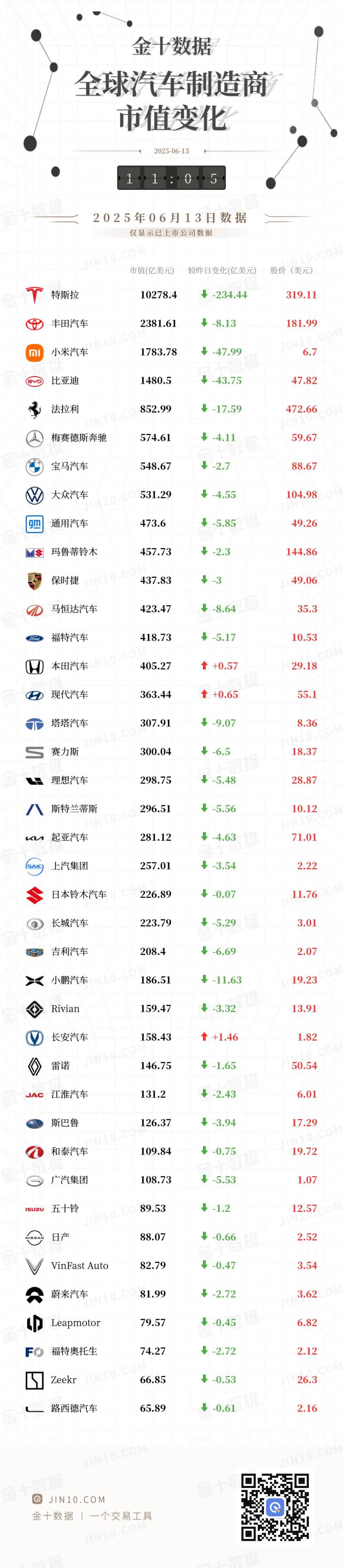
金十图示:2025年06月13日(周五)全球汽车制造商市值变化
news flash· 2025-06-13 03:12
| | 付期刊 | TUZ/8.4 | V - 234.44 | 319.11 | | --- | --- | --- | --- | --- | | 中 丰田汽车 | | 2381.61 | + -8.13 | 181.99 | | והו | 小米汽车 | 1783.78 | + -47.99 | 6.7 | | BHD) | 比亚迪 | 1480.5 | + -43.75 | 47.82 | | P | 法拉利 | 852.99 | + -17.59 | 472.66 | | | 梅赛德斯奔驰 | 574.61 | + -4.11 | 59.67 | | S | 宝马汽车 | 548.67 | + -2.7 | 88.67 | 金十图示:2025年06月13日(周五)全球汽车制造商市值变化 | 入》 大众汽车 | 531.29 | V -4.55 | 104.98 | | --- | --- | --- | --- | | 通用汽车 | 473.6 | + -5.85 | 49.26 | | > 玛鲁蒂铃木 | 457.73 | + -2.3 | 144.86 | | 保时捷 | 437.83 | + ...




狂降18万,宝马“神车”伤透3亿中产
创业邦· 2025-06-12 12:55
Core Viewpoint - The article discusses the significant price cuts in the luxury car market, particularly focusing on BMW, and highlights the challenges faced by traditional luxury brands in the context of increasing competition from domestic manufacturers and changing consumer preferences [3][5][11]. Group 1: BMW's Price Cuts - BMW's recent price cuts have led to a dramatic drop in the value of its vehicles, with the BMW 5 Series seeing a price reduction of up to 180,000 yuan, causing distress among loyal customers [5][10]. - The company's first-quarter financial results for 2025 showed a total revenue of 33.758 billion euros, a year-on-year decline of 7.8%, and a net profit of 2.173 billion euros, down 26.4% [6]. - In China, BMW's sales dropped by 17.2% year-on-year, making it the only major market where sales declined, highlighting the brand's struggles in its largest single market [6][13]. Group 2: Market Dynamics - The luxury car market is experiencing intense price wars, with brands like BYD and Geely launching discounts on over 70 models within a week, forcing traditional luxury brands to respond [19]. - The decline in sales for luxury brands like BMW, Mercedes-Benz, and Audi in China is attributed to the rise of domestic competitors and changing consumer preferences, with sales figures showing significant year-on-year drops [13][14]. - The shift towards electric vehicles and smart technology is challenging traditional luxury brands, which must adapt to remain competitive in a rapidly evolving market [14][22]. Group 3: Future Outlook - Despite current challenges, traditional luxury brands like BMW, Audi, and Mercedes-Benz are investing heavily in partnerships and technology, with a total investment exceeding 35 billion euros in 2024, indicating a long-term strategy to regain market competitiveness [23]. - The article suggests that the ongoing price cuts and market dynamics may lead to a significant transformation in the luxury car segment, with the potential for new entrants to disrupt established players [19][23].

狂降18万,宝马“神车”伤透3亿中产
创业邦· 2025-06-12 12:50
Core Viewpoint - The article discusses the current challenges faced by luxury car brands, particularly BMW, in the context of price cuts and market competition in China, highlighting the impact on brand perception and sales performance [4][10][21]. Group 1: Price Cuts and Market Dynamics - BMW has experienced significant price cuts, with the BMW 5 Series dropping by 180,000 yuan, leading to concerns among loyal customers about the brand's value [5][16]. - The luxury car market is witnessing a price war, with brands like BYD and Geely offering discounts, forcing traditional luxury brands to respond similarly to maintain market share [30][31]. - In the first quarter of 2025, BMW's revenue fell by 7.8% to 33.758 billion euros, and net profit decreased by 26.4% to 2.173 billion euros, indicating financial pressure despite some sales growth in other markets [10][21]. Group 2: Sales Performance in China - China is BMW's largest single market, but it saw a 17.2% decline in sales in the first quarter of 2025, which is the most significant drop among major markets [10][11]. - The overall sales performance of luxury brands in China has been declining, with Mercedes-Benz, BMW, and Audi experiencing year-on-year sales drops of 7%, 13.4%, and 10.9% respectively [21][22]. Group 3: Brand Perception and Future Strategies - The aggressive pricing strategy may damage the luxury image of brands like BMW, as low prices can lead consumers to perceive the brand as less prestigious [19][20]. - Traditional luxury brands are now seeking partnerships with Chinese companies, such as BMW and Audi collaborating with Huawei, to enhance their competitiveness in the evolving market [38][40]. - Despite current challenges, the long-term financial strength of luxury brands remains significant, with BBA (BMW, Benz, Audi) planning to invest over 35 billion euros globally in 2024 [40][41].