中兴通讯

Search documents
海外市场流动性有企稳迹象,情绪或会好转勘误版
Soochow Securities· 2026-02-24 05:52
证券研究报告·宏观报告·宏观周报 金融产品周报 20260207 海外市场流动性有企稳迹象,情绪或会好转 【勘误版】 [Table_Summary] 基金规模统计:(2026.2.2-2026.2.6) 市场行情展望:(2026.2.9-2026.2.13) 基金配置建议: 2026 年 02 月 24 日 《商品流动性冲击之后,哪些品种被 "错杀"?》 2026-02-04 《黄金 ETF,2026 年 1 月复盘与 2 月 证券分析师 芦哲 展望》 执业证书:S0600524110003 luzhe@dwzq.com.cn 证券分析师 唐遥衎 2026-02-03 执业证书:S0600524120016 东吴证券研究所 1 / 20 tangyk@dwzq.com.cn 相关研究 请务必阅读正文之后的免责声明部分 [Table_Tag] ◼ 权益类 ETF 基金规模变化统计:规模变化排名前三名的权益类 ETF 类 型分别为:规模指数 ETF(154.06 亿元),跨境行业指数 ETF(66.24 亿 元),策略指数 ETF(53.71 亿元);基金规模变化排名后三名的权益 类 ETF 类型分别为:跨境规模 ...
CPO正式进入从0到1的规模化落地元年,通信ETF嘉实(159695)一键布局光通信产业链
Xin Lang Cai Jing· 2026-02-24 03:54
2026年2月24日早盘,光通信模块概念涨幅居前,截至11:18,国证通信指数强势上涨4.32%,成分股天 孚通信上涨14.21%,德科立上涨14.08%,通鼎互联上涨10.04%,长江通信,长飞光纤等个股跟涨。 数据显示,截至2026年1月30日,国证通信指数前十大权重股分别为中际旭创、新易盛、中兴通讯、天 孚通信、中国移动、中国电信、中国联通、信维通信、亨通光电、中天科技,前十大权重股合计占比 54.9%。 通信ETF嘉实(159695)紧密跟踪国证通信指数,一键布局光通信产业链。 上个马年沪指涨近60%!新年新福利来了,炒股排面要拉满,新号启幸运>> 2026年2月,英伟达宣布将于年内规模部署CPO(共封装光学)技术,标志着CPO正式进入从0到1的规 模化落地元年。国盛证券强调,CPO并非替代可插拔光模块,而是与其互补并行,重点打开光通信在柜 内互联的新增量空间;其技术实现高度依赖硅光芯片能力,而光模块龙头厂商在硅光设计(PIC)领域 已具备领先储备与先发优势,技术壁垒进一步强化头部集中趋势。 中信建投证券指出,AI大模型正加速迈入商业变现深水区,从"低价/免费圈地"阶段转向"为高质量付 费"阶段,带动 ...
未知机构:浙商通信张建民国产算力主线强化产业正循环加速国产视频生成模-20260224
未知机构· 2026-02-24 03:20
Summary of Key Points from Conference Call Industry Overview - The conference call focuses on the domestic AI computing power industry, highlighting advancements in AI video generation and the increasing demand for computing resources during peak traffic events like the Spring Festival [1][2]. Core Insights and Arguments - The AI video generation model Seedance 2.0, developed by ByteDance, has evolved into a "director-level" tool, capable of producing multi-scene, movie-quality videos with original audio in just 60 seconds. This advancement transforms AI video into a significant productivity tool [1][2]. - During the Spring Festival, ByteDance leveraged high visibility from the New Year's Gala to achieve peak concurrent usage, emphasizing the growing demand for computing power [1][2]. - The "Doubao" AI cloud partnership with CCTV for the Spring Festival resulted in a total of 1.9 billion AI interactions, with peak activity reaching 633 billion tokens per minute. This indicates a substantial increase in consumer engagement and computing requests [3]. - Major companies like Tencent and Alibaba are competing for consumer entry points, with Tencent distributing 1 billion yuan in red envelopes and Alibaba launching a 3 billion yuan free order campaign, which enhances the consumption ecosystem and drives up computing demand [3]. - The domestic AI landscape is characterized by a strong demand-side pull, with the native adaptation of the Zhiyuan GLM-5 model to domestic GPU ecosystems, optimizing compatibility with seven major domestic chip platforms [3]. Important but Overlooked Content - Key companies to watch in the server segment include Inspur Information, ZTE, and Unisplendour. In the networking switch sector, focus on Huaqin Technology, Shengke Communication, Ruijie Networks, and StarNet Ruijie. For liquid cooling and power solutions, companies like Invec, Shenling Environment, and Kexin Innovation Source are noteworthy [4]. - A risk factor mentioned is the potential for industry progress to fall short of expectations, which could impact the overall growth and development of the AI computing power sector [5].
未知机构:浙商通信张建民国产算力主线强化产业正循环加速国产视频生成-20260224
未知机构· 2026-02-24 03:05
Summary of Key Points from the Conference Call Industry and Company Involved - The conference call focuses on the domestic AI video generation industry, specifically highlighting ByteDance's AI video generation model Seedance 2.0 and its impact on the market [1][2]. Core Insights and Arguments - **Advancement of Domestic Video Generation Models**: ByteDance's Seedance 2.0 has evolved into a "director-level" tool, capable of generating multi-shot, movie-quality videos with original audio in just 60 seconds. This represents a significant breakthrough in AI video production, transforming it into a productive asset [1][2]. - **Increased Demand for Computing Power During Spring Festival**: The competition for traffic during the Spring Festival has amplified the demand for computing power. ByteDance leveraged the high visibility of the Spring Festival Gala to achieve peak concurrent usage [2]. - **AI Interaction Metrics**: On New Year's Eve, as the exclusive AI cloud partner for the Spring Festival Gala, the AI interaction volume reached 1.9 billion, with a peak of 63.3 billion tokens per minute. This indicates a substantial increase in user engagement and computing resource consumption [2]. - **Competitive Strategies of Major Companies**: Tencent distributed 1 billion yuan in red envelopes to stimulate social engagement, while Alibaba's 3 billion yuan promotional campaign integrated its ecosystem, creating a consumable closed loop. These strategies highlight the fierce competition among major players for consumer entry points, driving up concurrent requests and token consumption [2]. - **Acceleration of the Domestic Large Model and Computing Power Cycle**: The Zhipu GLM-5 model is natively adapted to the domestic GPU ecosystem, having undergone deep optimization from the core to the inference framework, ensuring compatibility with seven major domestic chip platforms. This reflects the robust demand-side traction in the domestic AI sector and the gradual improvement of the ecosystem between domestic large models and computing power [2]. Other Important but Potentially Overlooked Content - **Key Companies to Watch**: The call emphasizes several companies in the server, networking, liquid cooling/power, and connector sectors, including Inspur Information, ZTE, Unisplendour, Huaqin Technology, and others, indicating a broad interest in the supporting infrastructure of the AI industry [3]. - **Risk Warning**: There is a cautionary note regarding the potential risks associated with the industry, particularly the possibility of slower-than-expected progress in technological advancements [4].
未知机构:浙商通信张建民国产算力主线强化产业正循环加速国产视频生-20260224
未知机构· 2026-02-24 02:35
Summary of Key Points from Conference Call Industry Overview - The conference call focuses on the domestic AI computing power industry, highlighting advancements in AI video generation and the increasing demand for computing resources during peak traffic events like the Spring Festival [1][2]. Core Insights and Arguments - The AI video generation model Seedance 2.0, developed by ByteDance, has evolved into a "director-level" tool, capable of producing multi-scene, movie-quality videos with original audio in just 60 seconds. This advancement transforms AI video into a significant productivity tool [1][2]. - During the Spring Festival, ByteDance leveraged high visibility from the New Year's Gala to achieve peak concurrent usage, emphasizing the growing demand for computing power [1][2]. - The "Doubao" AI cloud partnership with CCTV for the Spring Festival resulted in a total of 1.9 billion AI interactions on New Year's Eve, with peak activity reaching 633 billion tokens per minute. This indicates a substantial increase in consumer engagement and computing requests [3]. - Major companies like Tencent and Alibaba are competing for consumer entry points, with Tencent distributing 1 billion yuan in red envelopes and Alibaba launching a 3 billion yuan free order campaign, which enhances the consumption ecosystem and drives up computing demand [3]. - The domestic AI landscape is characterized by a strong demand-side pull, with the native adaptation of the Zhiyuan GLM-5 model to domestic GPU ecosystems, optimizing compatibility with seven major domestic chip platforms [3]. Important but Overlooked Content - Key companies to watch in the server sector include Inspur Information, ZTE, and Unisplendour; in the networking sector, focus on Huaqin Technology, Shengke Communication, Ruijie Networks, and StarNet Ruijie; for liquid cooling and power solutions, consider Invec, Shenling Environment, and Kexin Innovation Source [4]. - A risk factor mentioned is the potential for industry progress to fall short of expectations, which could impact the overall growth and investment potential in the sector [5].
研判2026!中国计算机辅助制造(CAM)软件行业分析:制造强国战略与工业软件自主可控双轮驱动,智改数转浪潮催生巨大增量空间[图]
Chan Ye Xin Xi Wang· 2026-02-24 01:26
Core Viewpoint - The "intelligent transformation and digital upgrade" wave in manufacturing, driven by national strategies for a "strong manufacturing country" and "self-controllable industrial software," is creating significant market growth for Computer-Aided Manufacturing (CAM) software, with a projected market size of approximately 7.524 billion yuan in 2024, reflecting a year-on-year growth of 10.29% [1][9]. Industry Overview - CAM software is a specialized tool that utilizes computer technology to convert Computer-Aided Design (CAD) models into executable instructions for automated equipment, significantly enhancing production efficiency, processing accuracy, and material utilization [2][5]. Industry Development History - The CAM software industry in China has evolved through several phases: - 1978-1985: Initial exposure to digital technology during the early reform era. - 1986-1999: Policy foundations established with the inclusion of CAD/CAM in the national 863 program. - 2000-2005: Increased adoption post-WTO accession, with domestic companies beginning to enter international markets. - 2006-2015: Introduction of advanced technologies and products by leading firms. - 2016-present: Focus on cloud architecture and integration of CAD/CAM functionalities, enhancing competitiveness in the global market [3][4]. Market Size - The CAM software market in China is expected to reach approximately 7.524 billion yuan in 2024, with a growth rate of 10.29% year-on-year, driven by demand in high-end manufacturing sectors such as aerospace, new energy vehicles, and precision molds [9][10]. Key Companies' Performance - The competitive landscape of the CAM software industry is characterized by a dynamic "multi-polar competition" system, with local leaders like Zhongwang Software and Huatiansoft adopting integrated platform strategies to compete against international giants [10][11]. - Zhongwang Software reported a revenue of 538 million yuan in the first three quarters of 2025, a year-on-year increase of 4.99%, but faced a net profit decline of 479.34% [11][12]. Industry Development Trends 1. **Integration of Artificial Intelligence**: Future CAM software will evolve to integrate AI, transforming from automated tools to intelligent production partners capable of decision-making, thus reshaping manufacturing processes [13]. 2. **Shift to Cloud and Platform Services**: The industry is transitioning from traditional local deployments to cloud-based, subscription services, enhancing collaboration and reducing initial investment barriers for manufacturers [14]. 3. **Intensified Market Competition**: The domestic CAM software market is entering a critical phase of "core attack" and "value enhancement," with a focus on overcoming challenges in high-end market segments and developing specialized solutions for strategic industries [15][16].


测评7个手机智能体:点一杯奶茶,意味着交付40%高敏权限
2 1 Shi Ji Jing Ji Bao Dao· 2026-02-24 00:23
Core Insights - The rise of intelligent agents signifies a shift from machines merely chatting to machines performing tasks on behalf of users, with a notable focus on local deployment rather than cloud-based solutions [1][2] - The increasing integration of intelligent agents into personal devices raises concerns about privacy and the extent of permissions required for their operation [2][19] Group 1: Intelligent Agent Development - Intelligent agents like Doubao are being embedded in smartphones, allowing them to perform various tasks such as ordering food and playing games [3][4] - A significant number of permissions are required for these agents, with many devices exceeding 100 system permissions, which is notably higher than typical applications [5][6] Group 2: Permission and Privacy Concerns - Approximately 40% of the permissions requested by mobile intelligent agents are classified as high-sensitivity, including access to precise location and reading messages [7][10] - The use of accessibility permissions allows intelligent agents to bypass standard security measures, raising concerns about potential misuse and privacy violations [10][12] Group 3: Security Measures and User Awareness - Companies like Doubao and OPPO have begun to publish AI privacy and security white papers, focusing on user awareness and control over sensitive operations [24][25] - The need for transparent usage guidelines and the importance of logging AI operations have been emphasized to ensure accountability and traceability [25][29] Group 4: Data Handling and Cloud Risks - The process of data transmission to the cloud remains controversial, with concerns about sensitive information being exposed during this process [29][30] - Current intelligent agents struggle with effectively identifying and protecting sensitive information, highlighting a gap in privacy protection capabilities [30][32]


豆包新机进入倒计时,智能体和App“战”到哪一步了?
2 1 Shi Ji Jing Ji Bao Dao· 2026-02-24 00:20
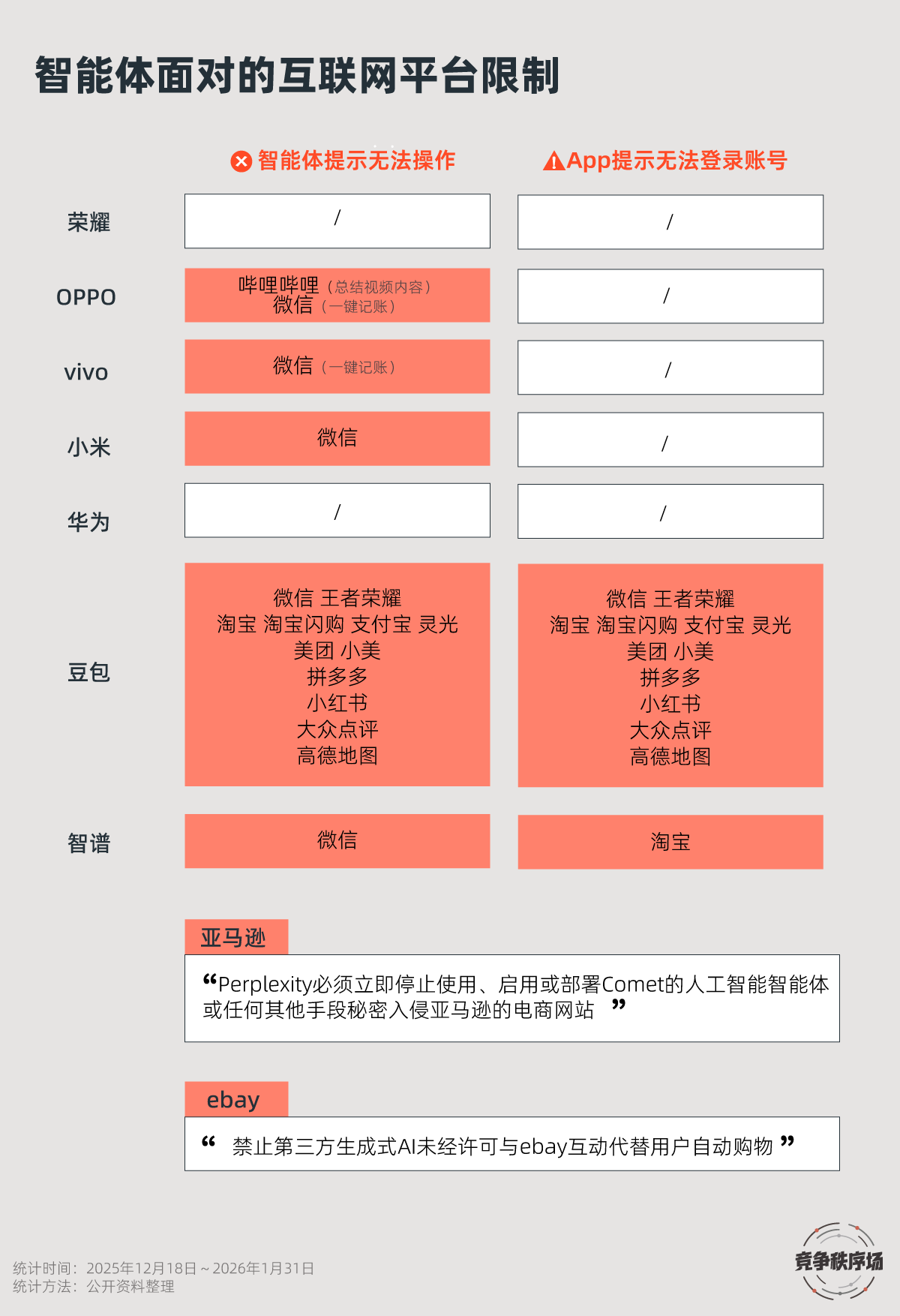
《21世纪经济报道》商业秩序工作室报道 没有哪款AI产品,像手机智能体这样,还在测试阶段就引发如此多争议。2025年年底,字节跳动和中兴努比亚发布搭载"豆包手机助手"的手机,这款3499元 的样机一夜售罄,但马上寸步难行——帮用户点外卖、发消息的智能体,被微信、支付宝、淘宝等App,用安全弹窗拦在门外。 "两方谁有问题?其实做法都有点问题。"在多家手机厂商和互联网公司都曾工作的业内人士说,App 不该彻底拒绝互联,但 Agent 也没有理由要求强制开 放。 事实上,字节对端侧AI的试探开始于更早。2024年,字节开始接触中兴等手机厂商,不只是提供基模,而是想让豆包完全承包手机AI助手和所有流量。置 换条件是免除托管费,自己承担 token 消耗成本。 谈判持续数轮,但最终只谈拢了国内市场份额不足 1% 的中兴手机。参与当时谈判的业内人士回忆道,成本减负固然诱人,但没有主流手机肯放弃自己的AI 战略。而且,"手机整个产线都是成本,没有办法拿整个身家赌一个AI的前途。" 直到豆包手机助手引起激烈讨论,态势有了变化。我们近期了解到,字节已于去2025年底开启豆包手机助手正式版项目,新机预计将于2026年Q2中晚期发 ...
万字详解智能体2.0:手机里的“互联互通”新战场
2 1 Shi Ji Jing Ji Bao Dao· 2026-02-24 00:10
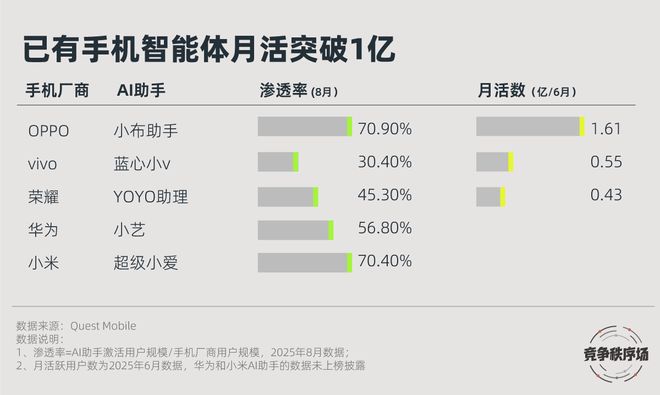
Core Insights - The AI industry is shifting focus towards edge-based intelligent agents, with significant developments in both domestic and international markets [1][2][3] - ByteDance's Doubao and other intelligent agents are gaining traction, operating across various personal devices and applications, but face challenges related to privacy and operational capabilities [2][3][5] - The industry consensus is that the future of intelligent agents will depend on their ability to connect multiple personal devices and services, reshaping the ecosystem [2][3] Group 1: Market Developments - OpenClaw has gained popularity in Silicon Valley, while Doubao is embedded in smartphones in China, with high demand reflected in the second-hand market [1] - The user base for intelligent agents among six major Chinese smartphone manufacturers grew by 65 million in one year, reaching a total of 535 million users [3] - OPPO, Vivo, and Honor are leading the charge in the domestic market, with OPPO's Xiaobu Assistant achieving 160 million monthly active users by June 2025 [3] Group 2: Technical Challenges - Current intelligent agents are struggling with task execution, often only able to perform basic functions like opening apps rather than completing complex tasks [7][8] - A recent evaluation of seven intelligent agents revealed a success rate of only 20% for completing tasks, with many tasks failing or being interrupted [5][7] - The technology behind these agents is still in its infancy, with most operating at a basic level and lacking the ability to handle complex, multi-step tasks effectively [8][10] Group 3: Privacy and Security Concerns - Intelligent agents require extensive permissions, often exceeding 100, raising concerns about privacy and potential misuse of sensitive data [17][18] - The use of high-sensitivity permissions, such as accessing location and reading messages, poses significant risks to user privacy [19][20] - The reliance on cloud processing for data handling introduces vulnerabilities, as sensitive information may be exposed during transmission [27][28] Group 4: Industry Dynamics - A ceasefire agreement has been reached between ByteDance and several app developers, allowing for normal login procedures while limiting AI operations [35] - The competitive landscape is marked by tensions between smartphone manufacturers and app developers, with concerns over the implications of intelligent agents on existing business models [30][31] - The future of intelligent agents hinges on establishing a viable revenue-sharing model and addressing the concerns of both hardware manufacturers and app developers [31][32]



AI从“聊天”到“干活”,国内产业落地迎来爆发期
Sou Hu Cai Jing· 2026-02-23 22:23
Group 1 - The AI industry in China is experiencing a "qualitative leap," evolving from a "virtual dialogue tool" to "physical intelligent agents" capable of performing tasks, marking an explosive phase of industrial application [1] - Major domestic AI models have been released since February, including ByteDance's Doubao Model 2.0, Zhipu GLM-5, and Tencent's Mix Yuan Image 3.0, with multi-modal capabilities becoming the core of industry competition [1] Group 2 - AI is deeply integrated into the real economy, with 91% of retail companies deploying AI technology, resulting in both revenue growth and cost reduction [3] - Companies like State Grid are using AI to optimize power dispatch, while CRRC's "Zhuo Lun" model is promoting the intelligence of rail transit equipment [3] - The construction of AI WAN (Wide Area Network) is accelerating, with companies like ZTE and Zhongji Xuchuang focusing on network equipment and optical module technology to establish "high-speed channels" for AI data transmission [3] Group 3 - Policy and capital support are crucial for the implementation of the AI industry, with the Ministry of Industry and Information Technology promoting deep integration of AI and industrial internet, and over 20 computing network standards being established by the China Communications Standards Association [3] - There is a continuous trend of technology companies raising funds through bond issuance, with firms like Kuaishou and Alibaba directing capital towards the AI sector [3] - The domestic AI sector is transitioning from "technological frenzy" to "effective implementation," becoming a core driver of new productive forces [3]