中航证券

Search documents
QT接近尾声 鲍威尔“鸽声”一锤定音 10月降息几成定局
2 1 Shi Ji Jing Ji Bao Dao· 2025-10-15 23:41
Group 1 - The Federal Reserve, led by Chairman Powell, is signaling a potential interest rate cut in October due to signs of a cooling labor market [1][7] - Powell indicated that the quantitative tightening (QT) program may be nearing its end, as the financial system's liquidity conditions are tightening [1][3] - The Fed's balance sheet has decreased from over $9 trillion to $6.6 trillion since mid-2022 due to QT measures [3] Group 2 - The end of QT is seen as a way to balance market sentiment, control inflation, and adjust liquidity conditions, with the timing differing from the cessation of interest rate hikes [4][5] - Analysts predict that ending QT could improve market liquidity, alleviate pressure on the bond market, and enhance expectations for monetary policy easing [5][6] Group 3 - Market expectations for a rate cut have increased, with concerns about the labor market overshadowing inflation risks [7][8] - The anticipated rate cut is expected to lower the 10-year U.S. Treasury yield, reflecting the impact of easing monetary policy on asset prices [9][10] Group 4 - A preventive rate cut is likely to benefit U.S. equities by enhancing market liquidity and reducing financing costs for companies [11] - The expected decline in U.S. Treasury yields may improve global financial market conditions and attract capital to emerging markets [11][12]

国家统计局,重磅发布!这些数据意味着什么?最新解读来了
券商中国· 2025-10-15 06:50
Core Viewpoint - The article highlights that while the Consumer Price Index (CPI) remains low, core inflation is showing signs of recovery, and the Producer Price Index (PPI) is experiencing a narrowing decline, indicating marginal improvement in industrial demand [1][2][4]. CPI Analysis - In September, the CPI increased by 0.1% month-on-month but decreased by 0.3% year-on-year, with the core CPI (excluding food and energy) rising by 1.0%, marking the first time in 19 months that it has returned to 1% [1][2]. - The decline in CPI is primarily driven by food prices, which fell by 4.4%, with significant drops in pork, fresh vegetables, and eggs, down 17.0%, 13.7%, and 13.5% respectively [3][4]. - The "tail effect" contributed to a 0.8 percentage point decrease in the year-on-year CPI [3]. PPI Analysis - The PPI remained flat month-on-month and saw a year-on-year decline of 2.3%, with the rate of decline narrowing by 0.6 percentage points compared to the previous month [1][5]. - Certain industries, such as coal processing and black metal smelting, have shown price increases, indicating a stabilization in prices due to improved supply-demand dynamics [5][6]. - The overall improvement in PPI is attributed to the reduction of high base effects from the previous year and the impact of policies aimed at regulating market competition [6][7]. Market Dynamics - The "anti-involution" policies are expected to enhance industrial capacity utilization and promote re-inflation, which may positively influence the capital market and stabilize social confidence [7].

A股大消息,又“爆了”
天天基金网· 2025-10-11 01:25
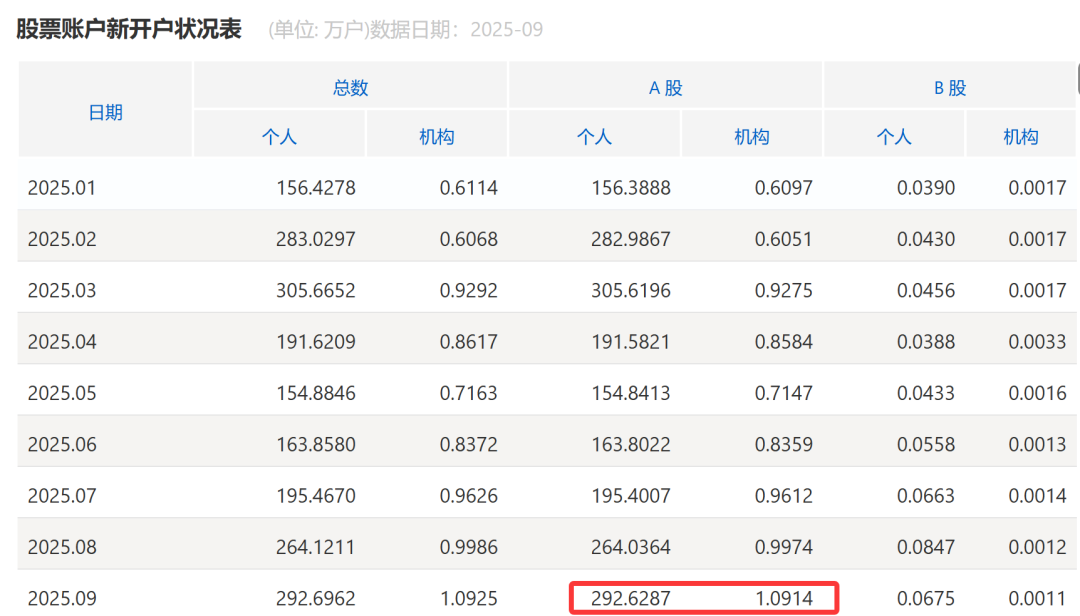
Core Insights - The article highlights a significant increase in new stock accounts in the A-share market, indicating a bullish sentiment among investors [3][6][8] Group 1: New Account Openings - In September, the Shanghai Stock Exchange reported 2.9372 million new A-share accounts, a 60.73% increase year-on-year, marking the second-highest monthly figure of the year [3][6] - The total number of new accounts opened in the first three quarters of this year reached 20.1489 million, a 49.64% increase compared to 13.4646 million in the same period last year [6] - The majority of new accounts in September were individual accounts (2.9263 million), with institutional accounts reaching 10,900, the first time institutional openings surpassed 10,000 this year [6][8] Group 2: Market Trends and Investor Demographics - The current influx of new accounts is not as dramatic as the surge seen during the "9·24" market rally last year, suggesting a more moderate entry pace for individual investors [8] - Younger investors, particularly those under 35, are driving the recent account openings, indicating a shift in investor demographics [8] Group 3: Margin Trading and Market Activity - The margin trading balance in the A-share market has reached a new high of 2.44 trillion yuan as of September 25, reflecting strong market activity [10][12] - Several brokerage firms have increased their margin trading limits in response to the growing demand, indicating a competitive market environment [12] - Despite the rise in margin trading, the overall leverage level remains within a manageable range, with the financing balance accounting for only 2.54% of the circulating market value, significantly lower than the historical peak of 4.72% [12]

A股大消息,又“爆了”
中国基金报· 2025-10-10 12:04
Core Viewpoint - The A-share market in China has seen a significant increase in new account openings, with September 2023 recording 2.9372 million new accounts, marking a year-on-year growth of 60.73% and the second-highest monthly figure of the year [2][5]. Summary by Sections New Account Openings - In September 2023, the Shanghai Stock Exchange reported 2.9372 million new A-share accounts, contributing to a total of 20.1489 million new accounts for the first three quarters of the year, which is a 49.64% increase compared to 13.4646 million in the same period of 2022 [5]. - Among the new accounts in September, 2.9263 million were individual accounts and 10,900 were institutional accounts, marking the first time institutional accounts surpassed 10,000 this year [5]. Market Trends - The new account openings in September reflect a trend of increasing participation from younger investors, particularly those under 35 years old, indicating a shift in the investor demographic [7]. - Despite the surge in new accounts, the current monthly opening figures are still less than half of the 6.84 million accounts opened in October 2022, suggesting a more moderate pace of entry for individual investors [7]. Margin Trading - The margin trading balance in the A-share market has reached a new high, exceeding 2.2 trillion yuan since September, with a peak of 2.44 trillion yuan on September 25, 2023 [9]. - Several brokerage firms have responded to the growing demand for margin trading by increasing their financing business limits, indicating a robust market environment [11]. - The current leverage levels in the market remain within a manageable range, with the financing balance accounting for 2.54% of the circulating market value, significantly lower than the historical peak of 4.72% [11]. Market Liquidity - The daily trading volume in the A-share market has maintained a high level, exceeding 2 trillion yuan, which reflects sufficient market liquidity and a recovery in investor risk appetite [12].

A股大消息,又“爆了”
Zhong Guo Ji Jin Bao· 2025-10-10 11:52
Core Insights - In September, the number of new A-share accounts opened reached 2.9372 million, marking a year-on-year increase of 60.73%, making it the second-highest monthly figure of the year [1][2] - The total number of new accounts opened in the first three quarters of the year reached 20.1489 million, a 49.64% increase compared to the same period last year [2] - The surge in new accounts indicates a growing interest in the A-share market, with over 30 million new accounts opened since the "9.24" market rally last year [1] New Account Breakdown - Of the 2.9372 million new accounts in September, 2.9263 million were individual accounts and 10,900 were institutional accounts, marking the first time institutional accounts surpassed 10,000 this year [3] - The monthly comparison shows a steady increase in new accounts, with a significant rise in August due to market performance, followed by a further increase in September [4] Market Trends - Despite the increase in new accounts, the current monthly account openings are still less than half of the 6.84 million accounts opened in October 2024, indicating a relatively moderate pace of new individual investor entries [5] - The recent wave of new accounts has not reached the explosive levels seen during the "9.24" rally, with younger investors (under 35) becoming the primary demographic for new accounts [6] Margin Trading Developments - The margin trading balance has reached a new high, exceeding 2.2 trillion yuan since August, and peaking at 2.44 trillion yuan on September 25 [7] - The increase in new margin accounts has also surpassed last year's figures, reflecting a robust demand for margin trading [9] Broker Responses - Several brokerage firms have raised their financing business limits in response to the growing demand in the margin trading market, indicating a strategic move to enhance service levels and market share [10][11] - The current leverage levels in the market remain within a manageable range, with the financing balance accounting for 2.54% of the circulating market value, significantly lower than historical peaks [11]


大事不断!美国政府关门危机持续、高市早苗将当选日本首相、中国资产全线走强...A股节后将如何演绎?
雪球· 2025-10-05 06:55
Group 1: U.S. Government Shutdown - The U.S. government shutdown crisis is ongoing, with the House Republican leadership deciding not to return to Washington, indicating a prolonged shutdown that will impact key economic data releases [4] - Economic decisions are becoming more challenging due to the lack of accurate data, leading businesses and policymakers to make educated guesses about economic trends [4] - Despite short-term uncertainties, some analysts believe that markets have historically shown resilience to government shutdowns, with past experiences indicating potential reversals in market declines once attention shifts to other factors [5] Group 2: Japan's New Prime Minister - High-profile politician, Sanae Takaichi, has been elected as the new president of Japan's ruling Liberal Democratic Party, expected to become Japan's first female Prime Minister [7] - Takaichi advocates for fiscal expansion and a right-leaning political stance, calling for the maintenance of loose monetary policy and opposing interest rate hikes by the Bank of Japan [8] - Analysts predict significant impacts on the yen and Japanese government bond markets due to Takaichi's victory, with expectations of a weaker yen and a steepening yield curve [9][10] Group 3: A-Share Market Outlook - Historical analysis indicates a calendar effect in the A-share market, with the strongest performance observed in the first five trading days after the National Day holiday, showing a median return of 2.27% and an 80% win rate [12] - The current bullish trend in China's earnings fundamentals is believed to be developing, supported by external demand and improving domestic price stability [12] - Economic forecasts suggest a "N"-shaped oscillation in the fourth quarter, with technology remaining a key focus, while resource and consumer sectors may attract funding due to favorable policies [13]

机构密集发布四季度策略!科技成长是主线,“高切低”成胜负手
2 1 Shi Ji Jing Ji Bao Dao· 2025-10-01 09:35
Group 1 - The core view is that the A-share market is expected to continue rising in Q4 driven by "policy + liquidity," but volatility is inevitable [1][4][3] - Most institutions believe that the technology growth style will remain dominant, but investment may shift from a "one-sided" approach to a "balanced allocation" [1][4] - The market is anticipated to challenge new highs, with policy support, improved liquidity, and a rebound in A-share earnings as key driving factors [4][3] Group 2 - Historical data shows that Q4 typically has a strong profit effect, with most sectors and styles yielding positive returns [4][3] - The most certain upward window in Q4 is early November, with a median increase of 1.96% for the entire A-share market [4] - The market is expected to see a rebalancing of styles, with both growth and value sectors having opportunities [4][16] Group 3 - Technology innovation remains the clearest investment theme for Q4, with AI, innovative pharmaceuticals, and robotics continuing to lead [5][9] - Despite concerns about overheating in some tech stocks, the overall view is that technology remains the market's main line [6][8] - Institutions suggest focusing on sectors with positive fundamental changes and lower valuations within the technology space [7][11] Group 4 - The strategy of "high cut low" is emphasized, suggesting a shift from high-performing sectors to those with lagging performance [10][11] - Two main directions for this strategy include finding undervalued areas within technology and focusing on "anti-involution" sectors [11][12] - The "anti-involution" strategy targets industries with excess supply and low price levels, such as industrial metals and construction materials [12][13] Group 5 - The market style is expected to be more balanced in Q4 compared to Q3, with a focus on both growth and value [15][16] - Institutions recommend maintaining a balanced approach that includes growth sectors driven by AI and consumer upgrades, as well as dividend-paying assets [16][14] - The current dividend yield of the CSI Dividend Index is seen as attractive, making Q4 a key period for positioning in dividend styles [16]

年内份额增长率超200%,券商ETF(159842)盘中溢价,机构:看好低估值龙头券商机会
2 1 Shi Ji Jing Ji Bao Dao· 2025-09-30 02:02
Group 1 - The three major indices opened higher on September 30, with the Shanghai Composite Index up 0.19%, the Shenzhen Component Index up 0.19%, and the ChiNext Index up 0.04. The securities sector experienced fluctuations during the trading session [1] - The broker ETF (159842) saw a decline of 0.25% with a trading volume exceeding 850 million yuan, and a premium/discount rate of 0.12%. The ETF's circulating shares reached 5.525 billion, marking a year-to-date growth rate of 208.11%, the highest among similar products [1] - The broker ETF tracks the CSI All Share Securities Companies Index, which consists of up to 50 securities company stocks from the CSI All Share sample to reflect the overall performance of the industry [1] - Ping An Securities noted an improvement in market sentiment for the securities sector, with high trading activity benefiting from market recovery. The sector is expected to have significant growth potential with the new round of capital market reforms [1] - Financial regulatory policies are continuously improving, with the revised "Trust Company Management Measures" clarifying business scope and regulatory requirements, enhancing risk control, and promoting industry standardization [1] Group 2 - As of September 25, the A-share margin financing balance increased to 2.44 trillion yuan, setting a new historical record. The financing balance accounted for 2.54% of the circulating market value, and the financing buying amount represented 11.80% of A-share trading volume [2] - Despite the rise in margin financing, the overall leverage level in the market remains within a stable and controllable range, with the current financing balance significantly below the historical peak of 4.72% [2] - The average maintenance guarantee ratio in the market remains high, indicating that the current active trading environment is built on a relatively stable foundation [2] - Open Source Securities highlighted that the increasing trading volume suggests that the non-bank financial sector's performance may exceed expectations, particularly for undervalued leading brokerages [2] - The financial engineering team believes that the current industry index exhibits a "leading-lagging" dynamic relationship, with leading brokerages potentially driving industry momentum due to their trading volume advantages [2] - The securities sector is expected to benefit from increased market activity, with the combination of low valuation and performance elasticity creating a positive feedback loop, although attention should be paid to market volatility and proprietary investment yield risks [2]
长假来临,持股还是持币
2 1 Shi Ji Jing Ji Bao Dao· 2025-09-30 00:01
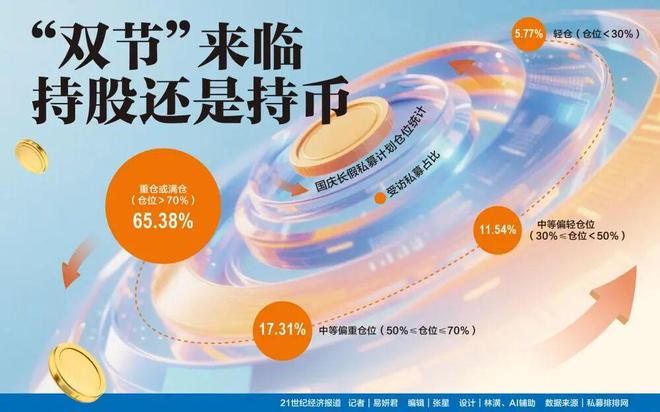
Group 1 - The core viewpoint of the articles is the debate on whether to hold stocks or cash during the upcoming National Day and Mid-Autumn Festival holidays, with many institutions favoring holding stocks due to historical trends indicating a higher probability of market gains post-holiday [1][4][6] - According to the analysis, the probability of the A-share market rising in the five trading days after the National Day holiday is 60%, and in a bull market, the post-holiday gains tend to be more sustained [4][5] - A significant portion of surveyed private equity firms, over 65%, prefer to hold a heavy or full position (over 70% allocation) during the holiday, reflecting a general optimism about market conditions [6][7] Group 2 - Historical data shows that in the last 15 years, the Shanghai Composite Index has risen in 10 of those years during the five trading days following the National Day holiday, indicating a trend of positive market performance [4][5] - Analysts suggest that external factors such as policies, liquidity, and market fundamentals will significantly influence the A-share market's performance after the holiday [5][9] - The investment sentiment for the fourth quarter is optimistic, with expectations of continued market challenges and opportunities in new sectors such as AI, robotics, and "anti-involution" themes [9][11] Group 3 - The upcoming fourth quarter is expected to see significant changes influenced by the Federal Reserve's interest rate decisions and the "14th Five-Year Plan" recommendations, which may open up new investment opportunities [9][12] - Analysts emphasize the importance of maintaining a balanced portfolio, suggesting that investors should manage their positions dynamically based on market conditions and liquidity [7][10] - Specific sectors such as new energy, robotics, and semiconductors are highlighted as having structural growth potential, with recommendations for investors to focus on low-positioned opportunities with upward momentum [11][12]
长假来临,持股还是持币
21世纪经济报道· 2025-09-29 23:50
Core Viewpoint - The article discusses the ongoing debate of whether to hold stocks or cash during the upcoming National Day and Mid-Autumn Festival holidays, with a prevailing optimism among institutions favoring stock holdings due to historical trends indicating a higher probability of market gains post-holiday [1][4]. Group 1: Market Sentiment and Predictions - Multiple brokerages, including CITIC Securities, suggest a 60% probability of A-share gains in the five trading days following the National Day holiday, particularly in a bull market where such gains tend to be sustained [1][4]. - A survey indicates that over 65% of private equity respondents prefer to hold a heavy or full position (over 70% allocation) during the holiday, reflecting confidence in market opportunities despite recent market fluctuations [1][5]. Group 2: Historical Trends and Analysis - Historical data shows that in the last decade, the probability of the A-share market rising after the National Day holiday is significant, with 10 out of 15 years seeing gains in the five trading days following the holiday [4][5]. - The Hang Seng Technology Index has a 72.86% probability of rising in the seven trading days post-holiday, outperforming the Hang Seng Index's 65.71% [4]. Group 3: Factors Influencing Market Movements - Key factors affecting post-holiday A-share performance include policy changes, external events, liquidity conditions, and fundamental market conditions [5][6]. - The liquidity environment is expected to remain loose, which could support market gains, while tightening could lead to weakness [5][6]. Group 4: Investment Themes for Q4 - Institutions are optimistic about investment opportunities in Q4, with themes such as new sectors, AI, robotics, and "anti-involution" being highlighted as key areas of focus [1][8]. - Analysts predict that the market may challenge new highs, driven by anticipated policy changes and economic expectations related to the "14th Five-Year Plan" [8][9]. Group 5: Sector-Specific Insights - New sectors, including renewable energy, robotics, and semiconductors, are expected to maintain structural growth, presenting investment opportunities [9][10]. - Traditional sectors like innovative pharmaceuticals, consumer electronics, and metals have already seen significant gains but still hold value due to improving demand and supply dynamics [10].